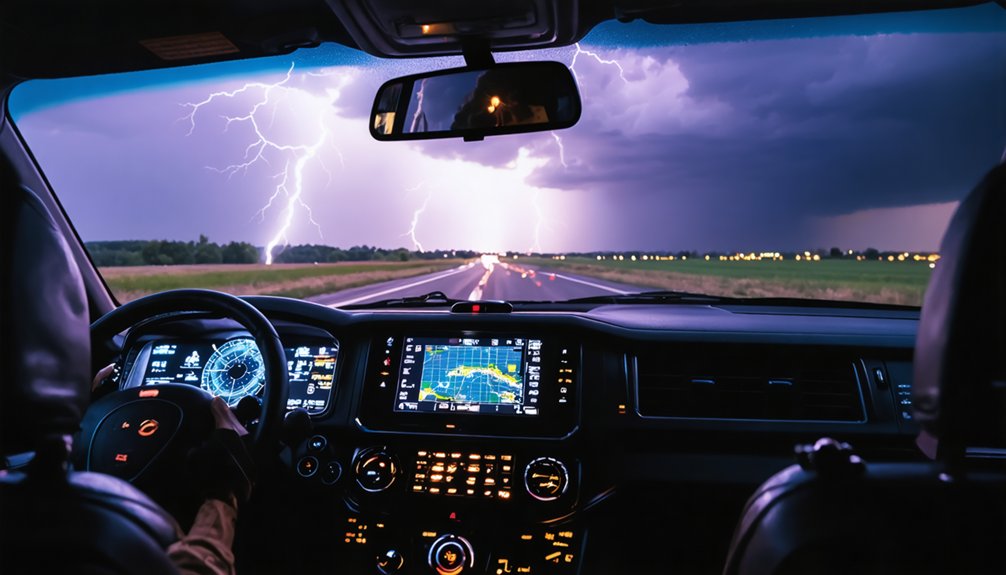
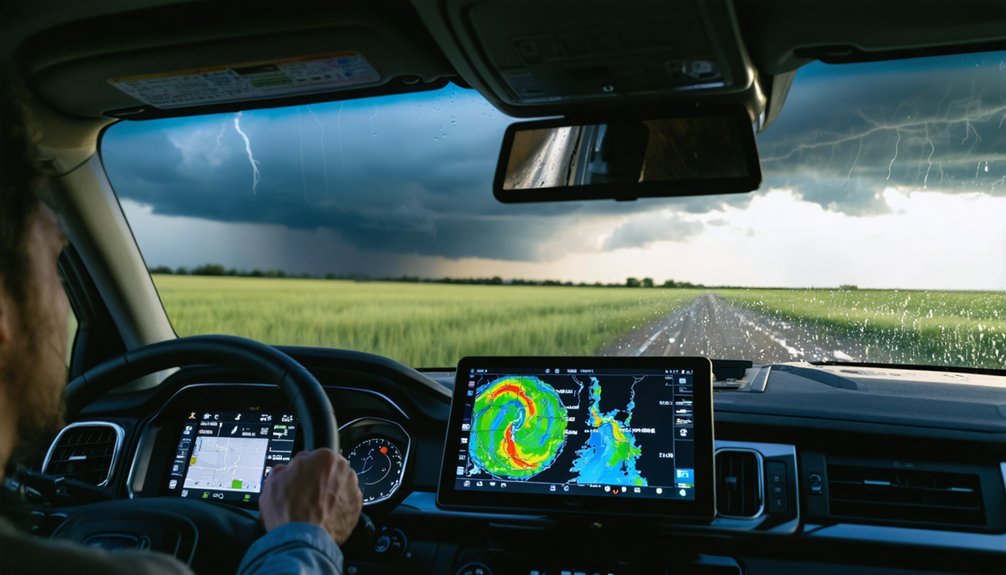
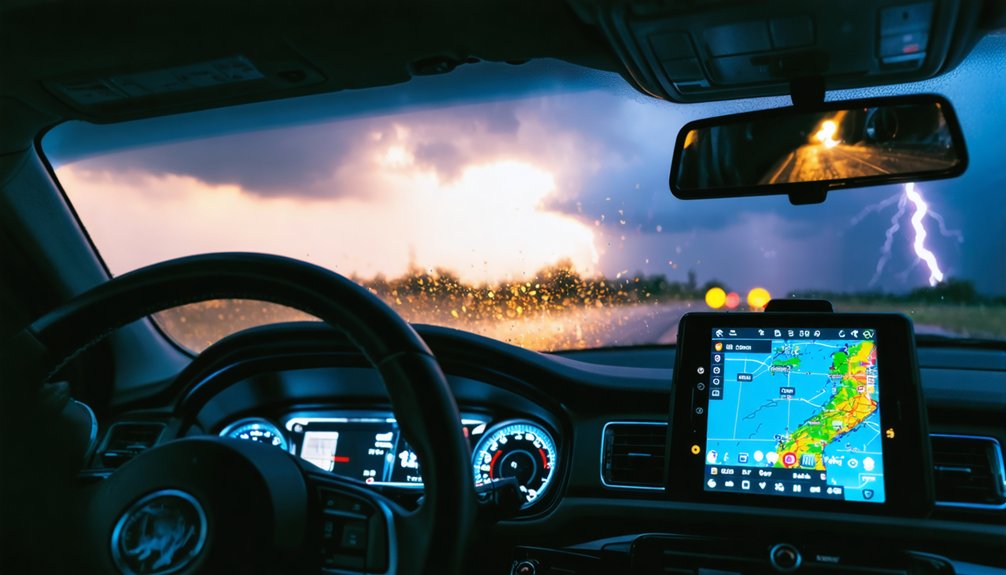
You can monitor storm trajectories using the Garmin inReach Mini 2, Spot Gen4, or Trimble R12i, each delivering satellite-based positioning with continuous data transmission across redundant communication channels. The Garmin inReach Mini 2 provides 10-meter accuracy, the Spot Gen4 updates coordinates every 2.5 minutes with 100% global coverage, and the Trimble R12i achieves centimeter-level precision. Prioritize IP67-rated durability, wide temperature tolerance, and multi-channel signal transmission — there’s much more to evaluate before choosing the right device.
Key Takeaways
- The Garmin inReach Mini 2 offers two-way satellite communication with 10-meter accuracy, making it reliable for storm trajectory monitoring.
- The Spot Gen4 provides 100% global satellite coverage with real-time coordinates transmitted every 2.5 minutes.
- The Trimble R12i delivers centimeter-level GPS accuracy with advanced meteorological data integration for precise storm tracking.
- Effective storm-monitoring GPS trackers must withstand temperatures from -40°F to 185°F and sustained winds exceeding 100 mph.
- Top trackers use cellular networks, satellite uplinks, and VHF radio links to ensure continuous, redundant storm data transmission.
How GPS Trackers Follow Storm Trajectories in Real Time
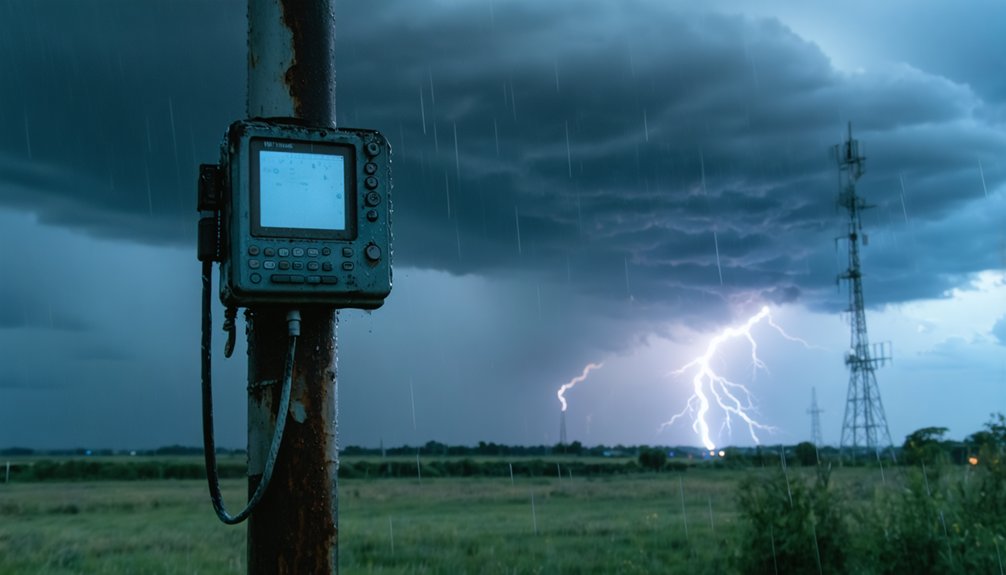
GPS trackers follow storm trajectories in real time by combining satellite-based positioning with continuous data transmission across multiple communication channels. You’ll get precise coordinate data pulled directly from GPS satellites, giving you exact storm locations as they shift and evolve.
Doppler radar complements this tracking technology by measuring precipitation intensity and storm motion simultaneously, sharpening your situational awareness. Time-difference-of-arrival techniques further pinpoint electrical activity, letting you interpret storm behavior with greater confidence.
Wide signal coverage maintains uninterrupted data flow even in remote areas, so you’re never operating blind during extreme conditions. Historical trajectory recording also lets you review past storm routes, strengthening your forecasting models.
Together, these systems deliver the accurate, real-time intelligence you need to make informed, independent decisions during severe weather events.
What Makes a GPS Tracker Reliable in Extreme Weather?
When you’re deploying a GPS tracker in extreme weather, its reliability hinges on two critical factors: durable weather-resistant construction and uninterrupted signal transmission.
You need hardware built to withstand high winds, heavy precipitation, and rapid pressure changes without compromising sensor accuracy or structural integrity.
Continuous signal transmission guarantees you’re receiving real-time coordinate data without gaps, even when atmospheric conditions actively interfere with communication channels.
Durable Weather-Resistant Design
Surviving hurricane-force winds, torrential rainfall, and extreme temperature swings requires a GPS tracker built to rigorous engineering standards. You need a device constructed from weather resistant materials like reinforced polycarbonate and marine-grade aluminum, capable of withstanding sustained winds exceeding 100 mph.
Rugged construction means IP67 or IP68 waterproof ratings, ensuring full submersion protection up to 1.5 meters for 30 minutes minimum.
Look for trackers rated across temperature ranges from -40°F to 185°F, maintaining operational integrity under genuine field stress. Shock-resistant housings protect internal components during debris impacts common in severe storm environments.
Sealed antenna ports prevent moisture infiltration that degrades signal accuracy. These specifications aren’t marketing language—they’re measurable performance thresholds that determine whether your tracking system survives when storm conditions escalate rapidly.
Continuous Signal Transmission
Reliable signal transmission separates a functional tracker from an expensive paperweight once storm conditions intensify. You need a device that maintains continuous uplinks across multiple communication channels, ensuring data integrity even when atmospheric interference peaks.
Quality GPS trackers leverage wide signal coverage ranges, pushing real-time location updates through satellite networks without dropout gaps.
When you’re operating in remote zones, uninterrupted data flow isn’t optional — it’s critical. Signal reliability depends on redundant transmission pathways that compensate when primary channels experience degradation.
Look for trackers supporting historical trajectory recording alongside live feeds, so you’re never missing movement data during brief transmission interruptions. Systems that automatically switch between communication protocols guarantee your storm location data reaches forecasting models continuously, giving you the precise, actionable intelligence needed to make rapid, informed decisions.
The Best GPS Trackers for Storm Monitoring Today
How do you choose the best GPS tracker for storm monitoring when the market offers so many options? Focus on devices that deliver reliable storm tracking technology with minimal latency and maximum GPS accuracy enhancements.
Here are three top-performing options you should consider:
- Garmin inReach Mini 2 – Offers two-way satellite communication with 10-meter accuracy, ideal for remote storm chasing operations.
- Spot Gen4 – Provides 100% global satellite network coverage, transmitting real-time coordinates every 2.5 minutes.
- Trimble R12i – Delivers centimeter-level GPS accuracy enhancements, supporting advanced meteorological data integration.
Each device supports continuous data transmission, ensuring you’re never disconnected during critical tracking windows.
Prioritize battery life, signal range, and sensor compatibility when making your final selection.
Satellite-Based Positioning vs. Standard GPS for Storm Tracking
When you’re tracking severe storms, satellite-based positioning systems outperform standard GPS by leveraging constellations of radio receivers that detect and geolocate intense RF lightning transients using time-difference-of-arrival techniques.
Standard GPS, while reliable for basic coordinate tracking, lacks the multi-layered data inputs—such as VHF lightning detection and tropospheric water vapor measurements—that satellite-based systems provide.
You’ll find that these limitations in standard GPS directly reduce forecasting precision, particularly when monitoring rapidly evolving storm trajectories that demand real-time, high-resolution positioning data.
Satellite Positioning System Benefits
Satellite-based positioning systems offer distinct advantages over standard GPS when it’s time to track storm trajectories with precision. You’ll gain notably enhanced satellite accuracy by leveraging multi-constellation networks that triangulate storm coordinates across broader coverage zones.
Here are three core positioning advantages:
- Higher Redundancy – Multiple satellite constellations reduce signal dropout risks during extreme atmospheric interference.
- Improved Coordinate Resolution – Satellite-based systems deliver sub-meter precision, outperforming standard GPS in pinpointing storm cell locations.
- Extended Coverage Range – Polar and remote regions remain accessible, ensuring uninterrupted trajectory monitoring regardless of terrain.
You’re able to integrate VHF lightning detection and time-difference-of-arrival techniques through satellite platforms, giving your storm tracking models richer, more reliable data inputs than standard GPS infrastructure alone can provide.
Standard GPS Tracking Limitations
While satellite-based positioning systems give you a clear edge in storm trajectory analysis, standard GPS tracking carries inherent limitations that can compromise monitoring accuracy when conditions deteriorate.
GPS accuracy challenges emerge when signal multipath interference, atmospheric disturbances, and satellite geometry errors degrade coordinate precision to ±10 meters or worse.
Unlike VHF lightning detection constellations using time-difference-of-arrival techniques, standard GPS can’t independently geolocate storm electrical activity.
Tracking software limitations further restrict your operational capacity—many platforms lack the processing bandwidth to handle continuous high-frequency data streams during extreme weather events.
Signal dropout in remote areas compounds these vulnerabilities, leaving critical trajectory gaps in your dataset.
Understanding these constraints lets you make informed decisions about supplementing standard GPS with Doppler radar and satellite imagery for thorough storm monitoring.
How GPS Trackers Use VHF Lightning Detection for Storm Tracking
GPS trackers leverage VHF lightning detection to pinpoint storm locations with remarkable precision. By utilizing satellite constellations equipped with radio receivers, you can detect intense RF lightning transients across vast distances.
Time-difference-of-arrival techniques then translate these signals into exact storm coordinates, giving you unmatched Storm Detection capabilities.
Here’s how VHF Techniques enhance Lightning Tracking and Data Accuracy:
- Signal Reception – Radio receivers capture VHF lightning transients, establishing precise geolocations of active storm cells.
- Time-Difference Calculation – Multiple satellites measure signal arrival times, triangulating exact storm positions with minimal error.
- Continuous Data Transmission – Real-time updates stream directly into forecasting models, sharpening trajectory predictions instantly.
You gain actionable intelligence that keeps you ahead of developing storms, maximizing both safety and operational freedom.
How Mobile Weather Stations Work With GPS Trackers
Mobile weather stations combine high-precision sensors with GPS trackers to deliver continuous, geotagged meteorological data in real time. You’ll get precise readings on wind speed, atmospheric pressure, humidity, and temperature, all tagged with exact coordinates.
This mobile data integration lets you cross-reference meteorological parameters with storm position data, sharpening your trajectory models instantly.
Sensor calibration is critical here. Without properly calibrated instruments, even accurate GPS coordinates can’t compensate for faulty atmospheric readings, degrading forecast reliability.
You’ll want to verify calibration intervals regularly, especially under extreme field conditions where sensor drift accelerates.
When your GPS tracker syncs with the station’s data output, you’re building a dynamic, location-aware dataset that updates storm tracking models continuously—giving you actionable intelligence rather than static snapshots of developing weather systems.
How GPS Trackers Transmit Data During Live Storms
During live storms, your GPS tracker relies on multiple communication channels—cellular networks, satellite uplinks, and VHF radio links—to push real-time location data through even the most signal-degraded environments.
Storm data transmission stays continuous because redundant pathways automatically switch when one channel fails. Live storm tracking depends on three core transmission mechanisms:
- Cellular Data Bursts — Your tracker compresses GPS coordinates into rapid data packets, pushing updates every few seconds through LTE or 4G networks.
- Satellite Uplinks — When cellular coverage drops, satellite connections maintain uninterrupted data flow across remote terrain.
- Historical Trajectory Logging — Your device records every coordinate locally, ensuring no positional data is lost during temporary transmission gaps.
These layered systems guarantee you’re never operating blind during critical storm events.
How GPS Data Improves Storm Forecasting Accuracy
Once your tracker’s data reaches the forecasting network, it does more than confirm a storm’s current position—it actively sharpens predictive models. GPS accuracy feeds directly into weather modeling systems, allowing predictive algorithms to recalibrate storm dynamics in real time.
Your data integration contributes GPS-derived water vapor measurements, wind shear metrics, and precise coordinates that refine meteorological insights across regional forecast grids.
Real time analytics process your tracker’s inputs alongside Doppler radar and satellite feeds, giving tracking technologies a multi-layered data stream.
Sensor enhancements on mobile stations further strengthen storm prediction by capturing granular atmospheric pressure shifts and temperature gradients.
Each transmitted data point tightens the model’s confidence intervals, reducing forecast error margins.
You’re not just tracking a storm—you’re actively improving how accurately it gets predicted.
Which GPS Tracker Is Right for Storm Chasing?
Choosing the right GPS tracker for storm chasing depends on three core performance metrics: signal coverage range, data transmission speed, and sensor integration capability. You need storm tracker features that perform under extreme conditions without signal dropout.
Evaluate your options using these critical storm tracking technology benchmarks:
- Signal Coverage Range – Prioritize units covering wide-area networks, ensuring uninterrupted data flow in remote locations.
- Data Transmission Speed – Select trackers delivering real-time updates with minimal latency during rapid storm development.
- Sensor Integration Capability – Choose devices compatible with mobile weather stations, enabling simultaneous meteorological data collection.
Your tracker must handle continuous operation, historical trajectory recording, and GPS-derived atmospheric data inputs.
Matching these specifications to your operational demands maximizes both safety and forecasting precision.
Frequently Asked Questions
What Is the Average Lifespan of a GPS Tracker Used in Storms?
You’ll find a GPS tracker’s average lifespan ranges from 3-5 years, though tracker durability varies based on exposure intensity. Rugged models withstand extreme conditions longer, giving you reliable, uninterrupted storm monitoring freedom throughout demanding field operations.
Can GPS Trackers Legally Operate in Restricted Airspace During Severe Storms?
You might think regulations limit you, but you can legally operate GPS trackers in restricted airspace during severe storms with proper FAA authorization. Always verify airspace regulations and understand legal implications before deploying storm-tracking equipment.
How Much Do Professional Storm-Chasing GPS Tracking Systems Typically Cost?
You’ll find professional storm-chasing GPS tracking systems range from $500 to $5,000+, depending on tracker features like real-time transmission and precision sensors. A thorough cost comparison helps you choose systems balancing performance, freedom, and budget effectively.
Are GPS Trackers Waterproof Enough to Survive Direct Hurricane-Force Conditions?
Yes, you’ll find GPS trackers built with waterproof materials rated IP67 or higher, ensuring storm resilience against hurricane-force winds exceeding 157 mph and torrential rainfall, maintaining continuous real-time data transmission throughout extreme meteorological conditions.
Do Insurance Companies Require GPS Trackers for Storm Research Vehicles?
insurance companies don’t universally require GPS trackers for storm research vehicles, but you’ll find many insurers strongly incentivize them—GPS data directly validates vehicle safety protocols, potentially reducing your premiums considerably.
References
- https://www.unavco.org/news/monitoring-hurricanes-with-gps-stations/
- https://play.google.com/store/apps/details?id=com.dspetty.stormgps&hl=pt_PT
- https://orbilu.uni.lu/bitstream/10993/46910/1/GPS_solutions_Hurricanes_s10291-021-01104-3.pdf
- https://play.google.com/store/apps/details?id=com.dspetty.stormgps&hl=en_NZ
- https://amt.copernicus.org/articles/13/5395/2020/
- https://ams.confex.com/ams/pdfpapers/87219.pdf
- https://www.cpc.ncep.noaa.gov/products/precip/CWlink/stormtracks/mstrack.shtml
- https://link.springer.com/chapter/10.1007/1345_2020_100
- https://ams.confex.com/ams/11aram22sls/techprogram/paper_81285.htm
- https://www.storm-gps.us