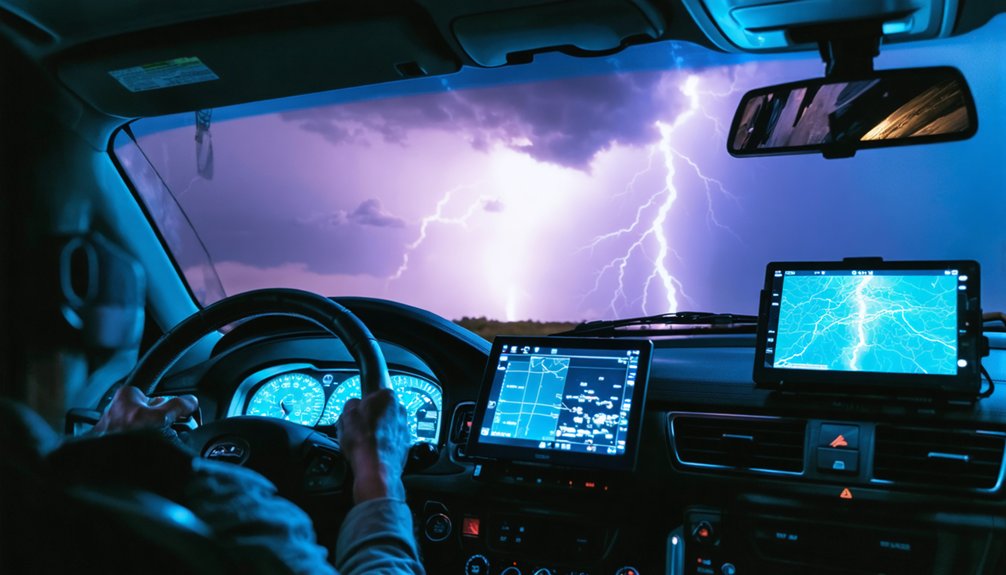
Media platforms have fundamentally transformed your storm chasing landscape from scientific documentation to performance-driven content creation. You’ll find algorithmic incentives now prioritize viral footage over meteorological rigor, while monetization through streaming ($150 per video) exceeds traditional news licensing rates (under $200). Smartphone integration has expanded participation from dozens to hundreds of chasers per storm, fragmenting the community across incompatible social channels. These platforms simultaneously create safety concerns through dangerous tactics yet enable real-time emergency communication reaching millions during severe weather events, revealing complexities that merit closer examination.
Key Takeaways
- Social media algorithms incentivize dangerous chase tactics and extreme visual content over scientific documentation and proper safety protocols.
- Livestreaming platforms transformed storm chasing into mass entertainment, routinely drawing tens of thousands of viewers during severe weather events.
- YouTube monetization and streaming revenue now exceed traditional news licensing rates, reshaping chasers’ financial models and content priorities.
- Personality-driven content and follower counts supersede empirical observations, shifting storm chasing from science-focused pursuit to spectacle.
- Community fragmentation across incompatible social channels replaced centralized platforms, hindering knowledge-sharing and collaborative weather documentation.
The Surge in Storm Chaser Numbers Driven by Social Platforms
How dramatically has smartphone technology altered the barrier to entry for storm chasing? You’ve witnessed transformation from specialized pursuit to mass participation. A decade ago, you’d encounter a handful of chasers per storm. Today, you’ll find approximately one hundred at identical events.
Consolidated radar apps, camera functions, and mapping tools eliminated traditional equipment costs, removing financial barriers that historically limited participation. The COVID-19 pandemic accelerated this surge, providing populations with newfound travel flexibility and extended free time to discover storm chasing.
However, this democratization presents critical challenges. Increased field density creates safety concerns you can’t ignore. Veteran observers note concerning shifts in community culture, with newcomer safety protocols lagging behind participation rates. The retention of scientific focus diminishes as content creation motivations replace meteorological documentation priorities.
How Video Platforms Encourage Dangerous Chase Tactics
The algorithmic architecture of modern video platforms systematically incentivizes proximity over prudence in storm chasing documentation. You’re witnessing a transformation where emphasis on extreme content directly shapes risky chase decisions in the field.
Platform mechanics driving dangerous behaviors include:
- Speed-driven positioning: Chasers maintain 50-60 mph pursuit velocities to capture bear’s cage footage, increasing collision risks at unmarked rural intersections
- Real-time streaming pressure: Live broadcast capabilities encourage immediate dangerous positioning without deliberation or escape planning
- Viral metric optimization: TikTok’s algorithm amplifies closest-approach videos, creating competitive pressure to minimize safety margins for view counts
- Radar fixation promotion: Platform-shared live data streams encourage screen attention over environmental awareness during active pursuits
You’re operating in an ecosystem where algorithmic rewards compromise traditional safety protocols, transforming documentation from observational practice into performance-driven risk escalation.
From Science to Spectacle: The Persona-Building Phenomenon
You’ll notice social media platforms systematically deprioritize scientific storm documentation in favor of personality-driven content that generates higher engagement metrics. The shift compels novice chasers to allocate resources toward brand development and extreme visual content rather than meteorological data collection or National Weather Service contributions.
This algorithmic bias transforms what was once a science-focused pursuit into a spectacle where your follower count and viral footage supersede empirical observations and threat assessment capabilities.
Scientific Documentation Gets Sidelined
Weather balloons, NOAA radios, and systematic atmospheric measurements once formed the backbone of legitimate storm documentation, yet media-driven chasing has relegated these scientific tools to secondary status. You’re witnessing detailed observation gaps widen as chasers prioritize dramatic footage over quantitative data collection. Field instrument modernization exists, but spectacle overshadows deployment.
Critical scientific elements now sidelined:
- Vertical atmospheric profiling through weather balloons testing instability, lift, and moisture parameters
- Real-time NOAA Weather Radio monitoring providing essential ground-truth meteorological conditions
- Systematic tornado damage documentation including precise path length, width, and travel distance measurements
- Flash flood reporting for roadways, rivers, and streams requiring timely NWS operational integration
Your freedom to chase shouldn’t compromise data integrity. NWS warning decisions depend on accurate, detailed spotter reports—not viral content metrics.
Building Brand Over Data
While atmospheric science demands methodical data collection and peer-reviewed analysis, today’s storm chasing ecosystem increasingly rewards charismatic self-presentation over empirical contribution. You’ll find platforms like YouTube and TikTok prioritizing personas over scientific rigor, where extreme actions generate more engagement than meteorological insights.
Warren Faidley’s evolution demonstrates this shift—transitioning from storm photographer to full-time influencer with branded merchandise and spokesperson roles. The pressure’s tangible: young chasers risk crossing ethical boundaries to capture dangerously close footage that drives viral content strategies.
Experienced observers like Quincy Vagell recognize this environment pushes participants beyond safe operational limits. The “Cyclone Cowboy” branding exemplifies how storm chasing’s transformed into performance art, where your follower count often outweighs your atmospheric data contributions. Recognition now comes from screens, not scientific journals.
Livestreaming Technology Connects Millions to Real-Time Weather Events
You’re witnessing storm chaser livestreams drawing tens of thousands of simultaneous viewers during severe weather events, with documented instances reaching 35,000 people directly in a tornado’s path during the March 11-12, 2026 outbreak.
Platforms like YouTube, Facebook, and TikTok now transmit real-time meteorological data—including 460+ meters squared per second squared storm-relative helicity values—to 4.7 million people under tornado watch conditions. This technology transforms livestreams into emergency communication networks where viewers report ground conditions from Tennessee to Ohio while chasers broadcast convection-allowing model analyses and rotating supercell observations.
Massive Audience Engagement Numbers
A livestream’s glowing viewer count tells an undeniable story: storm chasing has evolved from niche documentation into mass-participation spectacle. You’re witnessing unprecedented engagement metrics that reshape the entire meteorological media landscape.
Documented Audience Scale:
- 35,000 simultaneous viewers locked into single storm chase livestreams during active severe weather
- 4.7 million people under tornado watches receive real-time coverage commentary and situational awareness
- Tens of thousands concurrent on YouTube, Facebook, TikTok platforms during individual outbreak events
- 50 million global downloads of MyRadar app demonstrate weather content’s universal appeal
These numbers create powerful incentives for monetizing live viewership while raising questions about the ethical responsibility of influencers broadcasting life-threatening conditions.
The 2025 season marked this shift from “once-a-decade” engagement to routine mass audiences expecting constant, high-quality severe weather documentation.
Life-Saving Emergency Communications
Storm chasers transmit ground-truth observations directly to National Weather Service offices through multiple redundant communication channels, creating a critical data pipeline that fills radar blind spots and confirms tornado touchdowns within seconds of occurrence.
You’ll find spotters leveraging satellite systems like DataStorm when cellular networks collapse, while Garmin inReach devices maintain GPS connectivity in complete infrastructure failures. Real time alerts flow through SKYWARN networks, ham radios, and dedicated spotter apps including RadarScope’s Spotter Network.
This observation coordination operates independently of commercial media constraints, enabling you to bypass centralized broadcast gatekeepers. Vehicle-mounted weather sensors feed live atmospheric data directly to meteorologists, while two-way radios and CB channels create decentralized communication webs.
When tornadoes strike, your ground-level intelligence reaches emergency managers faster than any satellite scan.
The Changing Economics of Storm Footage in a Crowded Market
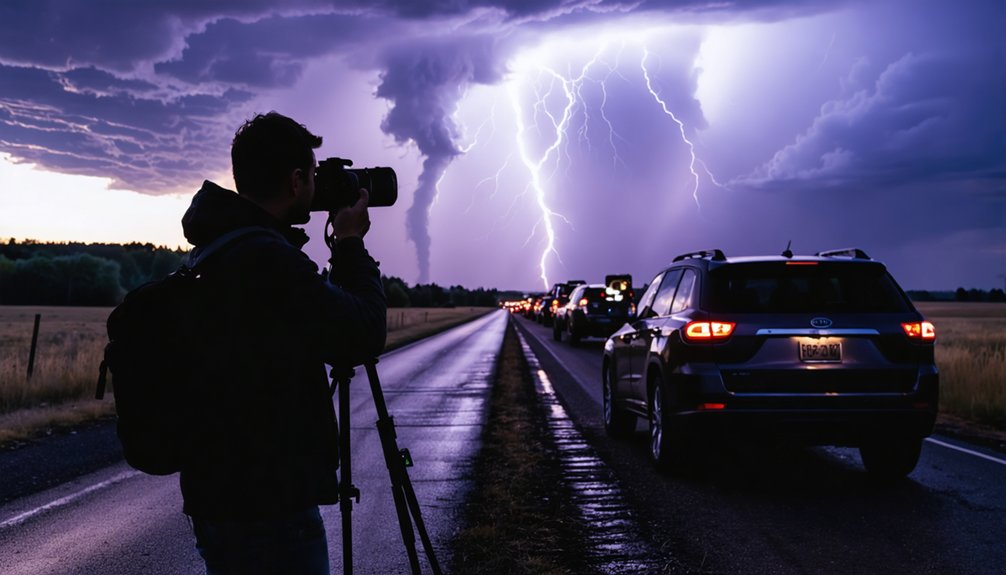
When smartphones transformed every bystander into a potential storm documenter, the economic foundation of professional chase photography collapsed. You’re now competing against networks’ vast inventory of free amateur submissions, forcing network discretionary budgets toward zero-cost alternatives despite compromised quality control measures.
Current market dynamics reveal:
- Professional footage leading prime-time newscasts earns less than $200 per clip
- Brokering payments lag 2+ months behind submission deadlines
- YouTube monetization ($150 per video) now exceeds typical licensing rates
- Strategic rejection of undervalued offers (approximately 12 annually) maintains rate integrity
You’ll find streaming revenue and platform ownership essential for financial independence. One viral video from 20 submissions generates superior returns compared to devalued brokering compensation, reducing vulnerability to arbitrary market fluctuations while preserving creative autonomy.
Community Fragmentation Across Multiple Social Channels
Everything storm chasers once shared through centralized platforms like Storm Track now scatters across YouTube, Facebook, TikTok, and Instagram, eliminating the single repository that sustained community cohesion for two decades.
You’ll find your colleagues’ chase reports dispersed across incompatible channels, each demanding separate searches through algorithms prioritizing engagement over relevance. Social media fragmentation forces you to navigate platform specific behaviors—TikTok’s preference for dramatic close-ups versus YouTube’s longer-form documentation—while competing against non-chaser content saturating hashtag feeds.
When news agencies harvest public videos through social monitoring rather than contacting experienced chasers, your footage loses value. The community you knew fragments further as COVID-era newcomers prioritize viral metrics over collaborative knowledge-sharing.
You’re left choosing between maintaining scientific credibility through selective posting or chasing algorithmic visibility across multiple channels simultaneously.
Recognition and Celebrity Status Among Modern Chasers
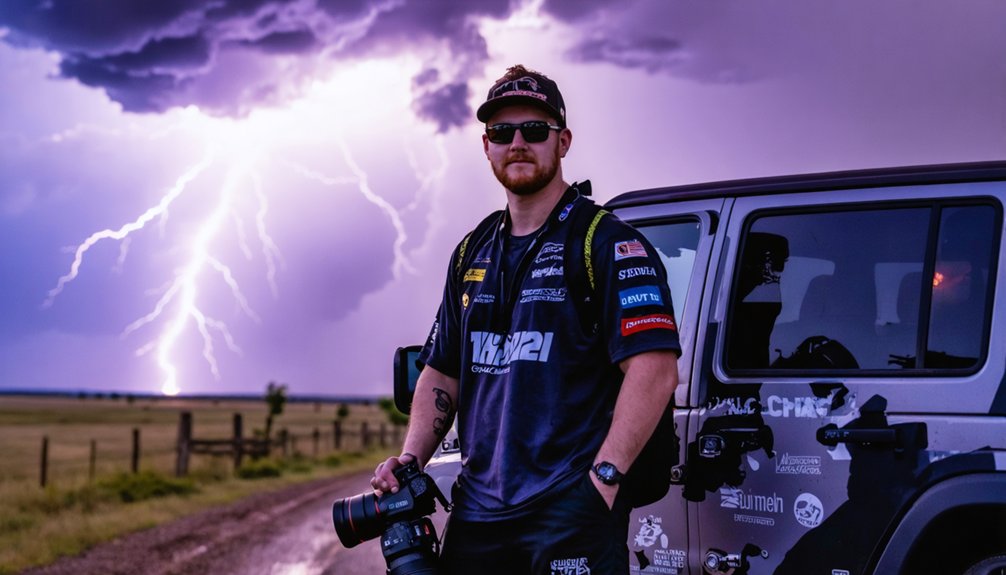
- Tornado intercept counts: Bryce Shelton documented 41 tornadoes, Brandon Copic 37, creating competitive hierarchies
- Social media followings: Reed Timmer’s 1.4 million YouTube subscribers exemplified entertainment-driven influence
- Photogenic documentation: Ben Holcomb’s 80 photogenic tornadoes demonstrated media-friendly achievements
- Research credentials: Tim Samaras’ Twistex project blended scientific rigor with televisual appeal
These metrics reshaped community perceptions, creating tensions between scientific legitimacy and entertainment spectacle.
The 2013 El Reno tornado deaths of prominent chasers underscored how celebrity status amplified both recognition and risk assessment debates.
Life-Saving Potential of Real-Time Storm Updates
How quickly can satellite data translate into lives saved during a hurricane? NOAA’s GOES-R satellites deliver high-resolution imagery every 30 seconds, enabling rapid emergency preparedness through live dashboards displaying cones of uncertainty and storm surge inundation maps.
During Hurricane Ian (2022), over 250 USGS water level sensors transmitted real-time storm surge data—exceeding 13 feet in Fort Myers—accessible to municipalities, FEMA, and first responders within minutes. This improved hazard tracking reduced response delays, allowing school districts and utilities to act swiftly before landfall.
You’re empowered with the same satellite and GFS model outputs previously reserved for agencies, enabling independent decisions on evacuation timing and flood barrier deployment. Real-time tools proved indispensable during Ian and Fiona, minimizing delays in an era demanding instant information access.
Contributing to Research While Building an Audience
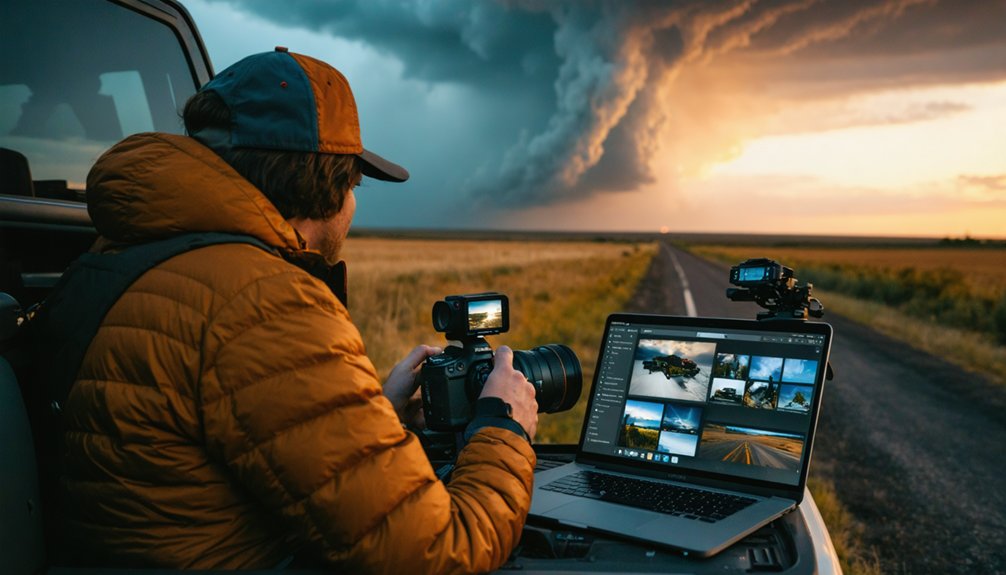
While chasing tornadoes across Oklahoma’s Tornado Alley, you’re simultaneously feeding scientific databases and building YouTube subscribers—a dual function that’s reshaped atmospheric research economics.
Your ground-truthed observations validate forecast models while expanding your viewership autonomously:
- Real-time documentation fills satellite coverage gaps, with your supercell footage supporting university-level meteorological studies
- Strategic partnerships with research institutions generate $17,000-$70,000 annually while maintaining creative independence
- Community outreach through educational breakdowns attracts research enthusiasts, amplifying scientific visibility beyond academic journals
- Media sales fund subsequent expeditions—your $500-per-clip tornado videos finance data collection without institutional constraints
You’re transforming storm documentation from pure hobbyism into legitimate atmospheric science contribution. Your camera simultaneously captures formation mechanisms for algorithm refinement and engaging content that democratizes weather research accessibility.
Frequently Asked Questions
What Legal Protections Exist for Storm Chasers’ Original Footage and Content?
You’ll protect your footage through intellectual property rights via copyright registration, enabling lawsuits like those against Cumulus Media. While fair use exceptions exist, commercial monetization typically fails this defense, letting you pursue damages and DMCA takedowns against unauthorized users.
How Do Insurance Companies View Storm Chasing as a Professional Activity?
Insurance companies classify storm chasing as high-risk due to liability concerns and public safety risks. You’ll face elevated premiums, limited coverage options, and strict policy exclusions. Underwriters assess your documented safety protocols and equipment specifications when determining insurability.
What Training or Certification Do Aspiring Storm Chasers Actually Need?
You’ll need SKYWARN certification (free, 2-3 hours) plus field experience across multiple severe weather seasons. Develop weather forecasting skills through meteorology courses. No formal license exists, but systematic training guarantees you’re prepared for independent, safe storm observation.
Do Law Enforcement Agencies Regulate or Restrict Access During Severe Weather?
Law enforcement can restrict road access during severe weather based on public safety concerns and established decision making protocols. You’ll find closures implemented when conditions threaten lives, though existing traffic laws govern enforcement rather than chaser-specific regulations currently.
How Do Meteorologists View the Accuracy of Amateur Storm Chaser Predictions?
You’ll find meteorologists view amateur predictions with astronomical skepticism—accuracy of amateur predictions rarely matches trained forecasters’ data-driven models. However, media coverage amplifies experienced chasers’ real-time observations, which you’ll discover meteorologists value more than amateurs’ forecasting attempts.