Analyzing storm structure is critical because you can’t accurately assess risk without understanding how wind speed profiles, pressure gradients, and directional asymmetries determine surge heights and damage patterns across specific geographic zones. Parametric models require precise characterization of maximum sustained winds, vortex structure, and quadrant-specific variations to generate thousands of synthetic scenarios that capture the full spectrum of possible events—something historical records alone cannot provide. These structural parameters feed directly into vulnerability curves calibrated to construction types, enabling you to quantify exceedance probabilities and estimate asset-specific failure thresholds with measurable accuracy. The following sections explore how these metrics integrate with site-specific factors.
Key Takeaways
- Storm structure parameters like wind speed and direction directly determine surge height and spatial distribution of maximum flooding impact.
- Parametric models using storm structure generate thousands of synthetic scenarios, capturing hazards beyond limited historical records.
- Wind direction controls asymmetric surge patterns, with the right-of-track sector experiencing peak water levels and greatest damage potential.
- Storm structure parameters feed asset-specific vulnerability curves that link wind speeds to failure probabilities for different construction types.
- Accurate storm structure modeling enables physics-based risk projections across future climate scenarios rather than relying on outdated historical data.
Understanding How Storm Components Influence Geographic Impact Zones
How do individual storm components interact with coastal geography to determine the spatial extent of catastrophic damage? You’ll find that the coastal terrain profile fundamentally controls surge penetration—shallow continental shelves amplify water levels while steep topography concentrates destructive forces.
Your risk assessment must account for nearshore wave characteristics, which vary based on bathymetry and wind speed interactions. Wave runup threatens bluff areas, while overtopping breaches protective structures.
You can’t ignore how barrier island elevations create vulnerability thresholds that dictate impact severity across specific stretches. Location determines whether tides, surge, or wave action dominate your damage profile.
Understanding these component interactions allows you to identify precise geographic vulnerability zones, assess wind-borne debris regions within one mile of high-water lines, and evaluate how wetlands and dunes attenuate wave energy before infrastructure encounters catastrophic loads.
The Role of Wind Speed and Direction in Maximum Inundation Modeling
While coastal geography establishes the physical template for storm surge vulnerability, wind parameters dictate the hydraulic forcing that translates atmospheric energy into inundation depth. You’ll find maximum sustained wind speed (Vmax) directly scales surge height through stress coefficients, with saturation occurring above 30 m/s due to multi scale turbulence effects in the atmospheric boundary layer.
Wind direction determines quadrant asymmetry—the right-of-track northeast sector experiences peak surge from combined translational velocity and rotational winds. Parametric models employ Holland formulations constrained by 1 ≤ B ≤ 1.25 to parameterize vortex structure, while boundary layer interactions modify surface stress (τ = C_D U_10 ρ_a) driving hydrodynamic codes. Validation against high-water marks from Katrina and Ike confirms direction-adjusted fields yield 0.96 correlation with observations, enabling probabilistic N-year inundation forecasts.
Parametric Models Enable Comprehensive Scenario Simulation
You can’t rely solely on historical storm records when evaluating future risk, as limited past observations fail to capture the full spectrum of possible events. Parametric wind models generate thousands of synthetic scenarios at near-zero computational cost, enabling you to analyze return periods and extreme conditions beyond documented baselines.
Physics-based approaches further enhance these simulations by integrating rainfall patterns and accounting for climate-driven shifts in storm characteristics like sea surface temperature influences.
Overcoming Limited Historical Data
Traditional catastrophe models face a fundamental constraint: they extrapolate future risk from historical storm data that no longer represents current climate conditions. You’re relying on pre-2000 baselines while ocean heat content increases and rapid intensification events become more frequent.
Physics-based parametric approaches break this limitation by enabling scenario simulation across multiple time horizon updates rather than static historical assumptions.
These models use measurable parameters—maximum winds, pressure gradients, radius of maximum wind—to generate synthetic event sets reflecting contemporary climate forcing. Parameter sensitivity analysis reveals how changing ocean temperatures alter tropical cyclone behavior without waiting decades for new historical records. You gain computational efficiency while exploring thousands of plausible scenarios that historical data simply can’t provide, liberating risk assessment from the constraints of inadequate past observations.
Efficient Multi-Scenario Wind Simulations
- Non-parametric transformation converts wind speed into multivariate Gaussian approximations
- Weibull and inverse Gaussian distributions fit de-seasonalized data efficiently
- ARMA models post-PCA process Gaussian-transformed multi-site information
- Static power curves translate modeled wind speeds into production forecasts
Your transmission-constrained systems gain thorough risk assessment capabilities through these simplifying yet realistic assumptions, extending single-area approaches to multi-area frameworks while preserving cross-correlations essential for independent decision-making.
Physics-Based Rainfall Integration
While wind patterns demand sophisticated statistical frameworks, precipitation modeling requires integration of fundamental hydrological physics to capture the nonlinear processes that generate extreme rainfall events. You’ll achieve superior forecasting accuracy by implementing physics based model constraints through graph neural networks that couple water cycle variables—rainfall, infiltration, groundwater recharge, evapotranspiration, and streamflow.
This multi process data integration employs omega equations and water vapor dynamics alongside finite element methods for watershed response simulation. You can execute ensemble forecasting with Monte Carlo perturbations, quantifying uncertainty in rainfall-induced hazards at resolutions reaching 6 square kilometers.
These parametric models outperform unconstrained deep learning approaches in heavy rainfall prediction while maintaining robustness in data-scarce regions, delivering actionable intelligence for flood risk mitigation, landslide forecasting, and resource management without extensive manual calibration.
Linking Storm Characteristics to Asset-Specific Vulnerability Curves
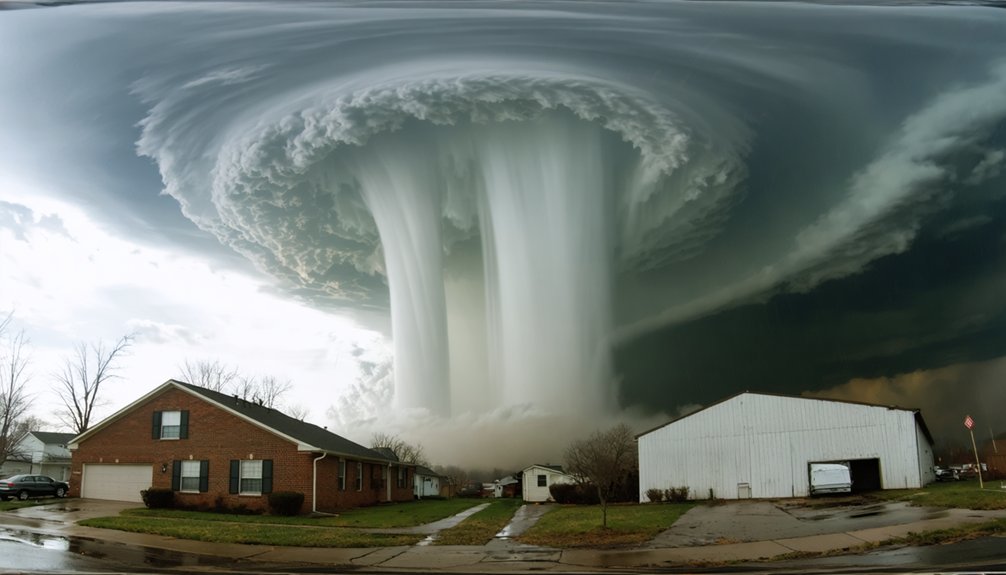
You must match parametric storm models—characterized by radius of maximum winds (RMW), central pressure, and forward speed—to asset-specific vulnerability curves to generate accurate damage predictions.
Wind gust factors derived from mean wind speed profiles, modeled through log law or power law formulations, directly feed into exceedance probability curves that express damage ratios as functions of wind speed. This linkage enables thorough scenario simulation where storm parameters from historical events like Typhoon Maemi populate vulnerability functions calibrated to specific construction types through disaggregation ratios k₁ to kₙ.
Wind Gust Vulnerability Matching
How do meteorologists and risk analysts bridge the gap between raw storm measurements and actual property damage? You’ll find the answer in wind gust vulnerability matching—a precise correlation between 3-second gust speeds and asset failure thresholds. This integrated vulnerability assessment enables you to quantify damage before storms strike:
- 58-73 mph gusts: Mobile homes destroyed, power outages begin
- 74-95 mph gusts: 25% gabled roof failure, snapped tree branches
- 96-110 mph gusts: Major roof/siding damage, shallow-rooted trees uprooted
- 130+ mph gusts: Severe structural collapse, weeks-long isolation
Wind model validation confirms these thresholds across construction types. You’re matching Enhanced Fujita ratings and Saffir-Simpson categories to specific vulnerability curves, transforming meteorological data into actionable risk intelligence that protects your assets and preserves autonomy during catastrophic events.
Parametric Models Enable Scenarios
Matching observed gust thresholds to asset failures demands thousands of plausible storm trajectories that span centuries of climatological variability—far exceeding the brief historical record. Parametric wind field modeling delivers this synthetic event cataloging by sampling statistical relations from best-track datasets, generating 900,000 TC tracks that represent extended climate realizations.
You’ll compute radial profiles using Holland models at 0.02° resolution within minutes, creating a scalable computational workflow that runs on desktop systems or multi-processor arrays. These synthetic catalogues drive extreme-value distributions for return period wind speeds, storm surge simulations via ADCIRC, and deep learning surge models covering entire coastlines.
How Storm Structure Data Improves Damage Cost Estimation Accuracy
Machine learning models trained on structural characteristics and storm parameters now achieve 84.24% accuracy within ±1 damage class when predicting hurricane impacts, directly translating to more precise cost estimates for insurance claims and recovery budgets. These improved damage assessment models distinguish between minor and major damage with 86.3% accuracy—an 11% improvement over previous methods—enabling you to allocate resources where they’re genuinely needed rather than relying on costly manual inspections.
AI-powered damage prediction achieves 86.3% accuracy, reducing insurance assessment costs by eliminating unnecessary manual inspections after hurricanes.
Critical advancements include:
- Convolutional neural networks classifying buildings into four damage states with validated accuracy across multiple hurricane events
- Geospatial analysis processing multispectral imagery to quantify damage extent across wide geographic areas
- Tornado assessment models reducing preliminary evaluation time from 5 days to 24-72 hours
- Post-Hurricane Maria assessments directing optimized infrastructure investments throughout Puerto Rico
Identifying Principal Controlling Variables Reduces Assessment Uncertainty

While machine learning models quantify damage outcomes with increasing precision, accurate risk assessment fundamentally depends on identifying which physical variables exert dominant control over storm impacts. You’ll reduce uncertainty substantially by recognizing wind speed and direction as principal variables controlling inundation risk, enabling statistical surge probability analysis through location-specific SLOSH simulations.
Basin bathymetry and shoreline orientation constitute secondary controlling factors, with simple topographic profiles allowing significant modeling refinement. This hierarchical approach directly improves forecasting meteorological uncertainties by concentrating computational resources on variables with maximum influence.
When you’re validating probabilistic surge models, identifying that wind parameters generate MEOW ranges proves more valuable than exhaustively modeling minor contributors. Your risk assessment gains predictive power by focusing on trajectory-intensity relationships and their bathymetric interactions rather than attempting equal-weight analysis of all environmental parameters.
Storm Anatomy Guides Targeted Mitigation and Hardening Decisions
Understanding storm anatomy transforms generic mitigation approaches into cost-effective, physics-based interventions. When you’re evaluating lateral wave forces and forecasting land inundation patterns, you’ll identify exactly where structural hardening delivers maximum protection. This precision lets you allocate resources efficiently rather than blanket-applying expensive measures.
Storm structure analysis empowers targeted decisions:
- Deploy elevated designs on stilts in zones experiencing peak surge heights
- Position breakwaters offshore where wave energy concentration threatens shorelines
- Implement zoning restrictions in bivariate-mapped high-vulnerability corridors
- Select water-resistant materials for structures facing prolonged inundation exposure
You’ll combine procedural strategies with natural barriers—mangroves absorbing wave energy while structural retrofits protect critical assets. No single intervention optimizes protection; understanding storm anatomy reveals which combinations reduce vulnerability without unnecessary expenditure, preserving your autonomy in disaster preparedness decisions.
Structure Analysis Supports Emergency Response and Recovery Planning

Storm structure intelligence directly determines response velocity and resource deployment efficacy during active events. You’ll leverage storm progression modeling to pre-position crews along predicted impact corridors, ensuring tactical advantage when infrastructure damage occurs.
Storm intelligence transforms reactive emergency response into strategic positioning, converting weather prediction into operational advantage before infrastructure failure occurs.
Geographic footprint determination enables precise mutual-aid requests, scaling contractor resources proportional to anticipated destruction patterns. Real-time structural analysis feeds dashboard visualizations that prioritize feeder restoration based on severity clusters and outage density.
Your damage assessment teams utilize geotagged data streams synchronized with Emergency Operations Center platforms, accelerating recovery coordination. AI-driven pattern recognition identifies critical infrastructure vulnerabilities, directing restoration sequences that maximize grid functionality.
This analytical framework empowers autonomous decision-making during chaotic conditions, eliminating bureaucratic delays. You’ll execute proportional response phases aligned with storm advancement rates, maintaining operational sovereignty while optimizing resource allocation across affected territories.
Integration of Storm Metrics With Site-Specific Risk Factors
When quantifying catastrophic event potential, your analytical framework must synthesize atmospheric measurements with geocoded vulnerability matrices to generate actionable threat assessments. Terrain adaptation fundamentally alters surge propagation patterns, requiring updated DEMs and shoreline configurations within your geophysical fluid dynamics models. Model ensemble integration across multiple MCDM methods—AHP, FAHP, EW combinations—eliminates dependence on restrictive historical datasets while maintaining statistical rigor.
Your extensive framework demands:
- High-resolution climate simulations (1.5 km convective storm processes) paired with infrastructure fragility curves for network failure probabilities
- Exposure layers quantifying wind damage, inland flooding, and coastal inundation across projected storm paths
- Sensitivity analysis through OAT and FAST methodologies to isolate indicator impacts
- GIS risk layers integrating maximum damage costs per square meter with vulnerability curves for spatially-explicit asset prioritization
This precision enables autonomous risk mitigation without bureaucratic constraints.
Frequently Asked Questions
What Sensors Are Most Effective for Monitoring Storm-Related Infrastructure Safety Systems?
You’ll find weather stations and specialized storm sensors most effective, as they deliver real-time sensor data on precipitation, wind speed, and lightning activity. These detailed monitoring systems enable autonomous decision-making, ensuring your infrastructure remains protected without external control.
How Do Redundant Facilities Distribute Risk in Tornado-Prone Regions?
Like chess pieces protecting a king, you’ll distribute redundant facility resilience across wider geographic zones. Spatial risk modeling guarantees that when 95% of sub-EF3 tornadoes strike, your critical infrastructure maintains operational independence despite localized failures.
What BMPS Best Mimic Pre-Development Hydrology for Frequent Rain Events?
You’ll maximize pre-development hydrology mimicry through infiltration practices like bioretention and rain gardens, combined with permeable pavement systems. These BMPs effectively capture the 95th percentile rainfall events, restoring natural volume and flow rate characteristics autonomously.
How Does Streambed Cohesion Affect Erosion Risk During Extreme Flooding?
Low streambed cohesion accelerates sediment transport dynamics, triggering severe scour and channel morphology changes. You’ll observe erosion outpacing deposition, forming deep scour holes and multi-threaded channels that exponentially amplify infrastructure damage and fluvial erosion hazards during extreme floods.
What Cost-Effective Retrofits Work Best for High-Value Coastal Infrastructure?
You’ll maximize protection by strengthening floodwalls with reinforced concrete and elevating critical systems above design flood elevations. These retrofits deliver $8 damage reduction per dollar invested, outperforming traditional grey infrastructure while preserving operational autonomy.