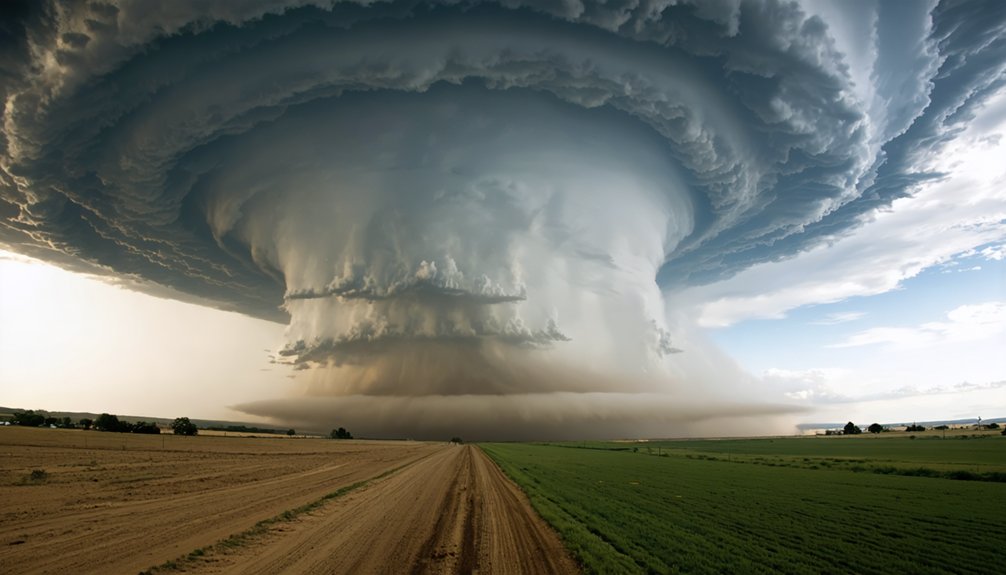
The relationship between tornadoes and climate change isn’t straightforward. Violent tornadoes (EF3+) have actually *declined* over the past 70 years, and overall tornado counts are falling. But here’s the catch: outbreak events are becoming more concentrated and severe, while warming creates competing forces of greater atmospheric instability and weaker wind shear. The UN IPCC assigns low confidence to current tornado trends. The full picture is far more complex than a simple yes or no.
Key Takeaways
- Strong tornadoes (EF3+) have actually declined over 70 years, yet individual tornado intensity within reliable datasets shows increasing trends.
- Climate change creates competing forces: warmer, humid air increases instability, while reduced wind shear weakens rotational energy needed for tornadoes.
- Current climate models cannot operate at scales small enough to definitively link tornado strength changes to climate change.
- The UN IPCC assigns low confidence to observed tornado trends, making definitive climate attribution scientifically impossible today.
- Future projections suggest fewer tornado days overall, but outbreak events will become more concentrated, severe, and geographically widespread.
Are Tornadoes Actually Getting Stronger?
Despite decades of media coverage suggesting otherwise, the data tells a more nuanced story: strong and violent tornadoes (EF3+) have actually declined sharply over the past 70 years, with 2017-2018 recording a historic 306 consecutive days without a single EF3+ tornado.
When you examine tornado strength trends objectively, you’ll find fewer violent tornadoes striking today than in previous generations.
However, climate impact analysis reveals a contradiction worth noting: within reliable datasets, individual tornado strength shows increasing trends, and outbreak clusters are growing denser geographically.
The UN IPCC acknowledges low confidence in observed tornado trends due to limited data collection methods and extreme year-to-year variability.
You shouldn’t accept simplified narratives — the science demands you weigh declining overall frequency against shifting intensity patterns simultaneously.
Tornado Frequency Is Falling: But the Story Is Complicated
The declining strength trends in strong tornadoes connect directly to a broader frequency pattern that’s equally counterintuitive: overall tornado counts are falling across the United States.
You’re looking at record-low tornado strikes in 2014 and 2018, plus a 306-day stretch without a single EF3+ event. The data’s clear on this.
But tornado patterns reveal significant regional differences that complicate the narrative. You can’t simply declare tornadoes are disappearing.
While traditional “Tornado Alley” in the central Plains sees fewer events, the southeastern United States is experiencing increases.
Simultaneously, outbreak days featuring 30+ tornadoes in a single day are becoming more frequent, and tornado clusters are growing denser geographically.
Frequency is falling overall, but the distribution is shifting and concentrating—a distinction that matters enormously for risk assessment.
Why Climate Change Makes Tornado Attribution So Hard
Pinning tornado trends on climate change is harder than it sounds, and the science reflects that difficulty.
Tornado dynamics operate at scales too small for current climate models to resolve accurately. You’re dealing with a phenomenon measured in hundreds of meters, while climate models operate at resolutions of kilometers or more — that’s a fundamental mismatch.
High year-to-year variability makes it nearly impossible to isolate a climate signal from natural noise. Limited historical data collection methods further compromise attribution efforts.
The UN IPCC itself assigns low confidence to observed tornado trends, and that’s not political hedging — it’s honest science.
Until higher-resolution climate models and longer observational records exist, definitive attribution between tornado behavior and climate change remains scientifically out of reach.
How Tornadoes Are Responding to a Warmer, More Unstable Atmosphere
While attribution remains elusive, the atmospheric mechanics linking warming to tornado dynamics are becoming clearer. A warmer, more humid atmosphere directly fuels atmospheric instability—the core ingredient tornadoes need to form.
Here’s what the data shows:
- Increasing instability: Higher moisture content and surface temperatures create stronger convective energy, intensifying severe thunderstorm conditions that precede tornadoes.
- Declining wind shear: Warmer Arctic temperatures reduce the jet stream’s strength, potentially decreasing the rotational forces tornadoes require.
- Competing forces: These two opposing trends—greater instability versus weaker shear—create scientific uncertainty about net tornado intensity changes.
You’re watching two atmospheric forces pulling in opposite directions. Current projections suggest fewer tornado days annually, but broader geographic coverage when conditions align, shifting risk rather than eliminating it.
Fewer Tornado Days, Worse Outbreaks: What the Projections Actually Show
What climate projections actually show defies intuitive expectations: annual tornado counts may remain roughly unchanged, but the days producing them will shrink while individual outbreak events grow more concentrated and severe.
You’re looking at a future where tornado patterns consolidate rather than expand uniformly.
The mechanics driving this are straightforward. Warming increases atmospheric instability while potentially reducing wind shear frequency, compressing favorable conditions into fewer, more explosive windows.
Warming compresses favorable conditions into fewer windows—but when they open, the explosive potential intensifies dramatically.
When those windows open, outbreak intensity escalates—more tornadoes clustered geographically within single events, striking broader geographic footprints.
Data already reflect early signals: 30-plus tornado outbreak days are increasing, and tornado clusters are tightening geographically.
You won’t necessarily face more tornado days annually, but the days that qualify will hit harder, demanding you recalibrate preparedness strategies accordingly.
Frequently Asked Questions
Which US Regions Are Seeing the Biggest Shifts in Tornado Activity?
Like rivers shifting course, tornado patterns are reshaping America’s map. You’re seeing regional differences grow: the SE US gains activity, while historical trends show central Plains “Tornado Alley” losing it, intensifying weather extremes eastward.
What Is the EF Scale and How Is Tornado Strength Measured?
The EF Scale measures tornado strength by evaluating damage indicators, rating storms from EF0 (weakest) to EF5 (most violent). You’ll find tornado measurement relies on post-storm damage surveys, not direct wind speed readings.
Has Climate Change Been Officially Linked to Tornadoes by Scientists?
Like a fingerprint that’s smudged, you can’t yet pin climate change directly to tornadoes. Scientists haven’t officially linked them — high tornado frequency variability and climate variability make attribution too uncertain for confident conclusions.
Why Are Tornado Outbreaks Becoming More Clustered Geographically?
You’re seeing tornado patterns shift as warming increases atmospheric instability, pushing geographical shifts that cluster outbreaks closer together. Data confirms tornadoes are hitting denser areas, particularly expanding eastward into the SE US, away from traditional Tornado Alley.
How Long Was the Record Period Without a Tornado-Related Death?
Can history surprise you? You’ll find that tornado death trends reached a milestone in 2017-2018, when historical tornado data confirmed the longest recorded period passed without a single tornado-related fatality occurring.
References
- https://www.c2es.org/content/tornadoes-and-climate-change/
- https://climateataglance.com/climate-at-a-glance-tornadoes
- https://u.osu.edu/janahouser/tornadoes-and-climate-change/