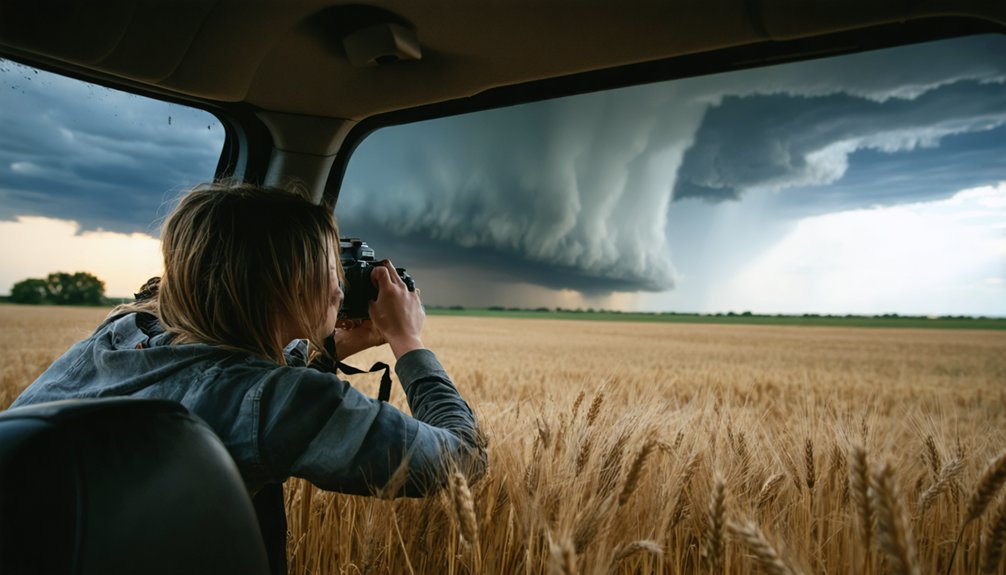
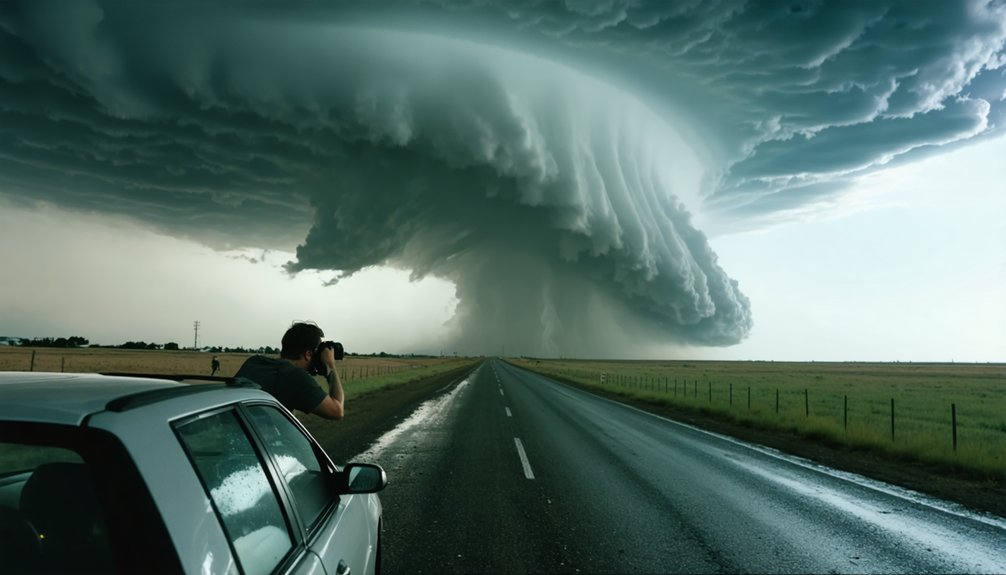
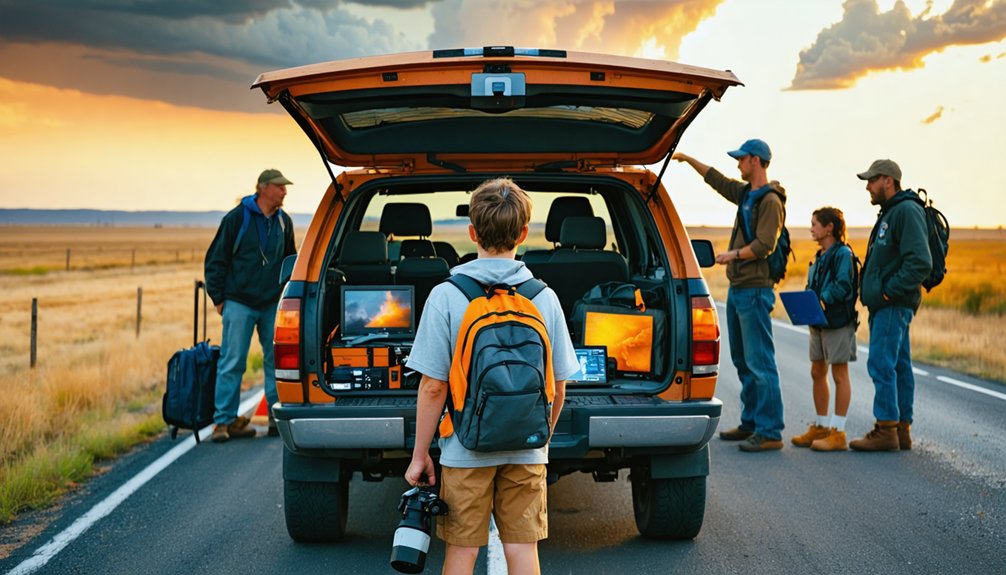
If you’re serious about storm chasing, start with Tim Vasquez’s *Storm Chasing Handbook*, which covers radar interpretation, hodograph analysis, and intercept decision trees. Pair it with *Chase 101* for forecasting frameworks and *Hunting Nature’s Fury* for tactical routing and risk psychology. For photography workflows, *Digital Storm Chasing* breaks down camera specs and GRLevelX integration. Each book builds a specific competency layer, and the full picture of how these resources work together gets even more precise below.
Key Takeaways
- *Storm Chasing Handbook* by Tim Vasquez is highly recommended for beginners, covering radar interpretation, weather maps, and chase logistics.
- *Chase 101* and *The Tornado Hunter’s Handbook* provide essential forecasting tools and supercell identification skills for new chasers.
- For tornado forecasting, *Nowcasting for Chasers* and *Risk Management in Tornado Alley* offer specialized mesoscale analysis and SPC outlook integration.
- *Digital Storm Chasing* by Tim Vasquez and *Capturing the Storm* are top resources for storm photography and documentation techniques.
- *Hunting Nature’s Fury* and *Into the Storm* combine safety protocols, risk assessment, and decision-making frameworks for field use.
The Best Storm Chasing Books for Beginners
Whether you’re drawn to tornado alley for the science or the spectacle, these five beginner-focused books give you the foundational knowledge to chase safely and effectively.
Start with Tim Vasquez’s *Storm Chasing Handbook*, which covers radar interpretation, weather maps, and chase logistics with technical precision.
Tim Vasquez’s *Storm Chasing Handbook* delivers radar interpretation, weather maps, and chase logistics with disciplined technical precision.
*Chase 101* introduces forecasting tools and decision-making frameworks you’ll rely on in the field.
*The Tornado Hunter’s Handbook* teaches you to identify supercell structures and early tornado indicators.
*Surviving Tornadoes* by Doug Kammerer reinforces storm chasing ethics through real accounts and safety protocols.
Finally, Mike Hollingshead’s *Storm Chasers: Ultimate Guide* prepares your vehicle and equipment for weather phenomena exploration in demanding conditions.
Together, these titles build your analytical foundation, letting you pursue storms with calculated confidence rather than reckless curiosity.
Which Storm Chasing Book Should You Start With?
You’ll also gain foundational weather pattern analysis skills through its detailed sections on forecasting tools and decision trees for intercept versus bailout scenarios.
Reddit’s r/stormchasing community ranked it first in 2024 with 200+ upvotes, confirming its practical relevance.
Once you’ve absorbed Vasquez’s framework, shift to Mike Hollingshead’s *Storm Chasers: Ultimate Guide* for equipment specifics and vehicle preparation.
These two books together give you analytical rigor and operational readiness before you ever enter Tornado Alley independently.
Top Storm Chasing Books for Tornado Forecasting
Master these four tornado forecasting techniques and storm prediction models through targeted reading:
- Mesoscale convective analysis using *Nowcasting for Chasers*
- Hodograph interpretation via *Storm Chasing Handbook*
- Supercell parametric modeling through *Chase 101*
- SPC outlook integration covered in *Risk Management in Tornado Alley*
Each resource builds analytical independence, letting you evaluate atmospheric data without relying on others.
Each resource sharpens your analytical independence, empowering you to read atmospheric data and make decisions entirely on your own terms.
You’ll move faster, position smarter, and chase on your own terms.
Best Storm Chasing Books for Radar and Nowcasting
The *Chaser’s Toolkit* supplements both by detailing GRLevelX configurations that optimize your radar display for rapid scanning.
Master these three resources, and you’ll make faster, data-grounded intercept decisions with minimal wasted positioning.
Storm Chasing Books Based on Real Outbreaks and Events
These historical tornadoes and their storm impact data give you analytical frameworks through four measurable lenses:
- Outbreak frequency patterns
- Atmospheric pressure differentials
- Tornado path deviation metrics
- Post-event damage assessments
Each lens sharpens your independent understanding of large-scale convective events.
Storm Chasing Memoirs From Chasers Who Lived It
Timmer’s chaser experiences include violent EF5 intercepts and hurricane penetrations, quantifying risk thresholds most chasers never test.
Hoadley’s 30+ years of route strategies map behavioral patterns across hundreds of supercell encounters. You’re not reading dramatized narratives—you’re analyzing documented intercept variables: positioning errors, escape route failures, and successful reads of mesocyclone rotation.
These memoirs function as field logs. You extract operational intelligence, calibrate your own risk tolerance, and refine your chase methodology using battle-tested observational data from chasers who operated without modern warning infrastructure.
Best Storm Chasing Books for Photography and Gear
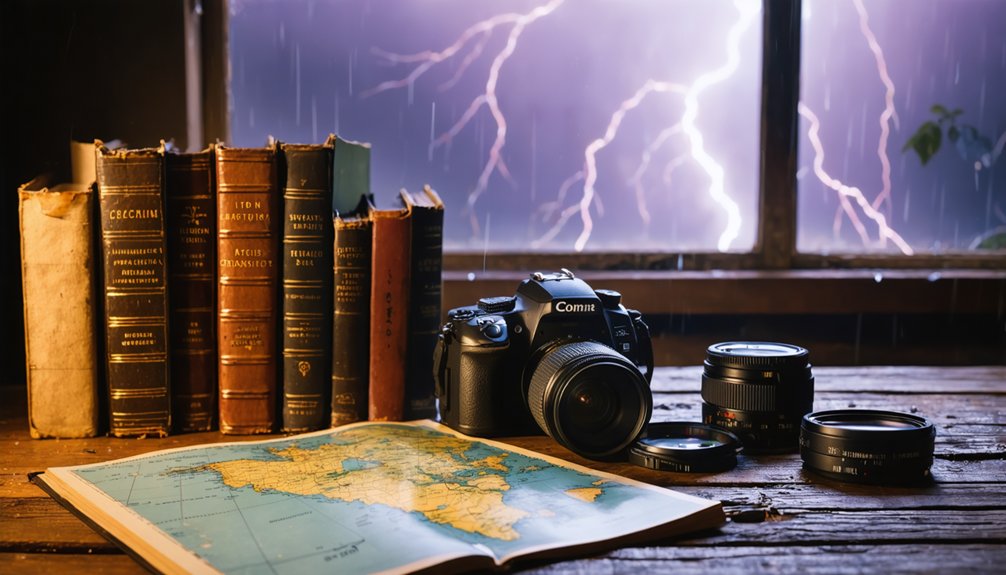
If you’re serious about documenting storms, you’ll need the right books to master both essential photography gear and field techniques.
*Digital Storm Chasing* by Tim Vasquez breaks down camera specs, lighting variables, and post-processing workflows with technical precision, while *Storm Chasers’ Gear Guide* catalogs hardware like GRLevelX-compatible laptops, GPS units, and vehicle modifications for active intercepts.
Cross-referencing these titles with *Capturing the Storm* gives you a data-backed framework for executing low-light supercell shots under real chase conditions.
Essential Photography Gear
- *Digital Storm Chasing* — covers camera specs, low-light exposure settings, and post-processing workflows.
- *Storm Chasers’ Gear Guide* — catalogs laptops, mobile radar units, GPS systems, and vehicle modifications.
- *Capturing the Storm* — details supercell photography under dynamic lighting conditions.
- *The Chaser’s Toolkit* — analyzes software like GRLevelX for real-time data integration.
Together, these resources give you a technical framework, letting you chase independently, document storms precisely, and make data-driven equipment decisions without unnecessary compromise.
Capturing Storm Images
Once your gear is cataloged and your software configured, capturing usable storm images demands a different skill set — one that blends technical camera knowledge with real-time atmospheric decision-making.
*Digital Storm Chasing* by Tim Vasquez breaks down storm photography techniques with precision, covering aperture settings, shutter speeds, and low-light supercell composition.
For capturing lightning bolts, you’ll need manual exposure control and triggering systems — both addressed in *Capturing the Storm* and *Weather Photography Handbook*.
These books treat photography as data collection, not aesthetics. You’re documenting structure, rotation, and electrical activity with measurable accuracy.
*Digital Storm Chasing* particularly analyzes post-processing workflows that preserve meteorological detail.
Combined, these resources give you the analytical framework to shoot independently, adapt quickly, and extract scientifically valuable imagery from volatile, rapidly evolving conditions.
Top Equipment Guides
- Mobile radar units calibrated for supercell tracking
- Weather forecasting tools integrated with satellite feeds
- GPS systems optimized for rapid escape-route recalculation
- Vehicle hardening specs for debris-impact resistance
Both titles treat gear selection as analytical fieldwork, not consumer shopping.
You’ll exit each chapter with measurable specifications, not vague recommendations—giving you operational independence when conditions deteriorate fast.
Storm Chasing Books on Safety, Risk, and Escape Planning
These titles don’t just outline safety protocols—they build the analytical framework you need to assess threats dynamically.
The *Storm Chasing Handbook* reinforces this with decision trees guiding intercept versus bailout calls.
You’ll also find NOAA Spotter Guidelines integrated into structured chase plans, giving you field-tested risk management tools.
Together, these resources let you chase aggressively while maintaining calculated, data-backed control over every exit strategy.
Top Storm Chasing Books Recommended on Forums and Review Sites
When you want community-validated picks, forums and review sites cut through the noise with hard data.
Storm chasing culture thrives on peer-driven recommendations, and community engagement reveals what actually works in the field.
Key metrics from top platforms:
- Reddit r/stormchasing — *Storm Chasing Handbook* dominates 2024 threads with 200+ upvotes, signaling broad beginner approval.
- Stormtrack.org — Recommends *Hunting Nature’s Fury* specifically for route tactics and intercept strategies.
- Goodreads — *Into the Storm* holds a 4.2/5 average across 500+ ratings, confirming sustained reader confidence.
- Bookshop.org — Features *Chaser* and *Wrath of God* among its Big 5 for narrative diversity.
Cross-referencing these sources gives you a data-backed shortlist, eliminating guesswork from your reading selection.
Storm Chasing Books That Cover Multiple Skills at Once
Few storm chasing books pack forecasting, safety, photography, and route strategy into a single volume, but those that do offer measurable efficiency gains for chasers building a core library.
*Storm Chasing Handbook* by Tim Vasquez stands out as the clearest multi-skill resource, integrating weather map interpretation, radar analysis, chase logistics, and decision trees for intercept versus bailout scenarios.
You’ll also find *Hunting Nature’s Fury* valuable for its dual focus on tactical routing and storm chasing psychology, helping you assess risk tolerance under extreme weather impacts.
*Into the Storm* bridges personal accounts with technical insight, reinforcing decision-making frameworks through real data.
When you consolidate multiple competencies into fewer titles, you reduce redundant reading time, accelerate skill acquisition, and build a leaner, more actionable reference library for fieldwork.
Frequently Asked Questions
Are Storm Chasing Books Suitable for Children or Young Readers?
Like a double-edged wind, suitability varies—you’ll find beginner titles like *Surviving Tornadoes* emphasize storm safety and weather education, making them accessible for young readers, while intense accounts like *Into the Storm* target adult audiences.
Can Storm Chasing Books Replace Formal Meteorology or Weather Certification Courses?
Storm chasing books can’t replace formal meteorology certifications, but they’ll sharpen your practical applications and storm chasing ethics. You’ll gain data-driven insights from texts like *Storm Chasing Handbook*, complementing—not substituting—accredited coursework for autonomous, informed decision-making.
Do Storm Chasing Authors Typically Hold Professional Meteorology Degrees or Certifications?
You’ll find that storm chasing authors vary widely—some hold meteorology degrees, others don’t. They typically master meteorology fundamentals and storm chasing techniques through fieldwork, self-study, and data-driven experience, giving you practical knowledge beyond formal certification constraints.
Are Any Storm Chasing Books Available in Languages Other Than English?
You’ll find limited multilingual options, but Spanish editions of select titles and French translations of Storm Warning exist. You can independently verify availability through Alibris or Bookshop.org, where international publishers occasionally release localized storm chasing literature.
Have Any Storm Chasing Books Been Adapted Into Documentaries or Films?
You’ll find several storm documentaries and film adaptations tied to chase books. *Into the Storm* and *Night of the Twisters* both adapted to screen, giving you data-rich visual narratives that complement their source material effectively.
References
- https://www.reddit.com/r/stormchasing/comments/rsdxg7/any_suggestions_for_good_storm_chasingtornado/
- https://bookshop.org/lists/the-big-5-books-on-storm-chasing
- https://www.alibris.com/search/books/subject/Storm-chasers
- https://www.amazon.com/Into-Storm-Hurricanes-Death-Defying-Adventures/dp/0451234596
- https://stormtrack.org/threads/what-are-good-reading-materials-for-beginning-chasers.2309/
- https://www.reddit.com/r/stormchasing/comments/xu2xf5/what_is_the_best_book_about_storm_chasing/
- https://www.reddit.com/r/stormchasing/comments/1kbqsj4/books_on_storm_chasing/
- https://www.goodreads.com/shelf/show/storm-chasing
- https://books.google.com/books/about/Storm_Chasing_Handbook.html?id=iZqPPQAACAAJ
- https://paulfinchauthor.com/20-best-books-on-storms-2023-reading-list-recommendations/