You don’t need a formal degree to start storm chasing, but your training choices directly shape your safety and career ceiling. SKYWARN certification covers foundational spotting protocols, while a bachelor’s in atmospheric science opens up NWS, media, and research roles. Core competencies like radar interpretation, convective analysis, and field decision-making are essential regardless of your path. First aid and defensive driving certifications round out your preparedness. The full picture of how to build your storm chasing career strategically is ahead.
Key Takeaways
- A formal degree isn’t required for storm chasing, but professional media or research roles typically demand a bachelor’s in atmospheric science.
- Approximately 44.7% of storm chasers hold bachelor’s degrees, with programs covering atmospheric dynamics, thermodynamics, and synoptic analysis.
- SKYWARN training is a free, accessible starting point that teaches storm chasing basics and essential safety protocols.
- Essential certifications include first aid, CPR, and defensive driving courses specifically tailored for high-stress, hazardous field conditions.
- A meteorology degree unlocks career pathways in the National Weather Service, media, and research while enhancing radar interpretation skills.
Do You Actually Need a Degree to Chase Storms?
While a formal degree isn’t strictly required to chase storms, your career trajectory largely determines whether you’ll need one. If you’re pursuing independent chasing or volunteer spotting, you can operate without credentials.
However, professional roles in media, research, or meteorological support typically demand a bachelor’s degree in atmospheric science or a related field.
Professional storm chasing careers in media or research typically require a bachelor’s degree in atmospheric science.
Storm chasing ethics also factor into your educational foundation. Understanding weather systems isn’t optional—it’s a responsibility to yourself and others on the road.
Extreme weather preparedness requires genuine meteorological knowledge, whether self-taught or formally acquired.
Statistically, 44.7% of chasers hold bachelor’s degrees, signaling that education dominates the field. Your pathway remains flexible, but the more technical your goals, the more structured your education should be.
What a Meteorology Degree Actually Gets You as a Storm Chaser
When you earn a meteorology degree, you build core competencies in atmospheric dynamics, thermodynamics, and synoptic weather analysis—skills that directly sharpen your ability to read developing storm systems in the field.
You’ll gain hands-on proficiency with radar interpretation and numerical forecasting models, translating raw data into actionable chase decisions faster and more accurately than self-taught chasers typically can.
That credential also opens career advancement pathways, including positions with the National Weather Service, broadcast meteorology departments, and atmospheric research institutions that treat the degree as a baseline requirement.
Core Meteorology Skills Gained
A meteorology degree equips you with a structured framework for understanding atmospheric dynamics that directly translates to storm chasing effectiveness. You’ll develop competency in analyzing weather phenomena through thermodynamic principles, enabling precise identification of atmospheric instability triggers.
Core skills include radar interpretation, where you’ll decode velocity signatures and reflectivity gradients to anticipate storm patterns before they materialize. You’ll master synoptic-scale analysis, mesoscale convective organization, and boundary layer interactions—knowledge that separates calculated decisions from guesswork in the field.
Additionally, you’ll gain proficiency in numerical weather prediction models, allowing independent forecast verification rather than reliance on broadcast media. Data visualization tools, sounding analysis, and hodograph interpretation become second nature.
These competencies collectively sharpen your situational awareness, giving you the analytical independence to chase strategically and safely.
Forecasting And Radar Expertise
Earning a meteorology degree transforms radar interpretation from pattern recognition into mechanistic understanding. You’ll decode velocity data, reflectivity gradients, and dual-polarization signatures that untrained eyes miss entirely.
You’re not just spotting rotation—you’re quantifying shear vectors and correlating them against soundings.
Forecasting techniques become your strategic foundation. You’ll analyze convective available potential energy, wind shear profiles, and mesoscale boundaries to position yourself ideally before storms develop.
That positioning advantage separates productive chasers from those driving blindly toward dissipating cells.
Your degree also grants direct access to numerical weather prediction models—RAP, NAM, HRRR—letting you run independent forecast analyses rather than relying on others’ interpretations.
You control your decisions, your deployments, and ultimately your safety through rigorous, self-directed meteorological reasoning.
Career Advancement Opportunities
Your meteorology degree doesn’t just sharpen your chasing skills—it converts storm chasing from a cost-absorbing hobby into a credentialed professional platform.
Career growth accelerates when you leverage interdisciplinary approaches across field research, media, and National Weather Service reporting.
Your degree grants access to:
- Networking opportunities with SKYWARN coordinators and Warning Coordination Meteorologists
- Advanced certifications in storm prediction and radar interpretation
- Specialized training in technological advancements like next-generation forecasting models
- Mentorship programs connecting you with experienced chasers averaging 35 years old
- Team dynamics within research institutions, TV weather departments, and independent firms
Women currently represent only 2% of chasers, meaning credentialed professionals who enter now occupy uncrowded space.
Your degree positions you to chase independently, report professionally, or drive meteorological research forward.
SKYWARN Training: What It Covers and How to Sign Up
If you’re looking for an accessible entry point into storm chasing education, SKYWARN is the most practical starting option available. This free, two-hour program equips you with foundational storm safety knowledge, covering thunderstorm development, severe weather identification, and structured reporting protocols for the National Weather Service.
SKYWARN training addresses driving hazards during storms, lightning safety, and highway risks—the most statistically significant dangers you’ll face in the field. No deaths have been attributed to storms directly; driving remains your primary threat.
You can complete SKYWARN either online or in-person. To sign up, contact your local Warning Coordination Meteorologist, who coordinates regional sessions typically scheduled during slow weather seasons.
Completing this certification establishes your credibility as a spotter and builds the analytical framework essential for advanced storm chasing development.
First Aid, CPR, and Storm-Specific Certifications Worth Having
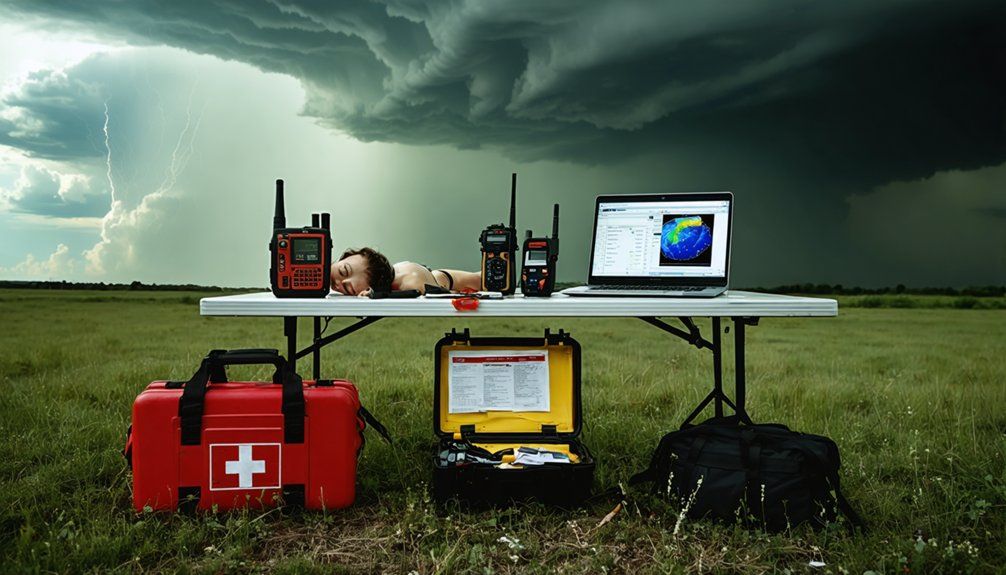
Beyond SKYWARN, first aid and CPR certifications round out your core safety preparation as a storm chaser. The Red Cross offers both, equipping you to handle roadside emergencies independently.
Since driving—not storms—poses the greatest risk, severe weather preparedness extends well beyond meteorological knowledge.
The greatest threat in storm chasing isn’t the storm—it’s the drive to reach it.
Prioritize these certifications to strengthen your storm safety protocols:
- CPR training through the American Red Cross or AHA
- First aid certification covering trauma, shock, and roadside injuries
- Defensive driving courses tailored to high-stress highway conditions
- Lightning safety protocols specific to field exposure scenarios
- Vehicle emergency preparedness including equipment and evacuation procedures
These credentials don’t just protect you—they make you a reliable asset in the field, operating autonomously and responsibly when conditions deteriorate rapidly.
How Much Does Storm Chasing Education Cost?
Storm chasing education costs vary across three tiers: free certifications, mid-range short courses, and full degree programs.
SKYWARN training costs you nothing—it’s a free, two-hour program covering thunderstorm fundamentals and reporting protocols.
Short course storm chasing costs scale by affiliation: students pay $32, members $64, and non-members $204.
These targeted educational investments deliver focused technical skills without committing to multi-year programs.
Degree-level educational investments represent the steepest tier. Bachelor’s programs in meteorology or atmospheric science run $40,000 to $100,000+, while master’s programs add two to three years beyond that.
You’re not required to hold a meteorology degree for storm chasing, but 44.7% of chasers carry bachelor’s degrees, suggesting formal education meaningfully improves your technical competency and professional positioning.
What Storm Chasing Field Experience Teaches You That School Can’t
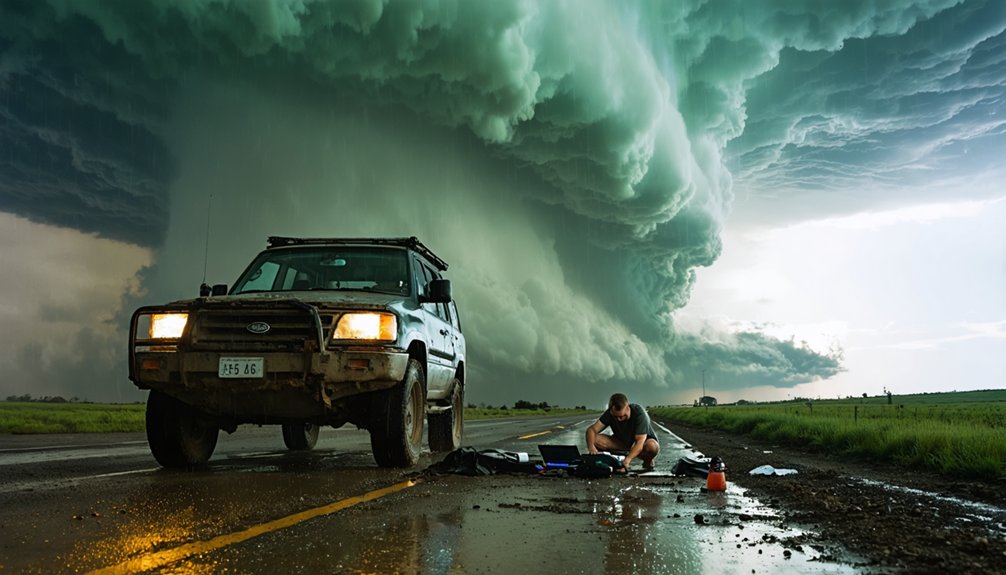
Classroom instruction builds your theoretical foundation, but field experience develops the perceptual and decision-making capacities that no textbook replicates.
Hands-on experience exposes you to practical challenges that sharpen your adaptive strategies and environmental awareness in real time.
Immersive field challenges forge the adaptive instincts and environmental awareness that classroom learning simply cannot replicate.
Field experience delivers critical real-world insights through:
- On-the-job learning: Reading atmospheric shifts instantaneously
- Observational skills: Identifying rotation, wall clouds, and inflow bands visually
- Decision-making under pressure: Repositioning when storms behave unpredictably
- Mentorship benefits: Experienced chasers accelerate your situational judgment
- Teamwork dynamics: Coordinating navigation, documentation, and communications simultaneously
These competencies can’t be downloaded from a curriculum.
You’ll develop pattern recognition, risk tolerance calibration, and rapid repositioning instincts exclusively through accumulated field hours.
This freedom-driven discipline rewards those who commit fully to experiential growth.
Radar Reading, Driving, and the Skills That Keep Chasers Alive
Surviving in the field demands a precise, interlocking set of technical skills that directly determine whether you intercept a storm safely or become a statistic.
Radar technology mastery sits at the foundation — you’ll interpret velocity data, reflectivity gradients, and rotation signatures in real time, making split-second positioning decisions. Misreading a hook echo costs you your escape route.
Driving skills are equally non-negotiable. Storm safety statistics confirm that vehicle accidents, not tornadoes, kill chasers. You’ll navigate rain-slicked highways, panicked civilian traffic, and rapidly shifting storm positions simultaneously.
Beyond radar and driving, you’ll develop calm situational awareness under pressure, lightning avoidance protocols, and equipment operation proficiency — cameras, tripods, and zoom lenses all demanding steady hands when conditions deteriorate fastest.
Each skill compounds the others, building your operational independence.
Media, Research, or Independent: Which Storm Chasing Career Fits You?
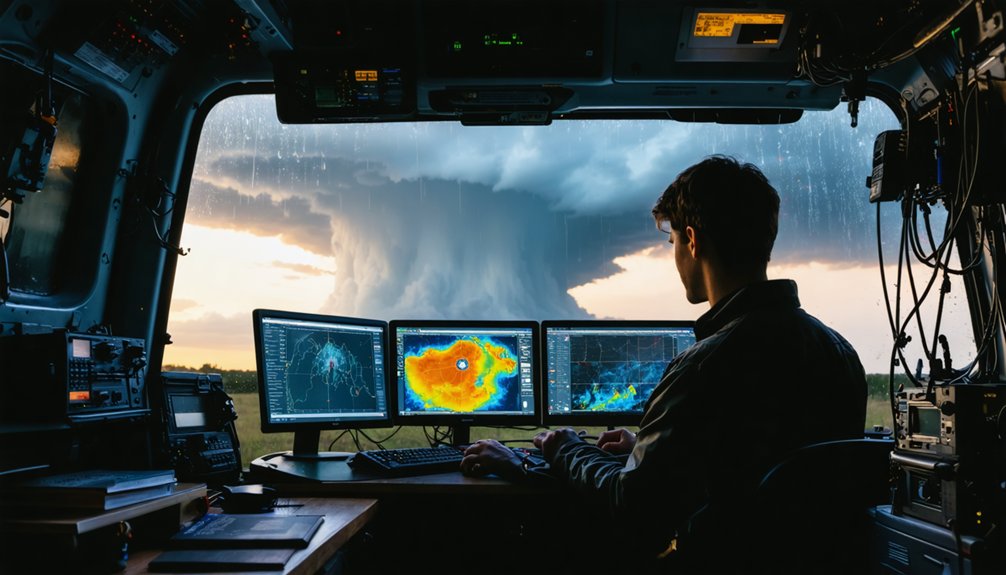
Where you direct your storm chasing career shapes every credential, skill set, and professional relationship you’ll build from this point forward.
Media roles demand strong communication and rapid deployment. Research opportunities require analytical depth and grant-writing competency. Independent chaser paths offer career flexibility but demand self-funding and disciplined networking strategies.
Consider these distinctions before committing:
Before locking in your path, weigh each option’s demands against your strengths, finances, and long-term professional vision.
- Media roles prioritize live reporting, camera operation, and broadcast meteorology credentials
- Research opportunities align with university affiliations, funding options, and peer-reviewed output
- Independent chasers rely heavily on mentorship benefits and community reputation
- Skill application varies dramatically across each path’s technical demands
- Networking strategies differ between government agencies, newsrooms, and private research firms
Identify where your strengths intersect with your tolerance for financial uncertainty, then build accordingly.
How to Start Storm Chasing Right Now, Whatever Your Background
Whether you’re a complete beginner or a seasoned meteorologist, your entry point into storm chasing depends entirely on your current skill set and educational background.
Start by honestly evaluating what you already know—if you hold an atmospheric science degree, you can pursue SKYWARN certification and field mentorship immediately; if you don’t, enrolling in free SKYWARN training and connecting with local weather spotter networks gives you a structured, low-cost foundation.
From there, you’ll build technical proficiency in radar interpretation, driving safety, and severe weather protocols at a pace matched to your existing knowledge base.
Assess Your Current Background
Before diving into storm chasing, you need an honest assessment of your current background—your education, skills, and experience will determine your most efficient entry point.
Clarify your storm chasing motivations and honestly evaluate these core areas:
- Education: Do you hold a degree in atmospheric science, meteorology, or a related field?
- Weather pattern recognition: Can you interpret radar data and identify severe storm signatures?
- Field experience: Have you participated in weather spotter networks or research projects?
- Technical skills: Are you proficient with cameras, data analysis tools, and navigation systems?
- Safety awareness: Do you understand driving protocols and severe weather hazards?
Your answers reveal specific gaps to address, letting you build a targeted, efficient path into storm chasing without wasting time on unnecessary prerequisites.
Take Immediate First Steps
Regardless of your current background, concrete actions exist that you can take today to accelerate your entry into storm chasing.
Register for SKYWARN training immediately—it’s free, takes two hours, and delivers storm chasing basics alongside critical safety protocols. Contact your local Warning Coordination Meteorologist to locate upcoming sessions.
Simultaneously, connect with established chasers through online communities and regional spotter networks. Field mentorship accelerates your learning curve faster than independent study alone.
Begin documenting local weather patterns systematically.
Practice radar interpretation using free platforms like College of DuPage’s NEXRAD viewer. Invest in a quality dashcam and weather radio.
Enroll in a Red Cross first aid course.
These parallel actions build your foundational competency stack efficiently, positioning you for serious field engagement regardless of whether formal meteorological education follows.
Frequently Asked Questions
What Percentage of Storm Chasers Are Women in the Field?
Women make up just 2% of storm chaser demographics, reflecting significant gender representation gaps in the field. You’ll find this pursuit dominated by men, though it’s an open, freedom-embracing career welcoming all passionate weather enthusiasts.
What Is the Average Age of a Professional Storm Chaser?
You’ll find storm chaser demographics reveal an average age of 35, though age trends span 18 to 65. You’re entering a field that welcomes diverse, freedom-seeking professionals regardless of when you start chasing.
Can Storm Chasers Work Directly With Local TV Weather Departments?
Yes, you can collaborate directly with local TV weather departments, leveraging media partnerships to deliver real-time storm data. These collaboration opportunities let you report findings, support on-air meteorologists, and build credible, independent career pathways in broadcast meteorology.
Which Related Majors Besides Meteorology Qualify Someone for Storm Chasing?
🌪 You’ll qualify through atmospheric physics, atmospheric chemistry, climatology studies, and environmental science. These disciplines sharpen your analytical edge, equipping you with the technical foundation you need to read, interpret, and chase severe weather effectively.
Are Storm Chasing Courses Offered During Specific Seasons Each Year?
Yes, you’ll find storm chasing courses held during slow seasons, keeping you free to apply chasing techniques when storm season peaks. Contact your local Warning Coordination Meteorologist to discover available training schedules that fit your pursuits.
References
- https://himalayas.app/career-guides/storm-chaser
- https://www.mymajors.com/career/storm-chaser/education/
- https://www.onlinedegree.com/careers/life-physical-science/storm-chaser/
- https://www.okcollegestart.org/Career_Planning/Career_Profile/Career_Profile.aspx?id=JPdLmXAP2BPAXSRqQAxw8oleqa76wXAP3DPAXXAP3DPAX&screen=1
- https://www.ametsoc.org/ams/education-careers/careers/professional-development/short-courses/starting-a-storm-chasing-course-at-your-college-or-university/
- https://www.weather.gov/skywarn/