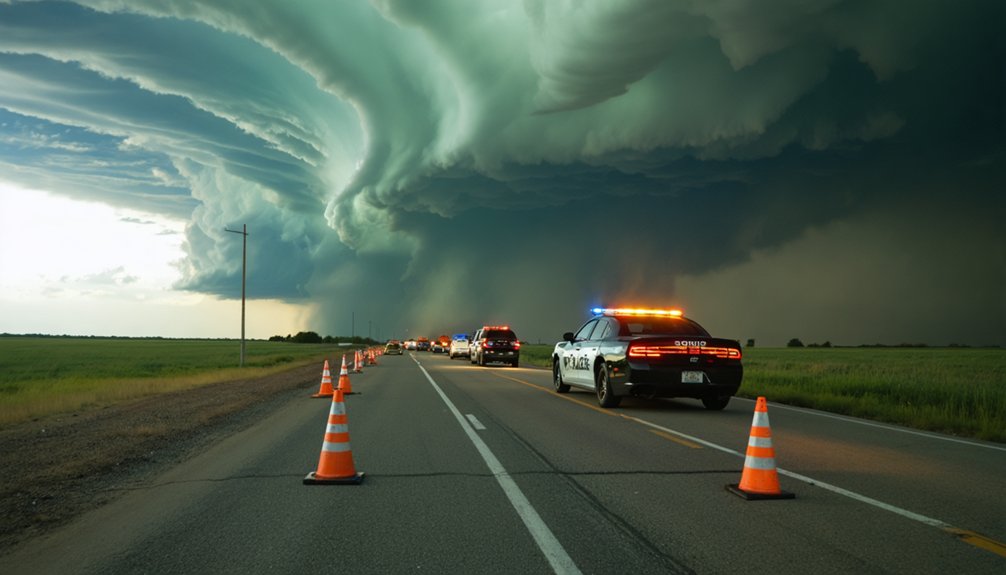
Oklahoma isn’t actually banning storm chasers — it’s licensing them. House Bill 2426 introduces a voluntary “Professional Severe Weather Tracker” designation to address documented gridlock on rural roads during severe weather events. Hundreds of chasers create dangerous traffic congestion that delays emergency response operations. Hobbyist chasers retain their legal right to chase storms under existing traffic laws. If you want the full technical breakdown, keep scrolling.
Key Takeaways
- Oklahoma is not banning storm chasing but introducing voluntary licensing to regulate professional chasers while protecting hobbyist rights.
- Hundreds of storm chasers create dangerous rural road gridlock, increasing collision risks and delaying critical disaster relief operations.
- House Bill 2426 creates a “Professional Severe Weather Tracker” designation, granting licensed chasers emergency vehicle privileges on restricted roads.
- Hobbyist chasers remain free to operate legally but must obey traffic laws and yield to licensed professionals and emergency vehicles.
- The bill cleared the House Business Committee 9-0, targeting a July 1, 2025 effective date pending further legislative approval.
Is Oklahoma Actually Banning Storm Chasers?
Despite the alarming headlines circulating on social media, Oklahoma isn’t actually banning storm chasers. House Bill 2426 introduces voluntary storm chasing regulations through a professional licensing framework — it doesn’t criminalize or restrict amateur activity.
You can still chase storms without a license; you’ll simply operate under existing traffic laws.
The bill creates an optional “Professional Severe Weather Tracker” designation for media-affiliated and university-connected chasers.
Professional licensing grants emergency vehicle privileges — flashing lights, siren use, speed limit exemptions, and restricted road access. Hobbyists retain full legal rights to observe weather events on public roads.
The misinformation spreading across Reddit and YouTube conflates expanded professional access with restriction. These are fundamentally different legislative actions.
No data supports a chasing ban — the bill enhances qualified professionals, not eliminates your freedom to chase.
What House Bill 2426 Actually Does
House Bill 2426 works through a structured, opt-in licensing framework — not a prohibition. It creates a “Professional Severe Weather Tracker” license, administered by the Oklahoma Insurance Department, targeting storm chasers affiliated with media outlets or research universities like the University of Oklahoma.
You’d pay $500 initially, $250 at renewal, and you’d need a criminal background check, proof of insurance, and a meteorologist endorsement.
Once licensed, you gain emergency vehicle privileges — flashing lights, sirens, speed limit exemptions, and road closure access. This directly addresses storm chaser ethics by distinguishing credentialed professionals from hobbyists.
Media responsibility becomes codified here: journalists and researchers operating in severe weather get structured authority, not unchecked access.
Unlicensed chasers retain full legal rights to chase — they simply operate without those elevated privileges.
What the Bill Means for Hobbyist Storm Chasers
If you chase storms as a hobbyist, House Bill 2426 leaves your core activities legally intact. Your hobbyist rights remain protected under existing traffic law frameworks.
Storm chaser culture continues operating independently, just without emergency vehicle privileges.
Here’s what the bill specifically means for you:
- You must obey all traffic laws without exception
- You can’t access closed roads or restricted disaster zones
- You must yield to licensed professional trackers and emergency vehicles
- Failure to yield carries a $1,000 fine
- Tour companies and independent chasers receive no licensing pathway
The bill creates a professional tier above you, not a prohibition against you. Your observational freedom stays intact.
The legislation targets operational efficiency for credentialed professionals, leaving unlicensed chasers operating exactly as they currently do.
Who Qualifies for a Professional Storm Chaser License?
To qualify for a Professional Severe Weather Tracker license under House Bill 2426, you must be employed by a media outlet or a university research program, such as the University of Oklahoma.
You’ll also need to secure a meteorologist’s endorsement, confirming your professional standing in the field. Additionally, you must pass a criminal background check and provide proof of insurance before the Oklahoma Insurance Department will issue your $500 initial license.
Eligibility And Employment Requirements
Under House Bill 2426, qualifying for a Professional Severe Weather Tracker license isn’t open to just anyone—eligibility is strictly tied to institutional affiliation. The licensing criteria demand verified media affiliation or active enrollment in a university research program.
To qualify, you must meet all of the following requirements:
- Employment by a recognized media outlet or university like the University of Oklahoma
- Passing a criminal background check
- Submitting proof of adequate insurance coverage
- Securing a formal meteorologist endorsement
- Paying the $500 initial licensing fee
These standards deliberately exclude hobbyists, tour operators, and independent chasers from obtaining emergency vehicle privileges.
If you don’t meet the institutional threshold, you’re simply ineligible—no exceptions. The bill prioritizes verified professional accountability over unrestricted individual access.
Endorsements And Background Checks
Beyond meeting employment thresholds, applicants must clear two additional gatekeeping mechanisms built into HB 2426: a criminal background check and a formal meteorologist endorsement.
The background checks screen your criminal history before any privileges are granted. If your record triggers disqualifying criteria, your application stops there.
The endorsement process adds a professional verification layer — you’ll need a licensed meteorologist to formally validate your qualifications. This isn’t a casual signature; it’s a credentialed professional staking their reputation on your competency in severe weather environments.
Together, these mechanisms function as a two-factor qualification filter. They’re designed to guarantee that only operationally sound individuals access emergency vehicle status.
If you value the freedom to chase professionally, these are the objective benchmarks you’ll need to satisfy.
How Storm Chaser Traffic Jams Pushed Oklahoma to Act
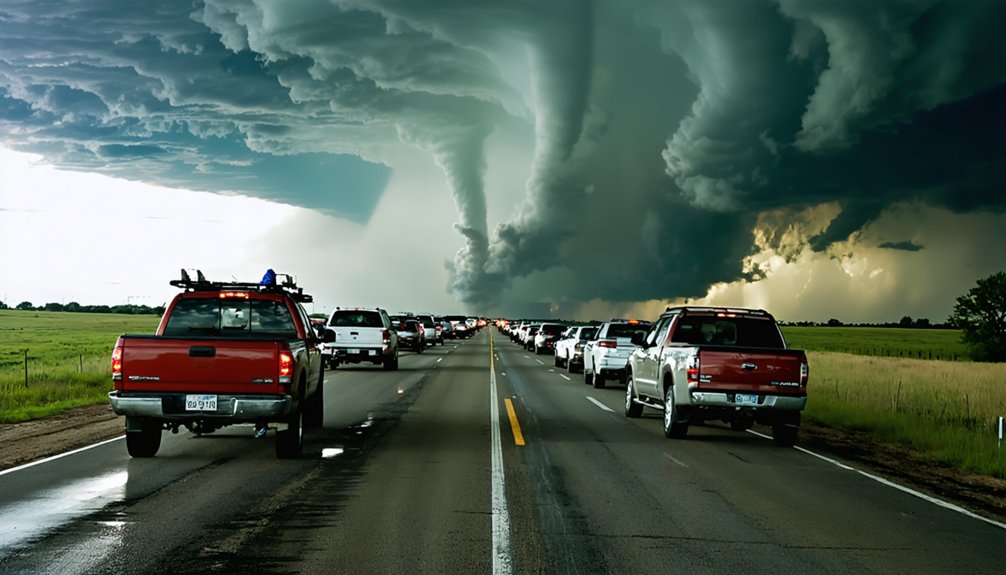
When severe weather strikes Oklahoma, you’ll witness hundreds of storm chasers converging on the same rural roads simultaneously, creating dangerous gridlock that impedes emergency response vehicles.
This congestion generates measurable safety risks, as blocked roadways delay critical disaster relief operations and increase collision probabilities in already hazardous conditions.
These documented traffic disruptions pushed legislators to pursue a regulatory framework that separates credentialed professionals from the broader chasing population.
Roadway Chaos During Storms
During severe weather outbreaks in Oklahoma, converging storm chasers have repeatedly turned critical roadways into gridlocked corridors, directly impeding emergency response times and public evacuation routes.
Documented congestion events reveal measurable delays affecting both storm chaser safety and severe weather preparedness infrastructure.
Key documented impacts include:
- Emergency vehicles blocked by clustered chase vehicles on rural highways
- Evacuation corridors compromised during active tornado events
- First responders delayed by non-essential traffic in restricted zones
- Collision risks escalating when multiple chasers pursue identical storm cells
- Communication breakdowns between chasing teams and local emergency dispatch
You’re looking at systemic inefficiencies that erode public safety margins.
Oklahoma’s legislative response targets operational coordination, not individual freedom, creating a structured framework that prioritizes qualified professionals maneuvering through dangerous conditions efficiently.
Safety Risks From Congestion
Storm chaser traffic congestion isn’t merely an inconvenience—it’s a quantifiable public safety hazard that Oklahoma’s legislature has now moved to structurally address.
When dozens of vehicles converge on rural corridors during active tornado events, emergency response times increase, evacuation routes compress, and collision risk spikes sharply.
You’re looking at compounding variables: high-speed wind events, reduced visibility, and uncoordinated vehicle clusters simultaneously occupying the same restricted roadways. Effective traffic management breaks down entirely under those conditions.
Storm chaser safety deteriorates not just for chasers themselves, but for civilians traversing the same corridors.
Oklahoma’s legislative response targets this structural inefficiency by stratifying access—granting credentialed professionals priority movement while preserving your legal right to observe weather events independently, provided you maintain compliance with standard traffic law.
Calls For Professional Regulation
As storm chasing evolved from a niche scientific pursuit into a commercialized industry with thousands of active participants, Oklahoma’s road infrastructure simply couldn’t absorb the volume.
Legislators responded by targeting professional accountability and storm chasing ethics rather than restricting everyone.
House Bill 2426 proposes an optional license establishing clear behavioral standards for qualified chasers:
- Employment verification through media outlets or university research programs
- Criminal background checks and proof of insurance
- Meteorologist endorsement confirming technical competency
- Emergency vehicle privileges, including signal override and restricted road access
- Fines up to $500 for violations, with revocation risk
You retain full freedom to chase without licensure.
The bill simply creates a credentialed tier, separating researchers and journalists from recreational participants while reducing dangerous roadway congestion during active severe weather events.
What Happens If You Break Oklahoma’s New Storm Chasing Rules?
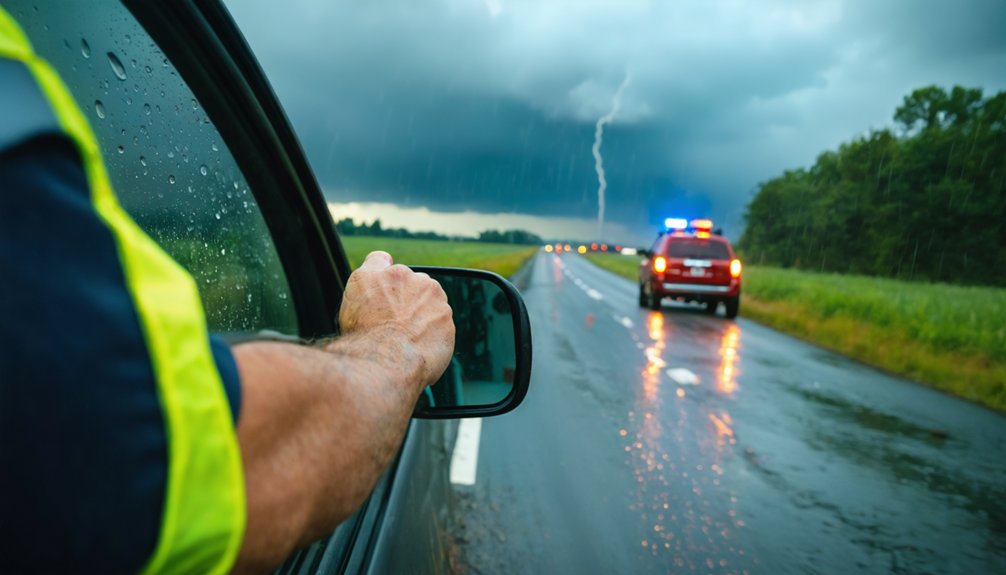
Oklahoma’s House Bill 2426 establishes a tiered penalty structure that targets both licensed professionals who violate operational protocols and unlicensed individuals who interfere with their activities.
If you hold a professional license and breach its operational conditions, you’ll face fines up to $500 and potential license revocation. These storm chaser penalties exist to maintain accountability among credentialed trackers exercising emergency vehicle privileges.
For unlicensed individuals, the stakes differ. Your traffic law violations remain governed by standard statutes, but if you fail to yield to a licensed tracker or emergency vehicle, you’ll incur a $1,000 fine.
The bill doesn’t restrict your ability to observe weather events privately, but it does require you to respect designated road closures and avoid interfering with professional operations during active severe weather events.
Where Oklahoma’s Storm Chaser Bill Stands Now
House Bill 2426 has cleared its first legislative hurdle, passing the House Business Committee 9-0 before advancing to the Commerce & Economic Development Oversight Committee.
Professional licensing and storm chaser safety remain central to ongoing deliberations. Here’s where things currently stand:
Professional licensing and storm chaser safety remain at the forefront as legislators continue working through key deliberations.
- Senate companion bill introduced by Sen. Mann runs parallel to House proceedings
- Bill was recently tabled in some proceedings pending additional data collection
- Two major legislative steps remain before reaching the Governor
- Effective date targets July 1, 2025, contingent on full passage
- No final law exists yet; hobbyist freedoms remain legally intact
You’re not facing an imminent ban.
The bill’s optional framework preserves your right to chase independently while establishing a voluntary credentialing pathway strictly for media-affiliated and university-affiliated professionals.
Frequently Asked Questions
Who Introduced the Similar Senate Proposal Alongside House Bill 2426?
“Knowledge is power” — Sen. Mann introduced the similar Senate proposal. You’ll find storm chaser regulations and weather tracking ethics at its core, empowering your freedom to chase while maintaining professional standards alongside House Bill 2426.
What Is the Renewal Fee for the Professional Severe Weather Tracker License?
You’ll pay a $250 renewal fee to maintain your Professional Severe Weather Tracker license, ensuring you retain authorized access to advanced tracking technology and emergency privileges during critical severe weather operations and data collection missions.
Which Government Department Is Responsible for Issuing the Storm Chaser License?
Like Prometheus carrying fire, you’ll find the Oklahoma Insurance Department holds the torch — it’s responsible for issuing your storm chaser license, where licensing implications and storm chaser ethics guide every professional’s credentialed journey forward.
What University Is Specifically Mentioned as Eligible for the Licensing Program?
The University of Oklahoma’s specifically eligible for the licensing program, enhancing storm chaser safety through structured university involvement. You’ll find its research programs qualify applicants, ensuring data-driven, technically sound severe weather tracking with professional credentials.
What Is the Effective Date if House Bill 2426 Successfully Passes?
If you’re planning your chasing season around this bill’s legislative impact, mark July 1, 2025, as the effective date — that’s when House Bill 2426 would officially take effect if it successfully passes.
References
- https://www.reddit.com/r/tornado/comments/1ijujon/anybody_else_hear_about_the_oklahoma_bill_that/
- https://oklahomavoice.com/2025/02/04/oklahoma-house-advances-controversial-bill-giving-some-storm-chasers-emergency-vehicle-status/
- https://www.okhouse.gov/posts/news-20250206_2
- https://www.foxweather.com/lifestyle/ok-rules-severe-weather-tornado
- https://www.youtube.com/watch?v=in6RgJOFTkI
- https://www.reddit.com/r/tornado/comments/1iv01ah/update_on_the_oklahoma_storm_chasing_bill/
- https://www.youtube.com/watch?v=HXAdm670rs8
- https://www.youtube.com/watch?v=3z3dJvT4K0k
- https://www.youtube.com/watch?v=FKDlTucCQ9E