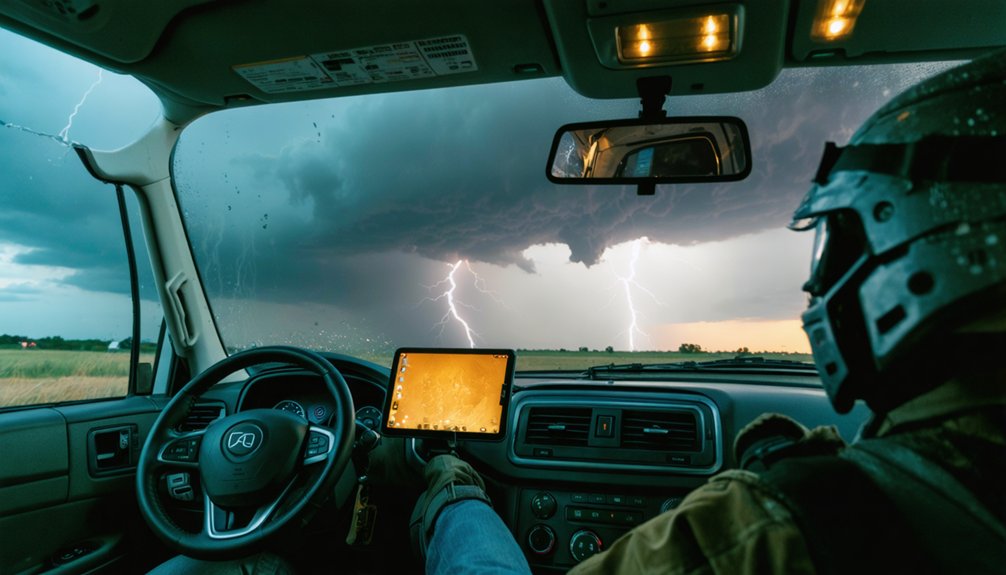
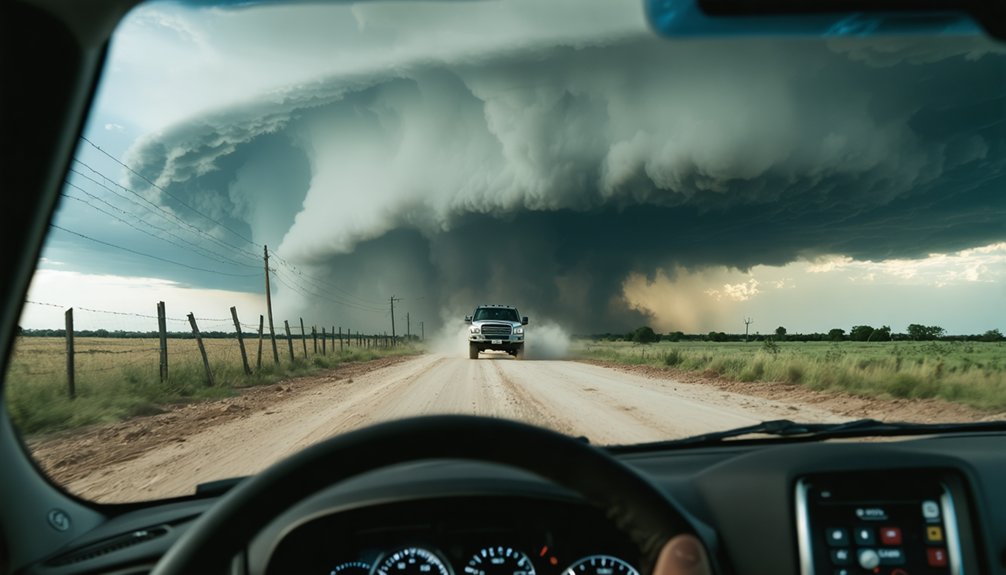
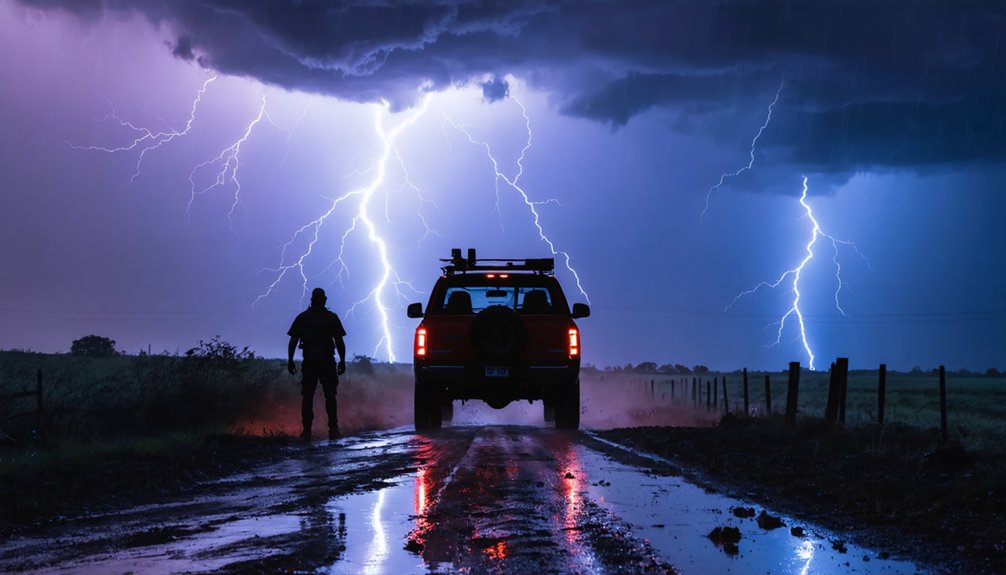
Storm chasing safety starts with checking radar and spotter reports before you enter any warned area. You’ll need at least two escape routes ready at all times, positioned near intersections — never dead ends. Don’t core punch through heavy precipitation, and never cross flooded roads. Use multiple communication devices, travel with a partner, and always comply with emergency responders. These fundamentals protect you when conditions shift without warning — and there’s much more to unpack ahead.
Key Takeaways
- Always monitor real-time radar data and spotter reports before entering storm areas, cross-referencing multiple sources for accurate situational awareness.
- Maintain at least two independent escape routes at right angles to storm motion, reassessing their viability every few minutes.
- Never attempt flooded road crossings or core punching through heavy precipitation, as both pose life-threatening risks.
- Use multiple communication devices, share GPS locations with your team, and document rerouting decisions in real time.
- Prioritize safety over data collection, respecting emergency responders and avoiding interference with active emergency operations.
Read Radar and Spotter Reports Before Entering Warned Areas
Before you enter any warned area, check the latest radar data and spotter reports to build a clear picture of what’s ahead. Effective storm tracking depends on your ability to synthesize multiple data sources before committing to a position.
Don’t rely solely on automated alerts—cross-reference radar interpretation with ground-level spotter observations to identify rotation, movement, and intensity trends.
Study velocity scans to detect mesocyclone signatures and note storm motion vectors before you move. Spotter networks often capture real-time details that radar misses, particularly in rapidly evolving situations.
This combined approach keeps you informed, reduces surprises, and preserves your escape options. Entering warned areas without this preparation compromises your safety and your ability to make sound, independent decisions in the field.
Always Keep Two Escape Routes Ready While Storm Chasing
When positioning for a chase, you’ll want to scout exit paths before the storm closes in, ensuring at least two viable routes lead away from the threat.
You must monitor radar continuously for any shifts in storm movement, as a sudden track change can cut off an escape corridor within minutes.
Plant yourself near four-way intersections whenever possible, giving you the flexibility to redirect quickly if one route becomes compromised.
Identifying Safe Exit Paths
Storm chasing demands constant positional awareness, and you’ll never want to find yourself boxed in with a tornado bearing down and no clear way out. Before committing to any position, identify at least two independent exit strategies leading toward safe zones away from the storm’s projected path.
Study your road network carefully. Rural areas often have sparse grids where dead ends trap chasers with zero options. Four-way intersections give you the most directional flexibility, letting you pivot quickly as storm behavior shifts unpredictably.
Always account for perpendicular escapes rather than relying solely on roads running parallel to storm movement. Storms accelerate, deviate, and intensify without warning.
Pre-mapping your exits before you need them keeps your options open and your decision-making sharp when seconds genuinely matter.
Monitoring Storm Movement Changes
Tracking storm movement in real time separates disciplined chasers from those caught off guard by sudden directional shifts. Your storm tracking strategy must account for deviant motion, acceleration, and unexpected turns. Storms don’t telegraph their intentions — you must anticipate them.
Use radar loops alongside spotter network updates to continuously refine your chase navigation decisions. When a storm accelerates or pivots, your current escape routes may instantly become compromised. Reassess your position every few minutes, not every few miles.
Maintain two viable exit corridors at all times, ideally at right angles to the storm’s forward motion. If one route closes due to flooding, debris, or traffic, you’ve got a backup.
Complacency during repositioning kills — treat every movement as a calculated tactical decision.
Positioning Near Intersection Routes
Positioning at four-way intersections gives you the tactical flexibility that parallel roads and dead ends simply can’t offer. Your intersection strategy should prioritize crossroads with paved exits running perpendicular to the storm’s tracked path, giving you north, south, east, and west options simultaneously.
Escape planning isn’t optional — it’s continuous. As the storm evolves, mentally update your two primary exit routes every few minutes. If one route becomes compromised by flooding, debris, or a shifting tornado track, you execute the secondary route without hesitation.
Never commit to a single road. Committing eliminates your freedom to respond to deviant storm motion. Identify your exits before you need them, not during a crisis.
Discipline in positioning directly determines your margin of survival.
Never Core Punch Through Heavy Precipitation or Hail
One of the most dangerous mistakes you can make while chasing is core punching — deliberately driving through a storm’s heavy precipitation core or large hail shaft to reposition on the other side.
Core punch risks include sudden zero-visibility conditions and baseball-sized hail destroying your vehicle. Precipitation dangers compound quickly once you’re committed inside the core.
Inside a core, zero visibility and baseball-sized hail can destroy your vehicle within seconds.
Avoid core punching by following these critical rules:
- Reposition ahead of time using road networks before the storm cuts off your options.
- Monitor radar loops to identify hail cores and precipitation shields before committing to any route.
- Never assume the core is passable based on visual appearance alone.
- Maintain escape routes so repositioning never requires penetrating dangerous precipitation zones.
Position at Intersections, Never Dead Ends
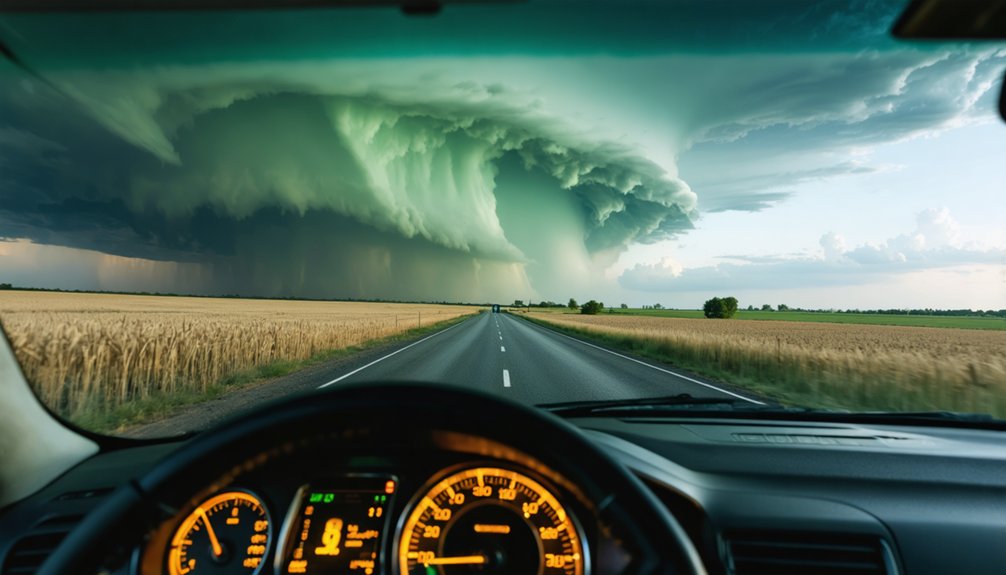
When you’re positioning your vehicle during a storm chase, always choose four-way intersections over dead ends, as they give you multiple escape vectors if the storm shifts unexpectedly.
Dead ends eliminate your options instantly—trapping you in a situation where the storm dictates your fate rather than your own tactical decision-making.
Before you commit to any position, mentally map at least two clear exit routes and verify they’re not compromised by flooding, downed lines, or traffic congestion.
Intersection Benefits Explained
Storm chasers who position at four-way intersections gain a critical tactical advantage: multiple escape routes in opposing directions.
Intersection advantages directly support smarter escape strategies when storms shift unexpectedly.
Four-way positioning delivers:
- North-south flexibility – Retreat parallel or perpendicular to storm motion instantly.
- Real-time directional choice – Read updated storm behavior before committing to one route.
- Reduced entrapment risk – Dead ends eliminate options; intersections preserve them.
- Team coordination efficiency – Multiple vehicles can split directions without blocking each other.
You’re never locked into a single path when you’ve chosen your spot deliberately.
Avoid cul-de-sacs, gravel dead ends, and rural roads that terminate without exit.
Your positioning decision precedes the storm’s next move — make it count before conditions deteriorate.
Recognizing Dead-End Dangers
Dead ends kill escape options before a tornado ever arrives. When you’re traversing storm terrain, a dead-end road removes your freedom to maneuver instantly. Tornadoes shift track unpredictably, and a blocked exit transforms your position from strategic to fatal.
Route planning must eliminate dead ends entirely from your chase strategy. Before committing to a road, confirm it connects through to a perpendicular escape corridor. Intersections give you north, south, east, and west options simultaneously — dead ends give you one direction: back into danger.
Always pre-load road maps of your target area and identify terminating roads before you’re under pressure. Never assume a road continues. Verify it.
Your mobility is your primary survival asset, and dead ends surrender that asset completely.
Planning Your Escape Routes
Positioning at four-way intersections gives you four immediate escape vectors — north, south, east, and west — so you’re never committed to a single trajectory when a tornado shifts track.
Escape route mapping isn’t optional; it’s foundational to surviving dynamic storm environments.
Apply these route flexibility principles before committing to any position:
- Pre-select two exits from every staging location before the storm arrives.
- Avoid dead-end roads, rural cul-de-sacs, and box canyons with single entry points.
- Monitor perpendicular roads relative to storm motion — your lateral escape corridor.
- Reassess continuously as storms deviate; a valid route at T-minus five minutes can become compromised instantly.
You own your freedom of movement. Don’t surrender it by poor positioning.
How Should You Handle Lightning in the Field?
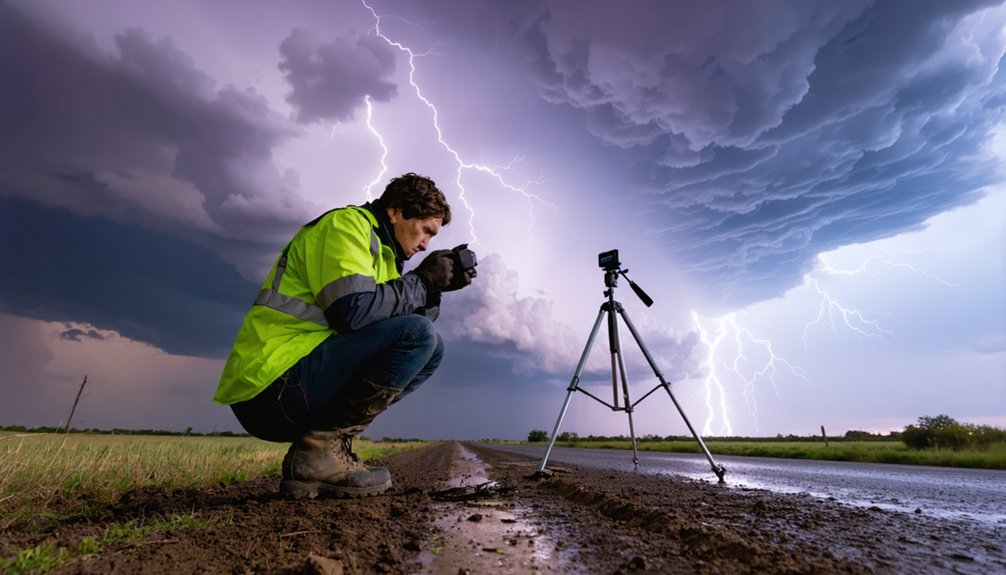
When lightning threatens in the field, you’ll need to act on a strict set of protocols to minimize exposure risk. Lightning awareness isn’t optional — it’s fundamental to keeping you alive during active storm operations.
Avoid positioning near tall objects like trees, power poles, or fences, as these attract ground strikes. If you’re caught in the open, kneel, squat, or sit to isolate yourself from ground current. Your safety gear should include rubber-soled footwear to reduce conductivity. Maintain distance from fences and power lines during cloud-to-ground activity.
If a sturdy building or hard-top vehicle is accessible, get inside immediately. Never underestimate lightning’s lateral range — a strike several hundred feet away can still deliver a lethal ground current.
Stop Driving When Hail Falls During a Chase
When hail begins to fall during a chase, pull over immediately, as even small hailstones can crack or shatter your windshield and compromise visibility.
Park under an overpass, canopy, or other overhead cover whenever possible to minimize vehicle damage.
Once the hail stops, assess your surroundings and resume driving only when conditions are safe and your sightlines are clear.
Hail Damages Your Windshield
Hail poses an immediate threat to your windshield, and continuing to drive through it compounds that risk considerably. Hail impact at highway speeds can shatter glass instantly, eliminating your forward visibility and your freedom to navigate safely.
Stop immediately and protect yourself using these protocols:
- Pull completely off the road to avoid blocking traffic lanes.
- Angle your vehicle so hail strikes the front, maximizing windshield protection.
- Avoid parking under overpasses — wind-driven hail still reaches sheltered areas.
- Cover your face if hail breaches the glass to prevent injury.
Cracked or shattered windshields compromise structural integrity and impair vision during critical chase moments.
A brief stop preserves your equipment, your safety, and your ability to continue operating effectively in the field.
Park In Safe Locations
During active hail, you need to stop driving and park in a safe location immediately. Continuing through a hailstorm risks cracking or shattering your windshield, eliminating visibility and compromising your safety.
When selecting a safe parking spot, prioritize vehicle positioning away from trees, power lines, and elevated structures that could direct debris onto your vehicle. Pull completely off the roadway to avoid traffic hazards while stopped.
If you’re near an underpass or parking structure, use it strategically, but never position under a low-clearance overpass during tornado threats. Face your vehicle away from the wind-driven hail direction to reduce direct impact on your windshield.
Stay in your vehicle with your seatbelt fastened until hail subsides. Then immediately reassess storm positioning before resuming your chase.
Resume Driving After Hail
Once the hail subsides and you’re ready to resume driving, don’t simply pull back onto the road without a quick reassessment of your situation. Hail safety extends beyond stopping — it includes a deliberate restart protocol.
Before resuming driving, run through these four checks:
- Radar scan — Confirm the hail core has shifted away from your position.
- Visibility check — Verify sight lines are clear before merging onto roadways.
- Vehicle inspection — Quickly assess windshield integrity and tire condition.
- Escape routes — Reconfirm two viable exit paths relative to storm movement.
Hail-covered roads reduce traction considerably. Accelerate gradually, maintain increased following distance, and stay alert for rapidly changing storm structure as you reposition.
Communication and Radar Equipment Every Chaser Needs
Reliable communication and radar equipment aren’t optional—they’re the backbone of safe and effective storm chasing. You’ll need multiple communication devices operating simultaneously, including HAM radios, push-to-talk systems, and a NOAA Weather Radio as your backup when data networks fail.
Don’t rely solely on cellular service—it collapses precisely when you need it most.
Maintain strict radar calibration standards by regularly verifying your software displays accurate, real-time data. Outdated or miscalibrated radar costs lives.
Carry power inverters and portable chargers to keep every device operational during extended chases.
Share your GPS location continuously with your team and log your intentions before entering warned areas.
Situational awareness depends entirely on functional equipment—there’s no freedom in the field without it.
Never Cross Flooded Roads During a Storm Chase
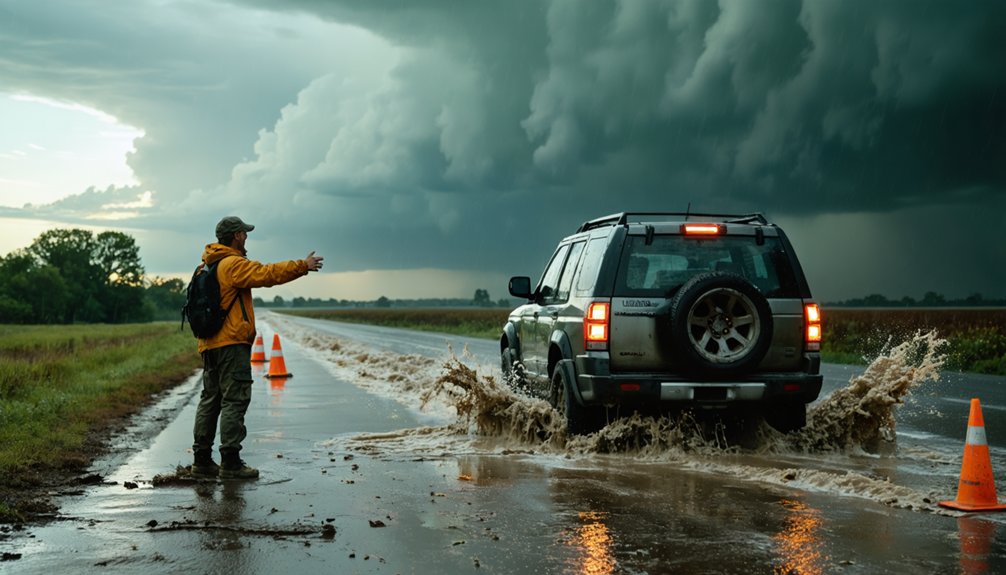
Beyond your communication setup, your radar feed will sometimes show storm-related flooding long before you encounter it on the road—but don’t count on that warning every time.
Flooded road hazards develop faster than data refreshes. Follow these safe driving tips:
- Never attempt low-water crossings—moving water as shallow as six inches can sweep a vehicle off course.
- Read the road surface—murky water conceals washed-out pavement, debris, and drop-offs.
- Reroute immediately—turn around before commitment forces a dangerous crossing.
- Treat every flooded stretch as impassable—depth is always unknown without direct measurement.
Your freedom to chase depends on keeping your vehicle operational.
One flooded crossing can end your chase permanently—and potentially your life. Discipline here isn’t optional.
Why Storm Chasers Should Always Travel in Pairs
Traveling in pairs isn’t a preference—it’s a structural safety requirement that directly improves your operational effectiveness in the field.
Pair dynamics create a division of labor that single operators simply can’t replicate. One person drives; the other monitors radar, tracks positioning, and logs communications. That separation of shared responsibilities eliminates dangerous task saturation behind the wheel.
Your partner also provides an independent perspective on storm behavior, catching motion changes or escape route problems you might miss under pressure.
When equipment fails or conditions deteriorate rapidly, a second set of hands accelerates your response time. Two-person teams maintain sharper situational awareness, communicate findings to chase networks more consistently, and execute safer repositioning decisions.
Don’t operate alone—pair up before you ever leave the staging area.
Always Follow Emergency Orders in the Field
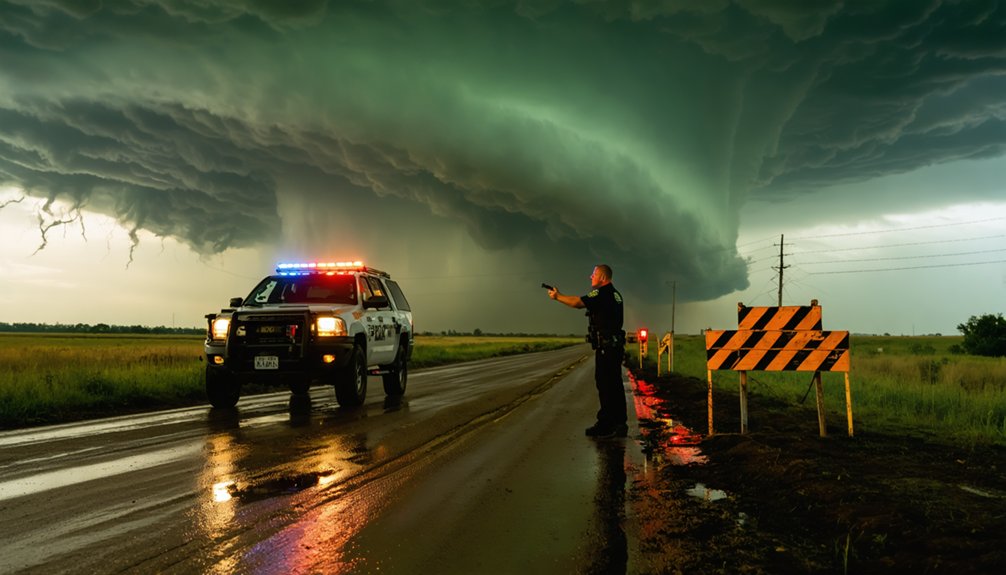
When law enforcement or emergency management personnel issue directives in the field, you comply immediately and without debate. Respecting emergency protocols protects you, your team, and civilian bystanders.
- Yield to road closures — reroute immediately; don’t negotiate access with officers.
- Monitor field communication channels — stay updated on evacuation orders via HAM radio or NOAA Weather Radio.
- Log directive changes — document any rerouting instructions with your chase team in real time.
- Disengage the intercept — no data point or footage justifies obstructing emergency response operations.
Authorities possess ground-level intelligence you don’t have from your radar screen.
Defying their orders creates dangerous conflicts, delays rescue efforts, and exposes you to legal consequences. Compliance isn’t weakness — it’s disciplined, professional storm chasing.
Frequently Asked Questions
What Type of Insurance Coverage Do Storm Chasers Typically Need?
You’ll need extensive vehicle insurance, liability coverage, property damage protection, and personal injury policies. These safeguard you against storm-related incidents, equipment losses, and third-party claims while you’re actively pursuing severe weather in the field.
How Do Storm Chasers Legally Film on Private Property During Chases?
You’ll need landowner permission before filming on private property. Respect property rights by obtaining verbal or written consent. Follow filming ethics by staying on public roads whenever possible, ensuring you’re never trespassing during your chase operations.
What Physical Fitness Level Is Recommended for Storm Chasing Activities?
You don’t need elite athleticism, but you’ll need solid endurance training to handle storm preparedness demands. Maintain cardiovascular fitness, core strength, and mental stamina — rapid repositioning, extended fieldwork, and emergency evacuations require a reliably capable, responsive body.
How Do Storm Chasers Handle Medical Emergencies Far From Hospitals?
You’ll want to carry extensive first aid kits and emergency supplies in your vehicle at all times. Train in wilderness medicine, maintain satellite communication devices, and you’ve got reliable protocols for managing trauma until professional help arrives.
What Permits Are Required for Professional Storm Chasing Activities?
Storm chasing permits and legal regulations aren’t universally mandated, but you’ll need to research local jurisdictions, obey traffic laws, respect private property, and comply with emergency management directives when operating in active storm zones or restricted areas.
References
- https://www.atms.unca.edu/cgodfrey/courses/swfex/pdf/ChasingSafety.pdf
- https://midweststormchasers.org/safety-tips/
- https://www.youtube.com/watch?v=nxPSFg2R8YY
- https://www.weather.gov/spotterguide/safetyfirst
- https://www.stormchasingusa.com/storm-chasing-and-safety/
- https://meetingsmags.com/illinois/il_planning/il_checklist/safety-tips-from-a-storm-chaser/
- https://www.tempesttours.com/safety-tips
- https://will.illinois.edu/weatherrealness/episode/storm-chasing-can-be-deadly-heres-how-to-stay-safe