The best storm chasing live stream moments you’ll find center on two landmark events: the 2013 El Reno tornado, which hit 2.6 miles wide with 295+ mph winds and 15+ simultaneous chasers broadcasting, and the 2007 Hannah tornado, where 12 chasers streamed real-time intercepts concurrently. These events delivered zero-delay, multi-angle footage under life-threatening conditions. The technical execution, survival moments, and coordinated ground operations captured during these intercepts set benchmarks that still define the field today.
Key Takeaways
- The 2013 El Reno tornado produced the most dramatic live stream footage, capturing a 2.6-mile-wide tornado with winds exceeding 295 mph.
- Multiple chasers broadcast real-time near-death escapes during El Reno, including vehicles being overtaken and teams abandoning equipment mid-stream.
- The 2007 Hannah tornado set benchmarks for live streaming quality, with 12 chasers simultaneously broadcasting real-time severe weather documentation.
- High-definition, zero-delay multi-angle feeds allowed viewers to switch perspectives, delivering unfiltered tornado intercept footage during extreme events.
- Modern advancements including 4K encoding, drone-assisted positioning, and cellular-bonded uplinks have significantly elevated live storm chasing coverage quality.
The Most Iconic Storm Chasing Live Stream Moments Ever Caught
Storm chasing has produced some of the most breathtaking live stream footage ever recorded, with the 2013 El Reno tornado event standing as a defining moment — captured in high-definition by 15+ chasers simultaneously in real-time.
This milestone redefined storm chaser experiences, demonstrating how coordinated multi-team deployments could document a single meteorological event from dozens of angles at once.
The live stream evolution accelerated considerably between 2007 and 2013. The 2007 Hannah tornado event, intercepted during a live broadcast by 12 chasers, established early benchmarks for real-time streaming quality and field coordination.
The 2007 Hannah tornado event marked a turning point, setting the standard for real-time storm chasing broadcasts.
You can trace today’s high-definition, multi-source coverage directly back to these foundational moments. Each event pushed technical standards forward, giving you unprecedented access to nature’s most powerful atmospheric phenomena as they unfolded.
What Made the 2013 El Reno Tornado Footage So Unforgettable?
The 2013 El Reno tornado didn’t just get recorded — it got documented from 15+ simultaneous vantage points in high-definition, giving meteorologists and researchers a dataset that no single-camera broadcast could’ve produced.
You’re watching chaser camaraderie translate directly into scientific value. Each team captured distinct tornado dynamics — width fluctuations, multi-vortex behavior, erratic path shifts — that cross-referenced data couldn’t replicate alone.
The El Reno event wasn’t just an adrenaline rush; it was a coordinated, unplanned documentation of history’s widest tornado.
What made the footage unforgettable:
- Real-time width expansion from 1.3 to 2.6 miles captured across multiple angles
- Simultaneous ground-truth measurements validating radar estimations
- Independent HD streams confirming violent debris signatures at ground level
That collective coverage redefined how researchers analyze extreme tornado dynamics permanently.
How the 2007 Hannah Tornado Became a Live Stream Landmark?
Before high-definition multi-cam setups became standard in storm chasing, 12 chasers intercepted the 2007 Hannah tornado during a live broadcast that redefined what real-time severe weather documentation could deliver.
You’re looking at a watershed moment where raw field coordination met emerging live stream technology, producing footage that pushed broadcast standards forward.
The Hannah Tornado event forced chasers to rethink deployment positioning, communication protocols, and bandwidth management simultaneously.
With 12 independent operators streaming concurrent angles, you could track rotational development across multiple vantage points in real time — something previously impossible.
Each feed delivered distinct atmospheric data, giving meteorologists actionable intelligence during active storm progression.
This live stream didn’t just capture a tornado.
It demonstrated that distributed chaser networks could operate as a cohesive, precision documentation system under extreme field conditions.
Why the El Reno Event Was the Most Dangerous Live Intercept Ever?
On May 31, 2013, 15+ chasers positioned themselves directly in the path of the El Reno tornado — a storm that rapidly expanded to 2.6 miles wide, making it the broadest tornado ever recorded.
The live stream risks were unprecedented, with tornado dangers escalating faster than chase coordination could adapt.
Key data points that defined this historic tornado interception:
Key data points defined this historic interception: wind speeds, erratic path shifts, and live footage at human limits.
- Wind speeds exceeded 295 mph, pushing storm chaser safety protocols beyond every established limit
- The tornado’s erratic path shifts created a viewer experience unlike anything previously broadcast live
- Real-time adrenaline rush footage captured multiple vehicles repositioning frantically within minutes
You’re watching chasers operating at absolute human limits, where freedom, precision, and survival converged simultaneously on camera.
How 15+ Chasers Coordinated on the Ground During El Reno?
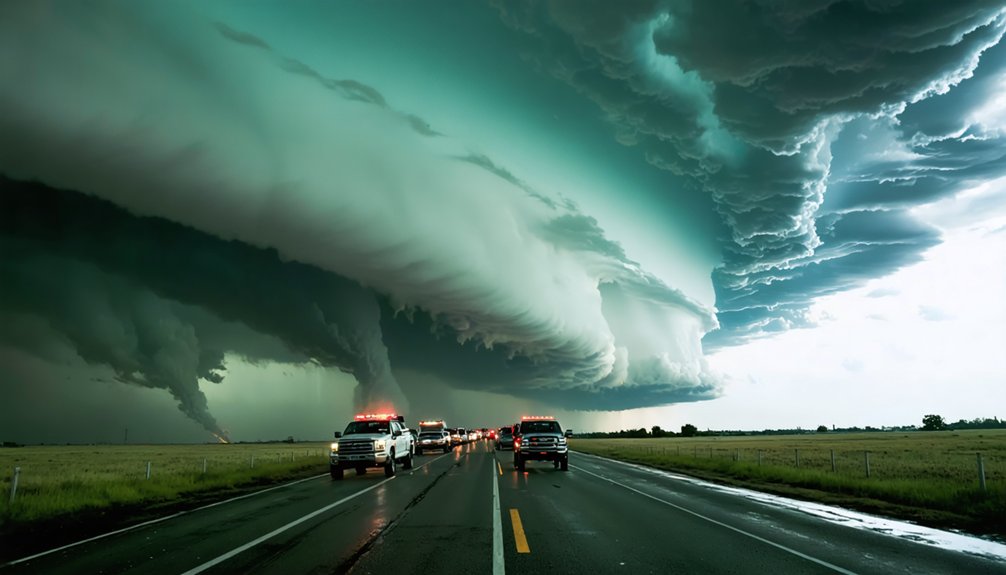
Managing 15+ chasers across a rapidly shifting kill zone required real-time radio coordination, GPS tracking, and split-second decision-making that went far beyond standard chase protocols.
You’re looking at a scenario where coordination strategies weren’t optional — they were survival-critical.
Teams split into designated intercept zones, each assigned specific quadrants to avoid vehicle clustering near the tornado’s erratic path. Communication techniques relied heavily on dedicated radio frequencies, preventing cross-chatter that could delay critical position updates.
GPS telemetry let team leads monitor every unit simultaneously, adjusting positioning as El Reno’s track shifted unpredictably.
You’d also see real-time data feeds integrated directly into chase vehicles, giving each driver independent situational awareness.
This decentralized yet synchronized approach kept 15+ professionals operational without compromising individual escape routes when the tornado expanded beyond all projected parameters.
The Footage Quality That Set These Streams Apart From the Rest
When you look at what separated these streams from amateur footage, the answer comes down to two factors: high-definition capture technology and real-time transmission quality.
The 2013 El Reno event and the 2007 tornado intercepts both delivered HD footage that let viewers identify structural details within the storm’s rotation as it happened.
You’re seeing the direct result of chasers investing in broadcast-grade equipment capable of maintaining stable, low-latency streams under extreme field conditions.
High-Definition Storm Footage
What truly set these storm-chasing streams apart was the shift to high-definition footage, most notably captured during the 2013 El Reno event.
You’re watching storm footage that delivers razor-sharp clarity, letting you analyze every rotation and debris field in real time. These high definition visuals redefined what independent chasers could broadcast without network backing.
- Swirling wall clouds rendered in crisp detail, revealing internal structure invisible to standard-definition cameras
- Multiple wedge formations tracked simultaneously across open Oklahoma terrain, with 15+ chasers feeding live HD angles
- Ground-level debris fields captured frame-by-frame, exposing violent surface interactions previously lost in low-resolution feeds
This wasn’t just better video — it was actionable data you could interpret yourself, free from filtered, delayed broadcast versions.
Real-Time Streaming Quality
Real-time streaming during the 2013 El Reno event pushed independent broadcast capabilities to a threshold that network coverage couldn’t match — you’re getting unfiltered, zero-delay feeds sourced from 15+ simultaneous chasers, each transmitting live data as the tornado evolved.
Streaming challenges were significant: bandwidth compression, signal dropout risks, and multi-feed synchronization all threatened transmission integrity. Yet independent operators maintained consistent high-definition output where institutional networks failed.
Viewer engagement spiked precisely because you controlled your feed selection — switching between chaser perspectives in real-time rather than accepting a single curated broadcast angle.
The 2007 event demonstrated earlier iterations of this capability with 12 chasers transmitting simultaneously, establishing foundational protocols that El Reno later refined.
Raw, decentralized streaming delivers situational accuracy that polished network production structurally can’t replicate.
Real Moments Where Chasers Nearly Lost Their Lives on Camera
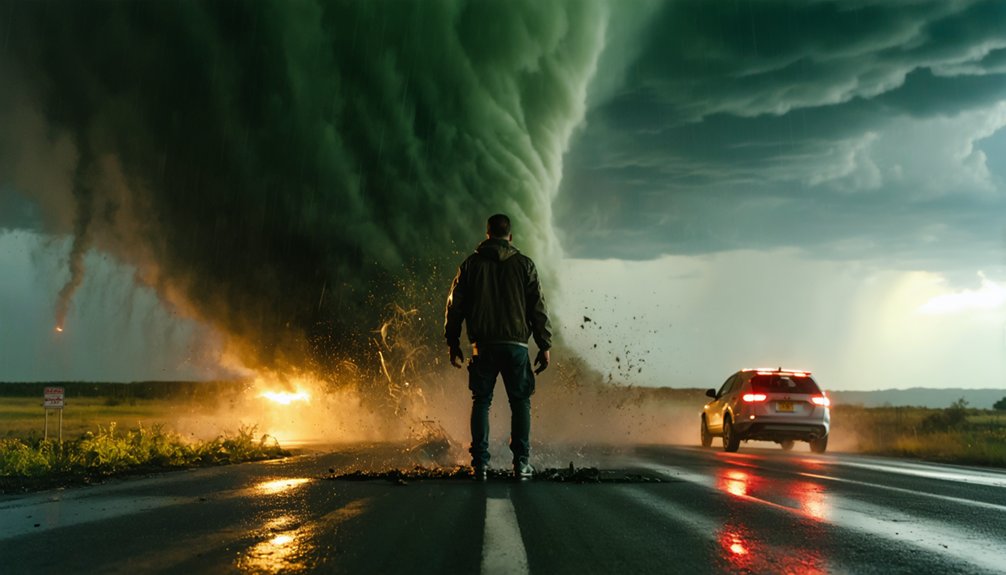
The 2013 El Reno event stands as the most statistically dangerous chase on record, with 15+ chasers operating within the tornado’s erratic, rain-wrapped circulation as it expanded to 2.6 miles wide in under minutes.
You can watch footage from that day and pinpoint the exact frames where seasoned veterans like Tim Samaras lost positional control, a lapse that cost three chasers their lives.
These on-camera survival moments aren’t dramatic embellishments — they’re precise, timestamped records of human error margins measured in seconds.
Near-Death Chase Encounters
Among the most harrowing documented encounters, the 2013 El Reno tornado stands out as a near-fatal event for multiple chasers, with 15+ teams recording live footage as the tornado rapidly expanded to record-breaking width.
These near miss encounters pushed chasers into survival mode, delivering unfiltered adrenaline rushes captured frame-by-frame.
You’re watching real-time decisions unfold under catastrophic pressure:
- Visibility dropped to near-zero as the 2.6-mile-wide vortex shifted unpredictably, trapping vehicles in its path.
- Multiple chase vehicles were overtaken, with teams abandoning equipment to escape rapidly changing debris fields.
- Live streams cut abruptly, documenting the exact moment chasers lost positional control against the storm’s erratic movement.
Three professional chasers died that day, making this footage both historically significant and devastatingly sobering.
On-Camera Survival Moments
When cameras kept rolling, chasers delivered some of storm chasing’s most visceral survival data. The 2013 El Reno event stands as the critical benchmark — 15+ chasers documented real-time escape maneuvers as the tornado rapidly expanded to 2.6 miles wide.
You’re watching raw storm safety protocols execute under maximum pressure.
These on-camera survival moments aren’t entertainment artifacts — they’re technical records exposing critical chaser ethics violations and life-preserving decisions simultaneously.
Multiple teams captured near-engulfment scenarios, providing measurable data on escape timing, vehicle positioning, and route miscalculations.
What these recordings reveal is precise: your margin between documentation and disaster collapses within seconds.
The 2013 footage permanently redefined proximity standards, forcing the chasing community to recalibrate ethical boundaries between data collection and reckless endangerment.
Dangerous Tornado Close Calls
Few moments in storm chasing history carry the raw technical weight of a near-fatal close call captured on live footage.
During the 2013 El Reno event, 15+ chasers faced a rapidly expanding wedge tornado, where chase tactics failed in real-time as the storm shifted unpredictably.
You’re watching raw tornado adrenaline translate directly into split-second repositioning decisions.
- Dashcam footage shows vehicles accelerating laterally at 70+ mph as the El Reno tornado’s multiple vortices rotate outward unexpectedly.
- Live stream feeds capture chasers broadcasting their own evacuation maneuvers, microphones picking up urgent directional calls.
- Real-time GPS data overlaid on footage reveals dangerously shrinking escape corridors within seconds.
These documented moments aren’t entertainment — they’re critical data points proving how fast controlled situations collapse.
How Live Streaming Technology Transformed What Viewers Could See
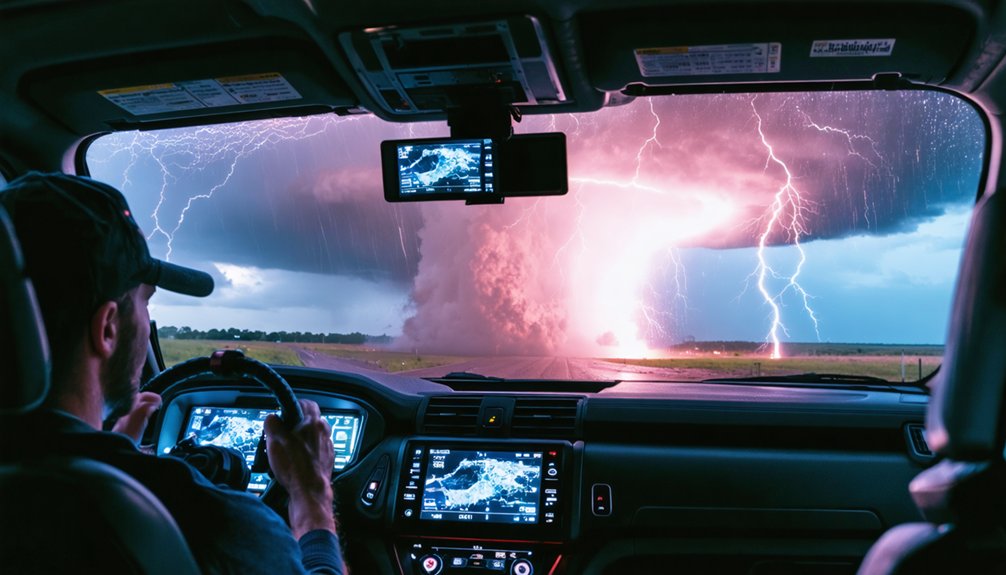
Live streaming technology fundamentally changed storm chasing coverage, putting you directly inside real-time tornado intercepts rather than waiting for edited broadcast replays.
Live streaming advancements eliminated the traditional broadcast delay, delivering raw, unfiltered footage the moment chasers encountered rotating supercells.
Before these technical breakthroughs, networks controlled what you saw and when.
Now, viewer engagement shifted power to you, letting you choose your preferred chaser’s perspective during simultaneous multi-team events like the 2013 El Reno tornado, where 15+ chasers broadcast concurrently in high-definition.
The 2007 tornado events demonstrated early proof-of-concept, with 12 chasers streaming live data feeds directly to audiences.
You gained access to real-time GPS positioning, Doppler radar overlays, and atmospheric pressure readings — technical metrics previously restricted to meteorological research teams.
What the Greatest Storm Chasing Streams Got Right That Others Didn’t?
The greatest storm chasing streams separated themselves through one measurable factor: technical redundancy paired with situational awareness.
You’ll notice that the 2013 El Reno event, covered by 15+ chasers, delivered uninterrupted footage precisely because teams ran backup transmission systems. Streaming impact was maximized when operators pre-positioned equipment and maintained clear exit routes simultaneously.
What separated elite streams from failed ones:
- Multi-angle positioning — teams triangulated vantage points, giving viewers dimensional storm perspective without sacrificing chaser safety
- Redundant uplink systems — backup satellite connections prevented feed drops during peak atmospheric interference
- Real-time communication protocols — coordinated radio channels kept 15+ operators informed of tornado track shifts instantly
You get freedom-defining footage when technical discipline meets field intelligence.
Anything less produces gaps, static, and preventable risk.
How Modern Chasers Are Raising the Bar on Live Tornado Coverage?
Modern chasers aren’t just matching the benchmark set by events like the 2013 El Reno coverage — they’re surpassing it through direct integration of 4K encoding hardware, cellular-bonded uplinks, and drone-assisted aerial positioning.
You’re now watching teams execute real-time analysis mid-intercept, pushing live radar overlays directly into streams while maintaining strict safety protocols.
Chaser collaboration has transformed isolated pursuits into coordinated data-sharing networks, feeding meteorological institutions simultaneously.
Coordinated chaser networks have replaced solo pursuits, delivering real-time data streams directly to meteorological institutions worldwide.
Advanced technology enables viewer engagement beyond passive observation — you’re accessing multi-angle feeds, live atmospheric readings, and crowd-sourced storm reports.
Community impact extends further through educational outreach programs that convert raw footage into structured learning modules.
These aren’t hobbyists chasing adrenaline; they’re precision operators redefining what independent, freedom-driven storm science delivers to both science and the public.
Frequently Asked Questions
What Equipment Do Storm Chasers Typically Use for Live Streaming Today?
You’ll typically use 4K cameras, cellular bonding devices, satellite uplinks, and ruggedized laptops for live streaming. You’re combining multiple LTE networks for storm tracking reliability, ensuring you’ve got redundant connections when extreme weather disrupts standard communications.
How Do Storm Chasers Obtain Funding for Their Chasing Expeditions?
Like fuel powering a chase vehicle, you’ll fund expeditions through crowdfunding strategies on platforms like Patreon, securing sponsorship opportunities from weather tech companies, and monetizing live streams—converting viewer engagement directly into operational capital.
What Weather Conditions Must Exist Before a Tornado Chase Begins?
Before you chase, you’ll need specific conditions: atmospheric instability, wind shear, and moisture convergence driving tornado formation. Monitor storm prediction data for CAPE values exceeding 2,500 J/kg and confirm rotating supercell development before deploying.
Are Storm Chasers Required to Hold Any Special Licenses or Certifications?
Here’s the ball game — you don’t need special licenses for storm chasing. No federal storm chasing regulations mandate certifications, but you’re expected to follow safety protocols, respecting road laws and emergency management guidelines.
How Do Chasers Communicate Tornado Data to Official Meteorological Agencies?
You’ll report tornado detection data directly to the National Weather Service via radio, mobile apps like SpotterNetwork, or phone. Your real-time observations boost data reliability, helping meteorologists issue faster, more accurate warnings to protect communities.
References
- https://www.youtube.com/watch?v=E4f1BenJqjo
- https://www.youtube.com/watch?v=1NemKSzkOkQ
- https://www.youtube.com/watch?v=dX9C_3OpZWA
- https://www.youtube.com/watch?v=XwQvpeZXgNU
- https://www.reddit.com/r/tornado/comments/1ck3riz/who_are_your_favorite_chasers_on_youtube_for/
- https://www.youtube.com/watch?v=EI4aPNCz2xE
- https://www.youtube.com/watch?v=BjBFEB3UtjY
- https://www.youtube.com/watch?v=Sc5Fb4yEBLs
- https://www.youtube.com/watch?v=mn7gIVaz8U4
- https://www.facebook.com/reedtimmer2.0/videos/the-most-insane-live-storm-chasing-moments-of-2023-ag1tornado-stormchasing-weath/296137523247092/