Effective storm chaser emergency response requires seven critical strategies: building a thorough emergency kit, keeping your vehicle deployment-ready, mastering real-time radar without sacrificing situational awareness, pre-planning perpendicular escape routes, coordinating with local authorities before deployment, applying field first aid when professional responders can’t reach victims, and submitting accurate, structured damage reports post-event. Each strategy directly impacts your survival and operational effectiveness in the field. The details behind executing each one correctly make all the difference.
Key Takeaways
- Pack emergency kits with first aid supplies, water, communication tools, GPS equipment, and weather gear before deploying into the field.
- Pre-plan at least two perpendicular escape routes, avoiding flood-prone roads, and keep your vehicle positioned for immediate departure.
- Alternate between real-time radar monitoring and direct environmental observation to maintain accurate situational awareness during storm pursuit.
- Submit structured reports with precise timestamps, GPS coordinates, and damage classifications immediately to local emergency management agencies.
- Deploy drones after storm clearance to capture aerial footage, cross-referencing imagery with satellite data to identify unaccessed damage areas.
Build Your Emergency Kit Before You Chase
Before you chase a single storm, you’ve got to assemble an emergency kit that covers your core survival and operational needs. Pack first aid supplies, food, water purification tools, and a portable weather radio as your baseline.
Add flashlights, extra batteries, blankets, and weather gear appropriate for the operational environment you’re entering.
Don’t overlook communication tools — they’re non-negotiable. A reliable two-way radio or satellite communicator keeps you connected when cell networks fail.
Pair that with GPS navigation equipment to execute escape routes under pressure.
Keep your vehicle fueled with a full tank and carry extra fuel for extended deployments.
Every item in your kit should serve a specific function. Redundancy in critical systems isn’t excess — it’s operational discipline.
Keep Your Vehicle Ready for Rapid Deployment
When conditions escalate, your vehicle has to perform without hesitation. Consistent vehicle maintenance isn’t optional—it’s operational discipline. Inspect tires, brakes, fluids, and electrical systems before every deployment. A mechanical failure in the field eliminates your escape options entirely.
Fuel management is equally critical. Keep your tank full before positioning near any storm structure, and carry approved extra fuel for extended operations in remote areas. You can’t predict when roads will close or how far your escape route will take you.
Store your GPS unit, emergency kit, and communications gear in fixed, accessible locations inside the vehicle. Every second you spend searching for equipment is a second you’re not moving.
Your vehicle isn’t just transportation—it’s your primary safety platform.
Master Real-Time Radar Without Losing Situational Awareness
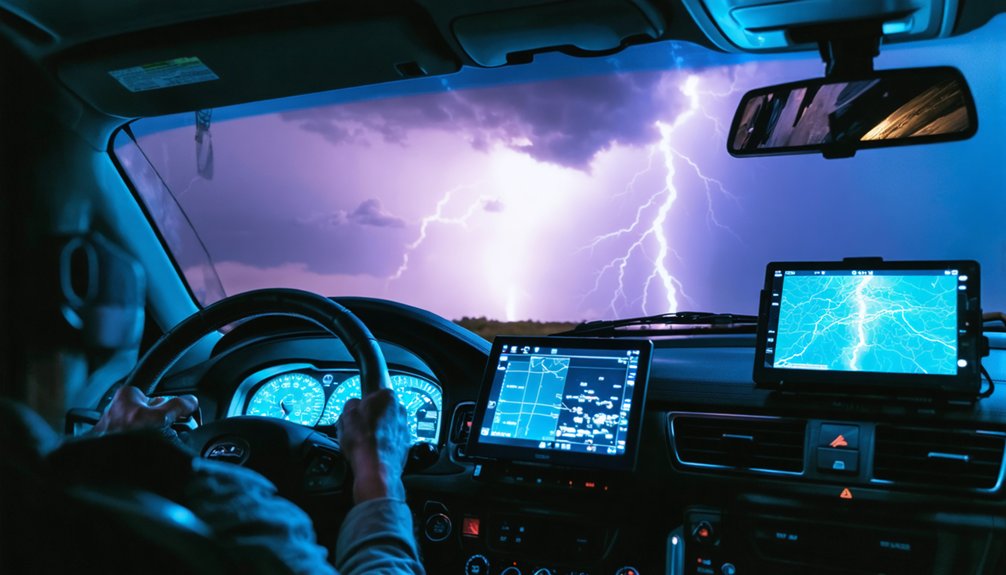
Real-time radar is your most critical decision-making tool in the field, but fixating on it will get you killed.
Radar integration means pulling data into your awareness, not burying your eyes in a screen. You need situational adaptability to cross-reference what the radar shows with what’s physically happening around you.
Radar is a tool, not a crutch—awareness lives in the space between the screen and your surroundings.
Follow these three discipline rules:
- Glance at radar, then scan your environment—alternate deliberately and consistently.
- Use real-time radar imagery over delayed weather apps for accurate storm-path positioning.
- Trust visual cues when radar and observed conditions diverge; adjust your position immediately.
Your environment changes faster than any refresh cycle. Staying locked to a screen eliminates your ability to identify incoming debris, shifting storm motion, or compromised escape routes before they become fatal mistakes.
Plan Escape Routes Before You Get Close
Every approach to a storm structure demands a pre-planned exit strategy before you close distance. Escape route planning isn’t optional—it’s foundational to storm approach safety.
Study road grids before you move in, identifying at least two viable exit paths that run perpendicular to the storm’s track. Rapid storm movement can cut off a single route within minutes.
Account for road-grid limitations in rural areas where paved options are sparse. Avoid low-lying roads susceptible to flooding and corridors where debris accumulation becomes likely.
Keep your vehicle positioned for immediate departure, never letting terrain or traffic box you in. Maintain visibility of the storm’s forward motion continuously.
If your exit windows start closing, retreat immediately—no data point justifies sacrificing your ability to move freely.
Coordinate With Local Authorities Before You Deploy
Locking down your escape routes addresses your personal mobility, but storm chasing doesn’t operate in isolation—local authorities need to know you’re in their jurisdiction before you deploy.
Local authority communication isn’t optional; it’s operationally critical. Emergency protocol alignment guarantees you’re not working against active response efforts.
Before you deploy, complete these three steps:
- Contact the local emergency management office and provide your planned operational area and timeline.
- Establish a shared communication channel so responders can push real-time updates directly to you.
- Confirm joint protocols covering how you’ll report observed conditions and when to clear the area.
You’re an asset in the field—but only if authorities know where you’re and what you’re doing.
Apply First Aid Skills When Responders Can’t Reach You
When professional responders can’t reach you, your first aid kit becomes your most critical piece of equipment—stock it with tourniquets, hemostatic gauze, splints, trauma bandages, and airway management tools.
You’ll need to assess and stabilize injuries quickly, prioritizing life-threatening hemorrhage control and airway management before addressing secondary trauma.
Train on these skills before you deploy, because a severe weather scenario isn’t the place to read instructions for the first time.
Essential First Aid Supplies
Storm chasers often operate in remote or disaster-struck areas where professional emergency responders can’t reach you quickly, making first aid competency a non-negotiable operational requirement.
Your first aid kits must contain essential supplies supporting immediate injury management and emergency preparedness.
Prioritize these three critical categories:
- Wound care: Sterile gauze, bandages, antiseptic wipes, and tourniquets for hemorrhage control.
- Immobilization tools: Splints and trauma wraps enabling injury assessment and stabilization of fractures.
- Medical support items: Nitrile gloves, CPR masks, and emergency blankets as core safety equipment.
Solid medical training guarantees you’ll execute treatment techniques correctly under pressure.
Without proper training, even well-stocked first aid kits lose effectiveness.
Invest in certified courses and practice regularly—your operational independence depends on it.
Managing Injuries Before Help
Severe injuries in the field demand immediate, competent response—because professional help often can’t reach you for critical minutes or longer.
Your injury assessment begins with a rapid head-to-toe scan: identify life-threatening bleeding, airway compromise, or suspected spinal trauma first.
Apply triage techniques to prioritize care when multiple casualties exist—address the most critical survivable injuries before minor ones.
Control hemorrhaging with direct pressure or tourniquets. Stabilize fractures using available materials.
Keep airway-compromised individuals positioned to prevent aspiration. Document observed conditions, injury type, and time of intervention—this data supports incoming responders and improves handoff accuracy.
You’re operating in a high-risk environment where self-reliance isn’t optional.
Continuous first aid training guarantees you execute these procedures confidently under pressure, without hesitation.
Report Storm Damage Accurately After the Event
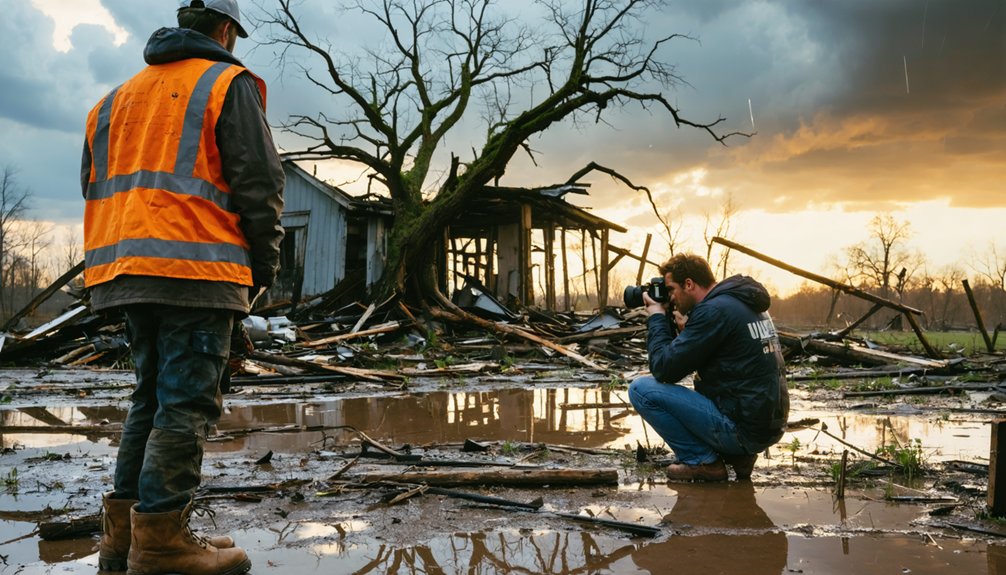
Once the storm passes, you’ll need to coordinate directly with emergency management teams to guarantee your observations align with official situational reports.
Share your time-stamped data, precise GPS coordinates, and field notes promptly, as this information directly supports accurate damage classification and resource deployment decisions.
You can also leverage drone overflights and satellite imagery to rapidly assess impact zones, giving responders an extensive picture of structural damage and debris distribution across affected areas.
Coordinating With Emergency Teams
After a storm passes, coordinating with emergency teams isn’t just a courtesy—it’s a critical operational step that directly influences how quickly responders can allocate resources and reach affected areas.
Your communication strategies and adherence to emergency protocols determine how actionable your field data becomes.
Follow these steps to coordinate effectively:
- Submit structured reports including precise timestamps, GPS coordinates, and observed damage classifications to local emergency management agencies immediately.
- Use designated communication channels specified in joint emergency protocols to avoid overwhelming responders with fragmented information.
- Cross-reference your damage assessments with official responders to confirm accuracy before data enters formal reporting systems.
Your independence in the field means nothing if your intelligence doesn’t translate into coordinated action.
Precise, timely coordination transforms raw storm data into life-saving operational decisions.
Leveraging Drones And Satellites
Drones and satellite imaging give you a decisive edge when evaluating post-storm damage across terrain that’s inaccessible or unsafe for ground teams. Deploy drone technology immediately after a storm clears to capture high-resolution aerial footage of impact zones, structural failures, and debris fields.
Cross-reference that footage with satellite imagery to map broader damage corridors and identify areas emergency responders haven’t yet reached.
Organize your data by location, timestamp, and damage severity before transmitting it to official weather services and emergency coordination teams. Structured reporting accelerates their situational understanding and improves resource deployment decisions.
Avoid submitting raw, unorganized files—clean, labeled data gets used faster. When you’re operating independently in the field, your drone and satellite data can fill critical intelligence gaps that ground-level responders simply can’t access.
Frequently Asked Questions
How Do Storm Chasers Handle Mental Health After Traumatic Emergency Response Events?
After traumatic events, you’ll need to prioritize trauma recovery through peer debriefings, professional counseling, and structured rest periods. Building emotional resilience requires you to actively process experiences, maintain support networks, and establish clear psychological boundaries between operations.
What Legal Liabilities Can Storm Chasers Face During Emergency Response Operations?
Legal liability’s a minefield you’re managing—document all actions, secure proper insurance coverage, and address liability concerns by following established safety protocols, coordinating with authorities, and ensuring your operations don’t obstruct official emergency response efforts.
How Do Storm Chasers Fund Their Emergency Response Equipment and Operations?
You’ll typically secure funding through crowdfunding campaigns, sponsorship opportunities, and grants. Pursue partnerships with weather technology companies, media outlets, and research institutions to cover vehicle readiness, emergency kits, and advanced forecasting equipment costs effectively.
Can Storm Chasers Legally Enter Restricted Disaster Zones After a Tornado?
You can’t freely roam restricted access zones without facing legal implications. You must respect emergency protocols, complete a thorough risk assessment, and coordinate with authorities to gain proper clearance before entering sensitive post-tornado areas.
How Do Storm Chasers Manage Fatigue During Multi-Day Severe Weather Deployments?
You’ll manage fatigue management through scheduled rest rotations, limiting shifts to maintain alertness. Prioritize sleep strategies like power naps between deployments, stay hydrated, and use continuous hands-on training to build the operational discipline that keeps you mission-ready.
References
- https://crazystormchasers.com/storm-chaser-emergency-response-coverage/
- https://www.youtube.com/watch?v=nxPSFg2R8YY
- https://www.livingskytours.com/storm-chasing-101/
- https://www.nytimes.com/wirecutter/reviews/tornado-preparedness-supplies-strategies/
- https://www.facebook.com/groups/327727507385830/posts/2961680903990464/
- https://www.facebook.com/FoxWeather/posts/so-you-wanna-be-storm-chaser-heres-some-tips-from-some-pros-who-have-been-chasin/404684264855640/
- https://www.reddit.com/r/stormchasing/comments/358qne/im_wanting_to_get_into_storm_chasing_what_should/
- http://www.osha.gov/tornado/preparedness
- https://www.rd.com/article/how-to-survive-a-hurricane/
- https://stormtrack.org/threads/what-are-some-short-term-chase-strategies.2665/