To stay safe around waterspouts, you’ll need to act fast and stay informed. Identify them early by watching for dark ring patterns on the water and funnel clouds forming under cumulus towers. Know the difference between fair-weather spouts (winds under 80 km/h) and tornadic spouts (exceeding 320 km/h). Keep a weather radio on board, wear life jackets, and steer perpendicular to the spout’s path immediately. The tips ahead cover every critical scenario in detail.
Key Takeaways
- Immediately return to shore or move inland at a 90-degree angle to the waterspout’s path without pausing to assess speed or direction.
- Distinguish between fair-weather waterspouts with winds under 80 km/h and dangerous tornadic waterspouts exceeding 320 km/h by observing cloud conditions.
- Reduce sail area, wear life jackets, and keep engines ready to maintain maneuverability and minimize exposure risk.
- Contact the coast guard via marine radio with your exact position and the waterspout’s location as soon as possible.
- After a waterspout dissipates, remain alert for residual debris, wave surges, and rapid development of new storms within the same system.
How to Spot a Waterspout Before It Reaches You
Spotting a waterspout early can be the difference between a safe retreat and a dangerous encounter.
You’ll want to monitor contrasting conditions first: cooler air temperatures combined with warmer water temperature create ideal formation conditions.
Scan the surface for dark spots or ring patterns, which signal rotating water below.
Dark spots and ring patterns on the water’s surface are nature’s warning—rotating chaos building from below.
Watch cloud patterns overhead for towering cumulus formations, indicating atmospheric instability.
A developing funnel or tube cloud bridging the water and cloud base confirms active formation.
Spiral patterns on the surface often precede full vortex development by several minutes, giving you a critical response window.
Train yourself to recognize these sequential indicators systematically.
Early detection isn’t luck—it’s disciplined observation.
The moment you identify these signs, you’re already positioned to act decisively and protect your freedom of movement.
Fair-Weather vs. Tornadic Waterspouts: Why the Difference Matters
When you’re out on the water, you need to know that fair-weather waterspouts form over warm water under cumulus clouds with weak vorticity, while tornadic waterspouts are extensions of supercell thunderstorms carrying wind speeds exceeding 160 km/h.
The danger gap between the two is significant — fair-weather spouts are short-lived and relatively weak, but tornadic variants can capsize vessels and cause fatalities.
You can spot the difference by watching the cloud base: a dark, rotating wall cloud signals a tornadic threat, while a clear or lightly overcast sky with a visible funnel descending toward calm water typically indicates a fair-weather spout.
Defining Each Waterspout Type
Although both share a similar visual appearance, fair-weather and tornadic waterspouts differ fundamentally in origin, intensity, and the threat they pose.
Fair-weather waterspouts develop upward from the water’s surface, driven by localized thermal instability and light wind shear. Their waterspout formation typically occurs under cumulus clouds in warm coastal waters, producing weaker vortices with wind speeds rarely exceeding 80 km/h.
Tornadic waterspouts, by contrast, descend downward from supercell or severe thunderstorm systems. They’re extensions of land-based tornadoes crossing water, carrying considerably greater destructive force and unpredictable movement.
Environmental impacts from tornadic variants include structural damage, dangerous debris projection, and life-threatening wave disruption.
You need to identify which type you’re facing, because your response strategy depends entirely on accurately distinguishing between these two fundamentally different atmospheric phenomena.
Key Danger Level Differences
Knowing the type isn’t enough — you also need to understand the measurable gap in destructive potential between the two. Fair-weather waterspouts typically generate wind speeds between 50–80 km/h, while tornadic waterspouts can exceed 320 km/h.
That’s not a marginal difference — it’s the gap between minor debris scatter and structural demolition.
Tornadic waterspouts maintain organized, persistent rotation and can travel inland, threatening populated areas. Fair-weather variants dissipate faster but still pose real risks to vessels without proper safety equipment.
Understanding waterspout behavior directly shapes your response window. A tornadic system demands immediate evacuation; a fair-weather spout still requires distance and vigilance.
Your freedom to act decisively depends on correctly reading which threat you’re actually facing before conditions escalate.
Spotting Them While Boating
Spotting a waterspout from a vessel gives you a narrow response window — one that shrinks fast if you misidentify what you’re looking at.
Watch for dark surface rings, spiral disk patterns, and developing funnel columns between cloud base and water. Fair-weather types form base-up; tornadic ones descend rapidly from mesocyclones. That distinction drives your boating techniques entirely.
A fair-weather spout may allow a controlled 90-degree course correction with reduced sail area. A tornadic spout demands immediate evasive action and full safety equipment deployment — life jackets on, hatches secured, engine engaged.
Monitor marine radio continuously; visual confirmation alone isn’t sufficient. Your identification accuracy directly determines whether you’re executing a measured maneuver or an emergency response. Don’t confuse the two.
Keep a Weather Radio on Board at All Times
Keeping a weather radio on board is one of the most critical safety measures you can take when traversing open water near waterspout-prone conditions.
Emergency preparedness demands real-time meteorological data, and a weather radio delivers exactly that.
Prioritize these three protocols:
- Monitor continuously — Tune your weather radio to NOAA frequencies, receiving updated alerts before conditions deteriorate.
- Report immediately — Contact the port authority or coast guard the moment you spot a waterspout, transmitting precise coordinates.
- Stay informed post-storm — Continue monitoring broadcasts after the event passes, confirming safe navigation windows.
Your freedom on open water depends on actionable intelligence, not assumptions.
Your survival on open water is earned through real-time data, decisive action, and zero tolerance for guesswork.
A weather radio transforms raw atmospheric data into decisive action, keeping you ahead of rapidly evolving threats rather than reacting dangerously after the fact.
How to Build a Waterspout Safety Plan Before You Head Out
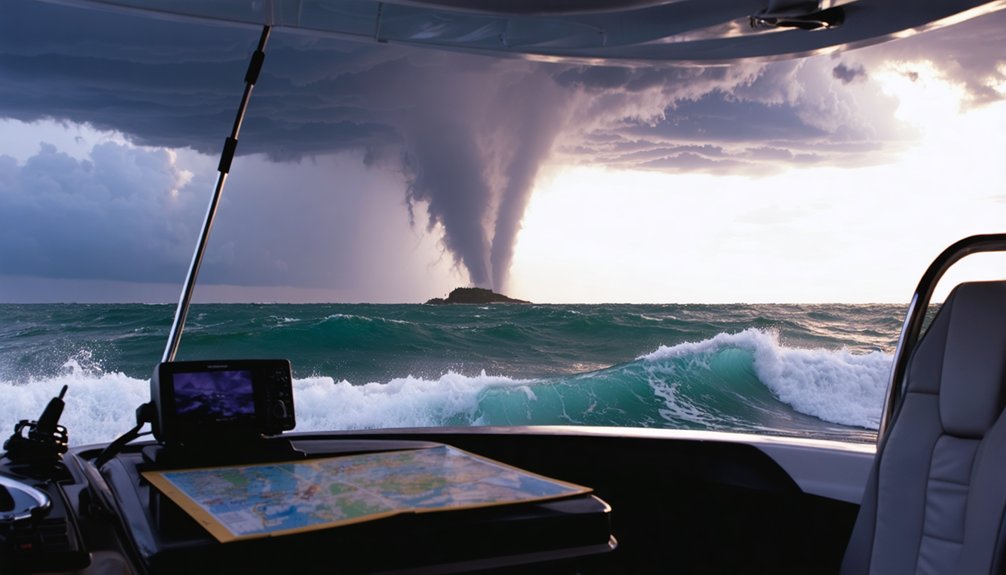
Before you leave the dock, you need a structured waterspout safety plan that converts preparedness into measurable, executable steps. Dismiss waterspout myths immediately — these vortices aren’t harmless spectacles. They generate destructive wind velocities and unpredictable trajectory shifts.
Build your plan around three executable priorities.
First, verify all safety equipment: life jackets, marine radio, first aid kit, and secured hatches.
Second, establish a designated escape vector — a 90-degree course away from any observed spout.
Third, assign crew roles for rapid sail reduction and engine readiness.
Before departure, check marine weather forecasts and identify atmospheric instability indicators: towering cumulus clouds and temperature differentials between air and water.
Document your float plan with port authority. Preparation isn’t optional — it’s your primary defense mechanism against waterspout encounters.
Get Off the Water the Moment You See One
The instant you spot a waterspout, you must return to shore immediately — no hesitation, no second-guessing.
Waterspouts can travel at speeds exceeding 40 mph and shift direction without warning, making your position on the water unpredictably dangerous within seconds.
Every moment you delay compounds your exposure to a vortex that can capsize vessels, generate lethal debris, and outpace standard recreational boat speeds.
Prioritize Immediate Shore Return
When a waterspout forms, your safest move is to head to shore immediately—don’t wait to assess its trajectory or speed. Water spout identification gives you the critical seconds needed to act decisively.
Maintaining safe distance isn’t optional—it’s survival strategy.
Follow these priorities:
- Steer perpendicular to the waterspout’s path, maximizing your escape angle and minimizing exposure time.
- Reduce sail area immediately, cutting wind resistance and keeping your vessel fully maneuverable under engine power.
- Notify the coast guard via marine radio, reporting your position and the spout’s approximate location.
Waterspouts can shift direction unpredictably and travel at speeds exceeding 40 mph.
Every second you spend observing instead of moving compounds your risk. Get to shore—your freedom depends on making smart, rapid decisions under pressure.
Waterspouts Move Unpredictably Fast
Waterspouts can accelerate to speeds exceeding 40 mph and shift direction with little to no warning, giving you a dangerously narrow response window once one forms.
Water spout behavior is erratic — tracking algorithms and visual cues both fail to reliably predict trajectory changes. You can’t outrun one by waiting to assess its path.
The moment you spot one, change your vessel’s course immediately at a 90-degree angle to the spout’s apparent movement.
Confirm your safety equipment — life jackets, marine radio, and emergency kit — is immediately accessible before conditions deteriorate.
Reduce sail area instantly to maintain maneuverability.
Contact the coast guard via marine radio to report your position and the spout’s location.
Every second you delay narrows your margin for a controlled, safe response.
Delay Increases Serious Danger
Every second you hesitate after spotting a waterspout compounds your exposure to a rapidly escalating threat.
Waterspout myths and safety misconceptions convince people they’ve got time to watch, photograph, or assess. You don’t. Immediate evacuation is non-negotiable.
Execute these three actions without delay:
- Exit the water perpendicularly — move at a 90-degree angle to the spout’s trajectory, maximizing your escape distance efficiently.
- Abandon open shoreline areas — beach pavilions offer zero structural protection; locate a solid inland building immediately.
- Report your sighting — contact coast guard or port authority via marine radio to protect others still exposed.
Dismissing urgency kills. Your freedom depends on disciplined, rapid decision-making — not curiosity.
Get moving the moment you spot one.
Which Direction Should You Travel to Avoid a Waterspout?
Knowing which direction to travel can mean the difference between safety and serious danger when a waterspout appears near your vessel or shoreline. Move perpendicular — at a 90-degree angle — to the waterspout’s tracked path.
Waterspout tracking confirms these vortices follow relatively predictable trajectories, making angular escape your most effective strategy.
On water, immediately alter your vessel’s course to a right angle from the spout’s direction, reduce sail area, and engage your engine to maximize maneuverability.
On shore, evacuate inland perpendicular to the spout’s movement path.
Never travel parallel to the waterspout’s direction, as this keeps you dangerously within its potential strike zone.
Transmit emergency signals to alert nearby vessels and coast guard authorities, then continue moving until you’ve created several kilometers of separation.
What to Do If You Can’t Outrun a Waterspout on a Boat?
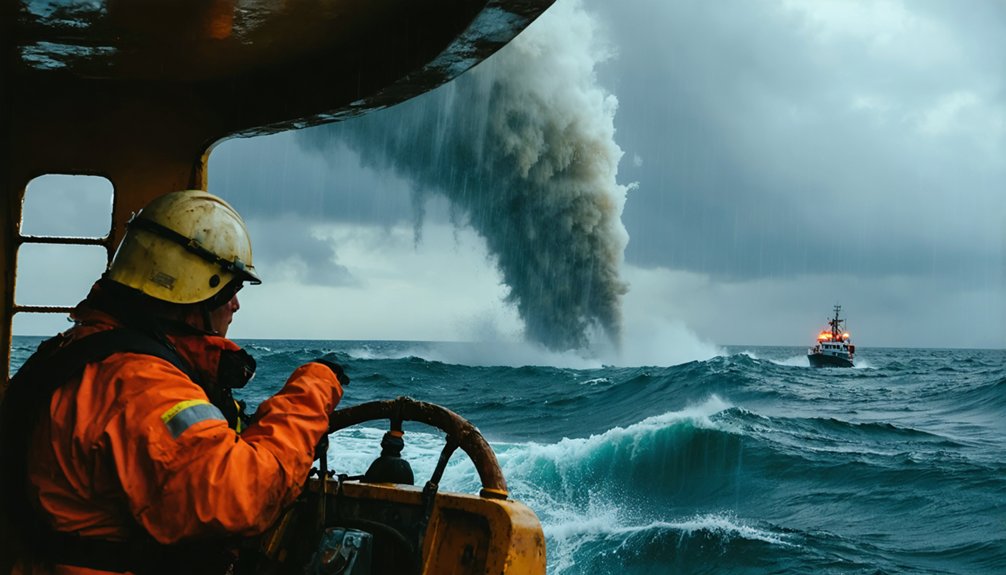
When outrunning a waterspout isn’t possible, you’ll need to shift focus from evasion to onboard protection. Boat safety demands immediate, decisive action to minimize structural and personal risk.
When escape fails, survival demands instant action — protect your vessel and crew before the storm decides for you.
Execute these critical steps:
- Reduce sail area immediately — take down sails or reef them tight to decrease wind resistance and vortex exposure.
- Secure all personnel — make sure everyone wears life jackets and moves to protected interior areas away from open deck exposure.
- Maintain engine readiness — keep the engine operational to sustain maneuverability and controlled positioning.
Weather awareness remains your strongest asset throughout this process. Continuously monitor marine radio for updated trajectory data.
Fasten loose equipment, close hatches, and brace for impact. Your disciplined response directly determines survivability when escape isn’t an option.
How Waterspouts Near Coastlines Threaten Swimmers and Beachgoers
Waterspouts near coastlines pose direct, measurable threats to swimmers and beachgoers through high-velocity wind rotation, water displacement, and airborne debris. Wind speeds can reach 80 mph, generating wave surges that disorient swimmers and compromise beach awareness within seconds.
You must recognize dark ring patterns on the water surface and funnel cloud formations as immediate evacuation triggers. Don’t underestimate the spout’s translational speed—some move at 10–15 knots toward shore.
Swimmer safety depends entirely on your response time. Exit the water immediately, move perpendicular to the spout’s tracked path, and seek a reinforced structure inland. Beach pavilions offer zero structural protection against debris impact.
Monitor marine radio frequencies continuously; reported sightings from vessels offshore give you critical lead time before coastal contact.
How to Stay Safe on Shore During a Waterspout
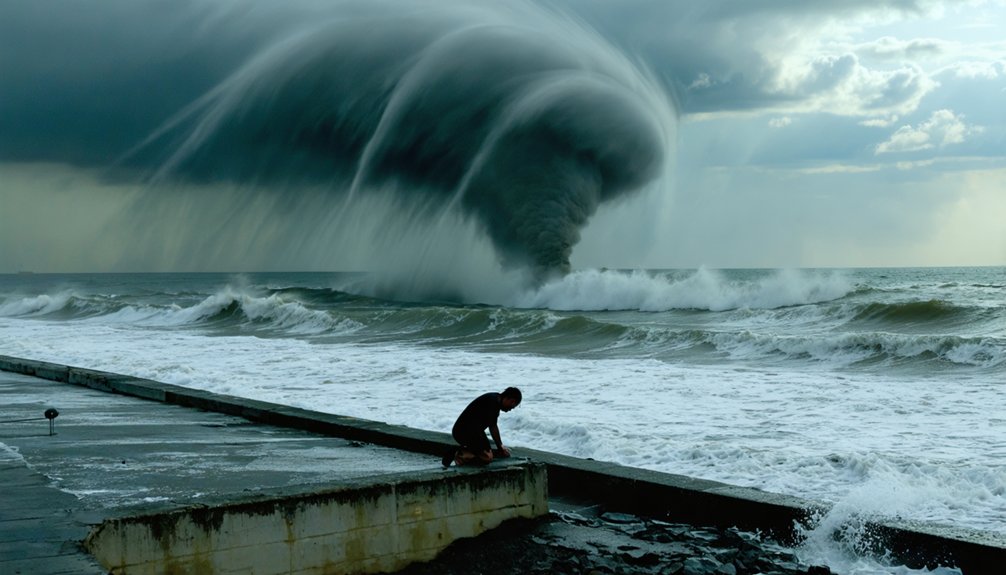
When a waterspout forms near shore, you’ll need to monitor marine radio broadcasts and weather alerts continuously for real-time updates on the spout’s trajectory and speed.
Move inland immediately at a 90-degree angle to the waterspout’s path, prioritizing sturdy buildings with interior rooms over open beach structures.
Don’t linger on the shoreline—exposure to wind-driven debris and potential spout landfall dramatically increases your injury risk.
Monitor Weather Alerts
Staying safe on shore during a waterspout starts with actively monitoring weather alerts before and during coastal activities. Tracking weather patterns and water temperature fluctuations gives you critical lead time to act decisively.
Use these three monitoring strategies:
- Tune into marine radio frequencies continuously for real-time National Weather Service updates specific to coastal zones.
- Track water temperature differentials — warmer water paired with cooler air creates prime waterspout conditions, signaling elevated risk.
- Download weather applications that provide hyperlocal storm alerts, radar imagery, and severe weather notifications directly to your device.
Don’t rely on visual observation alone. Waterspouts develop rapidly, sometimes within minutes.
Staying informed through multiple alert channels keeps you ahead of dangerous conditions and preserves your freedom to move safely before evacuation becomes critical.
Move Inland Immediately
Once a waterspout is spotted, you’ve got one immediate priority: move inland perpendicular to the spout’s direction of travel. Swift action dramatically reduces your exposure risk—waterspouts can shift unpredictably, accelerating from 0 to 80 km/h without warning.
Inland evacuation isn’t optional; it’s tactical. Abandon the beach immediately, leaving equipment behind. A 90-degree lateral exit from the spout’s projected path creates maximum separation distance with minimal travel time.
Target a sturdy, permanent structure—not a beach pavilion or open shelter. Interior rooms without windows, like bathrooms, offer ideal protection from debris projectiles traveling at dangerous velocities.
If you’re caught completely exposed, drop into the lowest available depression, cover your head, and stay flat until conditions clear completely.
Avoid Shoreline Exposure
Moving inland clears your immediate danger zone, but the shoreline itself remains a high-risk corridor even after you’ve gained distance. During beach evacuation, exposed coastal strips amplify your vulnerability to debris, surge, and rapidly shifting vortex paths.
Prioritize shoreline safety by executing these three actions:
- Angle your exit perpendicular to the waterspout’s tracked path, eliminating lateral exposure to its debris field.
- Abandon all beach structures—pavilions, piers, and open shelters offer negligible protection against wind-driven projectiles.
- Stay off coastal roads running parallel to the water, since spouts can translate onshore with minimal warning.
You’re not safe simply because the spout looks distant. Waterspouts shift direction unpredictably, and the shoreline concentrates risk.
Treat the entire coastal corridor as compromised until authorities issue an all-clear.
What to Do After a Waterspout Passes?
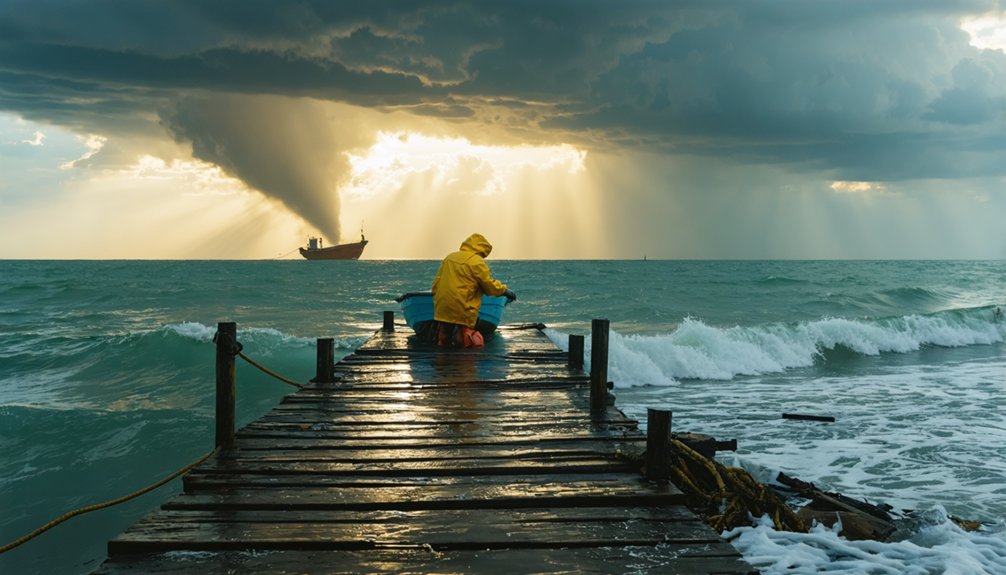
After a waterspout dissipates, you’ll need to stay alert and avoid assuming conditions are immediately safe.
Waterspout aftermath can include residual turbulence, debris-laden water, and secondary atmospheric instability. Monitor marine radio channels for updated weather advisories before re-entering exposed areas.
For safety recovery, inspect your vessel or surrounding structures for damage caused by flying debris or wave surges.
Document any property damage with photographs for insurance purposes. Report the waterspout’s location, duration, and intensity to your local coast guard or port authority — this data improves future forecasting accuracy.
Don’t return to open water until authorities confirm stable conditions.
Keep your emergency kit accessible, as follow-up storms can develop rapidly within the same atmospheric system.
Stay informed, stay disciplined, and reclaim your freedom only when conditions genuinely permit.
Frequently Asked Questions
Can Waterspouts Cause Dangerous Rip Currents Along Coastal Beaches?
Yes, waterspouts can trigger dangerous rip current dynamics along shorelines. During waterspout formation, you’ll notice intensified water circulation disrupting coastal currents. You’ve got to evacuate beaches immediately, moving perpendicular to the shore to avoid these hazardous, rapidly shifting underwater flows.
How Long Does a Typical Waterspout Last Before Dissipating Completely?
Like Odysseus’s fleeting storms, you’ll find waterspout duration typically lasts 2–20 minutes before dissipating. Factors affecting longevity include atmospheric instability, water temperature differentials, and wind shear—so you’ve got limited time to act freely and escape safely.
Are Children and Elderly People More Vulnerable During Waterspout Events?
Yes, they’re considerably more vulnerable. Prioritize children’s safety by evacuating them first and maintaining elderly precautions by ensuring mobility assistance. You’ll want to move both groups inland immediately, perpendicular to the waterspout’s path, minimizing exposure risk.
Can Multiple Waterspouts Form Simultaneously in the Same General Area?
Like clockwork, yes — simultaneous formation of multiple waterspouts can occur when unstable atmospheric conditions align. You’ll spot several vortices developing independently across open water, so stay vigilant, maintain distance, and report each one immediately.
Do Waterspouts Cause Significant Damage to Underwater Marine Ecosystems?
Waterspouts don’t typically cause significant underwater damage. You’ll find marine life experiences minimal waterspout impact, as vortex energy dissipates rapidly at the surface, leaving deeper ecosystems largely unaffected by the atmospheric disturbance above.
References
- https://crazystormchasers.com/dangers-of-chasing-waterspouts-up-close/
- https://battenhomesecurity.com/preparation-guides/waterspout-marine-safety/
- https://www.youtube.com/watch?v=X112yI0Sg5w
- https://www.sea-help.eu/en/guide/waterspouts-tornadoes-safety-tips/
- https://www.workybooks.com/resources/climate-science/waterspout
- https://www.weather.gov/mlb/waterspout_rules
- https://www.gwrymca.org/blog/water-safety-tips
- https://www.nyp.org/healthmatters/how-to-be-safer-in-the-water-10-tips-to-prevent-drowning
- https://www.youtube.com/watch?v=8HE-QPuZdCw
- https://www.youtube.com/watch?v=qS4VfY4N2vs