To protect your team in the field, you’ll need to assign clear communication roles, use satellite phones when cell networks fail, and build a redundant radio system. Set standardized protocols your team won’t forget, keep every device powered with backup banks and solar panels, and inspect all gear before each deployment. Running emergency drills guarantees you’re ready when conditions deteriorate fast — and there’s much more to cover on each of these critical strategies.
Key Takeaways
- Assign specific communication roles to each team member to prevent overlap and gaps during high-stress storm chasing situations.
- Build redundant communication systems using satellite phones and multiple radio frequencies to ensure connectivity when networks fail.
- Carry portable battery banks, vehicle inverters, and solar panels to maintain power for critical communication devices.
- Conduct pre-deployment gear inspections, testing all radios, satellite phones, batteries, and charging systems for operational readiness.
- Run structured emergency drills simulating real scenarios, rotating roles and debriefing to improve team communication protocols.
Assign Communication Roles Before the Chase Begins
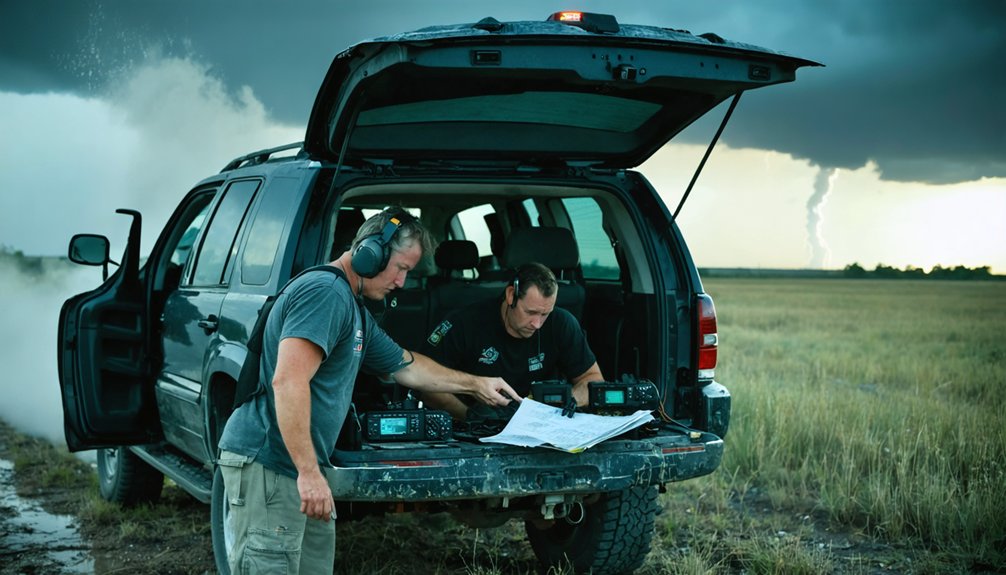
Before your team deploys, assign specific communication roles to each member to eliminate confusion during high-stress situations. Role assignment guarantees every critical function—navigation, data collection, and radio monitoring—has a dedicated operator. You can’t afford overlap or gaps when conditions deteriorate rapidly.
Designate one member solely for radio communication, another for satellite device management, and a third for logging weather updates. This structured team coordination prevents multiple members from transmitting simultaneously, reducing frequency congestion and miscommunication.
Assign dedicated roles before deployment—one radio operator, one satellite manager, one weather logger—to eliminate transmission overlap and miscommunication.
Verify each member understands their assigned duties before leaving. Use pre-chase briefings to reinforce protocol adherence and clarify any device-specific responsibilities.
When everyone operates within a defined role, your team responds faster, communicates cleaner, and maintains operational discipline regardless of what the storm throws at you.
Use Satellite Phones When Cell Networks Fail
When terrestrial cell networks collapse during severe storm conditions, you’ll need a satellite phone to maintain critical communications with your team and emergency services.
You should prioritize devices that support multiple satellite carriers, such as Iridium and Inmarsat, to guarantee redundancy if one network experiences downtime.
Selecting a carrier with proven signal integrity during extreme weather gives you a reliable communication lifeline when ground-based infrastructure fails entirely.
Satellite Phone Key Benefits
Satellite phones deliver reliable connectivity precisely when terrestrial cell networks collapse under severe weather conditions. Their satellite advantages extend beyond basic communication—you’re maintaining operational independence regardless of infrastructure damage on the ground.
When tornadoes destroy cell towers or floods knock out repeaters, your connectivity reliability remains intact through direct orbital links. You’ll benefit from signal integrity during extreme atmospheric conditions that would otherwise silence conventional devices.
Multiple satellite carriers give you network redundancy, so one provider’s downtime won’t cut off your team. Monitor your battery levels consistently, since extended chases demand sustained power management.
Budgeting for satellite service plans is non-negotiable if you’re serious about emergency preparedness. These devices aren’t luxuries—they’re essential tools that keep you connected, informed, and ultimately safer during high-stakes storm operations.
Choosing Reliable Satellite Carriers
Knowing which carrier backs your satellite phone determines whether that orbital link holds when you need it most. You can’t afford guesswork when terrestrial networks collapse mid-chase. Run a thorough carrier comparison before committing to any plan.
Iridium’s pole-to-pole constellation delivers near-global satellite coverage, making it a strong primary choice. Inmarsat and Globalstar offer competitive regional options but carry notable dead zones you’ll want to map against your chase territory.
Don’t lock into a single provider — redundancy across carriers protects you if one network experiences downtime. Evaluate contract flexibility, data speeds, and emergency priority routing.
Confirm that your chosen carrier maintains active satellites along your typical chase corridors. Your operational freedom depends on making this decision deliberately, not reactively.
Build a Redundant Radio System for Storm Chasing
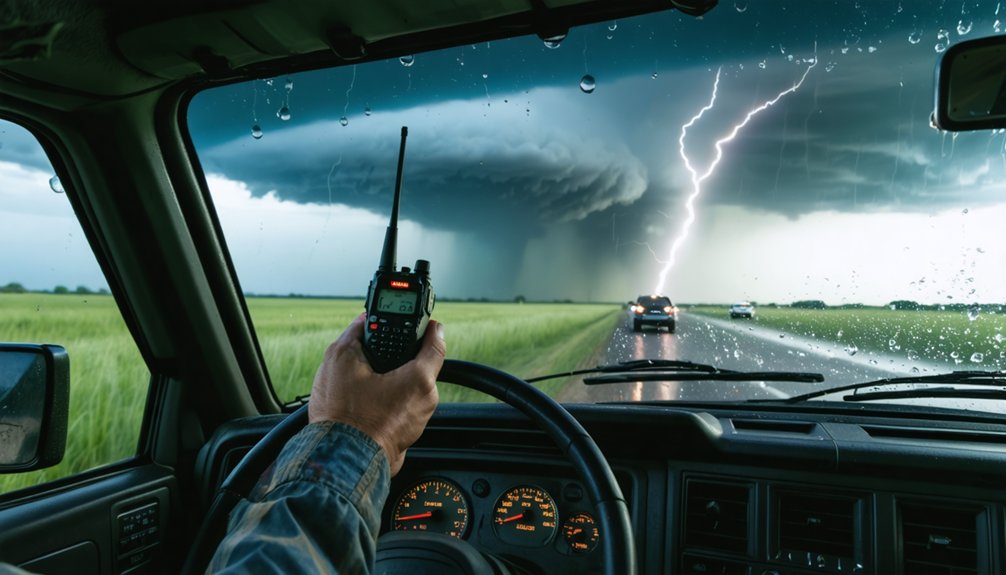
Building a redundant radio system means you’re not depending on a single frequency or device when cell networks collapse mid-chase. Smart radio frequency selection separates your primary and backup channels, preventing simultaneous failure across both systems.
Program multiple frequencies into each unit before deployment so you’re never scrambling mid-storm.
Your backup equipment options should include at least one ham radio capable of receiving broader weather alerts and chaser network transmissions. Two-way radios operating on different bands add another independent communication layer.
Use antenna splitters strategically to distribute signal across devices without signal degradation.
Test every radio before you hit the field. Confirm each unit transmits clearly, batteries hold charge, and frequencies connect reliably.
Redundancy only works when every backup component functions independently and completely.
Set Storm Chasing Communication Protocols Your Team Won’t Forget
Your team’s survival depends on communication protocols that are drilled, documented, and second nature before you ever leave the staging area.
Adopt standardized language to eliminate ambiguity during high-stress intercepts, and build a pre-defined emergency contact list that every member carries on their person.
Lock in scheduled check-in intervals so your team maintains situational awareness without flooding the radio channel during critical storm encounters.
Standardized Language Saves Lives
When a tornado shifts direction without warning, there’s no time to clarify ambiguous instructions. Standardized language eliminates guesswork and keeps your team coordinated under extreme pressure. You need pre-established terminology that everyone recognizes instantly—terms like “execute escape route alpha” or “immediate repositioning required” remove interpretation errors during crisis coordination.
Build a compact communication glossary before every chase operation. Assign specific phrases to specific actions, and drill them until they’re automatic. Communication clarity depends on consistency, not improvisation. Every team member must respond to the same words with the same actions, every time.
Avoid informal or regional slang that outsiders won’t understand if emergency services join your frequency. Precise, rehearsed language keeps your team alive when conditions deteriorate faster than anyone anticipates.
Pre-Defined Emergency Contact Lists
Standardized language keeps your team coordinated internally, but when conditions force you to contact outside resources, you need immediate access to the right people without searching through unsaved numbers.
Pre-defined emergency contact lists are non-negotiable emergency contact strategies that eliminate dangerous delays during active storm encounters.
Build your list to include local emergency services, National Weather Service offices, chase coordinators, and medical facilities along your planned route.
Store these contacts across multiple effective communication tools—satellite phones, two-way radios, and mobile devices—so device failure doesn’t eliminate your access.
Assign each team member a printed backup copy; electronics fail under extreme conditions.
Review and update your contact list before every deployment.
Outdated numbers compromise your entire response capability when seconds determine outcomes.
Scheduled Check-In Time Intervals
Everything breaks down when team members assume someone else is monitoring status—scheduled check-in intervals eliminate that assumption entirely.
You’ll establish your check-in frequency before deployment, not during active pursuit. Set fixed intervals—every 15 or 30 minutes—and document them in your protocol sheet so every team member references the same timeline.
Communication consistency depends on strict adherence to those intervals. If a check-in gets missed, your team immediately initiates the pre-defined response protocol rather than waiting.
You’re not radioing constantly; you’re radioing precisely when required. That discipline reduces channel congestion while maintaining situational awareness across all positions.
Assign one person as the interval timekeeper. That role owns accountability, ensuring nobody’s operating on assumptions when conditions deteriorate rapidly around you.
Keep Every Communication Device Powered in the Field
Keeping your communication devices powered throughout a storm chase isn’t optional—it’s the difference between coordinated response and complete operational failure. Your power management strategy directly determines how long you stay operational when conditions deteriorate fast.
Implement these battery maintenance priorities immediately:
- Carry portable battery banks sized to recharge every critical device at least twice.
- Install vehicle inverters to continuously convert engine power into usable charging capacity.
- Deploy solar panels during extended operations when vehicle power becomes unavailable.
- Prioritize critical devices first—radios and satellite phones over non-essential electronics.
Every uncharged device represents a communication gap that could strand your team.
You’ve earned operational freedom through preparation—don’t surrender it to a dead battery when conditions demand your absolute best response.
Inspect Your Storm Chasing Gear Before Every Deployment
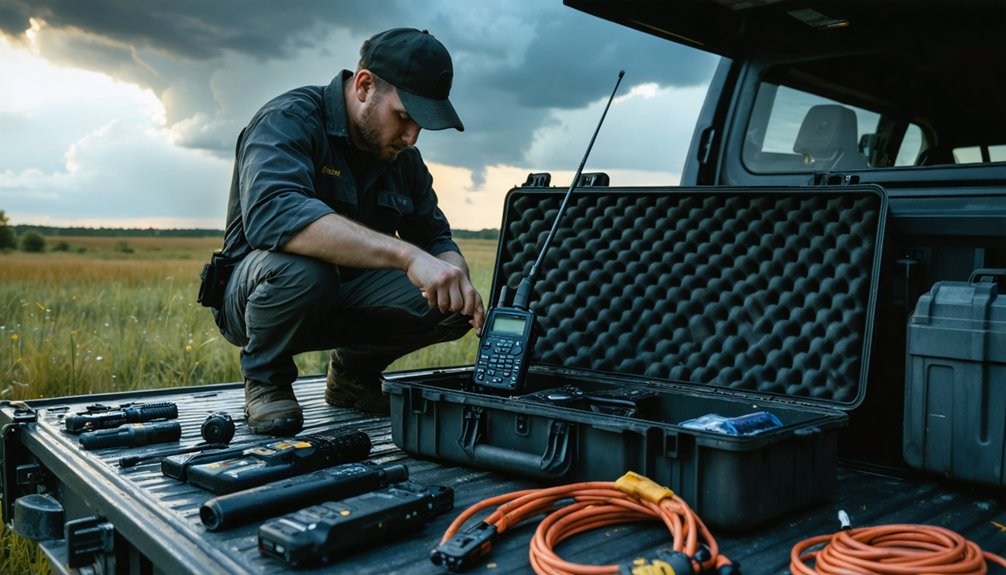
Pre-deployment gear inspection separates teams that maintain operational readiness from those that discover equipment failures mid-chase. You can’t afford surprises when you’re positioning ahead of a rotating supercell.
Execute your inspection checklist methodically before every deployment. Examine antennas and cables for fraying, corrosion, or connector damage. Test every radio and satellite phone functionally—don’t assume yesterday’s working device performs today. Verify battery levels and confirm charging systems operate correctly. Run firmware updates during downtime, not pre-storm hours.
Gear maintenance isn’t optional—it’s your operational foundation. Physical damage checks on protective cases prevent internal component failures during rough transport across unpaved storm corridors.
Document each inspection, note deficiencies, and address them immediately. Your communication capability during a life-threatening encounter depends entirely on the discipline you apply beforehand.
Run Emergency Communication Drills With Your Team
Gear inspections confirm your equipment works—drills confirm your team does. Without practiced execution, even perfect equipment fails under pressure. Run structured drills that stress-test your emergency scenarios before storms force the real thing.
Gear checks confirm your equipment works. Drills confirm your team does. Practice before the storm demands it.
Build communication efficiency through disciplined repetition:
- Simulate isolation — cut cellular access and require satellite-only contact, forcing real dependency on backup systems.
- Time your check-ins — measure response gaps and hold every member accountable to scheduled intervals.
- Rotate roles — guarantee navigation and data personnel can both operate communication devices independently.
- Debrief ruthlessly — identify every breakdown, hesitation, and protocol gap without softening the critique.
Your freedom in the field depends on your team’s ability to function without hesitation. Drill until the protocol becomes instinct.
Frequently Asked Questions
How Do Storm Chasers Legally Operate Ham Radios During Active Chases?
You’ll need a valid FCC amateur radio license to operate legally. Ham radio regulations require passing licensing exams, while storm chasing laws don’t restrict licensed operators from using frequencies during active chases.
What Satellite Communication Providers Offer the Best Storm Chasing Coverage Plans?
Like Odysseus traversing uncharted seas, you’ll find Iridium and Globalstar offer the strongest satellite coverage for storm chasers. Both guarantee communication reliability across remote regions, so you’re never left without a crucial connection when it matters most.
Can Storm Chasers Share Communication Frequencies With Emergency Services Legally?
You can’t share emergency service frequencies without proper licensing, but you’ll establish legal communication protocols through ham radio licensing and emergency service collaboration programs like SKYWARN, granting authorized access during severe weather operations.
How Do Extreme Temperatures Affect Satellite Phone Performance During Winter Storms?
Bitter blizzards brutally batter battery performance, exposing satellite limitations you can’t ignore. Winter impact slashes operational efficiency—you’ll experience reduced signal strength, shortened battery life, and slower processing speeds. Keep devices insulated and monitor power levels continuously.
What Insurance Options Exist for Damaged Storm Chasing Communication Equipment?
You’ll want specialized inland marine insurance coverage for your storm chasing gear, as standard policies won’t cover field damage. It guarantees swift equipment replacement, keeping your communication systems operational and your freedom to chase unrestricted.
References
- https://crazystormchasers.com/importance-of-backup-communication-systems-in-risk-assessment/
- https://crazystormchasers.com/storm-chaser-emergency-response-coverage/
- https://midweststormchasers.org/safety-tips/
- https://www.wiu.edu/SevereWeather/images/presentations/How_to_Effectively_Storm_Chase.pdf
- https://www.atms.unca.edu/cgodfrey/courses/swfex/pdf/ChasingSafety.pdf
- https://midlandusa.com/blogs/blog/how-to-use-two-way-radios-while-storm-chasing
- https://www.youtube.com/watch?v=Sr2lz72ZYwM
- https://www.weathercentertx.com/weather-101-different-types-of-weather/storm-chasing-101/
- https://www.youtube.com/watch?v=AswKDts1i0o
- https://hogonext.com/how-to-be-a-successful-storm-chaser/