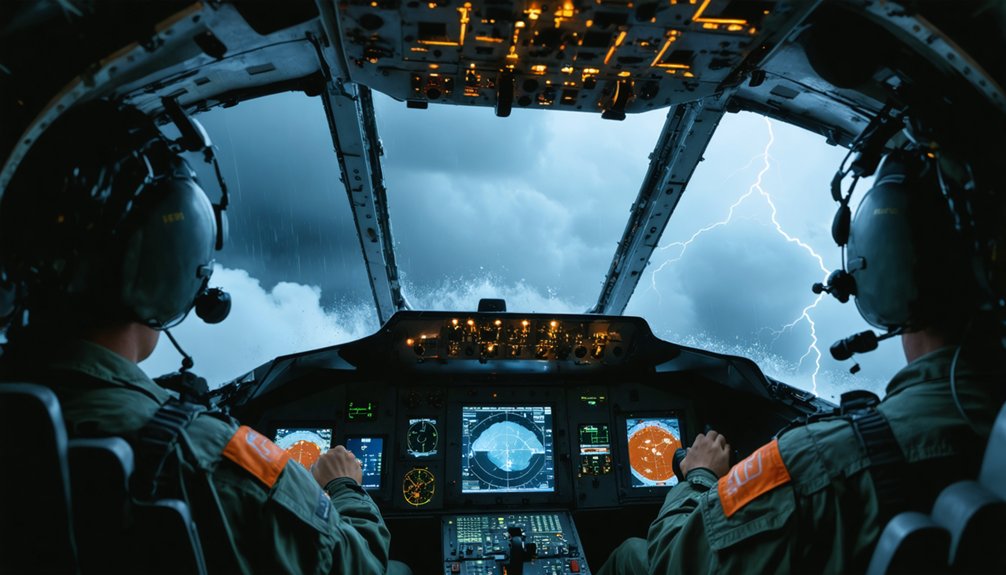
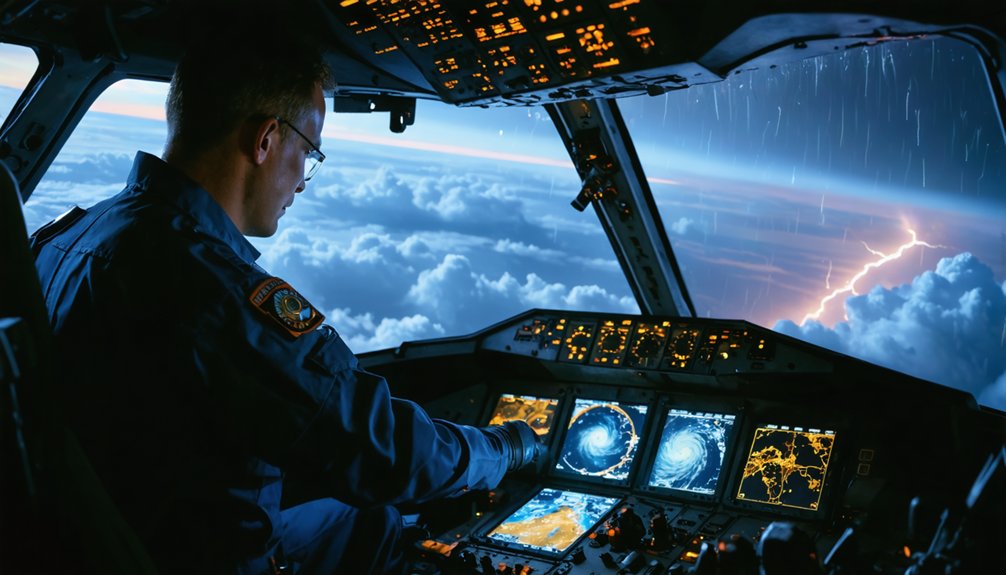
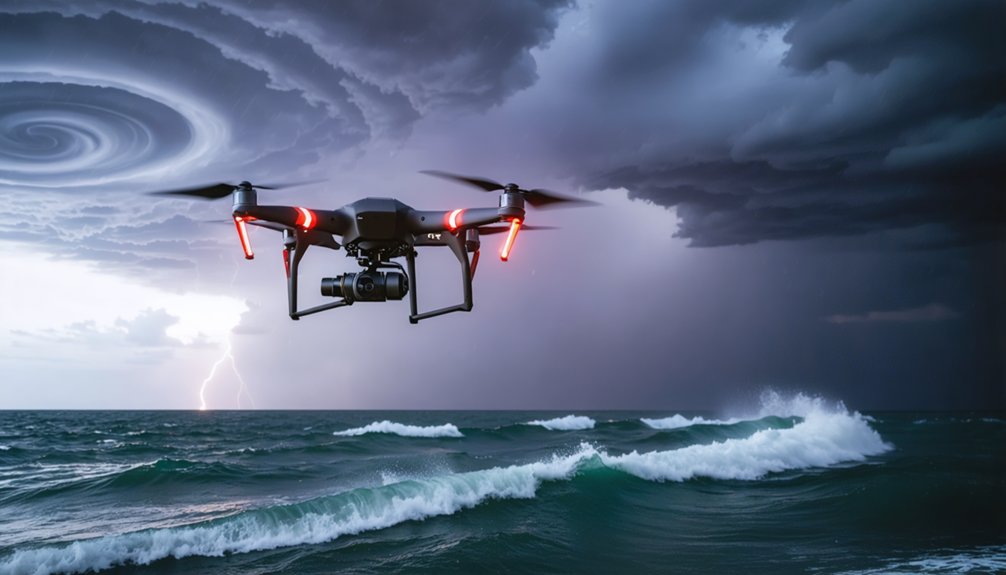
Preparing for hurricane season as a storm chaser means covering five critical areas before any storm develops. You’ll need a mechanically sound vehicle, verified supplies for at least 72 hours, current legal credentials, and dual GPS systems cross-referenced with live satellite feeds. Build your aerobic base to at least 150 minutes of weekly cardio and track your sleep debt carefully. Everything you need to execute a safe, effective chase season is covered ahead.
Key Takeaways
- Professionally inspect brakes, suspension, tires, and fuel systems to ensure your vehicle is mechanically reliable before any storm deployment.
- Pack non-perishable food, one gallon of water daily, first aid supplies, and high-capacity power banks for extended operations.
- Install dual GPS units with offline maps and monitor NOAA forecasts, radar overlays, and ensemble hurricane models continuously.
- Build aerobic fitness, prioritize 7–9 hours of sleep between deployments, and schedule mandatory 48-hour recovery periods every two weeks.
- Obtain Skywarn certification, carry liability insurance, research local regulations, and maintain documentation proving credentials and operational purpose.
Get Your Vehicle Storm-Ready Before Hurricane Season Hits
Before hurricane season arrives, you’ll want your vehicle mechanically sound from top to bottom. Start with a professional inspection of your brakes, suspension, and steering components — these systems determine whether you escape a collapsing situation or get trapped in one.
Verify tire pressure, tread depth, and carry a full spare set. Test your fuel injection system, confirm oil levels, and measure battery capacity under load.
Poor vehicle maintenance during high-stakes chasing isn’t a minor inconvenience — it’s a life-threatening failure point.
Install or reinforce hydraulic systems, winches, and heavy-duty mounting points to support your storm gear. Every piece of equipment you mount needs a secure anchor.
A mechanically compromised vehicle eliminates your options — and in hurricane season, options are everything.
Essential Supplies Every Hurricane Chaser Should Pack
Once your vehicle’s mechanical systems are locked in, your supply kit becomes the next critical layer of preparation.
You’ll need hydration essentials totaling at least one gallon per person daily for three days minimum. Stock food supplies with non-perishable, no-cook items that sustain energy across extended deployments.
Your emergency kits must include first aid components: bandages, antiseptics, and critical medications.
Your first aid kit isn’t a suggestion — bandages, antiseptics, and critical medications are non-negotiable field essentials.
Don’t overlook power sources — carry extra batteries and high-capacity power banks to keep navigation tools, radios, and communication devices operational when grid access disappears.
Pack weather gear suited for rapid temperature shifts, heavy rain, and high winds.
Safety equipment like a fire extinguisher, multi-tool, and emergency blanket aren’t optional — they’re operational necessities.
Every item you pack directly determines your survivability and mission effectiveness in the field.
Know the Laws Before You Chase a Hurricane
Legal compliance isn’t optional when you’re chasing hurricanes — it’s a structural component of every deployment. Before you intercept any storm system, you must understand the legal considerations governing your operational zone. Local regulations vary by county and state, so research jurisdiction-specific rules before departure.
Permitting requirements may apply when accessing restricted coastal zones or disaster-declared areas. Carry documentation proving your affiliation, credentials, and purpose. Liability insurance isn’t negotiable — it protects you financially if equipment, property, or personnel sustain damage during a chase operation.
Complete formal safety training through SKYWARN or equivalent certification programs to demonstrate operational competence to authorities.
Respecting evacuation orders isn’t weakness — it’s a legal obligation. Violating them exposes you to criminal penalties and eliminates your freedom to operate in future deployments.
How to Read Hurricane Forecasts Like a Pro
Reading hurricane forecasts accurately separates effective deployments from dangerous ones. You’ll need to monitor NOAA Convective Outlooks daily and cross-reference multiple hurricane models, including GFS and HRRR data, to identify credible storm predictions versus noise.
Don’t rely on a single model. Instead, compare ensemble outputs, track probability cones, and intensity forecasts simultaneously. The Storm Prediction Center’s watches and warnings provide critical ground-truth confirmation when models diverge.
Comparing ensemble outputs and tracking probability cones ensures smarter decisions when hurricane models diverge.
During active deployment, update your forecast analysis continuously using live radar overlays and real-time lightning data. Discrepancies between models signal instability in storm predictions, requiring immediate route adjustments.
Master reading wind shear charts, sea surface temperature maps, and pressure gradient data. These variables directly influence hurricane intensity and trajectory, giving you the decision-making clarity needed to stay mobile and safe.
Plan Your Hurricane Chase Routes With Multiple Escape Paths
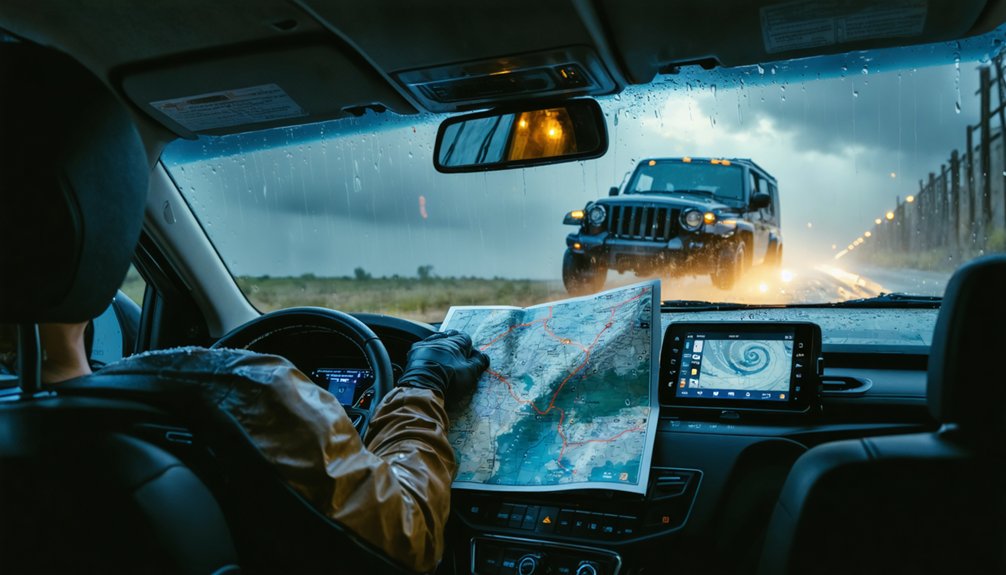
Planning hurricane chase routes demands multiple escape paths because a single corridor can collapse under rapid storm intensification, road flooding, or debris blockage.
You need layered escape route strategies mapped before deployment, not improvised under pressure.
Use dual GPS units loaded with offline maps and real-time weather overlays as your primary mapping tools. Cross-reference HRRR model data against live radar to identify which roads face surge risk, wind shear, or debris accumulation.
Designate at least three exit vectors per chase zone, prioritizing routes perpendicular to the storm’s projected track.
Update your route continuously as conditions shift. Communicate your active escape corridors to your team and external contacts via satellite phone.
Rigid adherence to pre-planned contingencies keeps your movement decisive, fast, and survivable when the storm accelerates unexpectedly.
What Safety Protocols Keep Hurricane Chasers Alive?
Strict safety protocols aren’t optional in hurricane chasing—they’re what separates survivors from statistics. Your storm safety framework must include Skywarn certification, which validates your understanding of meteorological hazards and emergency response procedures.
Respect all evacuation orders immediately; ignoring them eliminates your legal protection and endangers rescue teams.
Effective chaser strategies demand maintaining safe distances from flooding water, collapsing structures, and sustained wind fields exceeding operational thresholds. Never position your vehicle beneath storm surge zones or within confirmed tornado tracks embedded inside hurricane bands.
Carry a fire extinguisher, satellite phone, and emergency blanket without exception. Monitor live radar continuously, updating your positional awareness every few minutes.
Adhere strictly to traffic laws—reckless driving kills more chasers than the storms themselves. Discipline and precision keep you operational and alive.
Communication Gear You Can’t Chase Without
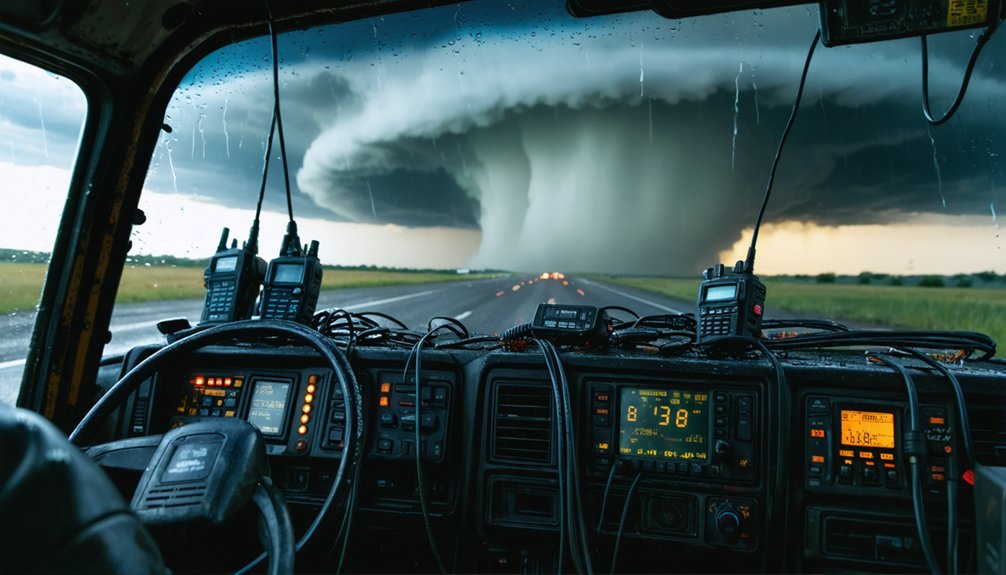
When you’re tracking a hurricane, you can’t rely on cell towers that may already be down or overloaded—you need a dedicated emergency call system and a satellite phone as your primary communication backbone.
You should equip your vehicle with dual GPS units loaded with offline maps and real-time weather overlays, ensuring navigation stays functional even when internet connectivity fails.
A portable weather radio tuned to NOAA broadcasts, combined with extra batteries and power banks, keeps you locked into live meteorological data when every update counts.
Essential Emergency Communication Tools
Reliable communication gear isn’t optional during hurricane season—it’s the operational backbone that keeps you informed, connected, and alive. Equip your vehicle with a satellite phone, ensuring you maintain contact when cellular towers fail.
Install dual GPS units loaded with offline maps and real-time weather overlays for precise positioning. A portable weather radio delivers direct NOAA alerts, reinforcing your emergency protocols when digital networks collapse.
Your communication strategies must layer redundancy into every system. Carry fully charged power banks and extra batteries to sustain all devices through extended operations.
A dedicated emergency call system provides a critical failsafe when standard channels go dark. Backup your data daily to both cloud storage and local drives.
These tools don’t just document the storm—they determine whether you make it home.
GPS And Satellite Systems
Among all the communication gear you’ll deploy, GPS and satellite systems form the navigational and positional core that everything else depends on.
Install dual GPS navigation units loaded with offline maps and real-time weather overlays so you’re never dependent on cellular connectivity in remote corridors. When cell networks collapse under storm pressure, satellite imagery feeds and satellite phones keep your positional awareness sharp and your communications intact.
You’ll want a dedicated satellite messenger device — a SPOT or Garmin inReach — transmitting your coordinates continuously to your support team.
Cross-reference your GPS navigation data against live satellite imagery to identify flooding roads, debris fields, and structural collapse zones before you’re committed to a route. Your freedom of movement depends entirely on the precision of these systems functioning simultaneously without failure.
How to Stay Physically Ready for a Long Chase Season
Your cardiovascular endurance directly impacts decision-making accuracy during multi-day chases, where fatigue-induced errors can place you in lethal positions.
You’ll want to build a consistent aerobic base—targeting at least 150 minutes of moderate-intensity cardio per week—before the season begins.
Managing sleep cycles and recognizing early fatigue markers like slowed reaction time and impaired judgment are non-negotiable protocols when you’re operating in high-stakes storm environments.
Building Cardiovascular Endurance
Staying physically ready for a long hurricane season demands consistent cardiovascular training, not last-minute preparation. You’ll need structured cardio workouts targeting VO2 max improvements, ideally three to five sessions weekly.
Prioritize endurance training through zone-two efforts, maintaining 60–70% of your maximum heart rate for 45-minute intervals. Set measurable fitness goals monthly, tracking distance, pace, and recovery time to gauge real progress.
Build exercise routines around running, cycling, or rowing to strengthen your heart and lungs simultaneously.
Apply practical nutrition tips by consuming 1.6–2.2 grams of protein per kilogram of bodyweight daily. Integrate recovery methods like active stretching and sleep optimization to prevent burnout.
Combine strength building with motivational strategies, using performance data to stay disciplined throughout the season’s physical demands.
Managing Fatigue Effectively
Managing fatigue during a long hurricane season requires a structured, evidence-based recovery strategy, not willpower alone. You can’t sustain peak decision-making under sleep deprivation, so prioritize 7–9 hours of consolidated sleep between deployments.
Implement fatigue management protocols by tracking cumulative sleep debt using wearable monitors like Garmin or Whoop devices.
Your rest strategies should include 20-minute power naps during low-activity windows, limiting caffeine intake after 2:00 PM, and scheduling mandatory 48-hour recovery periods every two weeks.
Avoid consecutive 16-hour chase days without structured downtime. Cognitive performance degrades measurably after 17 hours of wakefulness, equivalent to a 0.05% blood alcohol level.
You control your operational tempo, so build recovery windows directly into your chase calendar before the season launches.
How to Document Hurricanes Without Taking Deadly Risks
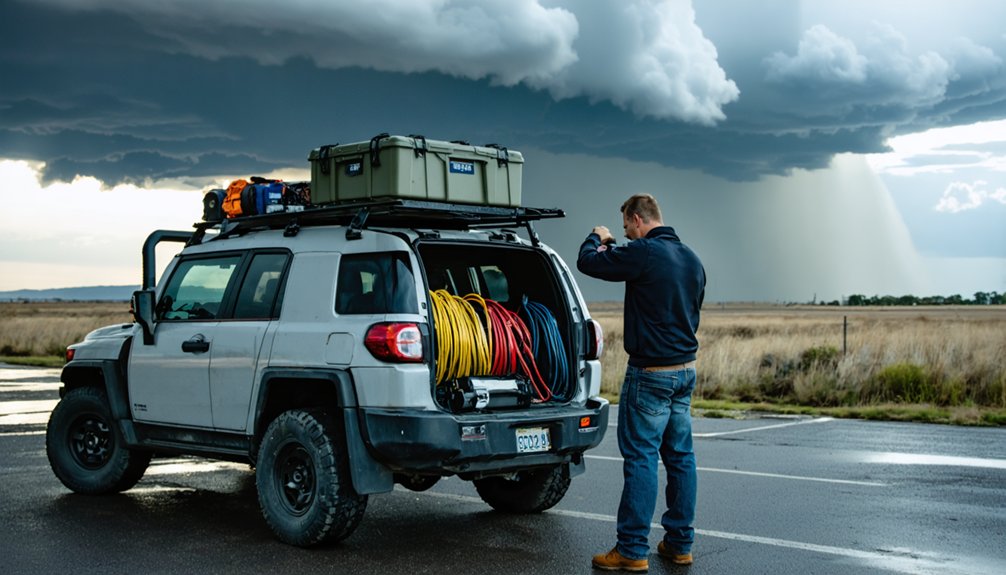
Documenting a hurricane effectively requires balancing data capture with strict safety margins. Your storm documentation strategy must prioritize risk assessment before deploying any equipment.
Position your vehicle perpendicular to the storm’s projected track, maintaining a minimum 50-mile buffer from the eyewall. Use high-definition cameras and drones only when sustained winds fall below 40 mph to prevent equipment loss.
Install dual GPS units with real-time weather overlays to monitor rapid intensity shifts. Backup all footage to cloud storage immediately, since power failures are unpredictable. Carry a satellite phone for continuous communication when cellular infrastructure fails.
Never compromise your exit route for additional footage. Your data holds zero value if you’re trapped. Prioritize established escape corridors, and cross-reference live radar before committing to any fixed documentation position.
Frequently Asked Questions
How Do Hurricane Chasers Fund Their Expeditions and Cover Operational Costs?
Like fuel powering your engine, crowdfunding strategies and sponsorship opportunities drive your expedition’s budget. You’ll secure grants, partner with weather agencies, sell footage, and leverage social media to cover vehicle maintenance, equipment, and operational costs effectively.
What Mental Health Challenges Do Storm Chasers Face After Dangerous Hurricane Encounters?
After dangerous encounters, you’ll likely face PTSD and acute stress responses. Prioritize trauma recovery through structured debriefing sessions and professional counseling. Build emotional resilience by tracking psychological metrics, maintaining peer support networks, and scheduling regular mental health evaluations.
How Do Insurance Companies Handle Coverage for Professional Hurricane Storm Chasers?
Over 60% of storm chasers face denied claims. You’ll encounter steep insurance premiums and strict coverage limitations, as insurers classify hurricane chasing as extreme high-risk activity, often requiring specialized policies that exclude storm-related vehicle and equipment damage entirely.
Can Beginners Legally Chase Hurricanes Without Prior Storm Chasing Experience?
You can legally chase hurricanes without prior experience, but you must respect chasing ethics and legal considerations—adhere to evacuation orders, traffic laws, and private property boundaries while continuously monitoring NOAA data to guarantee informed, responsible decisions.
What Professional Certifications Beyond Skywarn Are Recognized in the Storm Chasing Community?
“Knowledge is power” — pursue certification programs like NWA’s seal of approval and AMS’s credentials. You’ll gain advanced training through CoCoRaHS and emergency management courses, sharpening your meteorological precision and enhancing your freedom to chase professionally.
References
- https://www.wiu.edu/SevereWeather/images/presentations/How_to_Effectively_Storm_Chase.pdf
- https://www.youtube.com/watch?v=6otZLjSZvPU
- https://stormtrack.org/threads/hurricane-chasing.5851/
- https://www.reddit.com/r/stormchasing/comments/1boanfg/how_do_i_get_started_storm_chasing/
- https://www.youtube.com/watch?v=Ky-Qr9LwiS4
- https://www.weather.gov/safety/hurricane-plan
- https://www.noaa.gov/hurricane-prep
- https://www.reddit.com/r/stormchasing/comments/1ds937c/hurricane_chasing_tips_and_tricks/
- https://www.reddit.com/r/tornado/comments/184h2rf/as_someone_who_wants_to_be_a_storm_chaser_what/
- https://www.stormchase.us/Articles/VehiclePrep.html