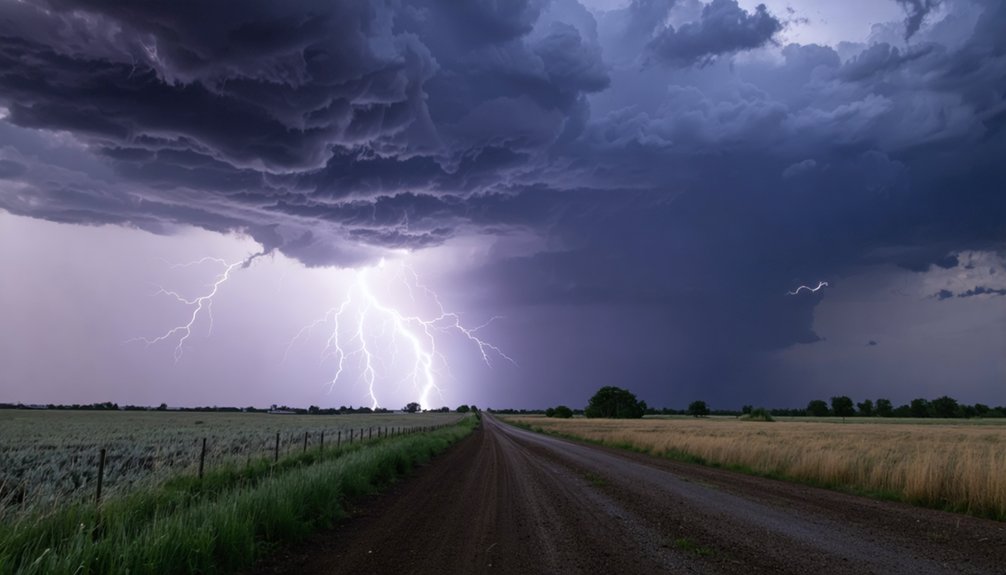
Understanding lightning strike patterns starts with recognizing that location, terrain, and storm conditions all drive risk. You’re at higher danger on elevated ground, near isolated trees, or beside open water, since wet soil and water bodies extend lethal current zones well beyond the strike point. Count seconds between flash and thunder, divide by three for kilometers, and act when you’re within 10 kilometers. Keep exploring these patterns to sharpen your survival instincts greatly.
Key Takeaways
- Higher ground, isolated trees, and water bodies are prime lightning strike locations due to increased conductivity and electric field concentration.
- Hair standing on end, skin tingling, and metallic smells signal an imminent lightning strike requiring immediate action.
- Use the flash-to-bang method: divide seconds between flash and thunder by 3 to estimate kilometers of distance.
- Seek large enclosed buildings with plumbing or wiring for strongest protection; metal-roofed vehicles serve as secondary shelter.
- In groups, maintain 15-meter spacing and crouch low with feet together to minimize strike and side-flash casualties.
Why Your Location Determines Your Lightning Strike Risk
Where you stand during a storm directly determines how much lightning risk you face. Geographic elevation plays a critical role — high ridges and mountain peaks intensify electric field concentrations, making you a prime target. Valleys reduce your exposure considerably.
Your position during a storm isn’t random — elevation transforms you into a target.
Ground conductivity also shapes strike patterns. Water bodies extend conductive zones outward, pulling discharge currents toward anyone standing nearby. Metal fences and isolated trees create lightning hotspots, concentrating strike probability within tight geographic clusters.
Florida’s high strike density demonstrates how regional climate and terrain combine to amplify risk.
You’re not powerless against these variables. Understanding that elevation, ground composition, and surrounding structures actively redirect lightning pathways gives you actionable intelligence.
Choose your position deliberately — your physical location isn’t passive; it’s a controllable risk factor.
How High Ground and Isolated Trees Put You in Danger
High ground and isolated trees don’t just increase your lightning risk — they concentrate it. At high elevation, you’re physically closer to the descending stepped leader, reducing the distance it must travel to complete a circuit through you. That proximity dramatically increases strike probability.
Tree height compounds this danger differently. A tall isolated tree creates a preferential discharge point because it narrows the gap between ground and storm charge. When you shelter beneath it, you’re exposed to both a direct strike and side flash — electricity jumping laterally from the tree to your body.
Statistics confirm mountain ridges and isolated trees rank among the most frequent strike locations.
Recognizing these environmental triggers lets you make faster, smarter decisions before the electrical field reaches critical ionization thresholds near you.
Which Storm Conditions Create the Highest Strike Zones
When you’re caught in a storm, terrain and surroundings directly determine your strike risk—elevated ridges and peaks intensify electric field concentration, making high ground statistically more dangerous than low-lying valleys.
Water bodies extend conductive strike zones far beyond the immediate storm area, pulling discharge pathways toward rivers, lakes, and coastlines where you remain vulnerable even at distance.
Urban heat islands compound these risks by generating localized convective activity, increasing lightning density over cities where ground conductivity already varies sharply across metal infrastructure, pavement, and building clusters.
Elevated Terrain Strike Risks
Elevated terrain amplifies lightning strike risk by shortening the gap between storm clouds and the ground, effectively reducing the distance a stepped leader must travel to initiate a discharge.
Elevation effects and terrain features directly influence where strikes concentrate. You’re markedly more vulnerable when positioned on ridgelines, summits, or exposed plateaus.
Recognize these high-risk terrain patterns:
- Mountain ridges attract disproportionately higher strike frequencies than surrounding valleys.
- Exposed summits eliminate natural barriers, placing you directly within discharge pathways.
- Rocky outcroppings increase ground conductivity variations, redirecting strike connection points.
- Open plateaus provide no elevation differential, making you the highest local point.
Descend immediately toward valleys or ravines when storms approach.
Your elevation relative to surrounding terrain determines your strike probability more than almost any other single variable.
Water Bodies Conducting Zones
Water bodies extend strike zones considerably beyond their shorelines because water conducts electricity across greater horizontal distances than dry land, pulling discharge pathways toward you even when you’re not standing directly at the water’s edge.
Water conductivity increases strike zones by drawing stepped leaders toward conductive surfaces from further distances than surrounding terrain allows.
During storm conditions featuring high humidity, elevated cloud charge separation, and strong electric field gradients, strike zones expand dramatically around lakes, rivers, and coastal areas.
You’re at heightened risk if you’re within these extended zones during peak discharge activity.
Moving away from water bodies immediately when thunder counts drop below 30 seconds isn’t optional—it’s critical.
Every second you delay repositioning away from high-conductivity zones increases your exposure to lateral current traveling through saturated ground.
Urban Heat Island Effects
Key strike-zone amplifiers in urban environments:
- Concrete and asphalt absorb solar radiation, accelerating thermal instability after sunset.
- Tall building clusters mechanically lift incoming air masses, triggering faster cloud electrification.
- Reduced vegetation limits moisture absorption, concentrating runoff that extends conductive strike zones.
- Industrial heat emissions compound atmospheric instability, pushing storm cell development beyond natural thresholds.
Understanding these compounding variables gives you precise insight into why dense city corridors experience disproportionately higher strike frequencies compared to adjacent rural landscapes during equivalent storm events.
How the Flash-to-Bang Method Tells You How Close Danger Is
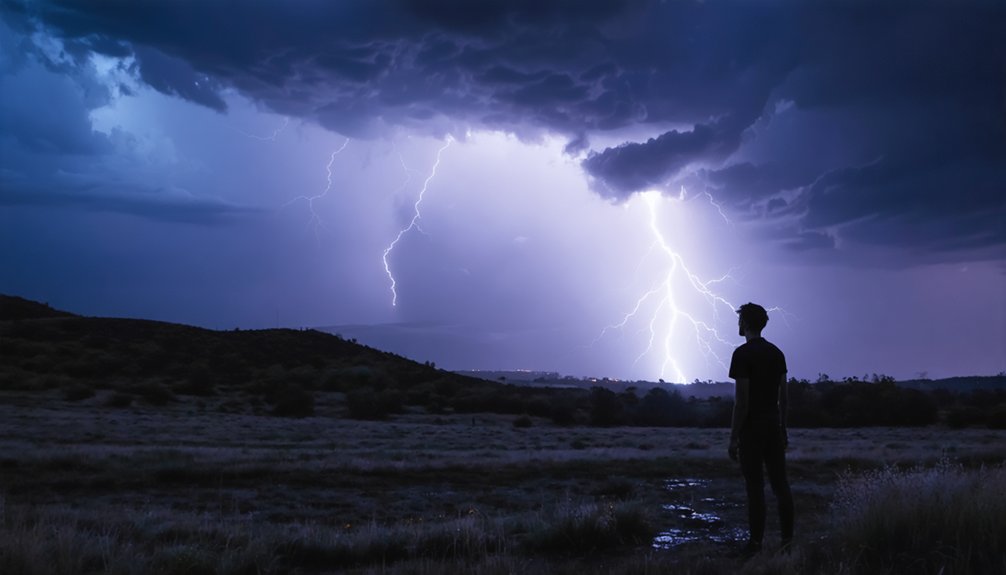
When lightning flashes across the sky, you can calculate its distance using the flash-to-bang method: count the seconds between the flash and the thunder, then divide by 3 to get the distance in kilometers. This flash timing technique gives you actionable data rather than guesswork.
Your distance calculation becomes critical at the 30-second threshold. A count of 30 seconds or less places the strike within 10 kilometers, signaling immediate danger. At that point, you need shelter now, not in five minutes.
Don’t wait for rain to intensify before acting. The electrical field builds before the visible storm arrives. If your hair stands on end or nearby electronics buzz, a strike is imminent.
The storm doesn’t wait for rain. When your hair rises or electronics hum, seek shelter immediately.
Use the data you’ve gathered to make smart, independent decisions about your safety.
Warning Signs Lightning Is About to Strike
Beyond the numbers the flash-to-bang method gives you, your own body and surroundings can signal that a strike is seconds away. Recognizing these warning signs puts control back in your hands when imminent danger closes in fast.
Watch for these four physical indicators:
- Hair standing on end — static charge is building around you, indicating ionization is already occurring nearby.
- Skin tingling — your body is detecting a rising electrical field, a direct precursor to discharge.
- Electronic devices buzzing — nearby equipment responds to intensifying electromagnetic fields before a strike connects.
- A sharp metallic taste or smell — ozone produced during air ionization reaches your senses moments before a bolt forms.
React immediately. These signals aren’t coincidental — they’re measurable, physical evidence that a channel is forming above you.
Why Wet Ground and Water Make Lightning More Dangerous
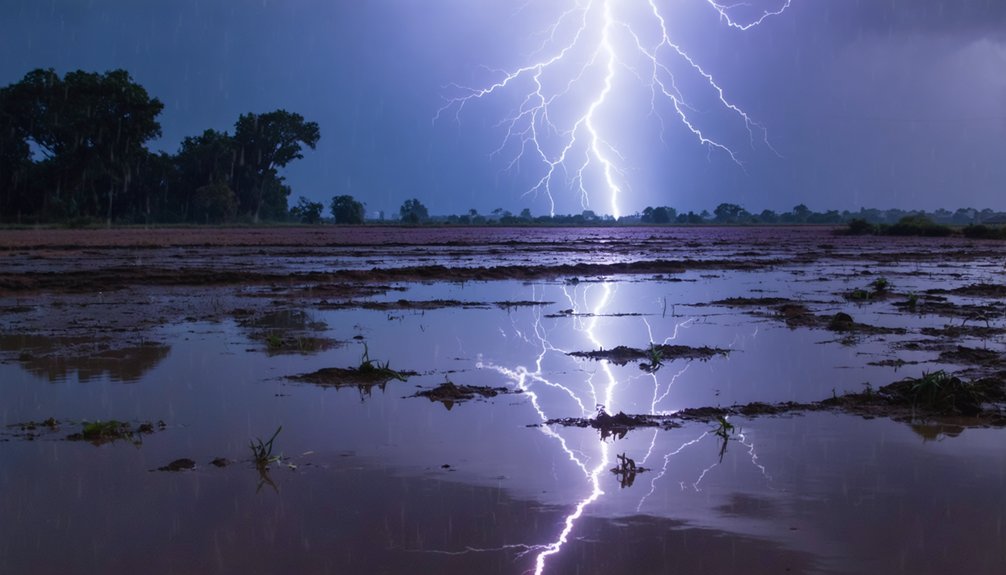
Water and wet ground dramatically expand the danger zone of a lightning strike because conductivity directly controls how far electrical current spreads after impact.
When soil absorbs moisture, its wet conductivity increases sharply, allowing current to radiate outward across a much wider surface area than dry ground permits. You’re at serious risk even if the strike lands meters away from your position.
Water reflection also amplifies danger by attracting stepped leaders toward open water surfaces, extending effective strike zones beyond visible boundaries.
Lakes, rivers, and flooded fields become active conductors that carry lethal current horizontally. You should move away from any water body immediately when storms approach.
Maintaining distance from wet surfaces preserves your ability to avoid ground current, which kills independently of a direct strike.
How to Stay Safe Once You Spot a High-Risk Pattern
Recognizing that wet ground and open water extend strike zones gives you the situational awareness to act before danger peaks.
Once you’ve identified a high-risk pattern, execute these steps immediately:
- Seek enclosed shelter locations — A large building with plumbing and wiring offers the strongest protection; a metal-roofed vehicle works as a secondary option.
- Apply the flash-to-bang method — Divide seconds between flash and thunder by 3 for kilometers; 30 seconds or less demands immediate action.
- Practice group spacing — Spread members at least 15 meters apart to prevent a single strike from incapacitating everyone.
- Crouch low in open terrain — Feet together, minimize your profile, and stay away from isolated trees and fence lines.
Frequently Asked Questions
How Many Lightning Strikes Happen Globally Every Single Second?
You’re witnessing roughly 100 lightning strikes every second worldwide. These lightning frequency statistics reveal fascinating global patterns, showing you that Earth’s atmosphere constantly discharges enormous electrical energy across continents, oceans, and tropical zones simultaneously.
Which US State Records the Highest Density of Lightning Strikes?
Florida claims the highest lightning strike density in the U.S. — you’d be shocked knowing 100 strikes hit Earth every second! Mastering lightning safety and storm forecasting data empowers you to make free, informed decisions outdoors.
How Long Should You Wait Outside After the Last Thunderclap?
You shouldn’t stay outside—wait 30 minutes after the last thunderclap before resuming outdoor activity. Thunder safety data confirms elevated strike risk persists within this window, so sharpen your storm awareness and seek shelter immediately.
What Percentage of Global Lightning Strikes Occur Over Tropical Regions?
About 25% of global lightning strikes hit tropical regions—you’ll find tropical lightning’s strike frequency remarkably concentrated given these zones cover limited Earth surface, revealing how warm, humid air you encounter there drives intense, disproportionate electrical activity.
How Does a Stepped Leader Actually Form Inside a Storm Cloud?
When charge separation exceeds 3 million volts per meter inside storm clouds, you’ll see lightning formation begin as air ionizes, creating a plasma channel. The stepped leader then advances downward in 50-meter increments.
References
- https://powerquality.blog/2023/07/25/power-system-grounding-understanding-lightning-strikes/
- https://www.nssl.noaa.gov/education/svrwx101/lightning/types/
- https://www.youtube.com/watch?v=KxWFIYUqOL4
- https://www.reddit.com/r/explainlikeimfive/comments/3hkyt7/eli5_why_does_lightning_strike_in_a_zigzag_pattern/
- https://www.youtube.com/watch?v=yDWbSa4tCns
- https://www.angelfire.com/trek/nz_usa/Lightning_Safety.html
- https://www.youtube.com/watch?v=JmbaFrh04J0
- https://www.dehn-international.com/sites/default/files/media/files/when-lightning-strikes-ds661-e_0.pdf
- https://www.weather.gov/safety/lightning-science-overview
- https://www.rospa.com/leisure-safety/lightning