You don’t need a meteorology degree to chase storms, but without one, you’re traversing some of the most dangerous atmospheric conditions on Earth using an incomplete toolkit. Hobbyists rely on Skywarn certification and field mentorship, while professionals leverage formal training in radar analysis, thermodynamics, and predictive modeling. Your goals determine your path — and understanding exactly what each route offers, costs, and pays will sharpen your decision considerably.
Key Takeaways
- No formal degree is required for hobbyist storm chasing, but a bachelor’s degree is advisable for research and institutional roles.
- Skywarn certification provides operational readiness for severe weather identification without the cost of a full meteorology degree.
- Field experience and mentorship from seasoned chasers can effectively replace formal education for developing practical storm chasing skills.
- A meteorology or atmospheric science degree significantly improves radar interpretation, storm dynamics knowledge, and overall forecasting ability.
- Formal credentials directly influence earning potential, particularly in government, research, and media-affiliated storm chasing positions.
Do You Actually Need a Degree for Storm Chasing?
Whether you need a degree to chase storms depends entirely on what you want to do with the skill. If you’re pursuing storm chasing as a hobbyist, no formal credential is required. You can enter the field through self-study, mentorship, and field experience. Many successful chasers started without academic backgrounds.
However, if you’re targeting research, government agencies like NOAA, or media collaboration, a bachelor’s degree in meteorology becomes strongly advisable. Professional roles demand competency in radar analysis, weather modeling, and forecasting systems that self-study rarely develops fully.
Regardless of your path, storm chasing ethics and safety protocols aren’t optional. Understanding storm structure isn’t just academic—it directly determines your survival in the field.
Your goals define your requirements; your commitment to safety defines your credibility.
What Hobbyist Storm Chasers Do Instead of College
If you’re drawn to storm chasing without pursuing a degree, you can build competency through direct field experience alongside seasoned chasers.
Mentorship accelerates your skill development faster than classroom instruction alone, exposing you to real-time radar interpretation, storm structure recognition, and operational decision-making.
You’ll absorb pattern recognition and forecasting judgment organically by logging hours in the field rather than in a lecture hall.
Learning Through Field Experience
Many hobbyist storm chasers bypass formal education entirely, relying instead on field experience, mentorship, and self-directed study to build operational competency.
You can develop sharp field observations by accompanying seasoned chasers during active severe weather events, absorbing real-time decision-making under pressure. These interactions transfer practical skills faster than passive classroom instruction.
You’ll learn radar interpretation, storm structure identification, and intercept positioning through direct exposure rather than textbooks.
Platforms like Spotter Network and Skywarn certification programs provide structured frameworks without requiring university enrollment. Many successful independent chasers built their competency entirely through seasons of accumulated field time.
This path demands discipline and intentional learning, but it’s fully viable.
Your operational effectiveness ultimately depends on how systematically you apply what field conditions teach you.
Mentorship Over Formal Degrees
Beyond accumulating field hours, hobbyist storm chasers often accelerate their operational development through direct mentorship with experienced professionals. This mentorship benefits you by compressing years of trial-and-error learning into focused, real-time instruction during active severe weather events.
You’ll gain practical skills that no textbook replicates—reading supercell structure, interpreting live radar signatures, and executing safe positioning under rapidly evolving conditions. Experienced mentors transfer decision-making frameworks built from hundreds of documented chase operations, giving you calibrated situational awareness faster than independent study allows.
This path preserves your autonomy. You control your learning pace, your chase territory, and your operational priorities without institutional constraints.
For hobbyists prioritizing field competency over credentials, structured mentorship delivers measurable skill acquisition with minimal financial overhead and maximum real-world application.
Can Skywarn Certification Replace a Meteorology Degree?
If you’re weighing Skywarn certification against a meteorology degree, you need to understand what each actually delivers.
Skywarn trains you to identify and report severe weather features, improving your situational awareness and safety protocols in the field, but it doesn’t cover advanced radar interpretation, numerical weather prediction, or storm dynamics at the analytical depth a degree provides.
When your goals extend beyond observation into forecasting, research, or institutional collaboration, certification alone falls short of what formal education equips you to handle.
Skywarn’s Core Training Benefits
Skywarn certification gives you structured exposure to storm spotter fundamentals—severe weather identification, radio communication protocols, and real-time reporting procedures—but it doesn’t replicate the analytical depth of a meteorology degree.
The Skywarn benefits, however, are operationally significant for independent chasers prioritizing field readiness over academic credentials.
Key training advantages include:
- Storm Recognition – You’ll identify wall clouds, rotation signatures, and hail shafts using standardized NWS classification criteria.
- Reporting Protocols – You’ll transmit structured ground-truth data directly to local NWS offices, improving forecast accuracy.
- Safety Frameworks – You’ll apply positioning strategies that reduce exposure during rapidly evolving severe events.
These competencies build functional independence without tuition costs, making Skywarn a tactically smart entry point for chasers operating outside institutional frameworks.
Degree Versus Certification Scope
Certification and degree programs don’t occupy the same functional tier—and conflating the two creates gaps in competency that field conditions will eventually expose.
Skywarn equips you with structured reporting protocols and hazard recognition—but its certification limitations become apparent when you’re interpreting mesoscale convective systems or running proximity sounding analysis. Those skills require coursework in thermodynamics, fluid dynamics, and numerical weather prediction that no short-cycle program delivers.
The degree benefits extend beyond knowledge accumulation. A meteorology bachelor’s gives you analytical frameworks that scale across radar platforms, forecast models, and research environments.
Skywarn optimizes you for one operational role—ground-truth reporting. A degree optimizes you for the full spectrum of severe weather decision-making. If autonomy and technical precision drive your goals, understanding that distinction keeps your training investments aligned with your actual operational ceiling.
When Certification Falls Short
When your operational goals extend beyond spotting reports and hazard relay, Skywarn’s training architecture hits a hard ceiling. Certification limitations become apparent once you pursue data-driven practical applications requiring deeper analytical competency.
Three scenarios where certification falls short:
- Radar interpretation — Skywarn doesn’t train you to analyze dual-polarization radar products or mesoscale convective signatures independently.
- Numerical weather modeling — Certification programs exclude hands-on forecasting using NAM, GFS, or HRRR model outputs.
- Research documentation — Peer-reviewed contributions and institutional collaborations require credentialed meteorological training, not observer certification.
You can chase storms with Skywarn credentials, but you can’t build predictive frameworks or contribute scientifically without formal education.
If you want operational autonomy backed by technical precision, a meteorology degree remains the superior investment.
What Formal Training Teaches That Self-Study Can’t
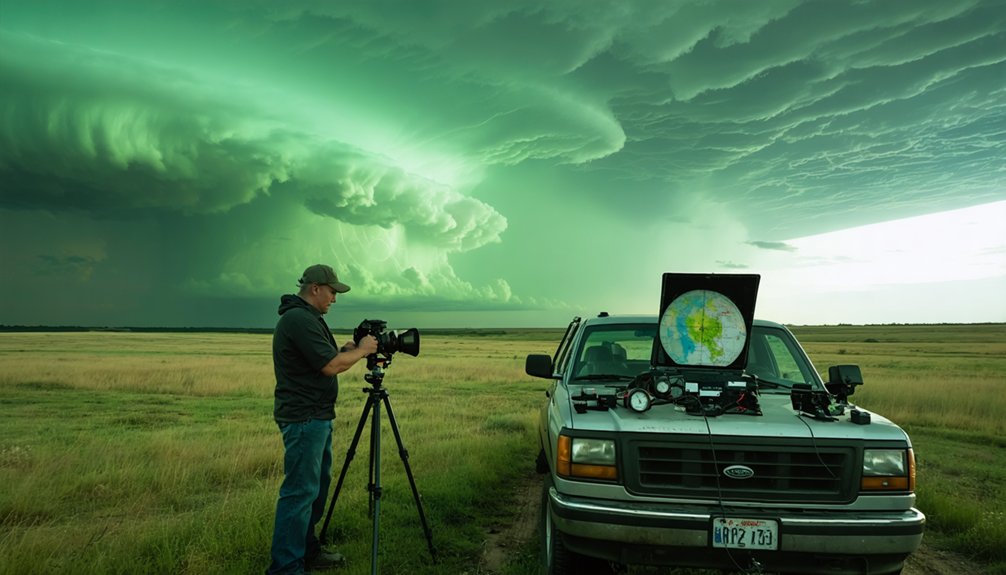
Formal training closes gaps that self-study rarely can. When you study storm structure inside a university curriculum, you’re not just memorizing diagrams—you’re learning how mesocyclones interact with wind shear across measurable atmospheric layers.
Predictive models like the NAM or GFS aren’t intuitive tools; interpreting them accurately requires coursework in thermodynamics, fluid dynamics, and numerical weather prediction. Self-study can expose you to these concepts, but structured education forces you to apply them under rigorous, tested conditions.
You’ll analyze real datasets, run simulations, and receive expert feedback. That feedback loop doesn’t exist when you’re working alone through YouTube tutorials or field guides.
If you want forecasting precision that keeps you alive in volatile conditions, formal training builds the analytical foundation that independent study consistently fails to replicate.
Which Degrees Actually Support a Storm Chasing Career?
Not every degree carries equal weight when you’re trying to build a credible storm chasing career. Degree relevance directly shapes your forecasting capability, employability, and field safety.
Not all degrees are created equal—choose wisely, because your credentials directly determine your safety and success in the field.
Here are the three degrees with the strongest educational impact:
- Bachelor’s in Meteorology or Atmospheric Science – Covers radar interpretation, storm dynamics, and forecasting models essential for professional chasing.
- Bachelor’s in Physics or Engineering – Builds analytical frameworks applicable to instrument design and data analysis in severe weather research.
- Master’s in Atmospheric Science – Deepens specialization in severe weather systems, qualifying you for NOAA roles and research positions.
You’re not locked into one path, but choosing strategically accelerates your credibility. The right degree doesn’t just open doors—it sharpens your decision-making when conditions turn dangerous.
When Does a Meteorology Degree Make a Real Difference?
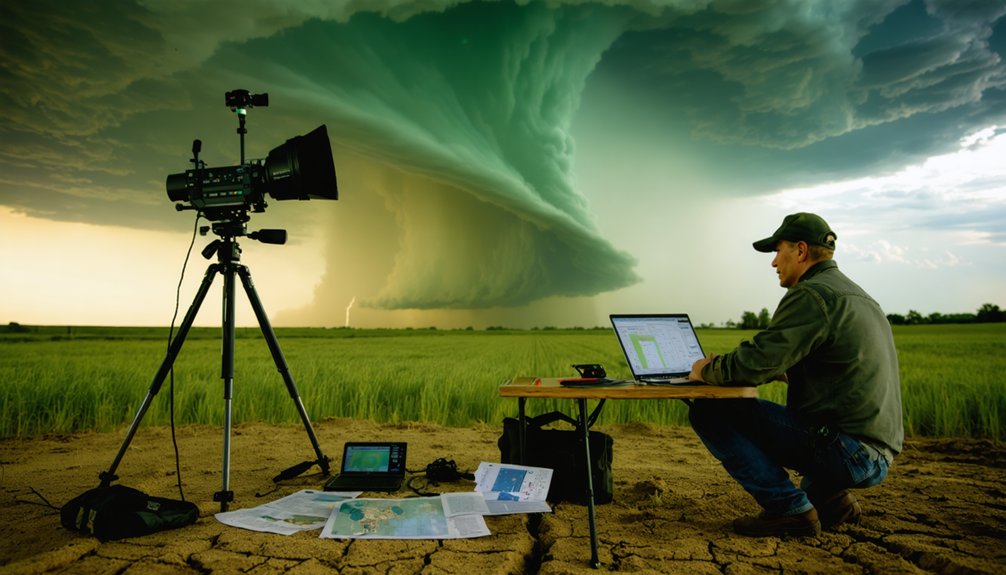
A meteorology degree’s value sharpens considerably once you move beyond hobbyist chasing into roles where forecasting accuracy and institutional credibility carry real consequences.
If you’re targeting NOAA, research institutions, or broadcast meteorology, degree impact becomes non-negotiable—agencies filter candidates by academic credentials before evaluating field experience.
Career progression also accelerates when you hold formal training in radar interpretation, mesoscale analysis, and numerical weather prediction.
Without that foundation, you’ll hit ceilings quickly in data-driven environments where colleagues hold master’s or PhD-level credentials.
Conversely, if you’re operating independently—documenting storms, contributing to citizen science networks, or building a media presence—your degree matters far less than your skill set and track record.
Know which lane you’re driving before committing $40,000 to $100,000 to a four-year program.
How Much Does a Storm Chasing Degree Actually Cost?
Pursuing a meteorology degree carries a price tag that varies sharply depending on institution type and enrollment status. Degree costs break down into predictable ranges you can plan against before committing your time and money.
- Bachelor’s degrees run $40,000–$100,000+ over four years.
- Master’s programs add 2–3 years and substantial tuition on top.
- Annual costs range from $8,000–$45,000, excluding books and housing.
These figures don’t have to stop you. Tuition assistance through federal aid, scholarships, and employer sponsorships can considerably reduce your out-of-pocket exposure.
Research assistantships at graduate levels often offset tuition entirely while providing hands-on severe weather training. You’re not locked into full sticker price.
Analyze every funding avenue available before deciding whether a formal degree fits your storm chasing trajectory.
What Storm Chasers Actually Earn on Average
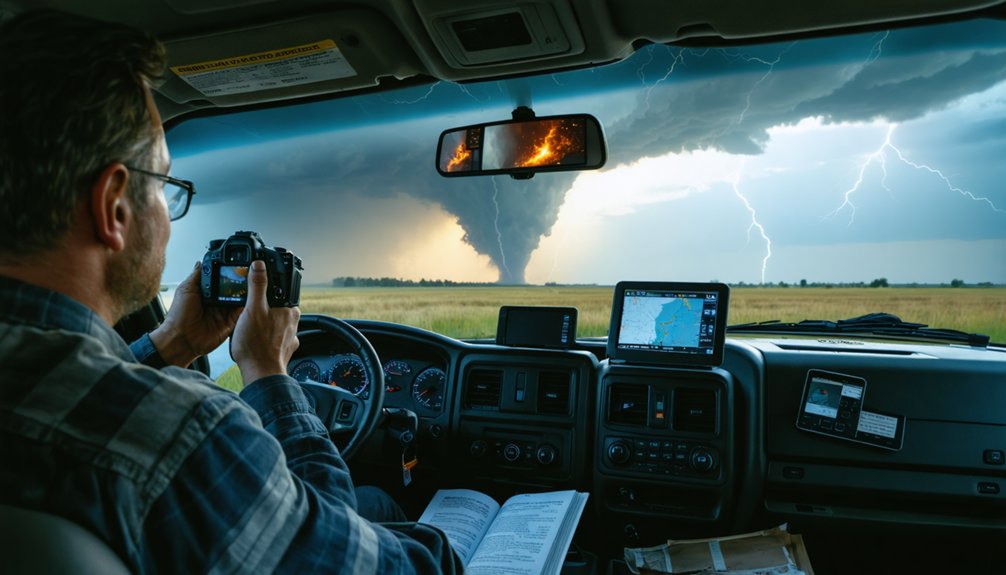
Storm chasers earn an average annual salary of $90,210 nationally, with entry-level or regionally limited roles pulling closer to $66,200. Hourly rates fall between $32 and $43, depending on experience and geography.
These salary comparisons reveal a wide earnings spectrum shaped by several income factors, including credentials, employer type, and supplemental roles.
You’ll rarely sustain a living through storm chasing alone. Most chasers who hit the higher salary ranges hold parallel positions in meteorology, broadcast media, or research institutions.
Your degree, or lack of one, directly influences which tier you occupy. Government agencies and research firms compensate formal credentials more competitively than freelance or independent chasing work.
If financial independence matters to you, diversifying your income across related fields greatly strengthens your earning potential and career longevity.
Hobbyist vs. Professional Goals: Which Path Actually Fits You?
Salary data only tells part of the story—what you’re actually chasing matters as much as what you’re earning. Your hobbyist motivations or professional aspirations shape every decision, from gear investment to degree pursuit.
Ask yourself three diagnostic questions:
- Are you chasing for personal fulfillment? Hobbyist motivations require no degree—field experience and Skywarn certification get you operational.
- Do you want institutional credibility? Professional aspirations tied to NOAA, media, or research demand formal meteorological credentials.
- Are you targeting the $90,210 average salary? Reaching that benchmark typically requires supplementary roles backed by academic training.
Your answer determines your investment threshold.
Don’t overbuild your educational path if hobbyist goals satisfy you—but don’t underprepare if you’re targeting a legitimate meteorological career.
Frequently Asked Questions
Can Storm Chasers Work Internationally Without a US Meteorology Degree?
You can pursue international storm chasers’ opportunities without a U.S. degree, as meteorology job requirements vary by country. Local credentials, field experience, and practical skills often outweigh formal U.S. academic qualifications abroad.
Do Insurance Companies Cover Storm Chasers With or Without Degrees?
Your degree doesn’t determine your insurance coverage — your risk profile does. Insurers assess storm chaser qualifications like safety training, certifications, and field experience. You’ll secure better insurance coverage by demonstrating competency, not academic credentials.
Are There Age Restrictions for Entering Professional Storm Chasing Careers?
No strict age restrictions govern storm chasing regulations, but you’ll typically need to be 18+ to access professional career pathways. Experience, analytical skills, and field competency drive your entry more than age-based barriers.
Can Military Weather Training Substitute for a Civilian Meteorology Degree?
Yes, your military meteorology training can substitute effectively. You’ve already built storm chasing skills through rigorous, real-world atmospheric analysis. Agencies and research teams recognize this experience, and it often rivals—or exceeds—what civilian degree programs actually deliver.
Do Storm Chasing Companies Require Background Checks Alongside Degree Verification?
Storm chasing qualifications vary by employer, but background check policies aren’t universally standardized. You’ll find most companies prioritize field experience and meteorological credentials over formal screenings, giving you flexibility in pursuing this career independently.
References
- https://observationhobbies.com/meteorology/how-to-become-a-storm-chaser-and-get-paid/
- https://www.okcollegestart.org/Career_Planning/Career_Profile/Career_Profile.aspx?id=JPdLmXAP2BPAXSRqQAxw8oleqa76wXAP3DPAXXAP3DPAX&screen=1
- https://www.mymajors.com/career/storm-chaser/education/
- https://www.becomeopedia.com/storm-chaser/
- https://climbtheladder.com/how-to-become-a-professional-storm-chaser/
- https://www.onlinedegree.com/careers/life-physical-science/storm-chaser/
- https://himalayas.app/career-guides/storm-chaser
- https://wxresearch.org/how-do-you-become-a-storm-chaser/
- https://www.facebook.com/groups/1821133111780534/posts/2029842074242969/
- https://www.careervillage.org/questions/1138348/how-to-be-a-storm-chaser