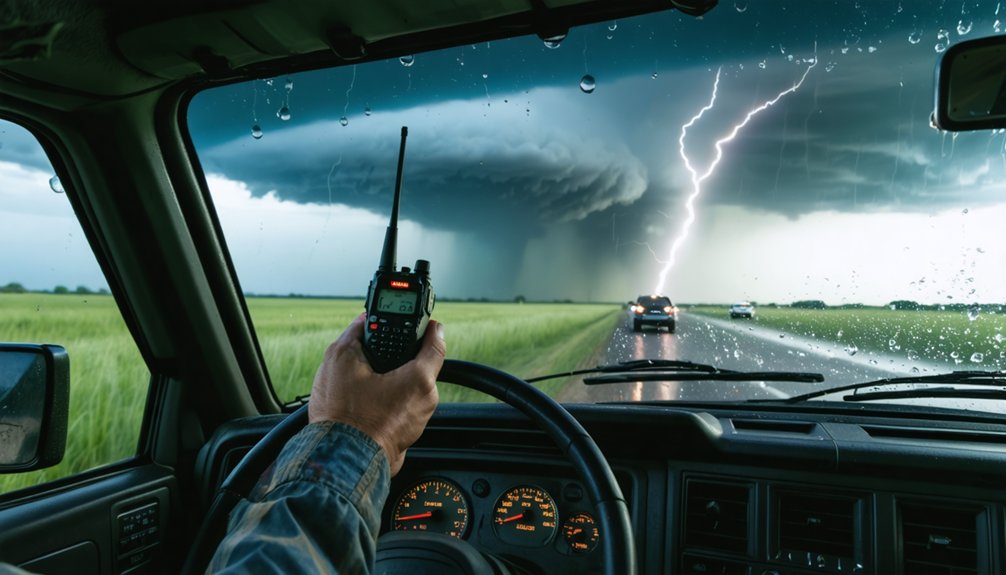
Clear communication in storm chasing isn’t optional—it’s what keeps you alive. Conditions shift within seconds, so you need standardized language to eliminate ambiguity and accelerate response times. You rely on satellite phones, two-way radios, and GPS-integrated devices to coordinate escapes and relay real-time data. Weak communication strategies create life-threatening gaps in situational awareness. Master these protocols, and you’ll understand exactly how every layer of your communication system works together under pressure.
Key Takeaways
- Standardized language eliminates ambiguity, accelerates response times, and ensures every team member reacts correctly when conditions shift within seconds.
- Satellite phones and two-way radios provide layered communication coverage, preventing dangerous information gaps in areas without cellular service.
- Daily equipment inspections verify signal strength and device reliability, reducing the risk of communication failure during active chases.
- Real-time radar, GPS, and meteorological data integration enables instant escape route recalculation, keeping teams safely ahead of storm movement.
- Coordinated team communication enhances situational awareness, reduces cognitive bias, and ensures critical storm shifts are never overlooked.
Why Clear Communication Keeps Storm Chasers Alive
When a storm shifts unexpectedly, clear communication isn’t a convenience—it’s the difference between a safe retreat and a fatal mistake. You’re operating in an environment where conditions change within seconds, and weak communication strategies cost lives.
Standardized language eliminates ambiguity. When every team member uses identical terminology, you reduce misinterpretation and accelerate response times.
Standardized language isn’t optional—it’s the foundation that keeps every team member aligned when seconds matter.
Teamwork dynamics further reinforce this precision—each person understands their specific role, whether maneuvering, collecting data, or monitoring escape routes.
Data supports this directly: teams implementing rigorous communication protocols experience approximately 30% fewer incidents. You maintain satellite phones for primary contact, two-way radios as backup, and conduct daily equipment checks to confirm everything functions reliably.
Your freedom to chase storms safely depends entirely on how effectively your team communicates under pressure.
Satellite Phones, Radios, and Gear Every Chase Team Needs
When you’re operating in areas with no cell coverage, you need satellite phones as your primary contact tool and two-way radios as your backup when satellite systems fail.
You should run daily checks on all antennas and cables, confirming each component shows no wear or damage before you deploy.
Redundant systems aren’t optional — they’re what keep your team connected when a primary device fails mid-chase.
Essential Communication Device Types
Reliable communication devices are the backbone of any chase team’s safety infrastructure. When you’re operating in remote zones with zero cell coverage, communication technology isn’t optional—it’s critical.
Device reliability directly determines whether your team stays coordinated or gets caught off-guard by rapid storm shifts.
Your kit should include:
- Satellite phones – maintain contact beyond cellular range
- Two-way radios – enable instant voice coordination between team members
- Radio backup systems – activate immediately when primary devices fail
- GPS-integrated devices – track storm movement and adjust escape routes in real time
You must conduct daily equipment checks, inspecting antennas and cables for wear or damage.
Redundant systems aren’t excessive—they’re essential. Every device you carry multiplies your team’s ability to respond accurately when conditions deteriorate fast.
Daily Equipment Inspection Protocols
Every chase day begins with a non-negotiable equipment inspection cycle before a single vehicle leaves the staging area.
You’ll run through structured inspection schedules covering satellite phones, two-way radios, antennas, and all connecting cables. Check each antenna mount for physical stress fractures, and verify cable connections show zero corrosion or wear. Power on every device, confirm signal acquisition, and test transmission clarity across all channels.
Equipment maintenance isn’t optional—it’s your operational foundation. A failed satellite phone during a tornadic event eliminates your primary lifeline. A damaged antenna cable degrades radio range precisely when you need maximum coverage.
Document every inspection finding using a standardized checklist, flagging any compromised component for immediate replacement. Your freedom to chase safely depends entirely on gear that performs without hesitation when conditions deteriorate rapidly.
Standardized Language Every Storm Chasing Team Should Use
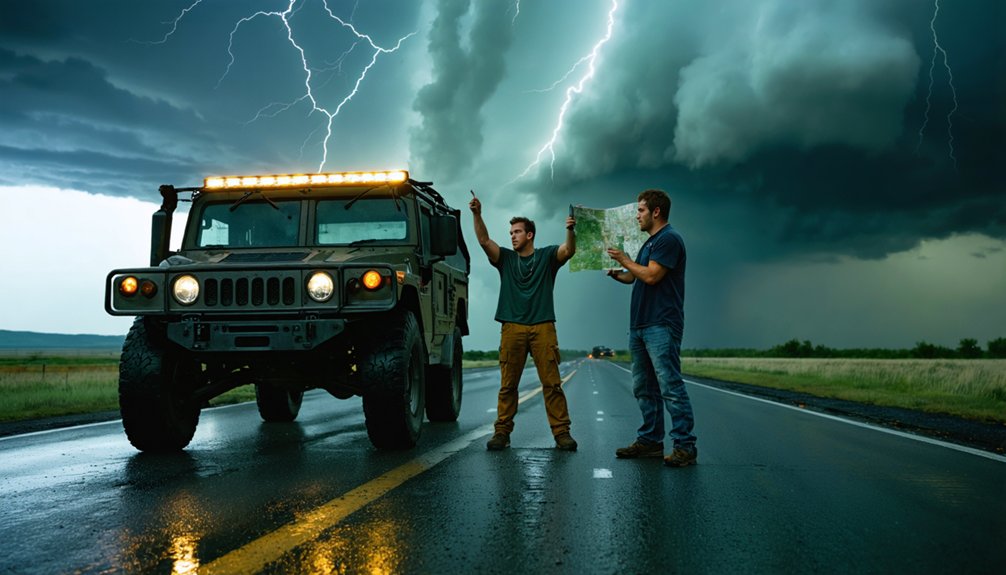
When your team adopts standardized language, you eliminate ambiguity and reduce the risk of costly misunderstandings during fast-moving storm events.
You should establish common terms for everything from storm position to evacuation signals, ensuring every member reacts quickly and accurately when conditions shift.
Unified protocols don’t just streamline communication—they directly reinforce your team’s safety by giving everyone a shared operational framework under high-stress conditions.
Common Terms Prevent Misunderstandings
Standardized language acts as a critical safety mechanism in storm chasing, cutting through confusion when conditions shift in seconds. When you use common terminology, your team processes information faster, enabling efficient exchanges that directly impact survival decisions.
Core standardized terms your team must adopt:
- Bearing: Direction of storm movement relative to your position
- Hook echo: Radar signature indicating possible tornado formation
- Escape vector: Your pre-planned evacuation route direction
- Inflow zone: Dangerous area feeding air directly into the storm
Without these shared definitions, you risk misinterpretation during critical moments.
Studies show standardized protocols reduce communication errors considerably under high-stress conditions. You’ll react faster, coordinate tighter, and maintain situational awareness when every team member operates from identical linguistic frameworks.
Precision in language equals precision in safety.
Unified Protocols Enhance Safety
Unified protocols transform how your team handles emergencies by eliminating ambiguous language that costs critical seconds. When every member uses identical terminology, you’re cutting response delays and reducing miscommunication risks that compromise safety margins.
Unified training guarantees each team member interprets directives identically, whether you’re executing a rapid repositioning or coordinating with NWS officials. Data consistently shows that standardized teams experience approximately 30% fewer incidents during high-pressure deployments.
Protocol benefits extend beyond basic safety. You’ll notice sharper situational awareness, faster decision execution, and cleaner data collection under volatile conditions.
Every standardized phrase your team masters directly translates into operational efficiency when storms escalate unpredictably.
Establish your protocols before deployment, drill them consistently, and you’ll maintain the tactical freedom necessary to respond accurately when severe weather demands immediate, precise action.
How Real-Time Data Shapes Communication During a Chase
Real-time data drives every critical decision you make during a chase. Through seamless data integration, you’re constantly synthesizing radar feeds, GPS positioning, and atmospheric readings to stay ahead of rapidly evolving conditions.
Real-time tracking lets you monitor storm movement against your escape routes with precision, giving you the autonomy to adjust instantly.
Effective real-time communication relies on:
- Radar data pinpointing storm position relative to your current location
- GPS tracking updating route adjustments as storm vectors shift
- Live meteorological feeds delivering accurate wind speed and pressure readings
- Streaming updates alerting emergency services and the public to active hazards
Each data stream sharpens your situational awareness, eliminates guesswork, and keeps your team coordinated when conditions deteriorate without warning.
Planning Escape Routes With Your Storm Chasing Team
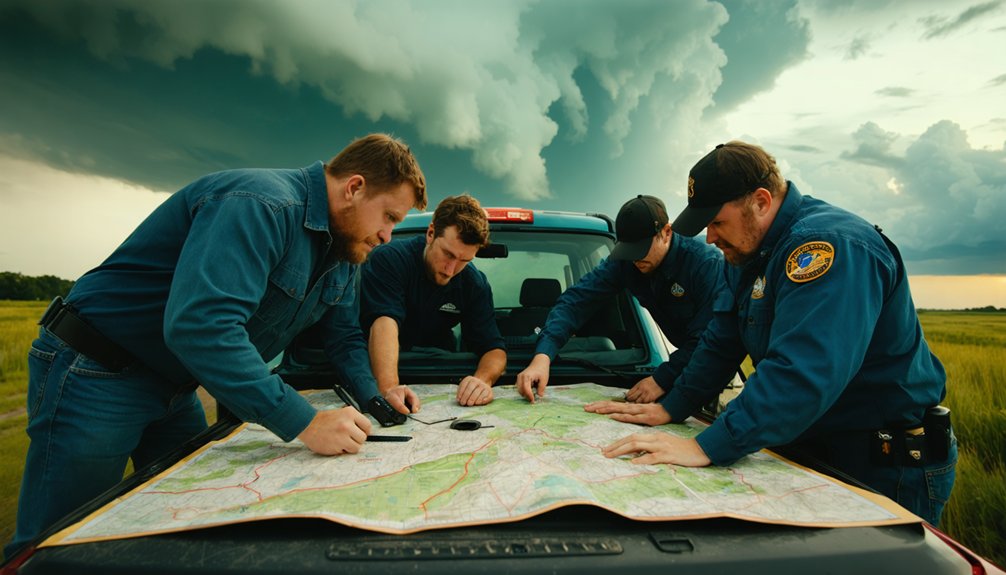
Before a storm intercept begins, you need at least two separate escape routes mapped and confirmed with your team. Each route should head in a different direction, prioritizing paved, elevated roads that won’t flood or become impassable under severe conditions.
Your escape route strategies must account for real-time storm movement. If the storm shifts, your team navigation techniques should allow immediate route recalculation without confusion or delay. Assign one member specifically to monitor GPS data and communicate adjustments clearly using standardized language everyone recognizes.
Maintain buffer zones between your vehicles and the storm at all times. Traveling in pairs keeps your driver focused while a second member tracks storm position.
These coordinated protocols preserve your freedom to exit safely when conditions deteriorate faster than anticipated.
Why Chasing as a Team Keeps Everyone Safer
When you chase as part of a coordinated team, you’re not just sharing the workload—you’re actively reducing your risk exposure. Strong team dynamics improve situational awareness and sharpen real-time risk assessment, cutting incident rates by roughly 30% through disciplined safety protocols.
Teams operating together gain these critical advantages:
- Divided roles keep the driver focused while others monitor storm position and escape corridors.
- Collective decision-making reduces cognitive bias during high-stress, rapidly evolving conditions.
- Redundant observation guarantees no critical storm shift goes unnoticed.
- Psychological resilience improves through shared pressure and mutual accountability.
You’re also building trust that directly translates into faster, more accurate responses when conditions deteriorate.
Chasing solo strips away these layers of protection—chasing as a team compounds your safety margins exponentially.
How Storm Chasers Report Events to the NWS and Local Services
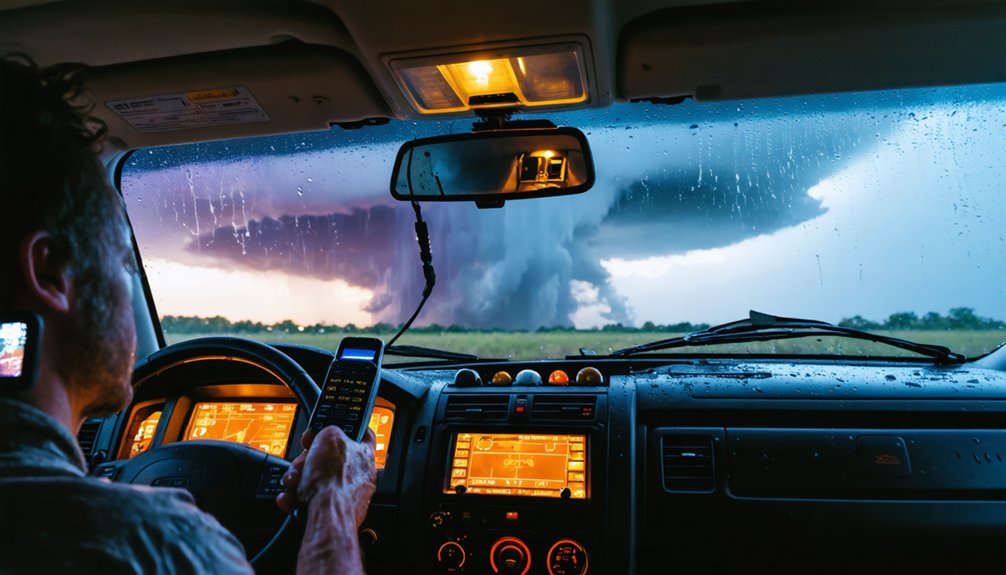
Coordinated teamwork doesn’t stop at keeping your crew safe—it extends outward to public safety through direct reporting to the National Weather Service and local emergency services.
When you witness a storm event, you submit precise data to NWS Reporting channels—location coordinates, time of occurrence, storm type, and intensity. That data directly supports official warnings and emergency response decisions.
You’ll also collaborate with local emergency services, sharing real-time updates so responders can position resources accurately.
Live streaming and social media amplify your reports, keeping civilians informed and increasing reaction time.
Every data point you contribute strengthens public meteorological records and refines future forecasting models.
Accurate, timely reporting isn’t optional—it’s a core responsibility that transforms your field observations into actionable intelligence protecting communities beyond your immediate chase zone.
Backup Protocols When Primary Communication Fails Mid-Chase
Even the most reliable satellite phone can fail mid-chase, so you need layered backup protocols ready before conditions deteriorate. Redundant systems’ importance can’t be overstated—single-point failures cost lives. Your backup communication strategies should activate instantly without debate.
Implement these protocols before every chase:
- Switch immediately to two-way radios if satellite contact drops
- Monitor a pre-assigned radio frequency shared with your entire team
- Confirm daily equipment checks on all antennas and cables for wear or damage
- Designate a secondary contact person outside the field who relays critical data
You don’t have freedom on the road without reliable communication infrastructure supporting every decision.
Test each redundant layer before departure, verify signal strength, and guarantee every team member executes the switchover without hesitation when primary devices fail.
Frequently Asked Questions
How Do Storm Chasers Manage Communication Fatigue During Extended Multi-Day Chases?
You’ll combat communication fatigue by rotating team roles, using standardized language to reduce cognitive load, and scheduling check-ins strategically. These communication strategies and fatigue management protocols keep you sharp, ensuring reliable coordination across extended multi-day chases.
What Psychological Training Helps Chasers Communicate Effectively Under Extreme Stress?
You’ll leverage cognitive restructuring techniques and psychological resilience training to sharpen crisis communication under extreme stress. These stress management methods reduce bias, boost situational awareness, and enhance your risk assessment accuracy by approximately 30% during high-stakes chasing operations.
How Are Communication Protocols Adapted for International Storm Chasing Operations?
Like a universal key, you’ll adapt international protocols by standardizing terminology across language barriers, embracing cultural considerations, and syncing real-time GPS data, ensuring your team communicates precisely, reacts swiftly, and maintains safety freedom during cross-border storm chasing operations.
Can Minors Legally Participate in Storm Chasing Communication Roles?
Minors can participate if you’ve secured parental consent and completed safety training. Legal age requirements vary by jurisdiction, but role responsibilities—like radio monitoring—remain clearly defined, ensuring you’re contributing effectively while maintaining personal freedom and operational safety.
How Do Chasers Handle Communication Barriers When Working With Non-English Speakers?
Like Babel’s builders, you tackle language barriers by using standardized visual protocols, translation apps, and culturally trained team members who understand cultural nuances, ensuring you communicate storm data precisely and freely across all linguistic boundaries.
References
- https://crazystormchasers.com/importance-of-backup-communication-systems-in-risk-assessment/
- https://www.youtube.com/watch?v=nPJlSzjyuAc
- https://crazystormchasers.com/community-engagement-in-storm-chasing-safety-measures/
- http://nwafiles.nwas.org/digest/papers/2004/Vol28/Pg59-Pietrycha.pdf
- https://www.reddit.com/r/stormchasing/comments/lvub71/how_important_are_storm_chasers_in_giving_data_or/
- https://midlandusa.com/blogs/blog/storm-chasers-rely-on-walkie-talkies-to-communicate
- https://crazystormchasers.com/the-role-of-teamwork-in-storm-chasing-championships/
- https://en.wikipedia.org/wiki/Storm_chasing
- https://www.speakap.com/insights/winter-storm-communication
- https://www.weather.gov/spotterguide/safetyfirst