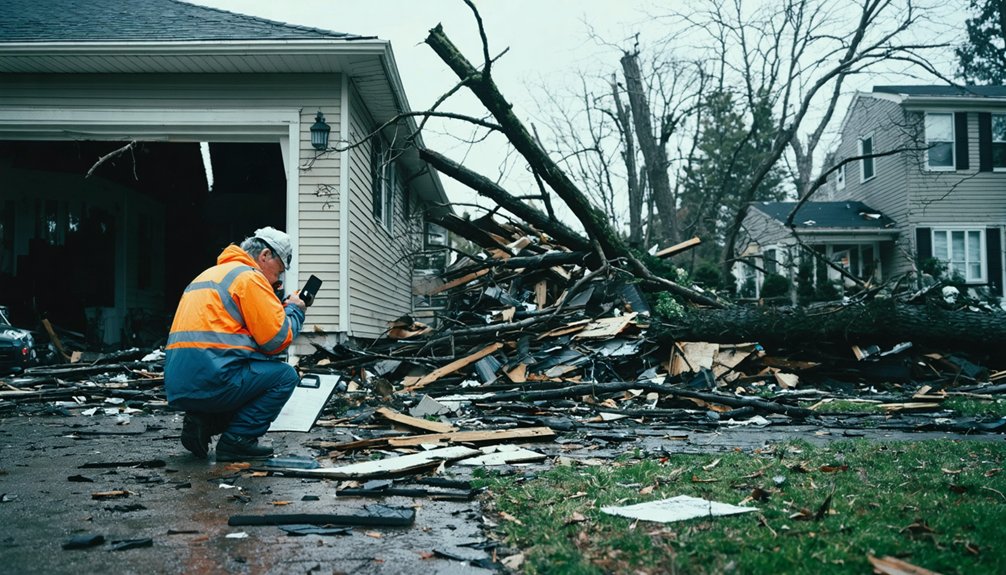
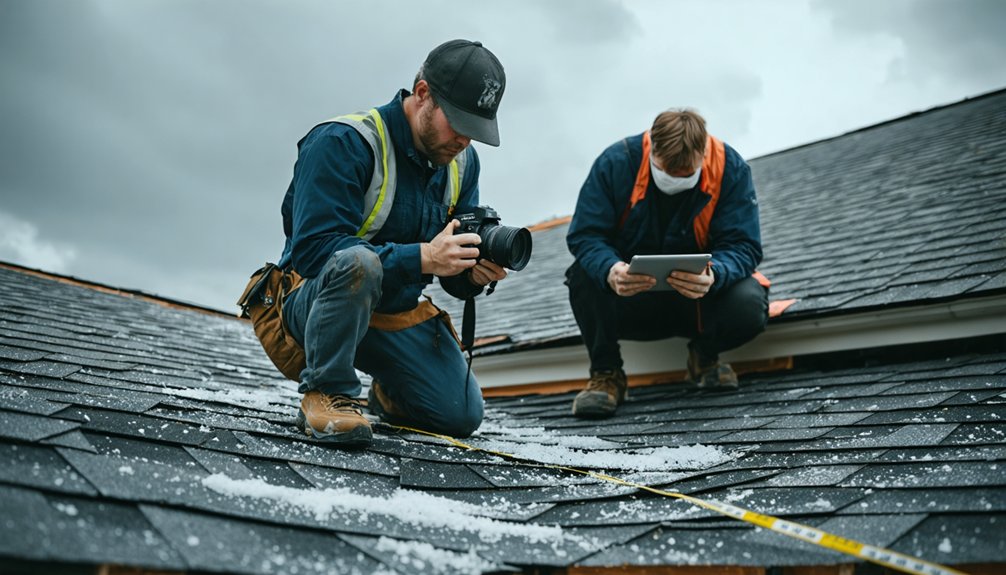
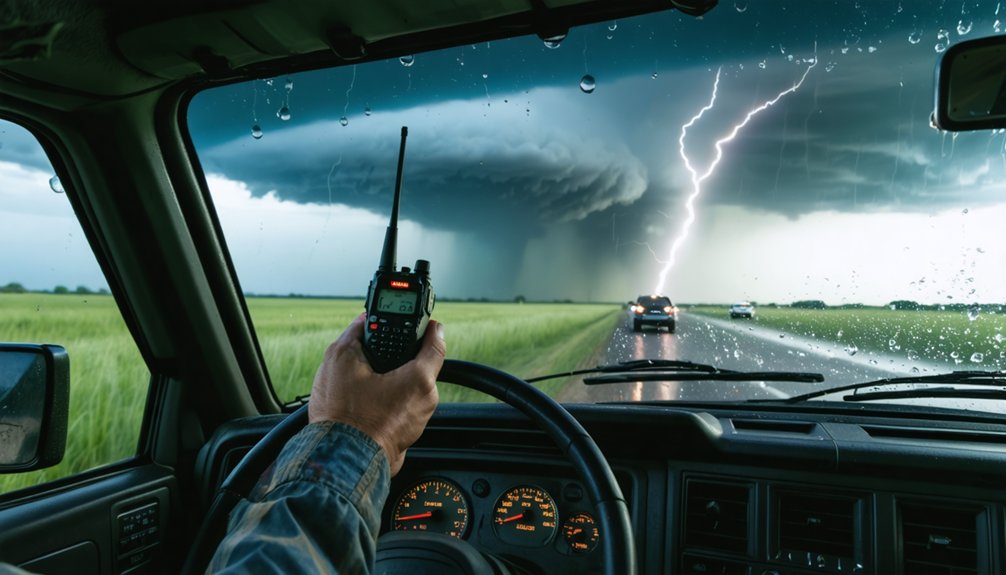
Overcoming communication hurdles in severe weather storm chasing requires building a layered system before you roll out. You can’t rely on a single channel when cellular networks collapse under surge traffic and storm interference degrades radio signals. Carry devices on separate carriers, include a satellite phone, and assign clear radio roles to every team member. Pre-test everything, download offline maps, and define your communication stack in advance — the strategies ahead will sharpen your entire approach.
Key Takeaways
- Establish a communication stack before departure, ranking channels by reliability and assigning specific roles to phones, radios, and satellite devices.
- Carry multiple smartphones on different carriers and include a satellite phone to maintain connectivity when terrestrial infrastructure fails.
- Use VHF/UHF two-way radios for direct vehicle-to-vehicle communication, operating independently of commercial towers during severe weather.
- Run live radar overlays alongside pre-downloaded offline maps to maintain situational awareness and confirm escape routes without service.
- Conduct full pre-departure testing of all devices, including antenna inspection, battery checks, GPS confirmation, and satellite phone registration.
Why Storm Chasers Lose Communication at the Worst Moments
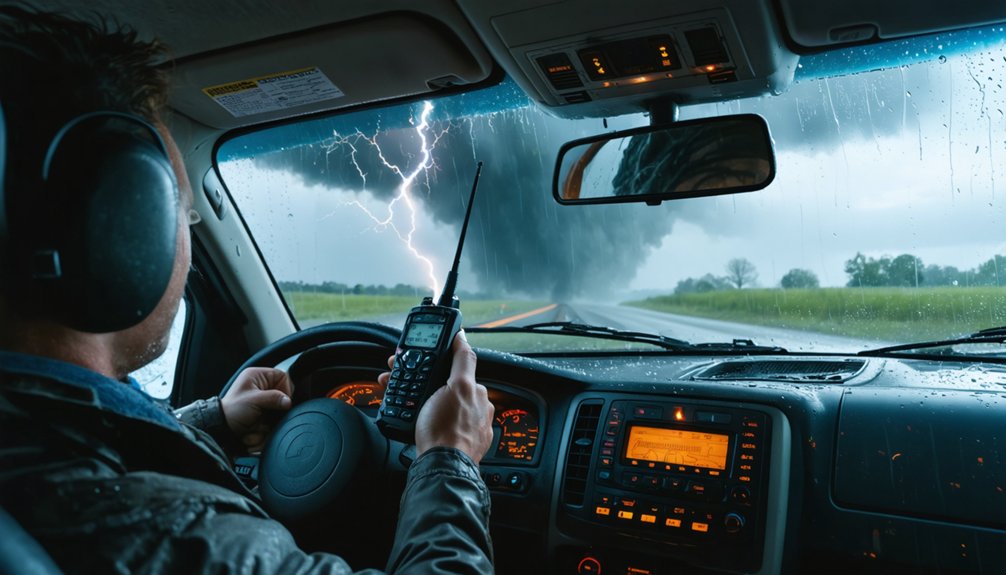
When a tornado wedges across the highway and you’re burning escape routes in real time, that’s precisely when cellular networks collapse under the surge of simultaneous calls, texts, and data requests from panicked residents, emergency responders, and chasers all competing for the same overloaded towers.
Storm-generated signal interference compounds the problem—torrential rain, hail cores, and electrically charged supercells actively degrade VHF/UHF radio propagation and disrupt satellite link stability.
Communication barriers also emerge structurally: vehicles separate across blocked highways, chaser-congested corridors saturate local frequencies, and multiple storm cells simultaneously demand your attention across different geographic zones.
Each failure point strips away one layer of your operational awareness precisely when situational clarity matters most. Understanding why these breakdowns occur is the foundation for engineering systems that won’t abandon you mid-chase.
Build Your Storm Chasing Communication Stack Before You Roll
Before you leave your driveway, you need to define your primary communication channels—mobile phones on separate carriers, two-way VHF/UHF radios, and satellite phone—so every team member knows exactly which link to use and when.
Once your primary channels are set, layer in redundant devices that operate independently of one another, ensuring at least one pathway survives a tower outage, network overload, or equipment failure mid-chase.
Test every device, antenna connection, and power source before departure, because a fault you discover in the field during a rapidly evolving storm is a fault you can’t afford.
Define Your Primary Channels
Every successful chase operation starts with a deliberate audit of your communication stack before you ever leave the staging area.
Define your primary channels explicitly—don’t assume everyone knows which device takes priority. Assign mobile phones, two-way radios, satellite phones, and mobile data terminals to specific roles within your communication protocols before conditions deteriorate.
Rank each channel by signal reliability, geographic coverage, and failure tolerance. Your primary channel should handle routine coordination; your secondary channel should activate automatically when the primary degrades.
Document these assignments in writing and distribute them to every team member.
Pre-defining channels eliminates hesitation during critical phases. When a supercell accelerates or escape routes shift, you need instant clarity—not a debate about which radio frequency to use.
Layer In Redundant Devices
Defining your primary channels gives you a framework—but a single-channel framework fails the moment a cell tower goes down or a carrier’s network saturates under storm traffic.
Redundant systems eliminate that single point of failure. Carry two smartphones on separate carriers so one network’s collapse doesn’t silence you. Add a satellite phone for remote stretches where terrestrial infrastructure simply doesn’t exist.
Mount VHF/UHF two-way radios for direct vehicle-to-vehicle coordination that requires zero commercial infrastructure. Layer a mobile data terminal on top for live radar feeds via cellular or satellite internet.
Each of these communication devices operates on a different pathway, meaning network degradation on one layer leaves the others fully functional. Stack the layers deliberately, test each before you roll, and you stay operational when conditions deteriorate fastest.
Test Everything Before Departure
Redundant layers mean nothing if any one of them is broken when you need it most. Run a full pre-departure checklist before every chase—no exceptions.
Key each radio, confirm satellite phone registration, verify mobile data sync, and check battery levels across every device. Swap in fresh batteries if anything reads below threshold.
Inspect antennas and cables for corrosion, fraying, or loose connectors that kill signal without warning. Equipment testing isn’t ceremonial; it’s your last controlled opportunity to catch failures before conditions force your hand.
Confirm that offline maps are downloaded and GPS units lock correctly. Brief every team member on what’s operational and what’s degraded.
You’re not chasing with broken gear—identify the fault, fix it, or replace it before you roll.
Choose Devices That Survive Severe Weather Conditions
When selecting communication devices for storm chasing, you’ll need to prioritize durability alongside signal performance. Device durability directly determines whether your gear survives hail strikes, torrential rain, and relentless vehicle vibration.
Choose units rated for weather resistance—specifically those meeting IP67 or higher ingress protection standards—to guarantee continued operation in extreme moisture and debris exposure.
Evaluate each device’s casing material, connector quality, and antenna resilience under mechanical stress. Ruggedized satellite phones, reinforced two-way radios, and hardened mobile data terminals outperform consumer-grade equipment when conditions deteriorate rapidly.
Mount devices securely to minimize vibration damage during high-speed repositioning on rough roads.
Cross-reference manufacturer specifications against actual field conditions you’ll encounter. A device that fails mid-chase because it couldn’t handle rain defeats your entire communication strategy before it starts.
Keep Your Gear Powered Through Long Chase Days
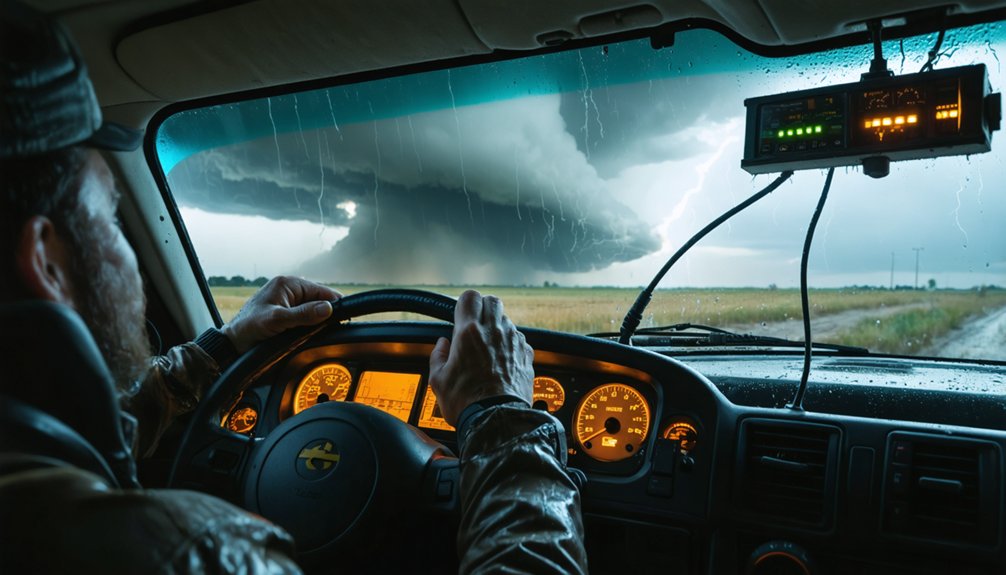
Even with durable, fully functional gear, a dead battery renders every device useless at the worst possible moment. Effective power management starts before you leave your staging area. Test every battery, confirm every charge level, and pack spares for radios, phones, and mobile data terminals.
During extended operations, rely on in-vehicle power supplies and portable battery banks to keep devices running continuously. Solar panels offer an additional layer of independence when grid access is unavailable.
Integrate power checks into your routine gear maintenance schedule so you’re identifying weak cells before they fail in the field. Carry dedicated chargers for each device and know your draw rates.
Understanding how long each unit runs under load lets you prioritize power allocation when conditions demand sustained, uninterrupted communication.
Why Satellite Phones Are Non-Negotiable in Dead Zones
When you chase storms across remote plains or through disaster-struck corridors, cellular networks frequently collapse under tower damage, network congestion, or simple geographic absence.
You can’t afford that failure point, so a satellite phone gives you a direct uplink independent of terrestrial infrastructure, keeping your team reachable regardless of conditions on the ground.
Treat it as non-negotiable: without that backup, a dead zone doesn’t just cut your communications—it cuts your margin for survival.
Cellular Networks Often Fail
Cellular networks collapse precisely when storm chasers need them most. Tower infrastructure sustains direct physical damage from high winds, hail, and flooding.
Simultaneously, surviving towers face overwhelming demand as emergency calls surge across entire regions. You’ll experience communication breakdowns at the worst possible moments—when you’re repositioning ahead of a violent supercell or coordinating an escape route with your team.
Signal interference compounds these failures. Atmospheric disruption, precipitation static, and physical obstructions degrade already-strained cellular signals further.
You can’t depend on a single commercial carrier when conditions deteriorate this rapidly. Redundant communication architecture isn’t optional—it’s operational survival.
Carrying devices on multiple carriers buys marginal improvement, but satellite phones eliminate your dependency on terrestrial infrastructure entirely, giving you independent, reliable communication regardless of ground-level network conditions.
Satellite Phones Ensure Reliability
Satellite phones operate on three fundamental advantages that make them non-negotiable for dead-zone communication: they bypass terrestrial cell towers entirely, they function in remote areas with zero commercial coverage, and they remain operational when ground-level infrastructure is physically destroyed.
When cellular networks collapse under storm pressure, satellite reliability becomes your operational lifeline. You’re not dependent on carriers, towers, or regional infrastructure—you’re communicating directly through orbiting systems that severe weather can’t touch.
Build satellite phones into your communication protocols as a primary fallback, not an afterthought. Test them before each chase, confirm signal acquisition, and assign a designated operator.
In dead zones where escape routes must be communicated instantly, satellite capability isn’t optional equipment—it’s the difference between coordinated movement and dangerous isolation.
Remote Areas Demand Backup
Dead zones don’t announce themselves—you find out you’re in one when a critical transmission fails to connect. In remote terrain, cellular infrastructure simply doesn’t exist, making satellite phones non-negotiable rather than optional.
Your remote communication strategies must account for this reality before you’re in the field, not during a developing situation.
Satellite phones operate independently of terrestrial towers, maintaining connectivity where every other device fails. That independence directly determines emergency protocol effectiveness—if your backup system requires the same infrastructure your primary system lost, it isn’t actually a backup.
Carry a satellite phone fully charged, tested, and immediately accessible. Program emergency contacts before departure.
When roads flood and cells go dark, your satellite link becomes your only thread to coordinated safety.
Two-Way Radios Still Matter More Than You Think
When cell towers go down or get overwhelmed during a severe weather event, two-way radios don’t care—they keep working. They’re your direct, infrastructure-free link between vehicles, solving radio communication challenges that cellular networks simply can’t handle.
Implementing effective radio protocols keeps your team coordinated when conditions deteriorate fast.
Two-way radios deliver critical advantages you shouldn’t overlook:
- Line-of-sight transmission operates independently of commercial towers
- VHF/UHF frequencies enable direct vehicle-to-vehicle coordination instantly
- Local emergency services can sometimes share your radio channel
- No subscription or network dependency means zero blackout risk from carrier failure
- Standardized terminology enforced over radio reduces misinterpretation during high-stress maneuvers
You maintain operational freedom when you’re not dependent on infrastructure someone else controls.
Keep radios tested, charged, and ready before every chase.
How Storm Chasing Teams Assign Radio Roles That Actually Work
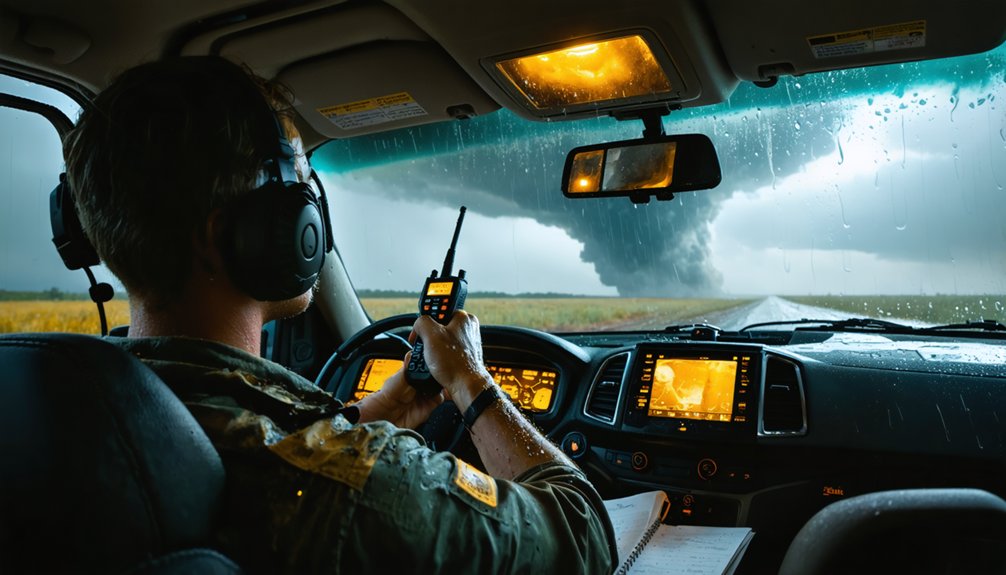
Effective radio coordination collapses without clearly assigned roles, so storm chasing teams structure responsibilities before the chase begins. You’ll typically designate a primary radio operator, a driver-navigator, and a dedicated spotter. Each role carries specific communication tasks, eliminating overlap and reducing transmission errors during high-pressure moments.
Role clarity directly drives communication efficiency. Your radio operator manages channel monitoring, initiates emergency traffic, and relays positioning updates. Your navigator processes incoming data without transmitting unnecessarily. Your spotter calls storm movement using standardized terminology, keeping transmissions brief and actionable.
Pre-chase briefings lock these assignments in place before conditions deteriorate. When everyone understands their function, you eliminate redundant calls, cut response time, and maintain coordinated movement across multiple vehicles—even when visibility drops and escape routes demand immediate, precise execution.
Run Live Radar and Offline Maps at the Same Time
Maintaining situational awareness during a chase requires you to run live radar overlays and offline maps simultaneously, not as redundant systems but as complementary data layers.
Live data integration feeds real-time storm position while downloaded state maps hold firm when cell service drops. Mapping synchronization ties both layers together, keeping your routing decisions grounded in current conditions.
- Load pre-downloaded regional maps before leaving basecamp
- Pair cellular radar apps with satellite internet as a fallback feed
- Sync GPS coordinates across both systems to eliminate positional drift
- Flag hail cores and flood zones on offline maps using pre-chase markup
- Cross-reference live radar returns against offline road networks to confirm escape routes
Neither layer alone gives you full operational freedom—run both or accept blind spots.
Frequently Asked Questions
How Do Storm Chasers Communicate With Local Emergency Services During Active Tornadoes?
You’ll use two-way radios following established radio protocols to contact local emergency services directly. Transmit emergency alerts concisely, prioritize critical storm data, and coordinate vehicle movements efficiently—ensuring responders receive accurate, real-time tornado positioning without depending on compromised cellular infrastructure.
What Standardized Terminology Do Storm Chasing Teams Use During High-Stress Situations?
You’ll use standardized storm terminology—consistent storm-movement calls, route labels, and emergency phrases—to guarantee communication clarity. These predefined terms align your team’s understanding, reduce misinterpretation, and keep responses sharp when visibility drops or escape routes demand immediate coordination.
How Do Teams Coordinate Movements When Multiple Storm Cells Appear Simultaneously?
You coordinate team dynamics by assigning vehicles to separate cells, using predefined protocols and real time updates via hybrid data systems, so you’re maintaining situational awareness across all targets while keeping escape routes and communication channels clear.
What Pre-Chase Briefing Protocols Help Reinforce Communication Under Extreme Fatigue?
Pre-chase briefings that could save a thousand lives sharpen your fatigue management by drilling standardized terminology, assigning clear roles, and rehearsing emergency protocols—maximizing briefing effectiveness so you execute flawlessly when stress and exhaustion peak during critical chasing phases.
How Do Chasers Handle Communication When Highways Are Blocked or Congested?
When highways block your path, you’ll deploy roadblock strategies and congestion tactics by switching to two-way radios, coordinating alternate routes via mobile data terminals, and using pre-planned protocols to keep vehicles moving freely and independently.
References
- https://www.comet.ucar.edu/increasing-awareness-and-understanding-severe-weather-through-storm-chasing-education
- https://crazystormchasers.com/importance-of-backup-communication-systems-in-risk-assessment/
- https://stormchaser.com/Storm-Chasing-Safety.pdf
- https://ams.confex.com/ams/pdfpapers/83867.pdf
- http://nwafiles.nwas.org/digest/papers/2004/Vol28/Pg59-Pietrycha.pdf
- https://www.youtube.com/watch?v=AswKDts1i0o
- https://midlandusa.com/blogs/blog/storm-chasers-rely-on-walkie-talkies-to-communicate
- https://www.atms.unca.edu/cgodfrey/courses/swfex/pdf/ChasingSafety.pdf
- https://www.reddit.com/r/stormchasing/comments/1hiplyk/storm_chasing_problems_internet_and_hail/
- https://stormtrack.org/threads/the-disparate-nature-of-storm-chasing-knowledge-how-do-we-fix.30976/