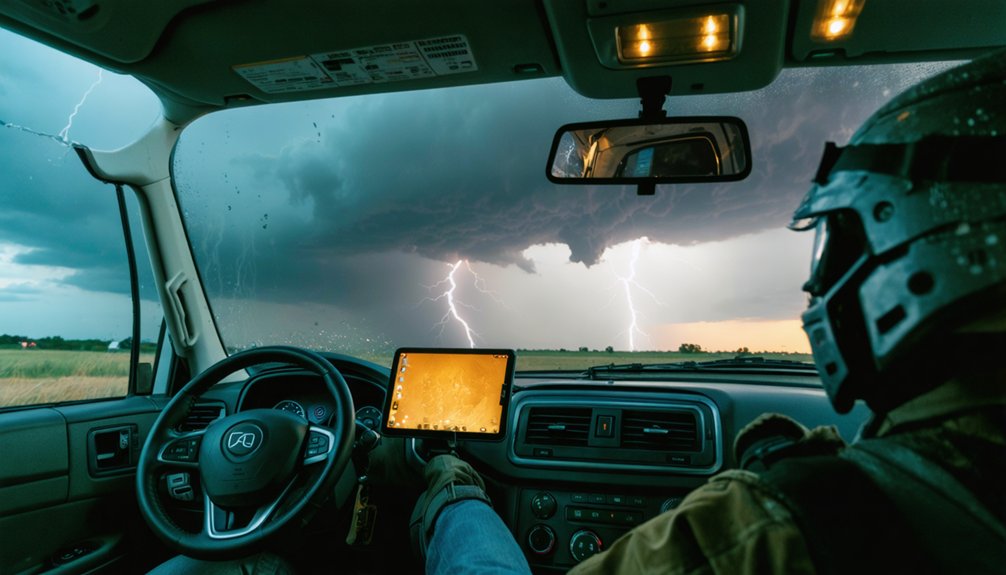
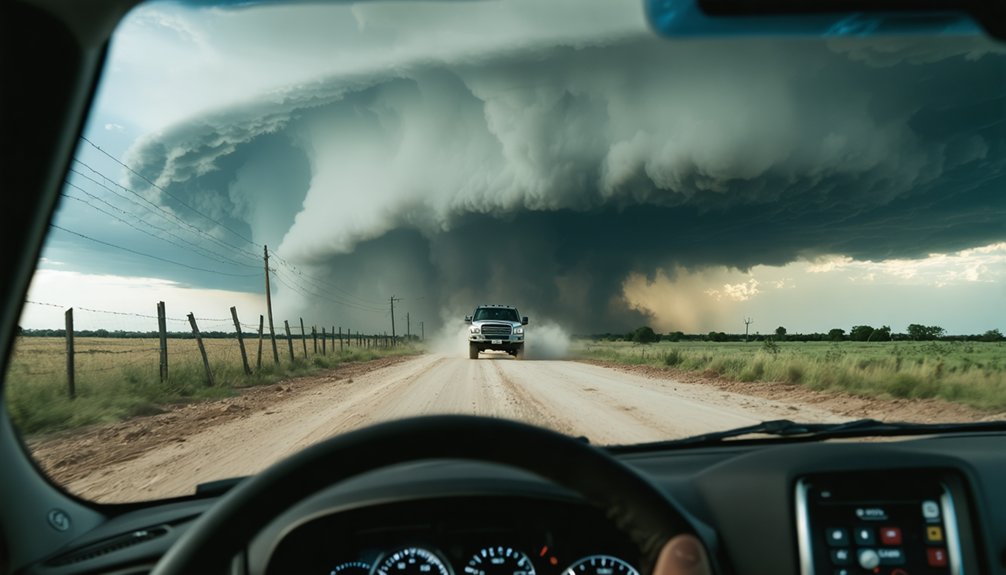
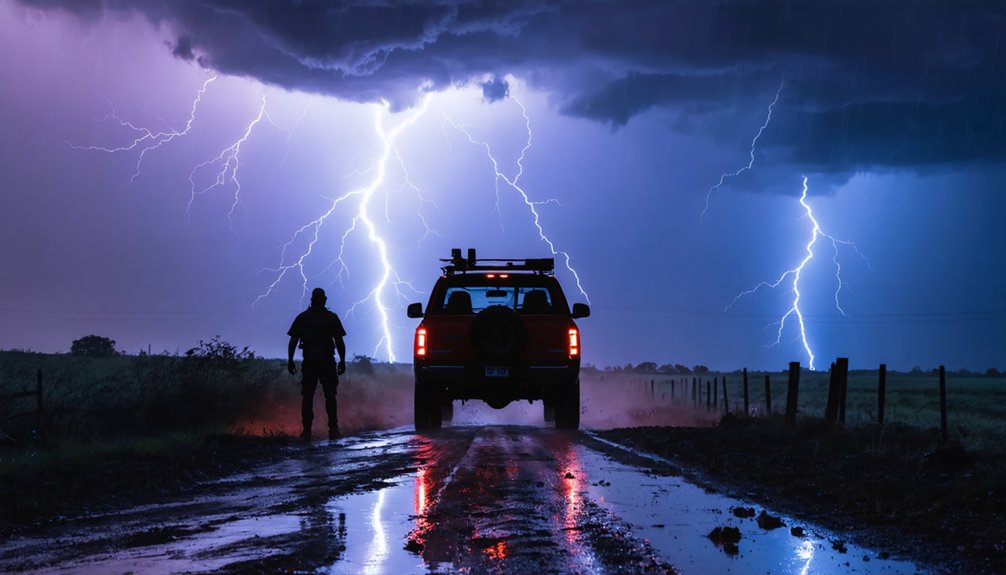
Storm chasing kills unprepared chasers every year, and the same preventable mistakes are almost always to blame. You must approach storms from the west, south, or east — never the north. Maintain visual contact at all times, abandon the chase if escape routes close, and never rely solely on delayed radar data. Chase with a trained partner, stay on public roads, and act immediately when conditions turn lethal. The full picture goes much deeper.
Key Takeaways
- Always approach storms from the west, south, or east; never from the north to avoid the most dangerous quadrants.
- Abandon the chase immediately if visibility drops, escape routes close, or storm conditions outpace your repositioning ability.
- Never rely solely on radar; use direct observation, instincts, and multiple data sources for real-time situational awareness.
- Chase with at least one trained partner, establish communication protocols beforehand, and confirm all equipment before departure.
- Avoid chasing after dark, core-punching, or positioning beneath rotating wall clouds, as these decisions exponentially increase fatal risk.
Why Storm Chasing Kills Unprepared Chasers
Storm chasing kills unprepared chasers because they underestimate how fast conditions deteriorate and how little margin for error exists when a tornado shifts direction. You’re dealing with dynamic weather patterns that rewrite themselves in seconds, not minutes.
Storm damage escalates rapidly when chasers misread positioning, lose visual contact, or chase after dark when visibility collapses. You can’t rely on delayed radar data alone to make life-or-death decisions.
Without a trained partner, a planned escape route, and constant situational awareness, you’re gambling with physics you can’t negotiate with. Unprepared chasers also ignore critical protocol—they core-punch storms, cross north of circulation, and make impulsive repositioning choices.
Every one of those errors compounds risk exponentially. Freedom in storm chasing is earned through discipline, preparation, and respect for the storm’s raw, indifferent power.
Read the Storm Before You Get Close
Knowing why chasers die is only half the equation—the other half is understanding what a storm tells you before you commit to closing distance.
Read cloud formation carefully—rotating wall clouds, rapid vertical development, and inflow bands signal storm intensity and imminent tornado production. If you lose sight of the tornado-producing region, reposition immediately.
Never approach from the north; work from the west, south, or east where your escape routes stay open.
Avoid core-punching, which blinds you to hail, embedded tornadoes, and sudden wind shifts.
Don’t chase low-visibility storms where your situational awareness collapses.
Radar helps, but it’s delayed—what you see with your eyes overrules what a screen shows.
Trust visual cues, maintain distance from fast-movers, and never let positioning pressure override what the storm is clearly communicating.
Approach Angles and Safe Distances That Keep You Alive
Where you position yourself relative to a tornado determines whether you survive an intercept or become a statistic. Approach angles matter enormously—always intercept from the west, south, or east. Never approach from the north; you’ll find yourself directly in the tornado’s path with no escape route.
Safe distances depend on the tornado’s speed and direction. Fast-moving tornadoes shrink your reaction window dramatically, so maintain greater separation than you think you need. If you lose visual contact with the tornado region, reposition immediately—don’t guess. Uncertainty means one thing: bail.
Your freedom to chase tomorrow depends on the discipline you exercise today. Wrong approach angles and miscalculated safe distances don’t offer second chances. Respect the storm’s mechanics, stay mobile, and never let confidence override situational awareness.
How Lightning Threatens Chasers and What to Do Immediately
When a cloud-to-ground lightning strike occurs within one mile of your position, you must move to shelter immediately—hesitation dramatically increases your risk.
Inside your vehicle, roll up the windows, stay put, and avoid touching any electronics or plugged-in adapters, since the car’s metal frame provides critical protection.
If you’re caught in the open without access to a vehicle, crouch low, cover your head, and seek a ditch, culvert, or depression where you can lie flat until the immediate threat passes.
Recognizing Immediate Lightning Dangers
Lightning poses one of the most immediate and unpredictable threats you’ll face while storm chasing, so you’ve got to recognize the danger signs and act without hesitation. Lightning hazards escalate rapidly when storm visibility deteriorates, leaving you exposed with minimal reaction time.
Watch for increasing strike frequency, the smell of ozone, or your hair standing on end—these signal imminent ground strikes. Once cloud-to-ground lightning occurs within one mile of your position, move to shelter immediately. Don’t wait for a second strike to confirm the threat.
Inside your vehicle, roll the windows up and avoid touching electronics or plugged-in adapters. If you’re caught in the open, crouch low, cover your head, or locate a culvert or depression and lie flat to minimize your exposure profile.
Seeking Shelter During Strikes
Knowing the warning signs gets you halfway there—acting on them correctly closes the gap.
Once cloud-to-ground lightning strikes within one mile, you move to shelter immediately—no debate, no delay.
Your vehicle is your primary refuge. Roll the windows up, kill the engine, and stay inside.
Don’t touch electronics or plugged-in adapters; the vehicle’s electrical system becomes a conduction risk during a direct strike.
Lightning awareness means anticipating exposure before it happens.
If you’re caught in the open with zero shelter options nearby, crouch low, minimize your contact points with the ground, and cover your head.
If terrain allows, a culvert, ditch, or depression reduces your exposure profile *considerably*.
Lie flat, cover your head, and wait.
Flat, open ground is never acceptable as a waiting position.
Flood Crossings, Wall Clouds, and Roads That Can Kill You
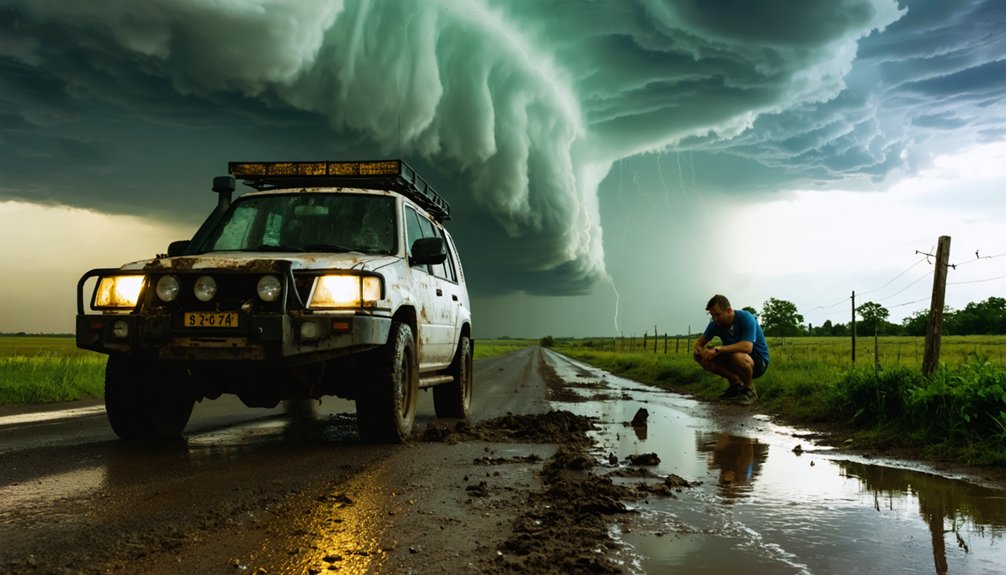
Flood crossings, wall clouds, and compromised road conditions represent some of the most immediate and lethal hazards you’ll face during a chase.
Flood hazards demand absolute decisiveness — if your vehicle stalls in floodwaters, exit immediately and move to higher ground. Never attempt a crossing when water depth is uncertain.
Road quality deteriorates rapidly during severe weather, so adjust your speed and following distance accordingly, and always obey traffic laws regardless of urgency.
Never position your vehicle directly beneath a rotating wall cloud; the structural violence above you can descend without warning.
Avoid driving north across a storm’s path, as that trajectory places you directly in the most dangerous quadrant.
Treat every compromised road as a potential fatal trap, not an acceptable risk.
Build a Chase Team With Defined Roles
Before you head out, assign specific roles to every member of your chase team—one person drives while another handles radar, communication, and navigation.
You shouldn’t let the driver multitask, because split attention in fast-moving storm situations creates dangerous decision delays.
Chase with at least one other experienced partner, and if you’re new, join a commercial tour or trained spotter group before attempting independent operations.
Assign Roles Before Chasing
Building a chase team with defined roles isn’t just a convenience—it’s a core safety requirement. Before you deploy, assign every team member a specific function: driver, navigator, or data analyst. Don’t let your driver multitask—it compromises reaction time and situational awareness during fast-moving events.
Establish clear communication protocols so every member knows how to relay critical updates without creating confusion. Designate who calls the bail-out and who monitors radar. That authority structure prevents hesitation when conditions deteriorate rapidly.
Run through your equipment checklists before departure, confirming radios, GPS units, and cameras are operational. Each team member should know their gear and responsibilities inside out.
When roles are locked in before you roll, your team operates with precision under pressure—exactly when it counts most.
Partner Up for Safety
Once your roles are locked in, the next step is making sure you’re never out there alone. Solo chasing eliminates your safety net entirely. A partner handles navigation, monitors radar, and manages communication protocols while you focus on driving. That division keeps everyone sharper and reactions faster.
Before heading out, confirm your equipment maintenance checklist together — radios, cameras, and vehicles must be field-ready.
- Chase with at least one trained partner who understands storm behavior
- Establish clear communication protocols before departure, not during pursuit
- Assign equipment maintenance responsibilities to a specific team member
- Coordinate repositioning decisions together to avoid impulsive moves
Your freedom on the road depends on preparation. A solid chase team doesn’t slow you down — it keeps you moving safely and decisively.
Why Radar Alone Will Get You Killed
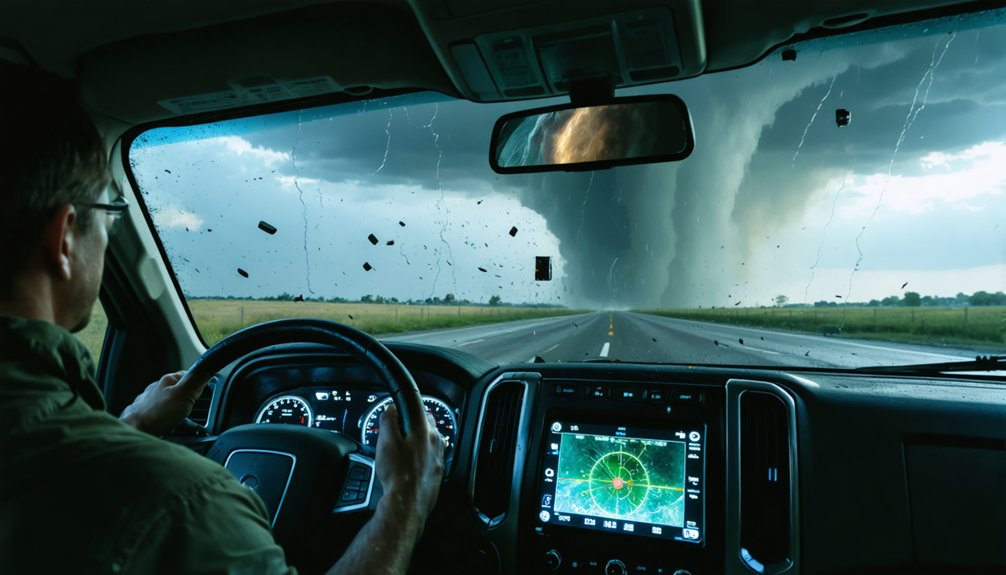
Radar is a powerful tool, but it’ll kill you if you treat it as your only source of truth. Radar limitations are real — data is delayed, never real-time, and storm prediction based solely on it leaves dangerous gaps in your situational awareness.
If conditions look unsafe in front of you, trust what you’re seeing over what the screen shows. Don’t position yourself based on where other chasers are heading; they may be working from the same outdated data you are.
Avoid chasing after dark, when visibility drops and radar becomes even less reliable as your primary guide. Low-visibility situations demand immediate withdrawal.
Your eyes, instincts, and direct observation must work alongside radar — never let one source override the other.
Chase on Public Roads and Leave Private Land Alone
Storm chasing doesn’t give you the right to access any land you choose. Private property boundaries don’t disappear because a tornado’s nearby. Trespassing violations carry real legal consequences that can end your chasing career permanently. Stay on public roads and protect your freedom to chase long-term.
- Stay on public roads whenever possible to maintain legal positioning
- Seek landowner permission before entering private property for observation
- Avoid damaging crops, fences, or infrastructure during repositioning maneuvers
- Respect environmental boundaries by not disturbing wildlife habitats or littering
Your best vantage points are almost always accessible from public roads anyway. When they’re not, move on. No single intercept justifies a trespassing violation, property damage, or the loss of your credibility within the chasing community.
When to Abandon the Chase and Get Out Fast
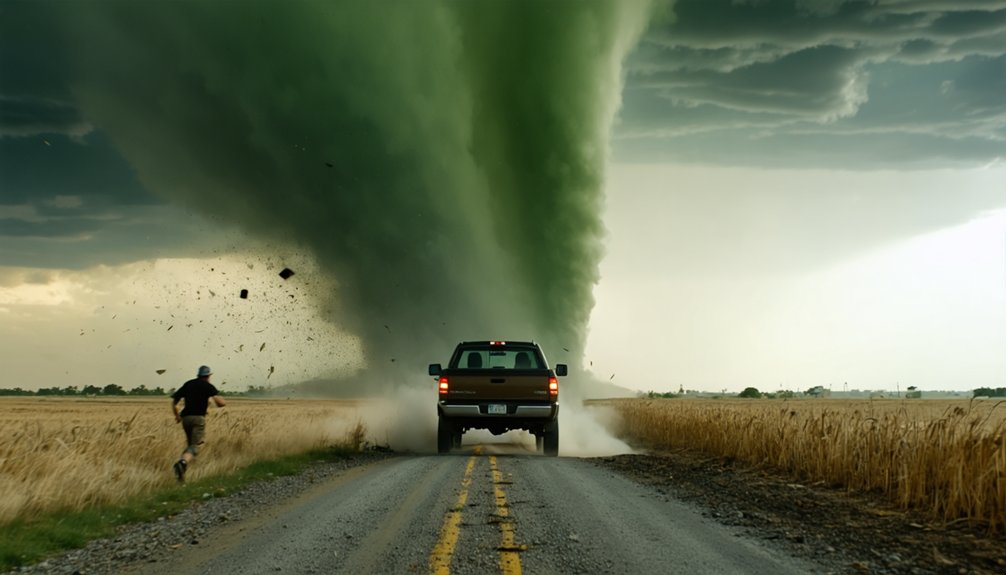
Knowing when to walk away from a chase is just as important as knowing how to position yourself legally and safely. If visibility drops, your escape route closes, or the storm outpaces your repositioning ability, you abandon the chase immediately. Don’t let storm documentation pressure you into staying when conditions turn lethal.
Abandon the chase the moment conditions turn lethal — no documentation is worth your life.
Radar data runs delayed, so trust what you’re seeing over what your screen’s telling you. Never chase after dark — reduced visibility kills faster than indecision.
If your vehicle stalls in floodwaters, exit immediately and move to higher ground. Maintain emergency communication with your team throughout the retreat so everyone evacuates cohesively.
Your freedom to chase another day depends entirely on your willingness to cut losses and get out fast when it counts.
Frequently Asked Questions
What Insurance Coverage Do Storm Chasers Typically Need Before Chasing?
You’ll need thorough insurance requirements before chasing, including liability, collision, and medical coverage options. Guarantee your policy covers storm-related vehicle damage, as standard plans often don’t—confirm exclusions with your provider beforehand.
How Do Storm Chasers Legally Film or Photograph Tornadoes for Media?
Like a watchful eagle, you must stay on public roads for tornado photography, respect private land boundaries, seek permission before entering, and follow media regulations by avoiding trespassing while capturing nature’s raw, untamed power.
What Physical Fitness Level Is Recommended for Active Storm Chasers?
You’ll need strong physical endurance to handle demanding field conditions. Prioritize emergency preparedness by maintaining cardiovascular fitness, core strength, and mental sharpness—ensuring you’re capable of rapid repositioning, extended drives, and quick evacuations when life-threatening situations demand immediate action.
Are There Age Restrictions for Participating in Storm Chasing Activities?
There’s no universal age restrictions for storm chasing, but you shouldn’t allow unsupervised youth participation. You must chase with experienced partners, complete spotter training first, and guarantee minors have parental consent and adult supervision throughout all chasing activities.
What Permits Are Required to Chase Storms Professionally Across State Lines?
Why navigate bureaucracy blindly? Storm chasing licensing and storm chasing regulations don’t require federal permits, but you’ll need to comply with each state’s traffic laws, respect private property boundaries, and carry valid vehicle insurance across state lines.
References
- https://www.atms.unca.edu/cgodfrey/courses/swfex/pdf/ChasingSafety.pdf
- https://www.youtube.com/watch?v=nxPSFg2R8YY
- https://www.reddit.com/r/stormchasing/comments/k89wnc/safety_tips_for_storm_chasing/
- https://www.livingskytours.com/storm-chasing-101/
- https://www.youtube.com/watch?v=h28hru7UhY8
- https://www.tempesttours.com/safety-tips
- https://www.youtube.com/watch?v=6otZLjSZvPU
- https://en.wikipedia.org/wiki/Storm_chasing
- https://weather.cod.edu/chasing/assets/documents/safety.pdf