Before you chase your first storm, you must train across five critical disciplines: synoptic pattern recognition, Skew-T diagram interpretation, radar velocity analysis, escape route planning, and real-time decision-making. You can’t safely assess a developing supercell without first mastering these fundamentals. Use structured spotter programs, radar simulation software, and mentored chases to validate your skills before field deployment. Define your abort criteria before conditions force the decision. Everything you need to sharpen that edge is ahead.
Key Takeaways
- Master Skew-T diagrams and hodographs to analyze storm dynamics before entering the field.
- Use the VAPOR acronym to systematically assess escape routes during active chasing situations.
- Define clear abort criteria, including increasing hail size or overhead rotating wall clouds.
- Practice with radar simulation software to replay historical supercells without physical danger.
- Complete structured spotter training programs to validate knowledge through quizzes and mentorship.
Five Variables Storm Chasers Must Assess Before Leaving the Driveway
Before you back out of the driveway, five critical variables will determine whether your chase day ends safely or catastrophically.
First, confirm your escape planning by identifying multiple exit routes before committing to any position.
Second, analyze storm dynamics using current Skew-T diagrams and hodographs to verify tornado potential.
Third, review synoptic and mesoscale patterns on surface maps to establish your chase window.
Fourth, check road networks against projected storm movement so you’re never crossing the tornado’s path.
Fifth, verify your equipment—GPS, radar software, and communication devices—are fully operational.
Skipping any variable doesn’t just compromise your safety; it endangers everyone around you.
Storm chasing rewards disciplined preparation, not improvisation.
Know your variables cold before the engine starts.
How the VAPOR Acronym Prevents Fatal Escape Route Errors
Vigilance is what separates a calculated exit from a fatal miscalculation, and the VAPOR acronym gives you a structured visual framework to execute that exit correctly.
Each letter targets a specific threat variable you must visually confirm before committing to your escape routes. You’re scanning for Visibility deterioration, Approach direction of the tornado, Precipitation intensity, Obstructions blocking your path, and Road conditions ahead.
Miss any single variable, and your exit becomes a trap. Storm chasers who skip this assessment often cross directly into the tornado’s projected path, a primary cause of fatal chasing accidents.
After executing any escape maneuver, immediately run through the vapor acronym again. Conditions shift rapidly, and your previously clear route can collapse within seconds.
Freedom demands discipline here.
Which Vehicle Features and Gear Storm Chasers Actually Need
Your vehicle is your lifeline in the field, so you’ll need four-wheel drive to navigate the muddy, unpaved roads that storms routinely force you onto.
Pair that capability with a reliable GPS unit and a mobile weather app on an Android device to maintain precise location awareness when heavy rain destroys visibility.
You must also carry emergency safety equipment, including a first aid kit and at least one team member certified in CPR, because rescue services won’t reach you quickly in active storm zones.
Four-Wheel Drive Necessity
When you’re chasing storms across the Great Plains, muddy back roads, flooded creek crossings, and soft shoulder terrain can trap a two-wheel drive vehicle instantly.
Four wheel drive advantages become critical when you’re repositioning fast and your escape route deteriorates beneath you. Two-wheel drive vehicles lose traction precisely when you can’t afford hesitation.
Off road capabilities let you push through compromised terrain without surrendering your position or your safety margin.
You’ll frequently encounter unpaved county roads turned to clay soup after a storm’s rain shaft passes over them. A four-wheel drive system transfers power to wheels that still grip, keeping you mobile when conditions punish lesser vehicles.
Select a truck or SUV with genuine four-wheel drive engagement, not just all-wheel drive, because serious terrain demands serious mechanical capability.
Essential Navigation Tools
Reliable navigation tools aren’t optional accessories—they’re the operational backbone of every chase.
You’ll need a dedicated GPS unit that functions independently of cellular networks, because signal coverage collapses in rural storm corridors exactly when you need it most. Pair that with navigation apps like Google Maps or Waze for real-time road condition updates, but never rely solely on them.
Load offline mapping software—Gaia GPS or OnX Maps work excellently—so you’re never blind during network outages. Your Android device or tablet should run both weather radar and mapping software simultaneously, giving you storm positioning alongside escape route visualization.
Cross-reference your GPS against physical county maps, because digital systems fail. Accurate navigation directly determines whether your escape route succeeds or becomes a fatal miscalculation.
Prioritize redundancy without exception.
Emergency Safety Equipment
Three vehicle features separate functional chase platforms from dangerous ones: four-wheel drive, high-quality tires, and a mechanically sound suspension capable of handling unpaved rural roads at speed.
Don’t compromise on any of them—your escape route depends on mechanical reliability when conditions deteriorate fast.
Beyond the vehicle itself, your safety gear and emergency preparedness kit must include a GPS unit for navigation through heavy rain and reduced visibility, plus an Android device running real-time radar apps.
Carry a first aid kit and guarantee at least one team member holds CPR certification.
These aren’t optional additions—they’re operational requirements. Inadequate equipment doesn’t just limit your effectiveness; it transfers risk to everyone sharing that road with you during an active chase sequence.
Which Weather Tools Confirm Dangerous Tornado Positioning in Real Time
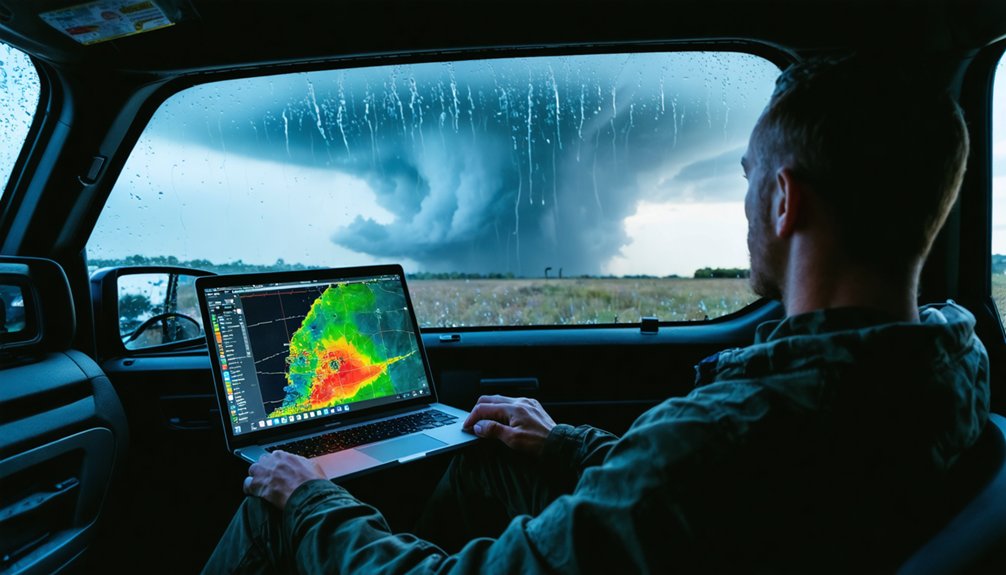
Confirming a tornado’s position in real time demands that you lean on multiple weather tools simultaneously, not just your eyes.
Tornado detection requires you to cross-reference Doppler radar platforms like RadarScope or GRLevel2 against ground-truth visual observations. Watch for tight rotational couplets on velocity scans, which indicate mesocyclone strength and position.
Real time monitoring through SpotterNetwork overlays lets you track confirmed reports from other chasers in your immediate area.
You should also monitor surface mesoanalysis charts to identify wind shift boundaries that signal dangerous positioning.
Remember the VAPOR acronym during visual checks after repositioning. If radar shows the hook surging southeast, re-evaluate your escape route immediately.
Don’t rely on a single data source — your safety depends on synthesizing every available tool with disciplined precision.
How to Read Skew-T Diagrams and Radar Data Before Every Chase
Real-time radar tools keep you alive in the field, but your pre-chase analysis of Skew-T diagrams and radar data determines whether you should’ve been there in the first place.
Master Skew-T analysis by examining temperature and dewpoint profiles to identify CAPE values, wind shear layers, and lifted indices that confirm dangerous atmospheric conditions. Strong hodograph curvature signals supercell potential, so don’t ignore it.
For radar interpretation, use GRLevel2 or RadarScope for data comparison against historical weather patterns, identifying rotation signatures before they intensify.
Storm forecasting requires cross-referencing surface maps with upper-air charts to isolate favorable chasing strategies.
Apply visualization techniques to mentally simulate storm movement and escape corridors.
Pre-chase preparation isn’t optional — it’s the foundation of every intelligent decision you’ll make downrange.
When to Abort the Chase and Reroute Immediately
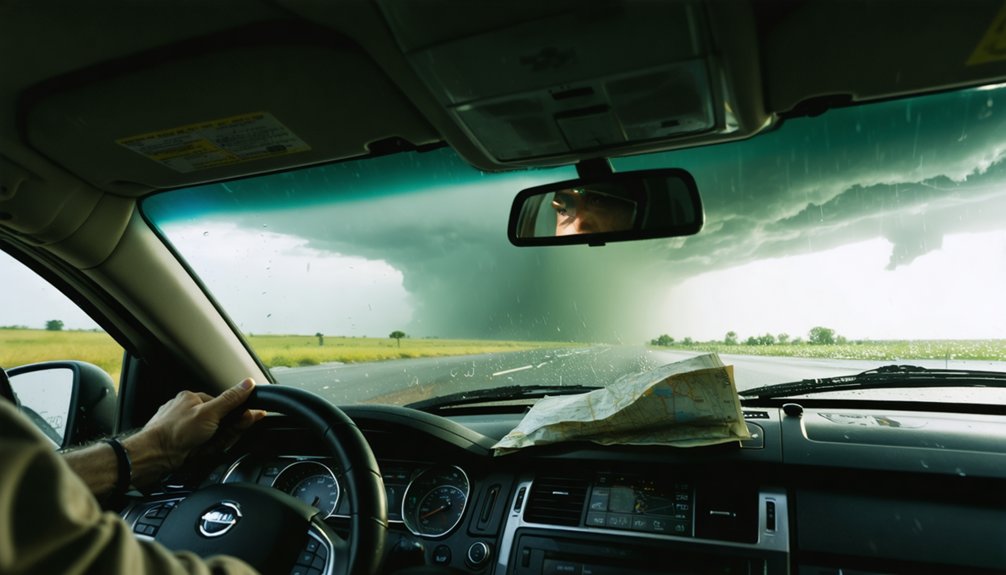
Knowing when to abort isn’t a sign of failure — it’s the mark of a disciplined chaser. Your abort criteria must be pre-defined, not improvised under pressure.
If the tornado shifts southeast, your escape route is compromised — reroute immediately. Don’t hesitate.
Watch for these hard stops: hail size increasing rapidly, rotating wall clouds directly overhead, or your vehicle crossing the tornado’s projected path. Each signals immediate withdrawal.
Your reroute strategies should prioritize roads that angle away from the storm’s forward motion — typically southeast-moving storms demand a southward or eastward exit.
After executing any maneuver, run consistent visual checks. Confirm you’re clear before slowing down.
Freedom in storm chasing comes from discipline, not recklessness. Abort early, reroute smartly, and you’ll chase another day.
Where Storm Chasers Build Real Risk Assessment Skills Fast
Three core environments accelerate real risk assessment skill-building faster than any classroom: live storm intercepts, radar simulation software, and structured spotter training programs. Each environment sharpens your decision-making under pressure, forcing you to evaluate escape routes before conditions deteriorate.
- Live intercepts expose you to real-time wind shifts, rotation, and rapidly closing escape routes.
- GRLevel2 or RadarScope simulations let you replay historical supercells and practice risk assessment without physical danger.
- SpotterNetwork.org training provides structured graphical models and quiz-based validation of your knowledge.
- Mentored chasing with experienced partners builds situational awareness you can’t develop alone.
Don’t wait for perfect conditions to start learning. Every simulation run and every structured training session sharpens the instincts that keep you mobile, positioned correctly, and alive in the field.
Frequently Asked Questions
What Legal Liability Do Storm Chasers Face When Entering Private Property?
You’re legally liable for trespassing if you enter private property without permission, risking fines or lawsuits. Always respect property rights, secure liability insurance, and seek landowner consent before accessing any land for storm observation.
How Do Storm Chasers Coordinate With Local Emergency Management Officials During Events?
You’ll need to master communication strategies fast—lives depend on it. Register with SpotterNetwork.org, follow emergency protocols, and relay real-time data directly to local emergency management officials during events. Don’t hesitate; your reports shape critical response decisions.
What Psychological Traits Make Someone Unsuitable for Storm Chasing Pursuits?
You’re unsuitable if you’ve poor risk perception, impulsive decision making, overconfidence, or thrill-seeking tendencies that override caution. These traits compromise your judgment, endangering yourself and others when conditions rapidly deteriorate during active storm pursuit.
How Does Storm Chasing Negatively Impact Local Ecosystems and Sensitive Environments?
You’ll cause ecosystem disruption by driving off-road through sensitive habitats. You’re responsible for wildlife disturbance when you trespass on private land. Minimize your impact—avoid littering, stay on established roads, and always respect fragile natural environments during pursuits.
What Insurance Coverage Do Professional Storm Chasers Typically Carry for Protection?
You’ll need liability coverage to protect against third-party claims and equipment insurance to safeguard your gear. Don’t overlook commercial auto policies, as standard personal policies typically exclude storm chasing activities, leaving you dangerously exposed financially.
References
- https://crazystormchasers.com/risk-assessment-training-for-novice-storm-chasers/
- https://www.stormchasingusa.com/blog/learning-the-basics-about-storm-chasing/
- https://www.youtube.com/watch?v=6otZLjSZvPU&vl=en
- https://weather.cod.edu/chasing/assets/documents/safety.pdf
- https://www.atms.unca.edu/cgodfrey/courses/swfex/pdf/ChasingSafety.pdf
- https://www.wiu.edu/SevereWeather/images/presentations/How_to_Effectively_Storm_Chase.pdf
- https://www.youtube.com/watch?v=fABwvj0rP_A
- https://www.livingskytours.com/storm-chasing-101/
- https://www.youtube.com/watch?v=6PWtNkh-MPE
- https://will.illinois.edu/weatherrealness/episode/storm-chasing-can-be-deadly-heres-how-to-stay-safe