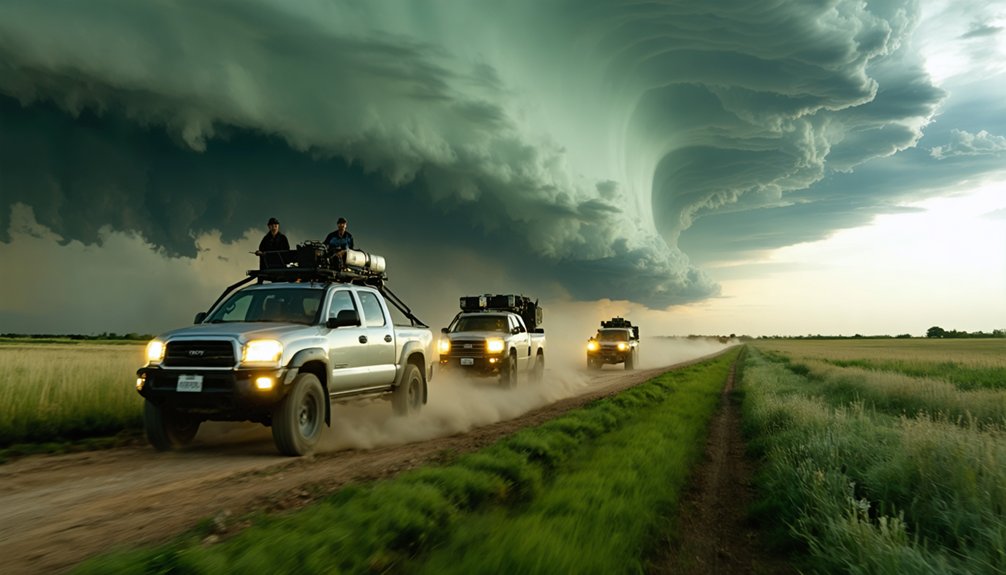
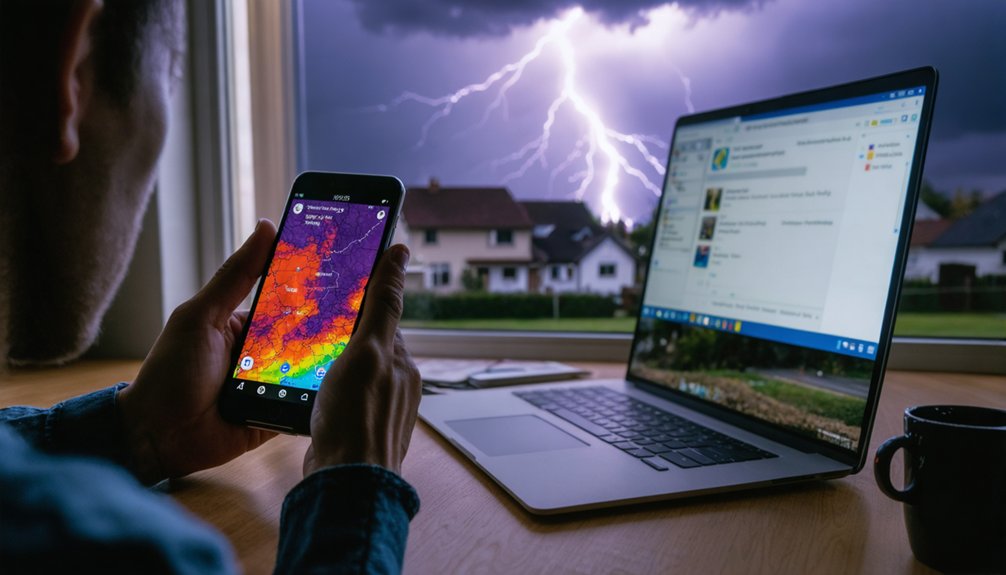
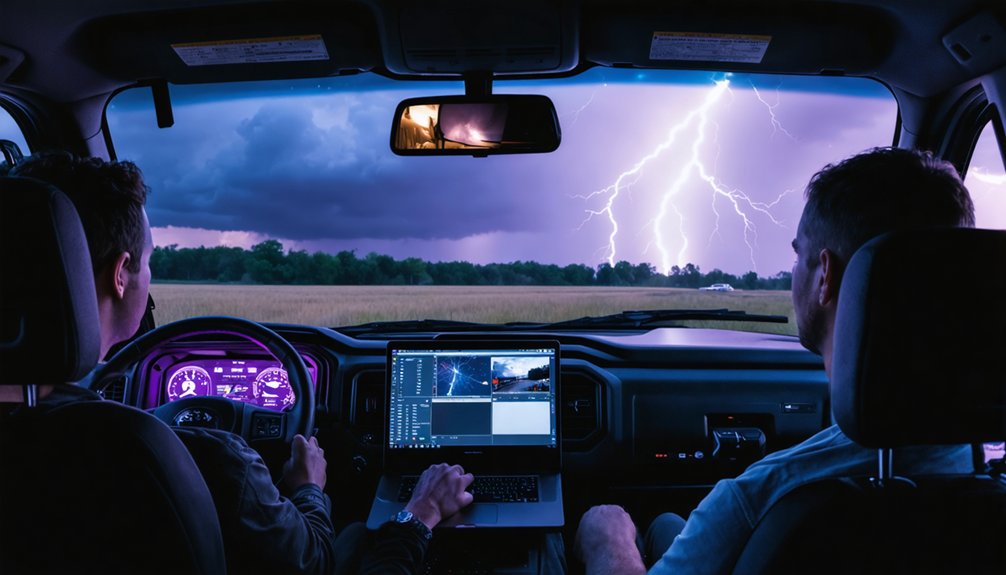
Storm chasing safety starts with preparation, not adrenaline. You’ll need solid meteorological knowledge, reliable gear, and pre-mapped escape routes before you ever leave home. Keep a 1–2 mile distance from tornado circulation, avoid driving through a storm’s core, and never shelter under overpasses. Monitor Doppler radar continuously, but trust your visual cues when danger closes in. Master these fundamentals first — what follows covers every critical layer of staying alive out there.
Key Takeaways
- Always maintain a safe distance of 1–2 miles from tornado circulation and plan at least two escape routes perpendicular to storm movement.
- Master Doppler radar interpretation, including hook echoes and velocity couplets, while continuously monitoring real-time weather updates during a chase.
- Equip yourself with essential safety gear, including a helmet, goggles, first aid kit, charged communication devices, and sufficient fuel and supplies.
- Never shelter under overpasses or drive through a storm’s precipitation core, as both conceal life-threatening hazards like debris and embedded tornadoes.
- Prioritize disciplined decision-making over thrill-seeking by building meteorological knowledge and respecting legal and ethical boundaries during storm chasing.
What Is Storm Chasing and Who Should Attempt It?
Storm chasing is the deliberate pursuit of severe weather phenomena—tornadoes, supercells, and violent thunderstorms—for purposes ranging from scientific research to media documentation. It’s not recreational thrill-seeking; it demands serious meteorological knowledge, disciplined decision-making, and physical preparedness.
Storm chasing isn’t thrill-seeking—it’s a discipline requiring deep meteorological knowledge, sharp decision-making, and serious physical readiness.
You should only attempt storm chasing if you’ve invested time studying weather patterns, radar interpretation, and storm structure.
Storm chasing ethics require that you respect landowners, emergency responders, and fellow chasers sharing the road. Legal considerations matter too—trespassing on private property or blocking emergency vehicles carries real consequences.
Beginners shouldn’t chase solo. Partner with experienced chasers or join structured training programs before heading into severe weather independently.
If you’re unprepared meteorologically, physically, or mentally, the field will expose those gaps quickly and dangerously.
Plan Your Storm Chasing Route Before You Leave Home
Before you ever leave home, you’ll want to thoroughly research your target area by studying forecast models, storm reports, and topographic maps to understand the terrain you’re entering.
Once you’ve identified your primary route, map at least two alternative escape routes that account for the storm’s projected movement and potential road closures.
You should also pinpoint safe shelter locations along each route — sturdy buildings, underpasses excluded — so you’re never more than a few minutes from cover if conditions deteriorate rapidly.
Research Your Target Area
Planning your storm chasing route before leaving home is one of the most critical steps you can take to guarantee a safe and successful chase. Researching your target area means diving deep into historical storm data to understand regional patterns, terrain challenges, and typical storm tracks specific to your destination.
Review topographic maps to identify potential hazards like flooded low-water crossings, dead-end roads, and limited escape corridors. Cross-reference multiple reliable forecasting sources to pinpoint high-probability storm initiation zones.
If you’re new to the field, invest in formal storm chasing training to sharpen your meteorological interpretation skills before hitting the road.
Know your target area’s road network intimately. Familiarity with county roads and highway intersections lets you reposition quickly and decisively when conditions demand immediate action.
Map Alternative Escape Routes
Once you’ve locked in your target area, your next move is mapping multiple escape routes before you ever leave home. Storm movement is dynamic, and a single exit path will get you killed.
Use weather pattern analysis to anticipate where the storm tracks and identify perpendicular roads that move you away from the circulation quickly. South-to-north storm movement means your escape runs east or west — never north ahead of it.
Pre-load offline maps in case cellular coverage drops and cuts off your emergency communication network. Mark alternate paved routes, avoiding dirt roads that become impassable after rainfall.
Know the storm’s projected path, your position relative to it, and every viable exit simultaneously. Freedom on the road means options — eliminate those options and you’ve eliminated your safety margin entirely.
Identify Safe Shelter Locations
Identifying safe shelter locations before departure is non-negotiable — your escape routes mean nothing if you have no fixed points to reach when conditions deteriorate faster than expected. Research your target area thoroughly and lock in concrete shelter options before you roll out.
Prioritize these three shelter criteria:
- Sturdy structures — Identify reinforced buildings like fire stations or brick structures offering reliable lightning safety and debris protection.
- Distance from storm damage zones — Pre-select locations positioned well outside likely tornado impact corridors to ensure storm damage prevention.
- Accessibility under pressure — Confirm shelters are reachable via paved roads that won’t wash out during heavy rainfall.
Mark every location in your GPS before departure. When conditions collapse rapidly, you’ll execute — not search.
Gear Up Properly Before Your First Storm Chasing Trip
Before heading out on your first storm chasing trip, you’ll need to gear up with the right equipment to stay safe and effective in the field. Your storm gear should include a sturdy helmet, safety goggles, mechanics gloves, and a reflective vest to protect against flying debris and hail. Pack a basic first aid kit and verify your vehicle carries adequate fuel, water, and food supplies.
Your safety equipment list shouldn’t stop there. Equip your vehicle with reliable mobile weather apps, a physical map, and a charged communication device. Mount a quality radar system and keep a dashcam running during chases. Store all gear within easy reach before departure — scrambling for equipment during an active storm wastes critical seconds and compromises your decision-making under pressure.
Read Radar and Monitor Weather Like a Storm Chaser
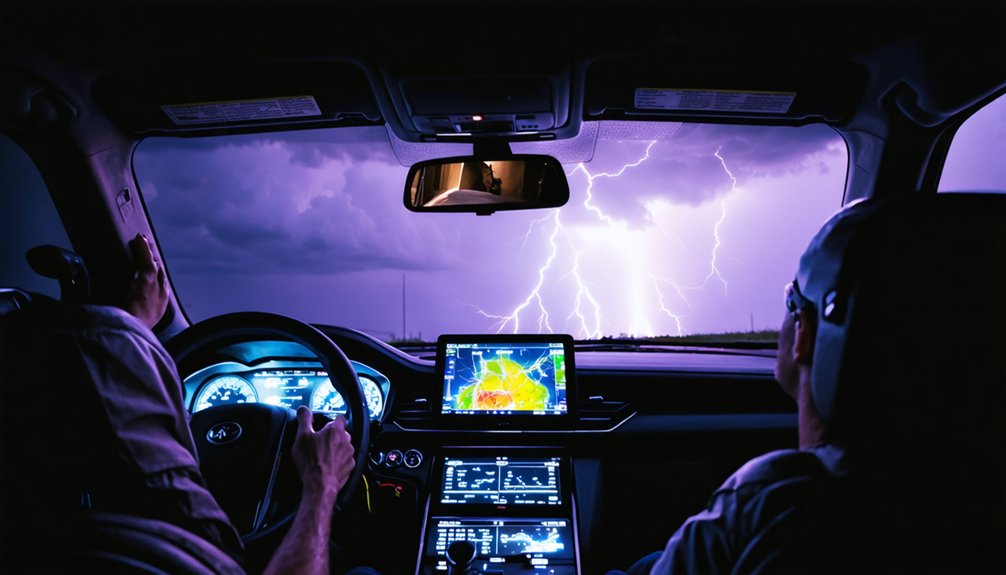
Reading radar effectively separates storm chasers who stay safe from those who don’t. Radar interpretation isn’t optional—it’s your primary tool for understanding developing weather patterns before you commit to a route.
Master these three fundamentals:
- Track storm movement and rotation — Identify hook echoes and velocity couplets on Doppler radar to detect active circulation before it’s visible.
- Monitor real-time updates continuously — Use mobile weather apps alongside local emergency broadcasts to stay ahead of rapidly shifting weather patterns.
- Never trust radar alone — If danger appears directly in front of you, trust your eyes over any screen.
Situational awareness keeps you free to chase another day. Radar fixation kills that freedom fast. Stay disciplined, stay methodical, and always prioritize what you can see over what the data shows.
Drive Smart and Respect Dangerous Storm Conditions
Driving smart during a storm chase means respecting conditions that can kill you before you react. Slow down significantly through heavy rain or blowing dust, and keep your headlights on so other drivers see you clearly. Never drive under rotating wall clouds — that decision removes your escape options entirely.
Lightning safety demands immediate action. When strikes occur within one mile, get inside your vehicle and roll your windows up without hesitation. Your car’s metal frame provides critical protection.
Storm preparedness means you’ve already mapped your escape routes before the storm forces your hand. Avoid unimproved dirt roads after heavy rain — they’ll trap your vehicle fast. Use turn signals consistently, respect private property, and never chase after dark. Visibility isn’t optional; it’s survival.
Maintain Safe Distance and Know Your Escape Routes
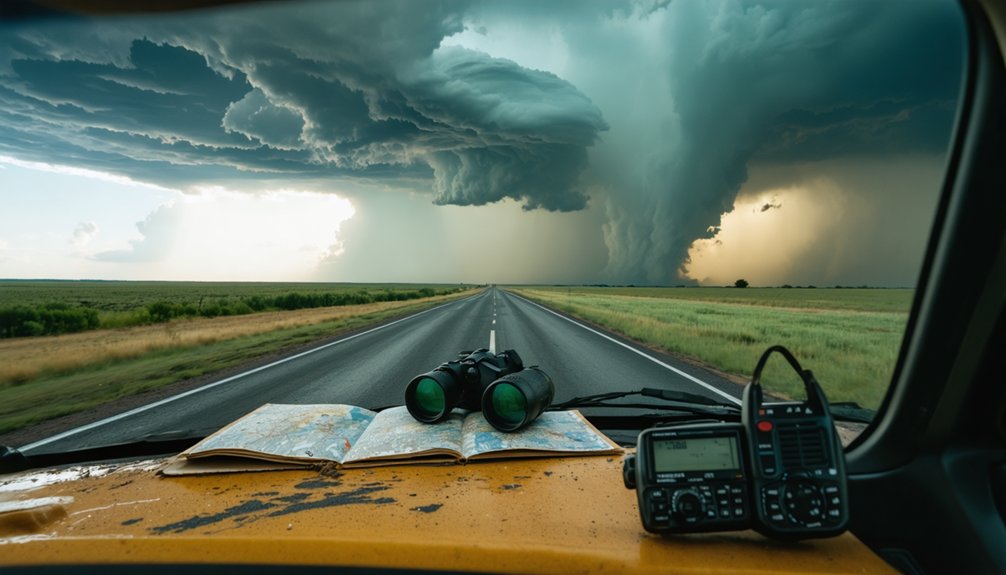
Smart driving keeps you alive on approach, but distance and escape planning keep you alive when the storm closes in. Stay 1–2 miles from active tornado circulation. Wildlife disturbances and environmental impacts—flooded roads, downed debris, displaced animals—can compromise escape routes instantly. Know your exit before you need it.
Distance and escape planning keep you alive when the storm closes in. Know your exit before you need it.
- Track storm movement using radar and visual confirmation, positioning yourself perpendicular to the tornado’s path.
- Pre-map paved escape routes heading south or east, avoiding unimproved dirt roads softened by rain.
- Identify emergency bailout points—ditches or low ground—if your vehicle becomes compromised.
If a tornado bears down without warning, abandon your vehicle, find the nearest low point, and cover your head immediately.
Recognize the Mistakes That Get Storm Chasers Killed
Some storm chasers die not from bad luck but from bad decisions, and you must recognize the most common fatal errors before you ever hit the road.
Never core punch a storm by driving through its precipitation core, where you’ll face zero visibility, massive hail, and a potentially embedded tornado you can’t see until it’s too late.
Equally dangerous is sheltering under an overpass, which funnels wind speeds to lethal velocities and turns debris into projectiles aimed directly at you.
Ignoring Visible Danger Signs
One of the deadliest mistakes a storm chaser can make is trusting radar over what’s directly in front of them. Radar delays, gaps, and blind spots create false confidence. When visible danger appears, your eyes outrank your screen every time.
Storm visibility conditions change within seconds. A wall cloud rotating overhead, a debris cloud at ground level, or a sudden pressure drop signals immediate threat. Don’t rationalize what you’re clearly seeing.
Recognize these critical visible danger signs you must never ignore:
- Rotating wall clouds descending below the storm base indicate imminent tornado formation
- Ground-level debris swirls confirm a tornado is already touching down nearby
- Sudden darkness combined with roaring wind signals you’ve lost your escape window
Trust your instincts. React immediately. Your freedom depends on your survival.
Core Punching Storm Centers
Core punching — driving directly through a storm’s precipitation core — ranks among the most reckless decisions you can make in the field. A storm core conceals everything dangerous: large hail, violent wind shear, embedded tornadoes, and zero visibility. You can’t see what’s forming around you, and you can’t react fast enough when it does.
Chasers who core punch typically do so chasing a better visual angle or following others blindly into danger. Don’t. Once you’re inside that precipitation shield, your escape options collapse rapidly. Wind shear intensifies without warning, and hail can disable your vehicle within seconds.
Maintain your position on the storm’s southern or southeastern flank. You’ll preserve visibility, maintain your escape route, and actually document what you came to see.
Overpass Sheltering Risks
Ducking under an overpass during a tornado feels instinctive — it’s a fatal instinct. Shelter misconceptions like this one kill chasers who should know better. Overpasses create wind tunnels, accelerating tornado winds and turning debris into high-velocity projectiles aimed directly at anyone crouching inside. You’re not protected — you’re trapped.
Overpass hazards include:
- Accelerated wind speeds — Confined geometry compresses airflow, dramatically increasing wind velocity beneath the structure.
- Debris concentration — Flying glass, metal, and rock funnel directly into your position with lethal force.
- Zero escape options — You’re exposed, elevated, and immobile when the tornado arrives.
If a tornado bears down, abandon your vehicle, find the nearest low ditch, lie flat, and cover your head immediately.
Handle a Tornado When You’re Dangerously Close
When a tornado closes in on your position, you’ve got seconds to act decisively. Abandon your vehicle immediately if it’s directly in the tornado’s path — steel and glass offer minimal protection against violent winds.
Your tornado preparedness mindset must kick in automatically. Locate the nearest ditch, culvert, or low-lying terrain and move there fast.
Lie flat, face down, protect your head with both arms, and stay low until the danger passes.
Never shelter under an overpass — wind acceleration creates lethal projectile zones.
Maintain emergency communication with your chase partner or base contact, confirming your GPS coordinates before taking cover.
Distance is your best defense. If you’ve maintained proper positioning, this scenario shouldn’t occur.
Situational awareness and disciplined escape route planning prevent dangerously close encounters entirely.
Follow These Storm Chasing Safety Rules on Every Chase
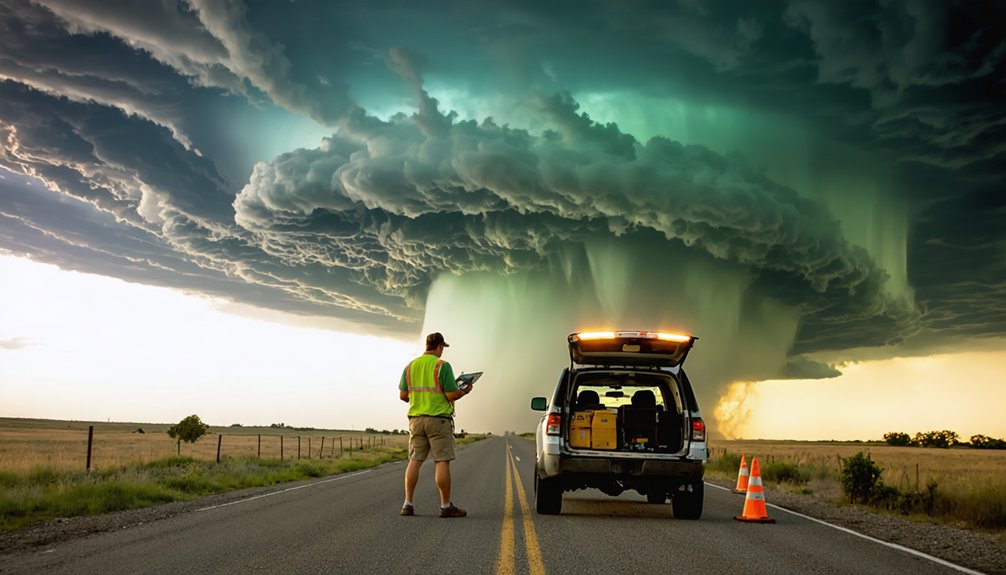
Every chase demands the same non-negotiable safety fundamentals, regardless of storm intensity or experience level. Understanding historical storm patterns sharpens your decision-making, while properly maintained storm chasing equipment keeps you operational when conditions deteriorate fast.
- Maintain 1-2 miles from tornado circulation — always pre-plan escape routes perpendicular to storm movement before you’re in a compromised position.
- Never core punch or drive through hail — historical storm patterns confirm that internal storm structure conceals rapidly intensifying rotation you won’t see until it’s too late.
- Conduct pre-chase equipment checks — verify communication devices, GPS, weather apps, helmets, gloves, and first aid kits before departure.
You own your safety decisions on every chase. Discipline, preparation, and situational awareness aren’t optional — they’re survival fundamentals.
Frequently Asked Questions
What Legal Permits Are Required for Storm Chasing in Different States?
Storm chasing permits aren’t federally mandated, but you’ll need to research state regulations before each expedition. Check local authorities for road access rules, as requirements vary considerably across states and jurisdictions.
How Do Storm Chasers Communicate With Each Other During Active Pursuits?
You’ll use communication technology like ham radios, CB radios, and mobile apps to coordinate with fellow chasers. Follow safety protocols by sharing real-time positioning, storm updates, and escape route changes to keep everyone informed and safe.
Can Storm Chasing Footage Be Sold to News Outlets or Weather Agencies?
Yes, you can sell your storm chasing footage to news outlets and weather agencies. Prioritize storm chasing ethics, document responsibly using proper safety equipment, and guarantee you’ve captured authentic, high-quality content that meets professional broadcast standards.
How Do Storm Chasers Manage Fatigue During Multi-Day Chasing Expeditions?
Like a marathon runner pacing themselves, you’ll combat storm fatigue by scheduling mandatory rest breaks, practicing adrenaline management through disciplined sleep rotations, monitoring your alertness levels, and prioritizing recovery over chasing opportunities during multi-day expeditions.
What Insurance Coverage Do Storm Chasers Need for Their Specialized Vehicles?
You’ll need specialized insurance policies that include extensive vehicle coverage for storm damage, hail, and flooding. Make certain your policy covers off-road use, equipment, and liability, as standard auto insurance won’t protect your specialized chase vehicle.
References
- https://www.reddit.com/r/stormchasing/comments/k89wnc/safety_tips_for_storm_chasing/
- https://www.livingskytours.com/storm-chasing-101/
- https://www.youtube.com/watch?v=nxPSFg2R8YY
- https://www.atms.unca.edu/cgodfrey/courses/swfex/pdf/ChasingSafety.pdf
- https://www.youtube.com/watch?v=6otZLjSZvPU
- https://www.youtube.com/watch?v=fHtr6wcRWRM
- https://www.youtube.com/watch?v=h28hru7UhY8
- https://meetingsmags.com/illinois/il_planning/il_checklist/safety-tips-from-a-storm-chaser/