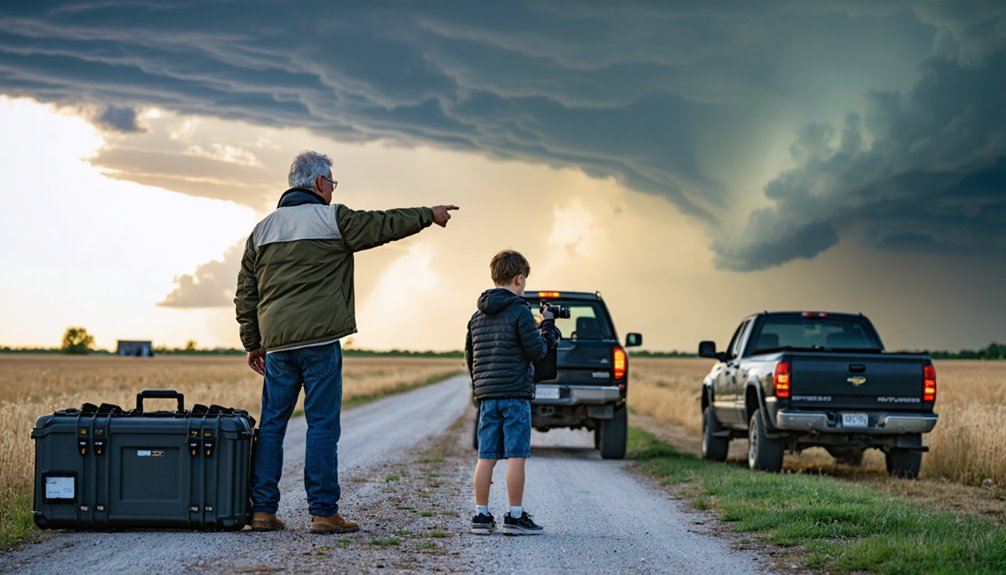
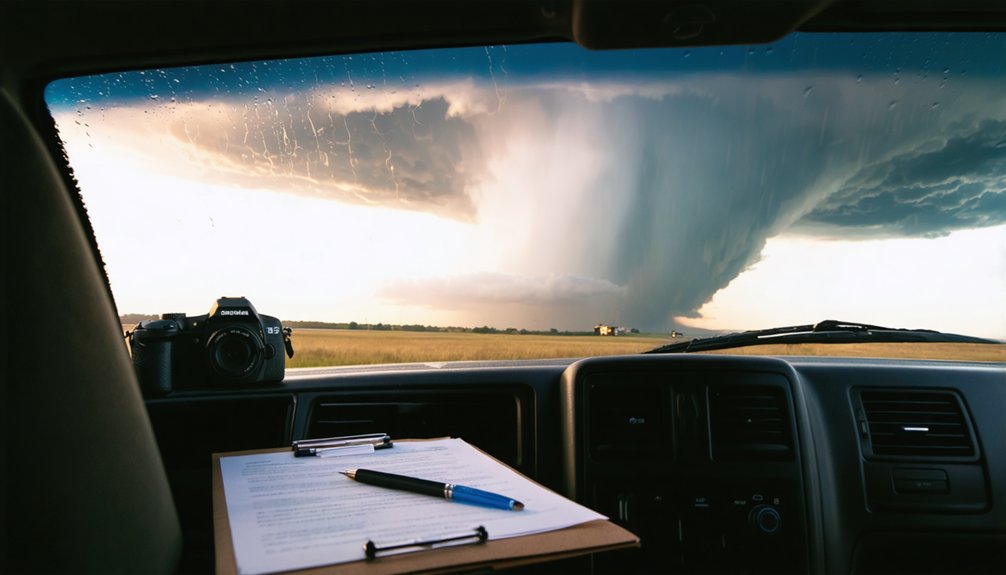
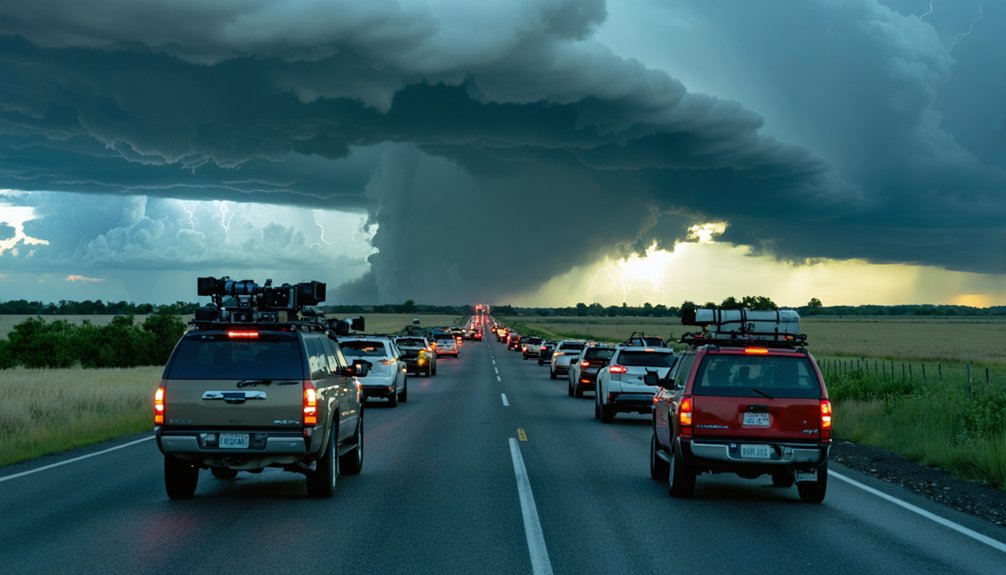
Safe storm chasing demands disciplined preparation, real-time awareness, and swift decision-making. You’ll need to study storm structure, pre-plan two perpendicular escape routes, and load your vehicle with reliable communication gear and protective equipment. Trust your pre-established exit triggers over in-the-moment data hunger, especially when visual contact is lost. Never chase alone, and assign clear team roles before departure. The strategies ahead will sharpen every layer of your safety protocol.
Key Takeaways
- Identify at least two perpendicular escape routes before pursuit begins, prioritizing roads angling away from the storm’s projected track.
- Monitor storm structure, speed, and movement continuously, executing exits immediately when visual contact is lost or routes become compromised.
- Trust pre-established decision triggers over real-time data hunger, as hesitation during escalating threats can prove fatal.
- Ensure vehicles are fully maintained and stocked with helmets, communication devices, first aid kits, and emergency gear before departure.
- Never chase alone; assign distinct team roles, establish clear radio channels, and maintain coordination throughout the entire pursuit.
Read the Storm Before You Chase It
Before you ever get close to a storm, you’ve got to understand what you’re looking at. Study the storm structure before you commit to an intercept. Analyze mesocyclone rotation, wall cloud development, and rear-flank downdraft positioning. These are your primary tornado indicators, and misreading them puts you directly in the kill zone.
Generate your own forecast using Skew-T diagrams and model data to pinpoint high-risk corridors. Don’t rely solely on delayed radar returns — trust what your eyes confirm in real time.
Identify the storm’s movement vector so you’re never caught in its projected path.
You’re free to chase, but that freedom depends entirely on accurate threat assessment. Read the data, verify visually, and position yourself with precision before closing distance.
Plan Your Escape Routes Before the Tornado Forms
Once you’ve confirmed storm structure and committed to an intercept, escape route planning becomes a non-negotiable tactical step — not an afterthought. Before the tornado forms, identify at least two perpendicular exit corridors — ideally roads running south or east, away from the storm’s northeast translational track.
Storm tracking data tells you where the threat’s heading; your exits must account for that vector. Factor in road surface conditions, chaser congestion, and potential flood-prone low-water crossings that could cut off your retreat.
Integrate emergency communication protocols into your route plan — your team needs a designated fallback point and a radio frequency for real-time coordination. If visibility drops and you lose the threat region, you execute your pre-planned exit immediately, without debate. Hesitation costs lives.
Build Your Storm Chasing Team Before You Leave
Assembling the right team isn’t a social exercise — it’s a tactical requirement that directly impacts your survival margin. Assign distinct operational roles before departure: one dedicated driver, one navigator, and one spotter minimum. Role overlap degrades situational awareness and increases incident probability.
Team communication must follow a structured protocol. Establish clear radio channels, predetermined call signs, and decision hierarchies so critical warnings transmit without confusion or delay. Every second lost to miscommunication narrows your escape window.
Equipment maintenance falls on every team member, not just the lead chaser. Cross-train each person on radar platforms, vehicle systems, and safety gear so no single point of failure compromises the mission. Never chase alone — operational redundancy isn’t optional, it’s your primary risk-reduction mechanism.
Gear Every Storm Chaser Should Have in the Vehicle
Your vehicle is a mobile operations platform, and its gear loadout determines your response capability when conditions deteriorate fast. Pack deliberately, not impulsively. Every item must serve a functional role.
Your vehicle is an extension of your preparedness — load it with intention, or pay the price when it matters most.
Prioritize protective clothing — helmets rated for impact, mechanics gloves, safety goggles, and reflective vests guard against hail, debris, and roadside hazards. These aren’t optional accessories; they’re operational necessities.
Communication devices are equally non-negotiable. Carry a weather radio, a backup handheld radio, and a charged mobile device with redundant data access. Radar apps mean nothing without reliable signal infrastructure behind them.
Supplement these with a stocked first aid kit, a flashlight with fresh batteries, and verified fluid levels before departure. Your gear inventory directly correlates with your margin for error when the situation turns critical.
Drive Defensively When Severe Weather Surrounds You
Gear readiness gets you into the field prepared, but vehicle control keeps you alive when the storm closes in. Before deployment, confirm fluid levels, tire pressure, and fuel capacity — vehicle maintenance isn’t optional when you’re operating in remote corridors.
Keep headlamps active whenever rain, dust, or debris degrades road visibility below safe operating thresholds. Never park on active roadways; pull completely off the shoulder before stopping to observe.
Maintain following distances wide enough to react to sudden braking in chaser-congested traffic. Put the phone down — distracted driving kills more chasers than tornadoes do.
You can’t protect your freedom to chase if you’re creating hazards for others. Defensive driving isn’t timid — it’s calculated, disciplined, and what separates sustainable field operations from preventable tragedies.
Recognize When Lightning, Hail, and Flash Floods Turn Fatal
Defensive driving handles road threats, but lightning, hail, and flash floods introduce hazard vectors that vehicle discipline alone can’t neutralize.
Lightning fatalities spike when chasers remain outside during close electrical activity. You must enter your vehicle immediately and avoid touching plugged-in electronics or adapters, which conduct lethal current.
Hail injury escalates rapidly once stones exceed golf-ball diameter, shattering glass and striking exposed personnel at terminal velocity. Retreat before hail cores overtake your position.
Flash floods present a subtler but equally lethal threshold—six inches of fast-moving water destabilizes vehicles, and twenty-four inches floats most trucks entirely. You can’t reclaim terrain lost to rushing water.
Monitor drainage patterns, avoid low-water crossings, and treat rising water as an unconditional evacuation trigger, not a negotiable risk variable.
Know the Legal Lines Storm Chasers Cannot Cross
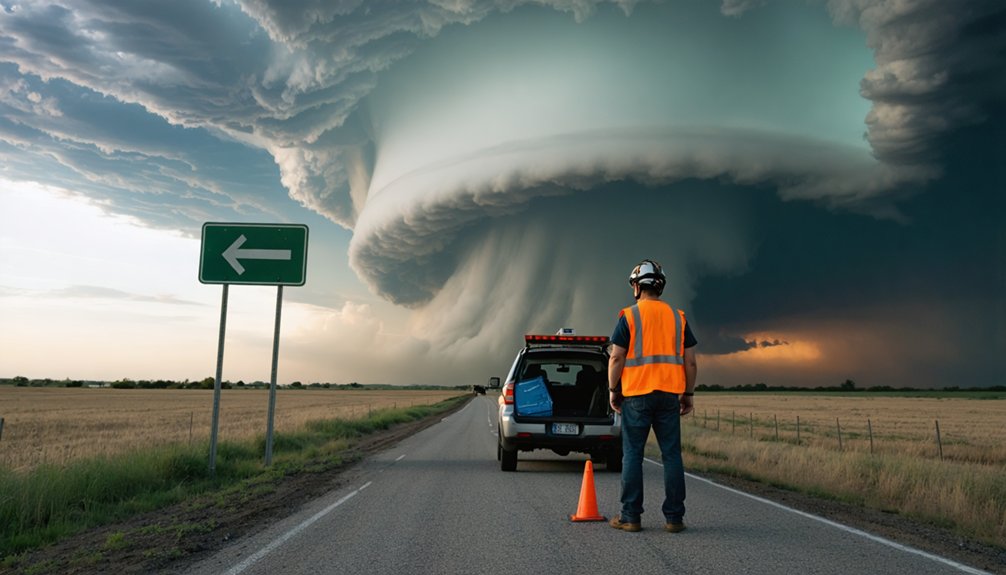
Storm chasing operates within a legal framework that carries real penalties when violated. You must respect legal boundaries that govern access to land, roadways, and emergency zones.
Trespassing restrictions apply regardless of storm urgency — entering private property without permission exposes you to criminal charges, civil liability, and revocation of any official credentials you hold.
Stay on public roads at all times unless landowner permission is explicitly granted.
Yield immediately to emergency vehicles, and never enter active tornado damage corridors where law enforcement has established perimeters.
Violating these zones obstructs rescue operations and creates measurable risk for first responders.
Document permission when accessing private land.
Know your state’s specific statutes on emergency zone access.
Freedom to chase depends entirely on operating within the boundaries that protect that freedom long-term.
Abandon the Chase Before the Storm Traps You
When a storm’s forward motion begins cutting off your planned escape routes, you’re approaching entrapment. Delayed recognition dramatically increases your risk exposure.
You must continuously cross-reference the tornado’s tracked movement vector against your current position, flagging any convergence that narrows your exit window to under two minutes of safe travel time.
If road options ahead reduce to a single corridor aligned with storm travel, execute your bail route immediately rather than gambling on storm deceleration or directional shift.
Recognize Dangerous Entrapment Signs
Recognizing entrapment before it occurs is one of the most critical decision-making skills a storm chaser can develop. Watch for entrapment warning indicators systematically: rapidly closing storm motion toward your position, blocked intersections from traffic or flooding, and deteriorating road surfaces from rain saturation. These hazard signs compound quickly, eliminating your exit windows within minutes.
Monitor your escape routes continuously against the tornado’s translational speed and direction. If the storm’s forward motion exceeds 40 mph, your repositioning margin shrinks dramatically. Trust your visual observations over radar data — radar lags reality by several minutes.
When two or more exit routes become compromised simultaneously, you’ve entered a critical threshold. Execute your bailout immediately, without hesitation. Your freedom to chase another day depends entirely on decisive, timely action.
Execute Timely Strategic Exits
Executing a timely exit demands discipline over instinct — the urge to hold position and gather more data is precisely what gets chasers trapped. Storm timing isn’t forgiving; a tornado’s forward motion can outpace your reaction window within seconds. Your exit planning must begin before the threat develops, not after.
Pre-designate two or three perpendicular escape routes on your navigation system, prioritizing roads that angle away from the storm’s projected track. Once you’ve lost visual contact with the threat region, you don’t negotiate — you move immediately. Trust your pre-planned decision triggers over real-time rationalization.
Blocked highways, chaser congestion, and muddy rural roads compress your margin fast. Execute your exit early, maintain speed discipline, and don’t let data hunger override your survival calculus.
Frequently Asked Questions
What Insurance Coverage Should Storm Chasers Carry During Active Chase Operations?
Like armor in battle, you’ll need robust insurance requirements before chasing. Carry extensive vehicle coverage, liability coverage for third-party damages, and personal injury protection to shield yourself financially during active storm operations.
How Do Storm Chasers Handle Mental Health Stress After Witnessing Destructive Tornadoes?
You’ll need mental health support after witnessing destructive tornadoes. Apply stress management techniques like structured debriefs, peer counseling, and physiological monitoring. You’re tracking trauma data systematically—don’t ignore psychological indicators; they’re as critical as meteorological variables.
Are There Age Restrictions for Minors Participating in Storm Chasing Activities?
While no federal law mandates age restrictions, minor participation still requires parental consent and supervised mentorship. You must guarantee minors train as spotters first, never chase independently, and always operate under an experienced chaser’s direct guidance.
How Do Storm Chasers Coordinate Communication With Local Emergency Management Officials?
You’ll coordinate by sharing real-time storm tracking data and risk assessment reports directly with local emergency management officials via radio frequencies, spotting networks like SKYWARN, and digital platforms, ensuring timely, accurate hazard communication during active severe weather events.
What Physical Fitness Level Is Recommended Before Beginning Storm Chasing Activities?
Over 30% of chaser injuries stem from physical fatigue. You’ll need a solid fitness assessment confirming cardiovascular endurance and strength. Physical preparedness lets you handle rapid evacuations, heavy gear, and prolonged outdoor exposure independently and effectively.
References
- https://www.reddit.com/r/stormchasing/comments/k89wnc/safety_tips_for_storm_chasing/
- https://www.atms.unca.edu/cgodfrey/courses/swfex/pdf/ChasingSafety.pdf
- https://en.wikipedia.org/wiki/Storm_chasing
- https://www.youtube.com/watch?v=nxPSFg2R8YY
- https://www.stormchasingusa.com/storm-chasing-and-safety/
- https://www.youtube.com/watch?v=h28hru7UhY8
- https://stormchaser.com/Storm-Chasing-Safety.pdf
- https://www.youtube.com/watch?v=fHtr6wcRWRM