Storm chasing’s closest calls aren’t always dramatic near-misses — they’re the product of cascading failures in judgment, technology, and storm behavior. The 2013 El Reno tornado killed three chasers when its 2.6-mile width overwhelmed every safety margin. Night intercepts like the Rolling Fork EF4 stripped visual confirmation entirely. Post-chase hydroplaning has claimed more lives than tornadoes ever did. Understanding these incidents means confronting the systemic vulnerabilities that turn manageable risks into fatalities — and the patterns run deeper than you’d expect.
Key Takeaways
- The 2013 El Reno tornado killed three veteran storm chasers when its erratic movement and 2.6-mile width overwhelmed traditional safety margins.
- Reed Timmer survived El Reno due to structural reinforcement in his armored vehicle, highlighting how equipment design can determine survival.
- Tanner Charles survived direct tornado contact with the Lewistown tornado through rapid repositioning despite equipment failures and sudden directional shifts.
- Two storm chasers were struck by the Rolling Fork EF4 tornado at night, where radar lag and low visibility eliminated reaction time.
- Some El Reno survivors escaped only by abandoning standard protocols and making immediate lateral movements away from the tornado’s path.
The 2013 El Reno Tornado That Killed Three Storm Chasers
On May 31, 2013, the El Reno tornado tore across central Oklahoma and delivered what the National Weather Service would later call “the most dangerous tornado in storm observing history.”
At its peak, it stretched 2.6 miles wide — the widest tornado ever recorded — and its erratic movement caught veteran chasers completely off guard.
TWISTEX scientist Tim Samaras, his son Paul, and colleague Carl Young died when the tornado shifted unpredictably, overwhelming their safety protocols in seconds. A fourth chaser also perished.
Even experienced teams relying on advanced weather forecasting couldn’t anticipate the tornado’s sudden expansion and direction changes.
The El Reno event remains the only tornado to directly kill storm chasers, fundamentally reshaping how you assess risk and positioning strategies in the field.
What the TWISTEX Team Was Chasing Before El Reno Killed Them
Before the El Reno supercell claimed their lives, the TWISTEX team had spent years deploying instrumented turtle probes directly into tornado paths to capture ground-level pressure, temperature, and wind data that airborne sensors couldn’t reach. Their historical tactics centered on precise intercept positioning — placing probes ahead of a tornado’s projected track, then retreating before impact.
The TWISTEX team placed probes in tornado paths, then raced to escape before impact.
Tim Samaras, Paul Samaras, and Carl Young operated under rigorous safety protocols that had kept them alive through hundreds of deployments. They’d successfully probed violent tornadoes across the Great Plains without incident.
El Reno broke their model. The tornado’s unprecedented 2.6-mile width and erratic movement outpaced their escape window entirely.
You see the brutal reality here — even disciplined, data-driven teams couldn’t anticipate a storm rewriting every known behavioral boundary in real time.
How El Reno Rewrote the Rules on Safe Chaser Positioning
What El Reno destroyed wasn’t just three lives — it demolished the positioning logic that had kept chasers safe for decades. Every safety protocol assumed predictable tornado movement. El Reno didn’t comply.
The tornado forced a complete risk assessment overhaul across the chasing community:
- Width monitoring became critical — a 2.6-mile-wide tornado eliminates every traditional escape margin
- Exit route pre-planning replaced reactive repositioning as the baseline standard
- Radar interpretation now accounts for violent, erratic directional shifts
- Proximity thresholds tightened dramatically, especially for violent wedge tornadoes
You can’t outrun what you can’t predict. El Reno proved that positioning confidence built over sixty years could collapse in minutes. The chasers who adapt these revised protocols survive. Those who don’t are gambling with the same storm logic that killed Samaras.
Chasers Who Outran the Widest Tornado Ever Recorded
Surviving the El Reno tornado wasn’t a matter of skill alone — it required real-time decisions made under conditions no chaser had ever trained for. The tornado shattered meteorological myths about predictable tornado movement, expanding to 2.6 miles wide while executing erratic directional shifts.
El Reno didn’t follow the rules — it rewrote them, expanding beyond reason while the playbook burned.
Chasers who escaped did so by abandoning standard positioning protocols and prioritizing lateral movement over forward observation. You couldn’t rely on established chase safety margins — the circulation consumed road corridors faster than vehicles could navigate them.
Reed Timmer’s armored vehicle sustained direct contact yet survived through structural reinforcement. Most escaping chasers reported recognizing the tornado’s anomalous expansion only seconds before repositioning.
El Reno demonstrated that survivability depended entirely on immediate adaptability, not pre-planned strategy or assumed behavioral patterns drawn from historical tornado data.
When a Tornado Turns: Why El Reno Caught Everyone Off Guard?
You’re tracking what appears to be a standard supercell when the El Reno tornado abruptly shifts direction, violating the northeast movement pattern most chasers had anticipated.
At 6:23 p.m. CDT, the tornado’s width explodes to an unprecedented 2.6 miles, consuming road corridors that chasers had calculated as safe positioning zones.
That catastrophic miscalculation in spatial awareness cost Tim Samaras, Paul Samaras, and Carl Young their lives, exposing a critical flaw in how chasers model the relationship between intercept distance and a tornado’s potential footprint.
Tornado’s Unpredictable Path
Few tornadoes in recorded history have demonstrated the kind of erratic, lethal unpredictability that the 2013 El Reno tornado exhibited on May 31st. Standard storm prediction models couldn’t account for its meteorological anomalies — it defied conventional tracking entirely.
You’re chasing what appears to be a manageable system, then it restructures violently:
- Width exploded to 2.6 miles, overwhelming standard safety margins instantly
- Erratic directional shifts made repositioning nearly impossible for experienced chasers
- Rapid intensification cycles outpaced real-time radar interpretation
- Multiple subvortices extended the danger zone unpredictably beyond the visible funnel
The National Weather Service later called it “the most dangerous tornado in storm observing history.”
When a tornado this size moves inconsistently, your escape routes vanish faster than you can calculate them.
Width That Shocked Chasers
At 6:23 p.m. CDT, the El Reno tornado reached 2.6 miles wide — a measurement that shattered meteorological myths about predictable tornado scaling. No chaser gear available in 2013 was calibrated for a circulation that expansive. You’d have needed significant standoff distance just to observe it safely, yet standard positioning protocols placed chasers dangerously close.
The National Weather Service later labeled it “the most dangerous tornado in storm observing history,” and that designation wasn’t ceremonial. The tornado’s rapid width expansion outpaced escape routes. If you’d been relying on conventional size-to-intensity assumptions, you were already operating on flawed data.
El Reno proved that freedom in storm chasing demands respect for hard limits — your gear, your models, and your positioning all failed simultaneously when the tornado redefined its own boundaries.
Fatal Positioning Mistakes
When the El Reno tornado abruptly shifted course, standard southeast positioning — the default safe zone most chasers relied on — became a death trap. Rapid wind shear and erratic cloud formation masked the tornado’s true track, stripping reaction time to near zero.
Fatal positioning errors that day included:
- Underestimating forward speed, which exceeded 60 mph during surge phases
- Misreading wind shear signatures that signaled directional instability minutes before the shift
- Trusting static positioning rules rather than continuously reassessing escape routes
- Ignoring cloud formation cues indicating multiple embedded circulations expanding the danger zone
You can’t rely on yesterday’s playbook when a tornado rewrites the rules mid-chase. El Reno proved that rigid positioning kills — situational awareness and dynamic repositioning are your only real margin of survival.
Two Silver Lining Tours Vans Struck by a Kansas Tornado
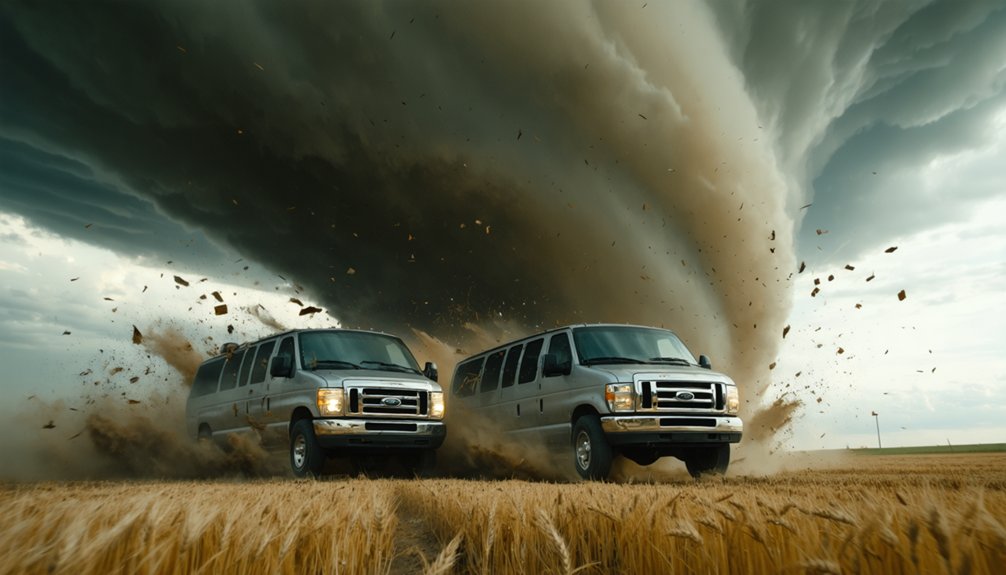
During a 2019 Kansas storm chase, a tornado directly struck two Silver Lining Tours vans, putting passengers and crew in immediate danger. The tornado’s rapid, unpredictable track overwhelmed real-time weather modeling assessments, leaving vehicles within the damage path before repositioning was possible.
Occupants endured violent structural impacts, debris strikes, and disorientation characteristic of direct tornado engagement.
What makes this incident analytically significant is how it exposed critical gaps in positional decision-making. Modern drone technology now supplements ground-level observations, providing aerial perspective on tornado motion that wasn’t accessible during this event.
Had such tools been deployed, the vans’ crews might’ve identified the tornado’s erratic deviation earlier. You understand the stakes clearly: when weather modeling and situational awareness fail simultaneously, direct tornado contact becomes an immediate, life-threatening reality.
Two Chasers Hit by the Rolling Fork EF4 at Night
Nighttime tornado interception strips you of your most critical safety tool — visual confirmation of the tornado’s position and movement.
In 2023, two storm chasers learned this firsthand when the Rolling Fork EF4 struck their vehicles under low-visibility, nighttime conditions.
You’re forced to rely entirely on radar data and spotty ground truth when the storm itself remains invisible, making accurate positioning nearly impossible.
Nighttime Tornado Interception Dangers
Storm chasing at night strips away one of a chaser’s most critical tools: visual confirmation of a tornado’s position, size, and movement. You’re maneuvering blind, relying entirely on radar interpretation and split-second decisions. Lightning strikes may briefly illuminate a funnel, but that strobe-like visibility is dangerously deceptive.
Nighttime interception compounds risk through:
- Reduced contrast: Tornadoes blend into dark skies, masking their true width and trajectory
- Equipment failures: Cold temperatures and moisture accelerate electronic malfunctions during critical moments
- Delayed repositioning: Dark rural roads limit your escape route options significantly
- Radar lag: Real-time data still carries latency, creating dangerous positioning miscalculations
The Rolling Fork EF4 demonstrated precisely how these factors converge. Two chasers paid the price for underestimating what darkness does to situational awareness.
Rolling Fork Chaser Impact Details
What happened at Rolling Fork in 2023 puts those nighttime hazards into sharp, documented focus. An EF4 tornado struck two storm chasers operating under full darkness, eliminating the visual margin that daylight provides.
Historical meteorology records confirm this event as one of the most operationally compromising intercepts in modern chasing. You can’t assess a tornado’s exact track, width, or acceleration when you can’t see it. Both chasers survived, but the incident exposed critical gaps in safety protocols—specifically, how nighttime positioning decisions carry disproportionate risk compared to daytime operations.
The Rolling Fork tornado moved erratically, mirroring El Reno’s unpredictable behavior. If you chase at night, your threat margin compresses dramatically. Distance, escape routes, and timing all demand tighter calculation when ambient visibility is effectively zero.
How Tanner Charles Survived the Lewistown Tornado
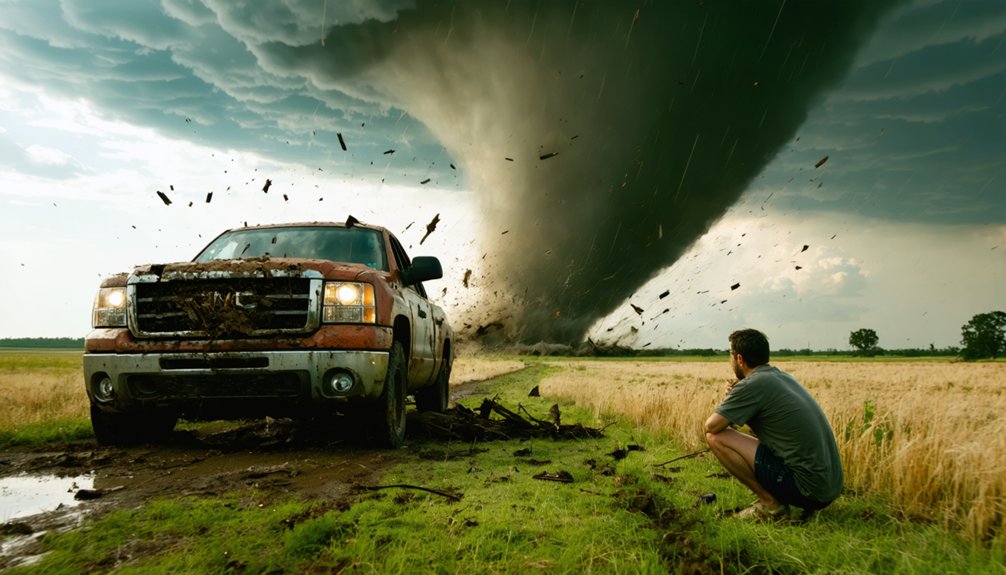
Among the closest calls in storm chasing history, Tanner Charles’s encounter with the Lewistown tornado stands out as a stark example of how quickly a chase can turn life-threatening. Meteorological anomalies in the tornado’s path created conditions that overwhelmed standard positioning strategies, leaving his vehicle directly in harm’s way.
Key factors that defined his survival:
- Equipment failures compromised real-time tracking data during the critical approach phase
- Rapid directional shifts in the tornado’s movement reduced available escape time
- Structural damage to his chase vehicle confirmed direct tornado contact
- Split-second repositioning decisions ultimately prevented a fatal outcome
Tanner’s experience reinforces that even experienced chasers operating disciplined protocols face irreducible risks when tornadoes behave outside predictable parameters. Your margin for error shrinks fast when the storm controls the variables.
Why Spring 2022 Became One of the Deadliest Chasing Seasons
Tanner Charles’s near-miss illustrates how individual positioning errors can turn fatal, but spring 2022 demonstrated that systemic factors could amplify lethality across an entire season. Four storm chasing fatalities occurred during that period, making it historically significant.
Meteorological anomalies drove the season’s danger — erratic tornado paths, rapid intensification cycles, and compressed warning windows stripped chasers of critical decision-making time. You couldn’t rely on standard behavioral models when storms defied predictable tracks.
Erratic tornado paths and rapid intensification cycles compressed warning windows, stripping chasers of critical decision-making time.
Equipment failures compounded these meteorological anomalies, as degraded radar feeds and communication breakdowns left chasers operating with incomplete situational awareness. When you’re intercepting volatile supercells without reliable data, margin for error collapses entirely.
Spring 2022 exposed how converging systemic vulnerabilities — atmospheric unpredictability combined with technological inadequacy — can transform an already dangerous pursuit into a statistically deadlier season.
The Storm Chasing Deaths That Had Nothing to Do With Tornadoes
When you examine storm chasing fatalities historically, you’ll find that tornadoes weren’t the primary killer — roads were.
Before 2013, every known direct chaser death resulted from driving hazards, with hydroplaning in post-chase wet conditions accounting for nearly half of all indirect fatalities.
You can trace a clear pattern: the chase itself carries risk, but the drive home has claimed just as many lives.
Driving Dangers After Chasing
Not every storm chasing death happens inside a tornado’s path. Nearly half of all indirect storm chasing fatalities stem from post-chase driving conditions, where compromised weather prediction and ignored safety protocols prove fatal.
After a chase, you’re exhausted, roads are wet, and visibility drops fast. Hydroplaning becomes your real enemy:
- Wet roads after storm passage dramatically reduce tire traction
- Fatigue impairs your reaction time during high-speed highway returns
- Poor weather prediction leaves you unprepared for lingering hazardous conditions
- Ignoring safety protocols around post-chase driving multiplies your risk exponentially
You survived the tornado. The drive home shouldn’t be what kills you. Statistically, it’s the overlooked danger that ends chasing careers permanently. Discipline doesn’t stop when the storm does — it extends through every mile of your return route.
Hydroplaning Claims Chaser Lives
Twelve indirect storm chasing deaths have occurred as of December 25, 2025, and nearly half trace directly to hydroplaning — not tornadoes, not lightning, not hail. Rain-saturated roads following a chase create loss-of-traction scenarios that kill experienced chasers who survived the actual storm.
Meteorological myths suggest the danger ends when the tornado dissipates. It doesn’t. Chaser camaraderie often fuels post-chase euphoria, reducing situational awareness during the drive out.
You accelerate on a wet highway, tires lose contact with the pavement, and vehicle control disappears within seconds. No warning. No recovery.
The storm chasing community frequently underestimates this post-event window. Your highest vulnerability isn’t always inside the hook echo — sometimes it’s the rain-slicked highway sixty miles behind it.
Pre-2013 Road Fatalities
Before a single tornado claimed a storm chaser’s life, road fatalities had already defined the mortality profile of the pursuit. For nearly sixty years, meteorological anomalies weren’t killing chasers — poor driving decisions were.
The pre-2013 death record reveals a pattern worth understanding:
- All known chaser fatalities before 2013 were driving-related, zero were tornado-caused
- Hydroplaning in post-chase conditions remained the dominant kill mechanism
- Safety protocols for vehicle operation lagged behind storm-intercept procedures
- Road hazards, not supercells, represented the highest statistical threat to chasers
You’re pursuing extreme meteorological anomalies, yet statistically, your greatest danger was the wet asphalt beneath your tires. That asymmetry forced a hard reckoning — safety protocols needed to address the drive home as aggressively as the intercept itself.
Frequently Asked Questions
How Many Storm Chasers Have Died Directly From Tornadoes Overall?
Four storm chasers have directly died from tornadoes—all in the 2013 El Reno event. You’d benefit from studying tornado survival strategies and storm chasing safety protocols to understand how that unprecedented, 2.6-mile-wide tornado overwhelmed even experienced professionals.
What Percentage of Indirect Storm Chasing Deaths Involve Hydroplaning Incidents?
Nearly half of indirect storm chasing deaths involve hydroplaning hazards — a striking statistic you can’t ignore. You’ll find vehicle safety critically matters post-chase, as hydroplaning incidents consistently account for approximately 50% of those indirect fatalities.
Which Storm Chasing Deaths Occurred Before Tornado-Related Fatalities Became Documented?
Before 2013, you’ll find all documented storm chasing deaths stemmed from driving-related incidents—no historical storm event involved tornado-direct fatalities. Chasing safety protocols then focused purely on traffic risks, not tornado intercept dangers.
What Phenomena Do Storm Chasers Pursue Beyond Tornadoes and Severe Thunderstorms?
You’ll pursue tropical cyclones, waterspouts, blizzards, and ice storms alongside hail storms and lightning strikes. These phenomena let you analyze diverse atmospheric dynamics, expanding your observational scope well beyond conventional tornado and severe thunderstorm interception objectives.
How Did Neil B. Ward Pioneered Early Storm Chasing Research Decades Ago?
Like a trailblazer cutting through uncharted wilderness, Ward pioneered storm chasing research in the 1950s–1960s alongside Oklahoma Highway Patrol support. His historical advancements and pioneering techniques laid the foundational groundwork you’d recognize in today’s structured, data-driven tornado research methodologies.
References
- https://en.wikipedia.org/wiki/Storm_chasing
- https://en.wikipedia.org/wiki/2013_El_Reno_tornado
- https://www.youtube.com/watch?v=6fYxgN7v5y4
- https://www.youtube.com/watch?v=WsEYQjULO9g
- https://www.youtube.com/watch?v=4KPnqetzYGs