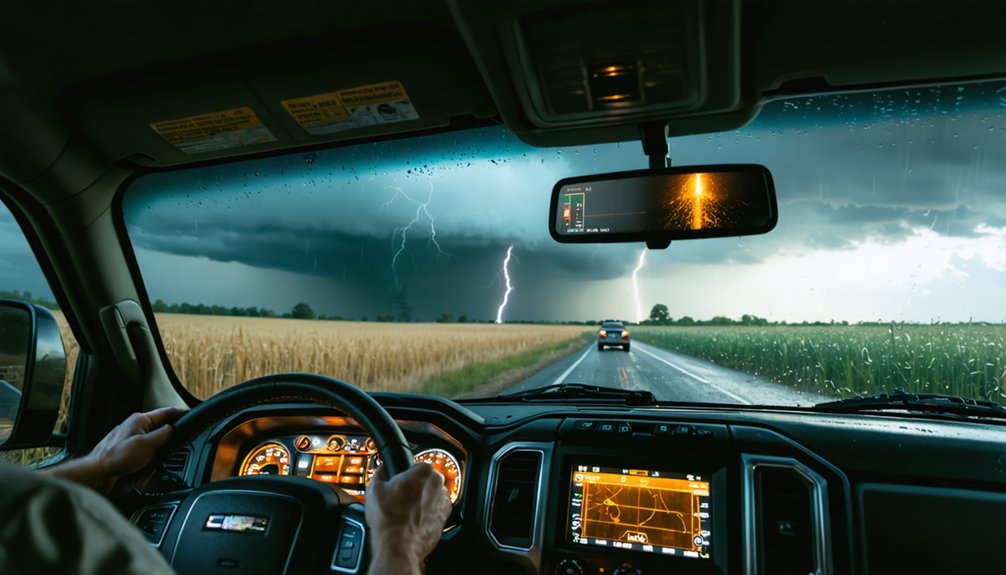
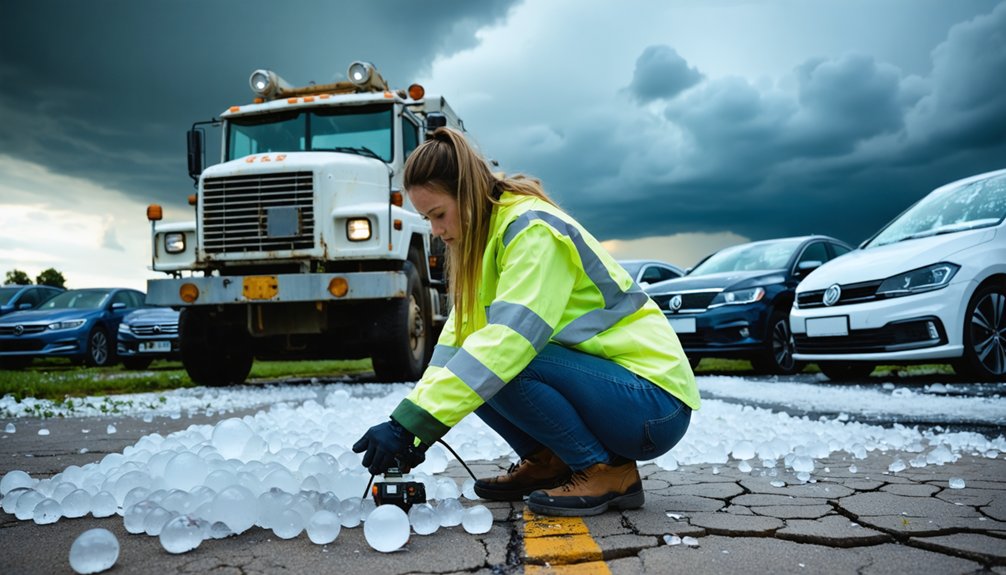
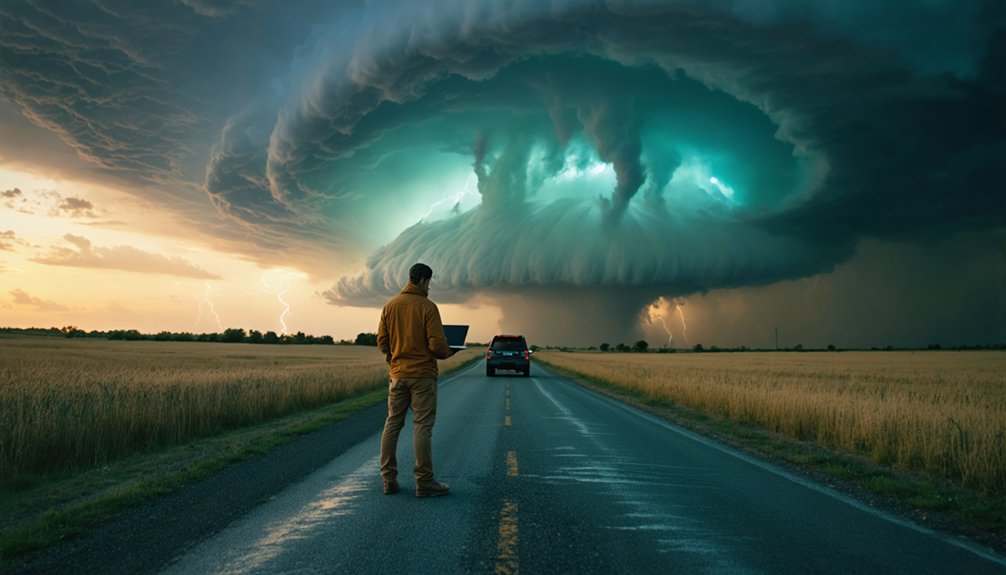
Ethical storm chasing means you prioritize public safety over dramatic footage. You maintain at least one mile from rotating wall clouds, follow all traffic laws, and coordinate with local spotters and NWS offices. You stick to paved roads, pack out all waste, and respect private property by staying on public roads. You plan two escape routes before committing to a position. The full picture of responsible chasing covers far more ground than most chasers realize.
Key Takeaways
- Maintain at least one mile distance from rotating wall clouds to minimize debris impact risk during supercell chasing.
- Always identify two viable escape routes before positioning, avoiding locations with only a single road exit.
- Coordinate with local spotters and NWS offices, sharing real-time GPS data and reporting observations promptly.
- Seek immediate shelter when lightning strikes occur within one mile, continuously tracking strike frequency and direction.
- Stay on paved roads, respect private property, and avoid interfering with emergency response operations.
What Separates Responsible Storm Chasers From Reckless Ones
Storm chasing carries inherent risks, but what distinguishes responsible chasers from reckless ones isn’t courage or proximity to the storm—it’s disciplined decision-making and adherence to established safety protocols.
Storm chasing ethics demand that you prioritize public safety over spectacle, maintaining at least one mile from rotating wall clouds and establishing multiple escape routes before positioning.
Ethical considerations extend beyond personal survival—you’re responsible for not blocking roads, not trespassing on private property, and not interfering with emergency responders.
Reckless chasers core-punch storms for social media validation, disregarding community impact and compromising escape route integrity for others.
You demonstrate responsibility by obeying traffic laws, using dedicated drivers, and maintaining 360-degree situational awareness.
Freedom in storm chasing isn’t unlimited—it’s earned through competence, preparation, and unwavering respect for both natural forces and affected communities.
Safety Rules Every Storm Chaser Must Follow
When positioning near a rotating wall cloud, you must keep at least one mile of distance between yourself and the storm to avoid direct debris impact.
You’ll also need to map out multiple escape routes that lead away from the storm’s center before you begin your approach, ensuring you’re never boxed in by terrain or traffic.
Additionally, track cloud-to-ground lightning strikes continuously, and if a strike occurs within one mile of your position, seek shelter immediately.
Maintaining Safe Storm Distances
Maintaining a safe distance from a storm’s most dangerous features isn’t optional—it’s the foundation of responsible chasing. When pursuing rotating wall clouds, you must keep at least one mile between your position and the storm’s core. That storm distance isn’t arbitrary—it’s calculated to minimize debris impact risk while preserving safe observation angles.
Core-punching sacrifices your escape route integrity for a momentary thrill, which contradicts every principle of disciplined chasing. You need clear sightlines, open roads, and verified exit vectors before committing to any position.
Constantly reassess your location relative to storm movement, because supercells shift direction unpredictably. Radar alone won’t protect you—visual confirmation is non-negotiable. Maintain situational awareness, keep your engine running, and never let proximity become a badge of courage.
Establishing Multiple Escape Routes
Escape routes aren’t a backup plan—they’re a primary operational requirement before you commit to any chase position.
Before deploying, identify at least two viable exits moving perpendicular or opposite to storm movement. Effective escape route planning demands you assess road networks, terrain limitations, and traffic density in real time.
Storm chase navigation isn’t static—conditions shift rapidly, and a route viable at deployment may become compromised within minutes.
Never position yourself where a single road represents your only exit. Bridges, dead ends, and heavily populated corridors trap chasers when storms accelerate or shift.
Continuously update your escape options as you reposition. If you can’t confirm two clear exits, you haven’t selected a position—you’ve selected a trap. Move accordingly.
Monitoring Lightning Strike Proximity
Lightning doesn’t negotiate—once a ground strike occurs within one mile of your position, you’re already inside the danger threshold and must seek shelter immediately.
Deploy lightning detection methods like dedicated strike detectors and GPS-integrated apps to monitor real-time strike proximity with precision. Don’t rely solely on visual observation; storm safety technology gives you quantifiable data that raw sight cannot.
Track strike frequency and direction trends—accelerating strike rates signal intensifying electrical activity and demand immediate repositioning. Integrate your lightning data with radar overlays to correlate electrical output with storm cell movement.
When strikes cluster near your coordinates, you’ve lost your buffer zone. Prioritize hard shelter over vehicle protection whenever structures are accessible. Your freedom to chase depends entirely on your discipline to retreat when numbers demand it.
How to Plan a Supercell Storm Chase Before You Leave Home
Planning a supercell storm chase begins long before you start your engine. You’ll need to master storm tracking techniques by analyzing upper-level wind shear, instability indices, and convective outlooks from reliable meteorological sources.
Study SPC outlooks, skew-T diagrams, and mesoscale discussions to identify your target area with precision.
Equipment preparation demands equal attention. Verify your vehicle’s fuel level, calibrate your GPS, test your radar software, and confirm your communication devices are fully charged.
Pack essential supplies including water, first aid materials, and extra batteries.
Define your primary and alternative escape routes before departure, accounting for terrain and traffic patterns.
Establish clear objectives focused on observation and learning. Pre-planning transforms a dangerous impulse into a disciplined, calculated expedition that respects both the storm’s power and your safety.
Is Night Chasing a Supercell Ever Worth the Risk?
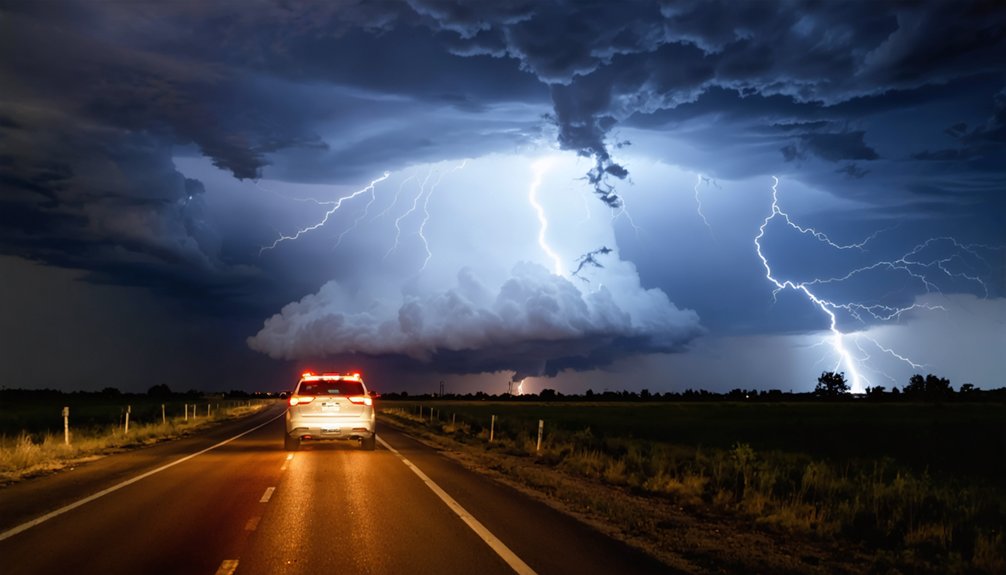
Once your daytime pre-chase planning wraps up, you’ll face one of storm chasing’s most contested decisions: whether to continue pursuing a supercell after dark.
Night vision limitations dramatically reduce your ability to read wall clouds, debris fields, and terrain hazards in real time. Radar can’t replace direct visual confirmation when you’re operating within a storm’s inflow or near its core.
Your risk assessment must account for several compounding factors: reduced escape route visibility, limited lightning illumination intervals, and degraded situational awareness from surrounding traffic.
Unless you’re an experienced chaser with favorable storm structure, adequate equipment, and verified escape corridors, retreating before darkness falls is the tactically sound choice.
Freedom in storm chasing means making disciplined decisions, not reckless ones driven by adrenaline.
How to Handle Private Property and Local Communities in the Field
Shifting from managing storm hazards to managing community relations demands equal discipline in the field.
Private property etiquette and community engagement aren’t optional—they’re foundational to preserving your access and reputation as a chaser.
Follow these four non-negotiable field protocols:
- Request permission before entering any private land; accept refusal without argument.
- Stay on public roads to avoid damaging crops, fences, or undeveloped terrain.
- Avoid photographing damaged structures or displaced residents without explicit consent.
- Coordinate with local authorities to avoid interfering with emergency response operations.
You represent the entire chasing community every time you enter someone’s jurisdiction.
Disrespectful behavior restricts future access for every chaser who follows.
Every reckless decision you make in the field closes doors for the chasers who come after you.
Operate with precision, restraint, and genuine respect for the people whose land and lives you’re moving through.
Traffic Laws Storm Chasers Break More Than They Admit
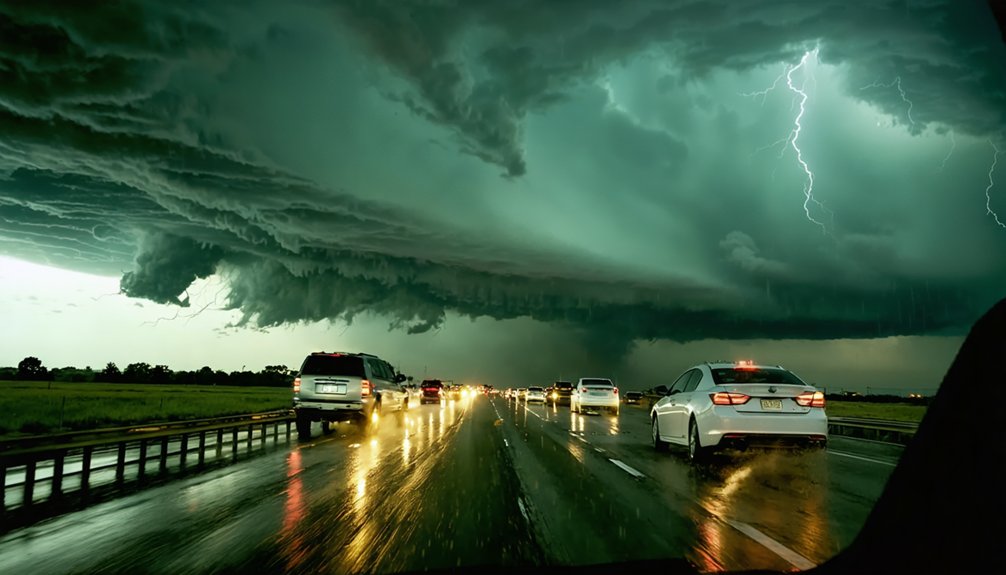
Respecting the community around you is only half the accountability equation—how you operate on the road defines the other half.
Traffic violations aren’t badges of dedication—they’re ethical failures that endanger civilians, compromise your credibility, and expose you to serious legal consequences. You’ve got freedom to chase, but that freedom carries ethical responsibility to every driver sharing the road with you.
Speed limits, stop signs, and seat belt requirements aren’t suggestions you override when a supercell demands attention. Assign a dedicated driver so you’re never simultaneously steering and analyzing radar.
Pull completely off the road when stopping, activate your emergency blinkers, and eliminate all texting. Crowded highways during severe weather aren’t your personal corridor.
Maintain 360-degree situational awareness—your pursuit never justifies putting others at risk.
How to Minimize Your Environmental Impact While Storm Chasing
When you chase storms, you’re moving through ecosystems that can’t recover quickly from careless intrusion, so you must treat every landscape as a resource worth protecting.
Stick to paved roads and designated pull-offs rather than driving across undeveloped terrain, crops, or sensitive vegetation. You reduce your environmental footprint most effectively by leaving no trace — pack out all waste, avoid cutting through fences, and keep your vehicle on established surfaces at all times.
Protecting Natural Ecosystems
Although storm chasing demands your full attention on atmospheric activity, you can’t ignore the environmental footprint your expedition leaves behind.
Ecosystem preservation isn’t optional — it’s a responsibility every chaser carries into the field.
Follow these core principles for wildlife protection and habitat integrity:
- Use designated parking aprons instead of driving onto undeveloped or vegetated terrain.
- Never cut through crops, breach fences, or damage natural ground cover to gain positioning advantage.
- Pack out all waste — leave zero trace in every ecosystem you enter.
- Avoid sensitive wildlife habitats, particularly during breeding or nesting seasons when disturbance causes lasting harm.
Your freedom to chase depends on maintaining public trust and environmental credibility.
Protect the landscape, and it’ll remain accessible for future expeditions.
Reducing Environmental Footprint
Every storm chasing expedition leaves a measurable environmental impact, and reducing that footprint requires deliberate, proactive decisions before and during each chase.
You’ll minimize fuel consumption by optimizing route efficiency and avoiding unnecessary repositioning. Integrate sustainable practices by using designated pull-off areas instead of driving onto undeveloped terrain or through vegetation. Pack out everything you bring in — no exceptions.
Make eco friendly choices when selecting fuel types and vehicle maintenance schedules; well-tuned engines consume less fuel and emit fewer pollutants.
Avoid cutting through crops, damaging fences, or compacting sensitive soils with repeated vehicle passes. Coordinate with fellow chasers to consolidate vehicles when targeting the same storm, reducing total emissions.
Your freedom to chase depends on preserving the landscapes that make observation possible.
How to Coordinate With Spotters, Agencies, and Fellow Chasers
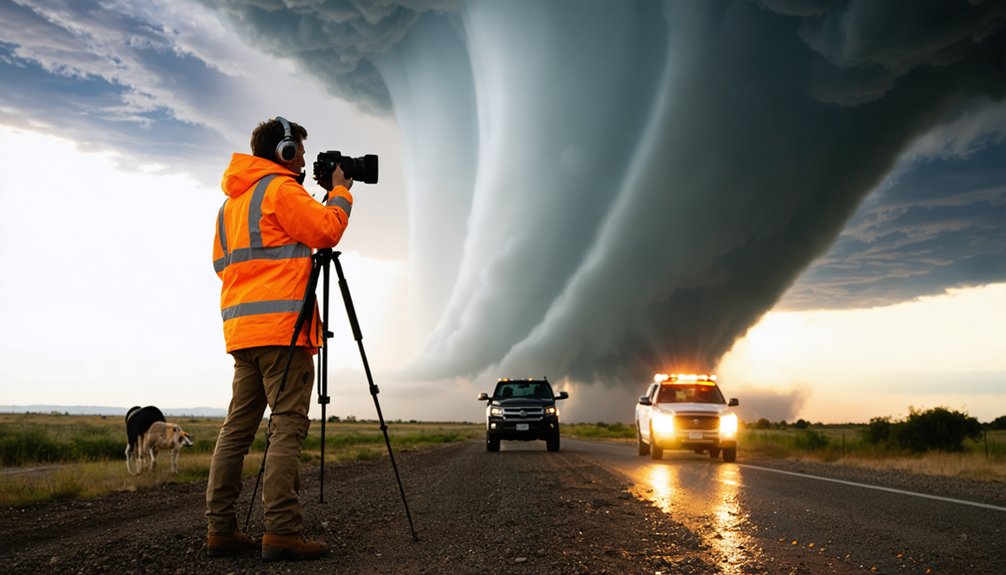
Coordinating with spotters, agencies, and fellow chasers isn’t optional—it’s a core safety requirement that directly affects your situational awareness and decision-making in the field.
Effective communication strategies and storm tracking technology give you a decisive operational edge.
Follow these four coordination protocols:
- Establish radio frequencies with local spotters and NWS offices before deploying into target areas.
- Share real-time position data using GPS-integrated storm tracking technology so teammates know your exact location.
- Report observations promptly to meteorological agencies—your ground-truth data directly improves public warning accuracy.
- Maintain open channel discipline—avoid cluttering frequencies with non-essential traffic during active tornado warnings.
You’re operating within a broader safety network.
Respecting that network protects you, fellow chasers, and the communities you’re moving through.
Frequently Asked Questions
What Insurance Coverage Do Storm Chasers Typically Need for Their Vehicles?
You’ll need extensive vehicle coverage and liability insurance to protect against storm damage, collisions, and third-party claims. Confirm your policy covers high-risk weather operations, as standard plans often exclude storm-chasing activities.
How Do Storm Chasers Handle Medical Emergencies Far From Hospitals?
Sure, just chase storms miles from civilization with zero medical prep—brilliant plan! You’ll carry extensive first aid kits, maintain remote access to emergency services via satellite communicators, and pre-identify nearest trauma centers along your planned routes.
Can Minors Legally Participate in Storm Chasing Expeditions With Adults?
Minors can legally participate if you’ve secured proper parental consent and followed applicable legal permissions by jurisdiction. You must *confirm* guardians acknowledge inherent risks, document authorization, and maintain direct adult supervision throughout every chasing expedition.
What Mental Health Challenges Do Experienced Storm Chasers Commonly Face?
You’ll face PTSD, anxiety, and adrenaline dependency as experienced chasers. Building emotional resilience requires structured coping strategies—debriefing after intense events, maintaining psychological support networks, and recognizing when storm exposure desensitizes your critical decision-making capabilities.
How Do Storm Chasers Fund Their Expeditions and Equipment Purchases?
You’ll fund expeditions through sponsorships, crowdfunding strategies, and merchandise sales. Reduce upfront costs by utilizing equipment rentals for specialized gear. Partnering with meteorological research institutions or media outlets also provides viable financial backing for your storm-chasing operations.
References
- https://www.flame.org/~cdoswell/chasesums/Chase_safety.html
- https://stormtrack.org/threads/storm-chasing-ethics-and-safety.26831/
- http://www.cimms.ou.edu/~stumpf/cethics.html
- https://weather.cod.edu/chasing/assets/documents/safety.pdf
- https://www.youtube.com/watch?v=nxPSFg2R8YY
- https://www.washingtonpost.com/news/capital-weather-gang/wp/2016/05/19/more-will-die-the-ethics-of-up-close-tornado-chasing/
- https://opensiuc.lib.siu.edu/cgi/viewcontent.cgi?httpsredir=1&article=1895&context=gs_rp
- https://stormchaser.com/Storm-Chasing-Safety.pdf
- https://www.livingskytours.com/storm-chasing-101/
- https://jiyushe.com/meteorologist/the-science-behind-storm-chasing-a-meteorologists-perspective.html