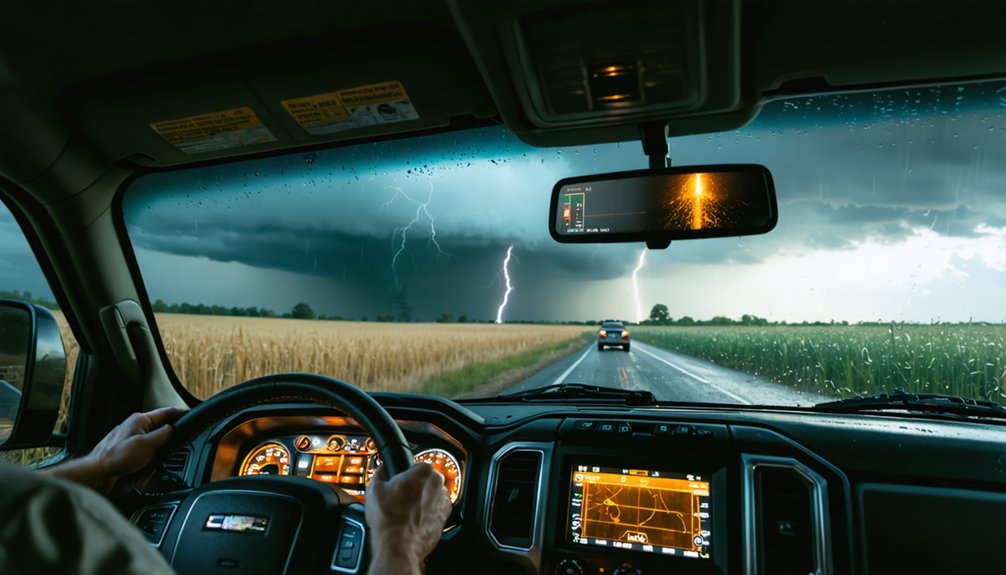
Predicting waterspouts starts with analyzing morning soundings on a Skew-T diagram, where you’re looking for steep lapse rates, precipitable water values exceeding 2.0 inches, and surface winds below 5 m/s through 500 mb. Cross-validate instability with high-definition models like ETA or AVN, then monitor Doppler radar for low-level convergence zones and rotational couplets. When NWS special marine warnings trigger, treat them as non-negotiable stop conditions. The expert-level details ahead will sharpen every stage of your decision framework.
Key Takeaways
- Morning soundings analyzed via Skew-T diagrams reveal instability, moisture, and wind shear critical for identifying high waterspout potential days.
- Precipitable water values exceeding 2.0 inches combined with surface winds below 5 m/s signal extremely favorable waterspout formation conditions.
- Doppler radar analysis identifies low-level convergence zones and rotational couplets that precede organized waterspout spin-up events.
- High-definition weather models like NGM, ETA, and AVN help predict spout potential before dangerous conditions fully develop.
- Dark, flat cumulus bases with visible funnel development and sudden pressure drops confirm active waterspout formation requiring immediate reassessment.
How Weather Models Help Predict Waterspout Formation
When forecasting waterspouts, high-definition weather models like the NGM, ETA, and AVN are your first line of analysis. You’ll review these weather models to identify days carrying high spout potential before conditions develop.
Watch for precipitable water values exceeding 2.0 inches, as they signal favorable moisture advection. When surface wind speeds drop below 5 m/s at all levels up to 500 mb, you’re looking at extremely high moisture advection conditions.
Combine local spout climatology with synoptic charts to pinpoint likely spout-producing cells within your target area.
Pull mesoscale analysis maps to extract critical wind shear parameters specific to that zone. Accelerate your model reviews using AFOS or PCGRIDDS systems to stay ahead of rapid atmospheric changes and maintain precise situational awareness throughout your forecast window.
What Morning Soundings Reveal Before a Waterspout Forms
Morning soundings in or near your forecast area are the primary tool for determining spout potential. You’ll analyze atmospheric layers through Skew-T diagrams, extracting critical stability metrics before convection initiates.
Pronounced sounding characteristics signal elevated spout risk within your immediate target zone.
Your sounding analysis should focus on four core ingredients: instability, moisture, wind shear, and lift. CAPE values quantify buoyancy, while PW values exceeding 2.0 inches confirm moisture-rich environments favorable for development.
Surface wind speeds below 5 m/s through 500 mb amplify that moisture advection notably.
MetEd’s buoyancy and CAPE modules sharpen your interpretation of each atmospheric layer’s contribution to severe storm potential.
Master these profiles early, and you’ll consistently identify high-risk windows before waterspouts ever touch the water’s surface.
Read a Skew-T Diagram to Gauge Waterspout Risk
Skew-T diagrams pack more predictive power into a single chart than almost any other tool in your waterspout forecasting arsenal.
Mastering skew T analysis lets you read atmospheric stability at a glance and act decisively before conditions turn dangerous.
Focus on these four critical indicators:
- Lapse rates — Steep environmental lapse rates signal strong instability, increasing waterspout probability greatly.
- Dewpoint spread — A narrow temperature-dewpoint gap near the surface confirms deep moisture available for funnel development.
- CAPE values — Higher convective available potential energy directly correlates with intensifying convective cells.
- Wind shear profile — Minimal directional shear through 500 mb keeps rotating columns organized and persistent.
You’re not guessing when you read these parameters correctly — you’re making calculated, data-backed decisions that keep you free and safe.
Radar and Satellite Signs That Precede Waterspouts
Radar and satellite imagery give you real-time confirmation of what soundings and models only suggest. When you’re tracking waterspout evolution, watch Doppler analysis for low-level convergence zones and rotational couplets beneath developing convection.
Radar signatures like bow echoes or tight reflectivity gradients often precede organized spin-up events over warm water.
On satellite, focus on satellite anomalies within cloud formations—specifically flat, dark cumulus bases showing rapid vertical development. Moisture indicators appear as dense, clustered convective cells aligned along convergence boundaries.
Wind patterns revealed through Doppler velocity scans expose directional shear that fuels rotation before a funnel becomes visible.
Combine storm tracking data from AFOS or PCGRIDDS with NOAA satellite loops to cross-validate threats. Acting on both data streams simultaneously sharpens your prediction accuracy considerably.
Cloud Warning Signs Every Waterspout Chaser Must Recognize
While radar and satellite tools confirm developing threats, your eyes remain a direct sensor that no instrument fully replaces. Recognizing critical cloud types and weather anomalies gives you the edge to act before conditions escalate.
Your eyes are a sensor no radar can replace—recognize the warning signs before conditions escalate.
Watch for these four visual triggers:
- Dark, flat cumulus bases — low, horizontal cloud undersides signal intense instability directly beneath.
- Funnel or tube clouds — a visible column connecting cloud base to water surface confirms active waterspout development.
- Sudden wind and pressure shifts — rapid calm over warm water frequently precedes violent rotation.
- Dark spots or ring patterns on the water surface — these weather anomalies indicate convergence zones where waterspouts initiate.
Identify these indicators early, maintain your 90-degree escape vector, and you’ll stay mobile and free.
Water Surface Patterns That Signal a Developing Waterspout
Before a waterspout fully develops, the water surface telegraphs its formation through measurable physical signatures.
You’ll notice dark spots or ring patterns spreading outward from a central convergence point — these aren’t random; they’re direct indicators of rotating low-level circulation making contact with the water’s surface.
Wind patterns shift noticeably in these zones, with surface speeds dropping below 5 m/s while convergence intensifies.
You can track these signatures using Doppler radar velocity data, cross-referencing what you’re visually observing against real-time readings.
Wave interference patterns also emerge where land breezes interact with marine convergence lines.
Recognizing these water surface anomalies early gives you a critical decision window — either position yourself for documentation or execute your 90-degree evasive heading before the spout fully matures.
Safe Distance Rules When Chasing Waterspouts on the Water
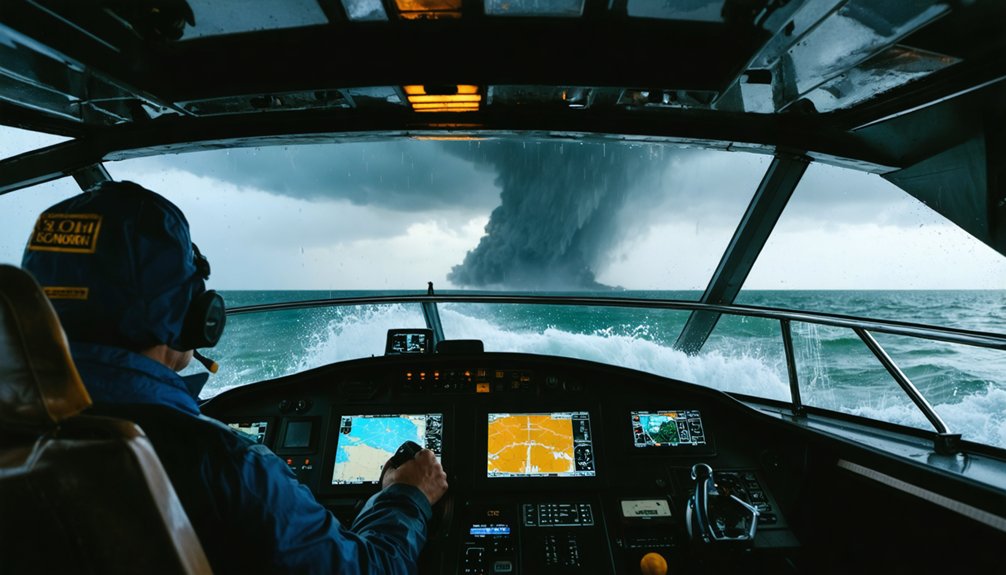
Maintaining a safe distance when chasing waterspouts isn’t optional — it’s a strict operational parameter. Your freedom to chase depends on disciplined protocols that keep you operational and alive.
Follow these critical safe navigation rules:
- Maintain a half-mile minimum buffer using GPS coordinates and onboard radar to track the waterspout’s exact position continuously.
- Execute a 90-degree escape vector relative to the waterspout’s apparent motion — never attempt direct penetration.
- Monitor emergency signaling equipment before each chase deployment, ensuring multi-frequency radios are fully functional for rapid distress communication.
- Track rotational movement data via Doppler radar velocity readings, recalculating your safe navigation corridor every 60 seconds as conditions shift.
Discipline isn’t restriction — it’s what keeps you in the field.
When to Choose Harbor Over Chasing in Storm Conditions
When thunderstorm conditions escalate beyond manageable thresholds—such as PW values exceeding 2.0 inches combined with surface winds below 5 m/s at multiple atmospheric levels—you must treat harbor as your primary option rather than a fallback.
You’ll need to weigh factors like proximity to safe anchorage, current radar-indicated cell movement, and your vessel’s ability to execute a 90-degree evasive course before committing to any continued observation.
Once the NWS issues a special marine warning via NOAA Weather Radio, you should immediately initiate your harbor approach, as chasing under active warning conditions introduces risks that no data collection objective can justify.
Recognizing Dangerous Storm Thresholds
Recognizing when conditions exceed safe thresholds is critical to deciding whether you stay on the water or head to harbor.
Monitor these threshold indicators to assess storm intensity before it’s too late:
- PW values exceeding 2.0 inches combined with surface winds below 5 m/s signal extremely favorable waterspout conditions.
- Dark, flat cumulus bases with visible funnel development confirm active waterspout formation—don’t wait for confirmation.
- Sudden pressure drops and wind shifts indicate rapid mesoscale intensification requiring immediate reassessment.
- NWS special marine warnings broadcast on NOAA Weather Radio confirm forecaster-identified spout-producing cells in your area.
When announced thunderstorm situations align with these parameters, harbor selection isn’t defeat—it’s smart tactical decision-making.
Your freedom depends on accurate threshold recognition, not reckless exposure.
Harbor Safety Decision Factors
Choosing harbor over active chasing isn’t a passive decision—it’s a data-driven one. When announced thunderstorm conditions indicate waterspout potential, your harbor location becomes your primary tactical asset.
You’re weighing real-time radar signatures, NWS special marine warnings, and PW values against your current position and window for safe transit.
If surface winds exceed 5 m/s across multiple atmospheric levels, or if convective cells are tightening near your coordinates, you commit to harbor—no negotiation.
Verify your safety equipment is accessible and functional before departure becomes impossible. NOAA Weather Radio broadcasts give you the final trigger point.
Freedom in storm chasing means knowing precisely when the data overrides your chase plan. That discipline keeps you operational for the next opportunity.
NWS Warning Response Protocol
NWS special marine warnings broadcast over NOAA Weather Radio are your hard trigger—once issued for your operating area, you treat them as a binary stop condition, not a factor to weigh against chase opportunity.
NWS alert systems remove subjective judgment when conditions deteriorate rapidly.
Execute this emergency response sequence immediately:
- Cease data collection and secure all equipment within your vessel’s protected storage.
- Plot the nearest harbor using GPS, prioritizing routes that avoid the warned zone entirely.
- Switch to multi-frequency radio and maintain continuous contact with Coast Guard on Channel 16.
- Log your position, heading, and ETA to harbor so rescue coordination remains viable if conditions worsen unexpectedly.
Your autonomy depends on returning intact—no chase data justifies operating inside an active NWS warning boundary.
How to Document and Report Waterspouts During a Chase
When you spot a waterspout, documenting it quickly and accurately serves both scientific and safety communities.
Apply proper documentation techniques by capturing high-resolution video and photographs that record the funnel’s diameter, intensity, and movement direction. Note the exact GPS coordinates, time, and estimated distance.
Capture high-resolution footage documenting the funnel’s diameter, intensity, and movement, while logging precise GPS coordinates, time, and distance.
Follow established reporting guidelines by contacting NWS immediately, enabling them to issue or update special marine warnings broadcast on NOAA Weather Radio.
Submit your visual data to the International Centre for Waterspout Research to contribute to global climatological records.
Record atmospheric observations alongside your visual data, including estimated wind speed, wave patterns, and cloud base height.
Precise documentation transforms your chase data into actionable intelligence, strengthening future waterspout forecasts and protecting other mariners operating in the same waters.
Frequently Asked Questions
What Time of Year Do Waterspouts Occur Most Frequently in Coastal Regions?
You’ll find waterspouts occur most frequently during late summer and early fall, when seasonal patterns align with warm sea surface temperatures and unstable weather conditions, typically peaking between August and October in coastal regions.
Can Waterspouts Travel Inland and Become Tornadoes After Landfall?
Yes, waterspouts can achieve inland migration after landfall, triggering tornado transformation if atmospheric conditions support it. You’ll notice intensified rotation, increased wind shear, and sustained CAPE values confirming the shift on your Doppler radar data.
What Licenses or Certifications Do Professional Waterspout Chasers Typically Need?
Over 70% of storm chasing is self-regulated—you don’t need formal licenses. However, you’ll want certifications in meteorology, safety procedures, and first aid to enhance your credibility and effectiveness during waterspout storm chasing pursuits.
How Long Does the Average Waterspout Last Before Dissipating Completely?
You’ll find waterspout duration typically ranges 2–20 minutes before dissipating factors like wind shear, cool air intrusion, or land contact break the vortex. Monitor radar closely—you’re tracking a rapidly evolving, freedom-demanding atmospheric phenomenon.
Are Certain Bodies of Water More Prone to Frequent Waterspout Formation?
Yes, certain waters are far more prone — don’t assume all open water’s equal. Warm lake characteristics and shallow ocean currents supercharge instability, making the Florida Keys, Great Lakes, and Adriatic Sea your highest-frequency waterspout hunting grounds.
References
- https://crazystormchasers.com/chasing-waterspouts-responsibly-and-safely/
- http://www.weatherclasses.com/uploads/1/3/1/3/131359169/waterspouts_medlin_2015_forlix_part2_reducedsize.pdf
- https://www.sailingscuttlebutt.com/2015/08/20/a-new-spin-on-waterspout-forecasting/
- https://www.youtube.com/watch?v=NHp69Mo9q5w
- https://greatlakesecho.org/2013/03/19/center-seeks-information-on-great-lakes-waterspouts-after-record-reports/
- https://www.wiu.edu/SevereWeather/images/presentations/How_to_Effectively_Storm_Chase.pdf
- https://www.sea-help.eu/en/guide/waterspouts-tornadoes-safety-tips/
- https://stthomassource.com/content/2025/05/29/understanding-waterspouts-how-these-weather-phenomena-take-shape/
- https://www.weather.gov/media/mlb/research/UsingtheWSR88DtoPredictEastCentralFloridaWaterspouts.pdf
- https://www.cruisingworld.com/weathering-waterspouts/