When you look up at a lightning bolt, you’re seeing a 30,000 Kelvin plasma channel radiating across virtually every visible wavelength against a near-zero luminance background. Your dark-adapted pupils have dilated fully, capturing maximum photons with minimal competition. Rayleigh scattering in clear air preserves the broad-spectrum white flash rather than filtering specific frequencies. That contrast ratio between channel and sky is what makes each strike feel almost violent in its intensity — and there’s far more physics behind it.
Key Takeaways
- Lightning’s 30,000 Kelvin plasma channel emits intense white light, creating extreme luminance contrast against a dark, clear sky.
- Dark-adapted pupils dilate fully at night, maximizing light sensitivity and making lightning appear significantly brighter.
- Clear air lacks particles that scatter or filter light, preserving lightning’s full brightness and broad visible spectrum.
- The absence of competing light sources at night means lightning’s photons face minimal interference reaching observers’ eyes.
- Multiple branches fire simultaneously during a strike, expanding the visible flash area and amplifying its overall visual impact.
Why Lightning Looks So Bright Against a Dark Sky?
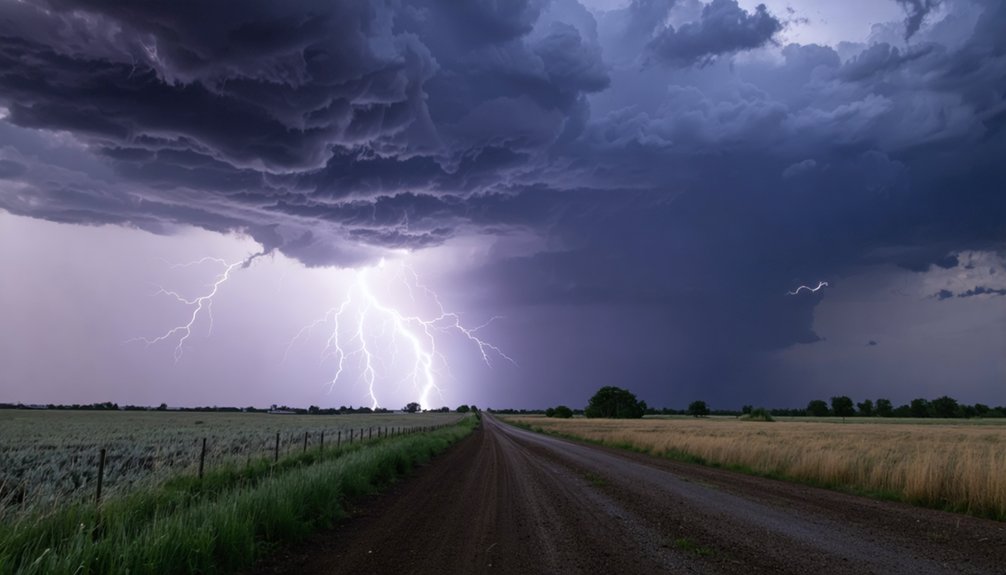
When you witness lightning split across a night sky, the contrast isn’t accidental — it’s the direct result of near-zero background luminance amplifying the perceived brightness of the flash. Your dark-adapted pupils dilate fully, maximizing retinal light capture and dramatically increasing your sensitivity to distant flashes.
Daytime conditions suppress this entirely — sunlight’s high luminance overwhelms lightning intensity, and constricted pupils reduce your atmospheric visibility of faint optical events.
At night, the sky delivers virtually zero competing photons, so the lightning channel’s 30,000 Kelvin black-body radiation registers with maximum perceptual impact. The stark luminance differential between the dark background and the ionized channel isn’t a subtle distinction — it’s an orders-of-magnitude contrast that your visual system detects instantaneously, making nighttime lightning appear extraordinarily vivid.
How Does the Lightning Channel Actually Produce Light?
The lightning channel produces light through a process rooted in extreme thermal physics — a discharge event superheats surrounding air to approximately 30,000 Kelvin, roughly five times hotter than the sun’s surface.
A lightning strike superheats air to 30,000 Kelvin — five times hotter than the surface of the sun.
At that temperature, the ionization process strips electrons from air molecules, creating a conductive plasma column that carries massive current between cloud and ground.
This plasma emits light energy through black-body radiation — the same physical principle governing any superheated object.
Electrical resistance within the channel converts current into thermal energy at an extraordinary rate, driving photon emission across the visible spectrum.
The result is that intense white flash you’re seeing overhead.
You’re not witnessing a single beam — you’re observing simultaneous illumination across every branch of a structurally complex, zig-zagging plasma channel.
Why Does Lightning Appear to Flash Across the Entire Sky?
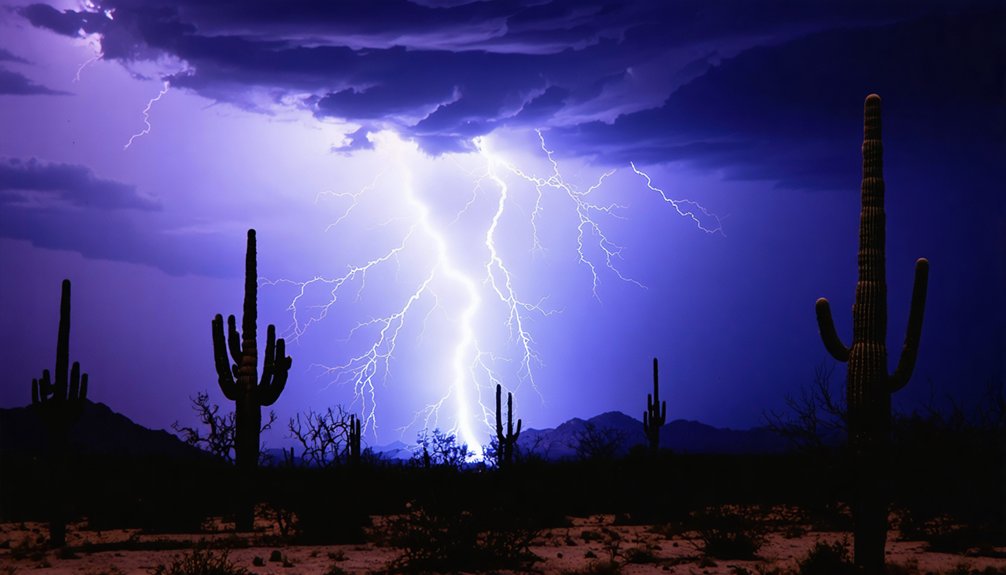
What you’re actually observing isn’t a single bolt — it’s dozens of branches firing simultaneously across a structurally complex channel that can span several miles of sky.
When the primary channel establishes ground contact, every branch illuminates at once, distributing light across a wide atmospheric cross-section.
Lightning duration typically measures between 0.2 and 0.3 seconds — brief, but sufficient for your visual system to register the full spatial extent of the discharge.
Atmospheric scattering compounds this effect by diffusing photons outward from each branch point, effectively widening the perceived flash beyond the channel’s physical boundaries.
Moisture, dust, and particulates redirect light in multiple directions simultaneously.
You’re not seeing one line of electricity — you’re seeing an entire network of conductive paths light up as a unified system.
Why Does Lightning Change Color in Different Weather?
Atmospheric composition directly controls which wavelengths reach your eyes by selectively absorbing and scattering light across the visible spectrum. Haze, dust, and moisture filter specific frequencies, shifting lightning color from white toward red or orange at greater distances.
You’ll notice pink and green hues during snowstorms, where ice crystals diffract wavelengths differently than liquid water droplets. Weather effects compound across distance — each additional mile strips away blue wavelengths preferentially, following Rayleigh scattering principles.
Raindrops absorb and redirect light, dimming overall intensity while altering spectral balance. Dry, clear air transmits the broadest spectrum, delivering the purest white flash directly to your retinas.
Understanding these weather effects lets you assess storm characteristics analytically, extracting real atmospheric data from lightning color variations you’d otherwise dismiss.
What Makes Some Lightning Strikes Visible Miles From the Storm?
Color shifts tell you what’s happening inside the storm, but some lightning announces itself from positions far beyond the storm’s visible edge. Positive lightning achieves clear air visibility through mechanisms you won’t see coming:
- Travel distance: Long distance strikes traverse 10–12 miles through clear air beyond the storm’s boundary.
- Origin point: These bolts exit from a thunderstorm’s back side, where no visible clouds warn you.
- Channel structure: The ionized path cuts through unobstructed atmosphere, losing minimal intensity before reaching your position.
- Contrast advantage: Clear air contains fewer particles to scatter light, preserving the flash’s brightness across extended distances.
You’re exposed precisely because the sky above you looks clear. That deceptive clarity makes these strikes statistically more dangerous than conventional lightning.
Frequently Asked Questions
Why Does Thunder Always Follow Lightning Instead of Occurring Simultaneously?
You hear thunder after lightning because light travels at 186,000 miles per second while sound moves at only 0.2 miles per second, creating a sound delay. Every five seconds of lightning speed gap equals roughly one mile distance.
Can Lightning Ever Be Completely Invisible to the Human Eye?
Yes, lightning can be invisible to you when daytime sunlight’s high luminance overwhelms your human perception. Lightning visibility drops as constricted pupils and atmospheric haze reduce your ability to detect distant flashes exceeding 30,000 Kelvin.
Why Do Some Lightning Strikes Last Longer Than Others Visually?
lightning duration varies because multiple return strokes repeat along the same channel. You’ll notice visual perception extends when 3–4 strokes occur milliseconds apart, making lightning duration appear longer than a single 0.2-second discharge.
Does Lightning Always Travel Downward From Clouds to the Ground?
No, lightning doesn’t always travel downward. You’ll find cloud discharge can move laterally or upward, creating electric pathways spanning 10-12 miles through clear air, with positive lightning often striking outward from storm systems entirely.
Why Does Lightning Appear Brighter When Reflected off Water Surfaces?
Brilliantly bouncing beams double your perceived light intensity as water reflection mirrors the flash beneath you. You’re fundamentally viewing two simultaneous sources, amplifying brightness analytically by nearly 100%, depending on surface angle and atmospheric clarity.
References
- https://www.youtube.com/watch?v=QfU-bPpPG9c
- https://saraichinwag.com/why-is-lightning-so-bright
- https://www.nssl.noaa.gov/education/svrwx101/lightning/faq/
- https://lpsfr.com/en/eclair-in-clear-weather-an-intriguing-meteorological-phenomenon/
- https://www.reddit.com/r/askscience/comments/10exqut/how_does_lightning_illuminate_the_sky/
- https://www.reddit.com/r/explainlikeimfive/comments/9ibq80/eli5_why_do_you_only_see_lightning_when_its_dark/
- https://ericsweatherlibrary.com/2015/07/25/natures-light-show-the-science-of-lightning/
- https://www.hko.gov.hk/en/education/weather/thunderstorm-and-lightning/00022-why-lightning-looks-the-way-it-does-crooked-and-forked.html
- https://www.popsci.com/environment/why-lightning-thunder-sunny/
- https://www.nature.com/articles/001139c0.pdf