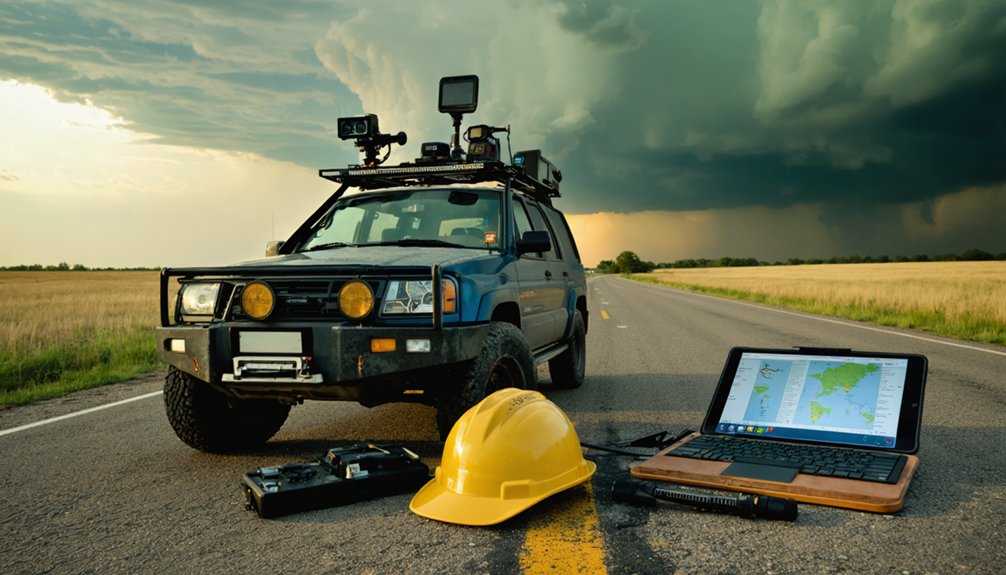
Reed Timmer didn’t build the Dominator alone—Kevin Barton and Todd Dalley constructed it in Freeport, Michigan, starting with a modified 2007 Chevrolet Tahoe. They armored it with heavy-duty steel, fitted impact-resistant Lexan polycarbonate windows, and loaded it with atmospheric sensors, radar systems, and deployable probes. Hydraulic suspension lowered the body against wind lift, while ground spikes anchored it against tornado forces. Each successive generation grew heavier, stronger, and more capable—and there’s far more engineering detail worth uncovering.
Key Takeaways
- The Dominator was built in Freeport, Michigan, beginning with a modified 2007 Chevrolet Tahoe before progressing to larger platforms like the GMC Yukon XL.
- Armor evolved from 16-gauge steel to 3/4-inch heavy-duty steel, with impact-resistant polycarbonate Lexan windows for debris protection.
- A hydraulic suspension system lowered the vehicle flush to the ground, reducing aerodynamic lift during high-velocity winds.
- Deployable ground spikes anchored the vehicle into soil, while total mass ranged between 8,000 and 11,000 pounds for stability.
- The vehicle was equipped with atmospheric sensors, roof-mounted radar, and satellite uplinks to collect and transmit real-time storm data.
Who Built the Dominator and Where It All Started
The Dominator storm-chasing vehicles were built in Freeport, Michigan between 2008 and 2013 by a fabrication team led by Kevin Barton and Todd Dalley. Reed Timmer’s vision drove the project from the start, prioritizing function over convention.
The team began with a modified 2007 Chevrolet Tahoe, establishing the foundation for what would become a serious storm-intercept platform. Each build refined the previous version, pushing structural capability further.
Vehicle aesthetics took a back seat to engineering demands, though deliberate paint finishes contributed to the Dominator’s recognizable, aggressive identity. You’re looking at a machine designed from the ground up to enter environments that would destroy standard vehicles.
The fabrication process wasn’t casual — it reflected calculated decisions made by people who understood exactly what tornado intercept conditions require.
How Reed Timmer Chose Each Vehicle Platform for the Job
When you look at the first Dominator, you’ll see Reed started with a 2007 Chevrolet Tahoe, a compact SUV platform that established the baseline for close-range tornado intercept work.
As chase conditions demanded greater mass and stability, he scaled up to a 2011 GMC Yukon XL and later a 2013 Ford F-350 Super Duty, each platform offering more structural capacity for heavier armor and equipment loads.
Beyond trucks and SUVs, the concept expanded further to include stock Subaru Foresters and an F-150-based build, showing that platform selection wasn’t fixed but adapted to specific operational and research requirements.
Starting With The Tahoe
Building the first Dominator around a 2007 Chevrolet Tahoe wasn’t arbitrary—Timmer needed a platform that balanced mass, ride height, and chassis rigidity without requiring an entirely custom-built frame from scratch. The Tahoe delivered a proven suspension geometry, a body-on-frame construction that accepted heavy modifications, and enough interior volume to house early scientific instruments.
You can see why it made sense: the platform required minimal structural compromise before armoring began. Paint durability became a practical concern immediately, since debris impact and hail exposure would destroy standard factory finishes fast.
Color schemes were secondary to protective coatings, with surface treatments prioritized over aesthetics. The Tahoe gave Timmer a legitimate starting point—not a perfect one, but a workable foundation that demonstrated whether the core Dominator concept could survive real tornado intercept conditions.
Scaling Up Vehicle Size
After proving the concept with the Tahoe, Timmer didn’t stay locked to that platform—he scaled up deliberately, choosing each successive base vehicle to solve specific engineering problems the previous build had exposed.
The 2011 GMC Yukon XL offered a longer wheelbase and wider stance, directly improving stability without requiring exotic fabrication. Manufacturing logistics favored GM’s platform because parts availability simplified both the initial build and field repairs.
Moving to the 2013 Ford F-350 Super Duty pushed capacity further—its commercial-grade chassis handled the cumulative weight of armor, hydraulics, and scientific instrumentation without compromising structural integrity.
Vehicle aesthetics took a back seat entirely; each platform selection prioritized load ratings, frame geometry, and modification compatibility. You’re watching an engineer eliminate variables, not a builder chasing visual appeal.
Expanding Beyond SUVs
The Dominator program didn’t stop at SUVs and heavy-duty trucks—Timmer pushed the concept further by testing it against lighter, more conventional platforms. Later builds incorporated stock Subaru Foresters and a Ford F-150-based configuration, proving the core engineering principles could adapt across vehicle classes.
Material sourcing shifted with each platform, requiring fabricators to rework armor integration around different chassis geometries and load tolerances. Vehicle aesthetics took a backseat to function—what mattered was structural compatibility, weight distribution, and survivability under tornado conditions.
Choosing a lighter platform meant recalculating anchor loads, steel placement, and suspension stress points. These builds demonstrated that the Dominator concept wasn’t locked to one vehicle type—it was a transferable engineering framework you could apply wherever the mission demanded maximum protection with available resources.
The Armor and Windows Built to Take a Direct Hit
Surviving a direct tornado intercept demanded armor engineered to strict performance thresholds, not just bolted-on plating. Dominator 2 used 16-gauge steel plating, while Dominator 3 stepped up to 3/4-inch heavy-duty steel, a meaningful jump in impact resistance. Beyond vehicle aesthetics, these choices reflected calculated decisions about debris penetration and structural integrity under violent loading conditions.
Dominator 3’s 3/4-inch steel wasn’t an upgrade for show — it was engineered to stop debris cold.
Windows presented a separate engineering challenge. Standard glass fails instantly under high-velocity debris, so Timmer’s team installed polycarbonate Lexan panels rated for severe impact.
Dominator 2’s windshield combined layered Lexan and glass, creating a composite barrier that outperformed either material alone. Public perception often framed the Dominator as spectacle, but the armor system was purely functional.
Polyethylene spray coatings added surface durability, completing a protection package built to absorb, deflect, and survive direct hits.
How the Dominator Was Built to Stay Planted in Tornado Winds
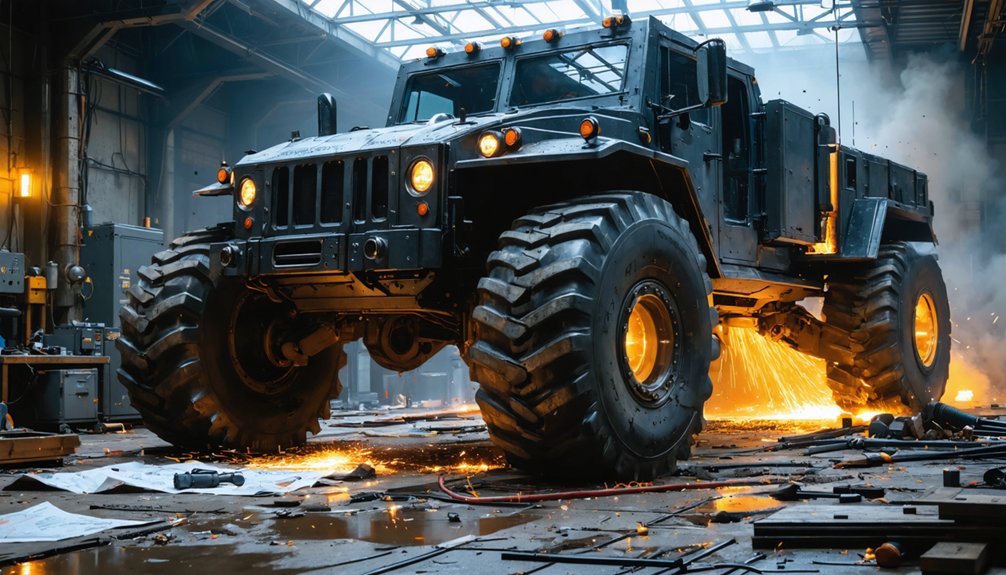
Keeping a multi-ton vehicle pinned to the ground inside a tornado required solving two distinct physics problems: aerodynamic lift and lateral displacement. The Dominator’s hydraulic system dropped the body flush against the ground, eliminating the gap where wind could generate upward force. You’re looking at pure mechanical logic: remove the lift surface, reduce the threat.
Deployable ground spikes then addressed lateral movement, anchoring the chassis against horizontal wind loads. Combined with weights between 8,000 and 11,000 pounds, these systems worked as an integrated stability network rather than isolated features.
Vehicle aesthetics took a deliberate backseat here — the Dominator looked like a weapon because it functioned like one. Public perception eventually caught up, recognizing that its aggressive, low-slung profile wasn’t cosmetic. It was engineered necessity.
The Hydraulic and Anchor Systems That Locked the Dominator Down
When tornado winds exceeded triple-digit speeds, two mechanical systems determined whether the Dominator stayed planted or became a projectile. Hydraulics dropped the body flush to the ground, eliminating the gap that wind resistance exploits to generate lift.
Ground spikes then deployed, anchoring the chassis directly into the earth for vehicle stabilization under extreme lateral and vertical forces.
These systems worked together rather than independently:
- Hydraulic suspension lowered the profile, reducing aerodynamic vulnerability
- Ground spikes penetrated the surface to resist sliding and tipping
- Low-profile positioning cut the angle where wind resistance could grab the undercarriage
- Combined mass and anchoring created a mechanical resistance stack against rotational wind forces
Without both systems operating simultaneously, the Dominator’s weight alone wouldn’t guarantee survival inside a violent tornado’s core.
What Scientific Instruments the Dominator Carried Into Storms

When you look past the armor and hydraulics, you’ll find that the Dominator’s real purpose was data collection. The vehicle carried anemometers, barometers, thermometers, hygrometers, rain gauges, and dew point sensors to capture real-time atmospheric measurements during active intercepts.
Roof-mounted radar systems and deployable probes extended that capability further, letting you pull pressure, temperature, and humidity readings from directly inside the storm’s core.
Atmospheric Data Collection Tools
Beyond its armored shell and anchoring systems, the Dominator carried a suite of atmospheric instruments that transformed it into a mobile research platform. You’d find sensors measuring pressure, temperature, humidity, and dew point in real time, feeding critical data during active intercepts. Aerial photography captured storm structure while supporting public safety awareness through documented visual evidence.
Core atmospheric tools included:
- Anemometers measuring wind speed and directional shifts inside the storm’s circulation
- Barometers and hygrometers tracking rapid pressure drops and moisture levels
- Thermometers and dew point sensors recording temperature gradients near the tornado core
- Deployable probes launched directly into storm paths to capture internal atmospheric readings
Each instrument served a precise function, turning every intercept into a structured data-collection mission rather than a simple survival exercise.
Real-Time Storm Monitoring Systems
To collect actionable storm data in real time, the Dominator integrated roof-mounted radar arrays and satellite communication systems that maintained operational contact even as surrounding conditions deteriorated. These systems let you track internal storm structure with precision, feeding continuous atmospheric readings directly to onboard instrumentation.
Anemometers measured wind velocity, barometers monitored pressure drops, and hygrometers captured moisture levels as the tornado envelope closed in. None of this relied on aesthetic design choices—every component served a functional, analytical purpose.
Satellite uplinks transmitted collected data offsite, protecting research integrity even if the vehicle sustained damage. Unlike engine performance metrics that define standard automotive builds, the Dominator’s onboard systems prioritized atmospheric measurement accuracy.
You’re looking at a purpose-built rolling laboratory engineered to extract scientific value from the most violent storm environments on earth.
From Tahoe to F-350: How Each Dominator Generation Was Upgraded
Each generation of the Dominator built on the last, with Reed Timmer’s team swapping out platforms to gain mass, stability, and protection capacity. The progression moved from a 2007 Chevrolet Tahoe through a 2011 GMC Yukon XL, then to a 2013 Ford F-350 Super Duty—each shift delivering heavier chassis specs and expanded armor capability.
Vehicle branding and aesthetic modifications evolved alongside functional upgrades, reinforcing the Dominator’s identity as a serious research machine.
- Dominator 1: Modified 2007 Tahoe, early intercept baseline
- Dominator 2: 2011 GMC Yukon XL, 16-gauge steel plating, layered Lexan windshield
- Dominator 3: 2013 F-350, ¾-inch steel, heaviest build at up to 11,000 pounds
- Later variants: Expanded to Subaru Foresters and an F-150 platform
What the Dominator Proved About Surviving a Direct Tornado Strike
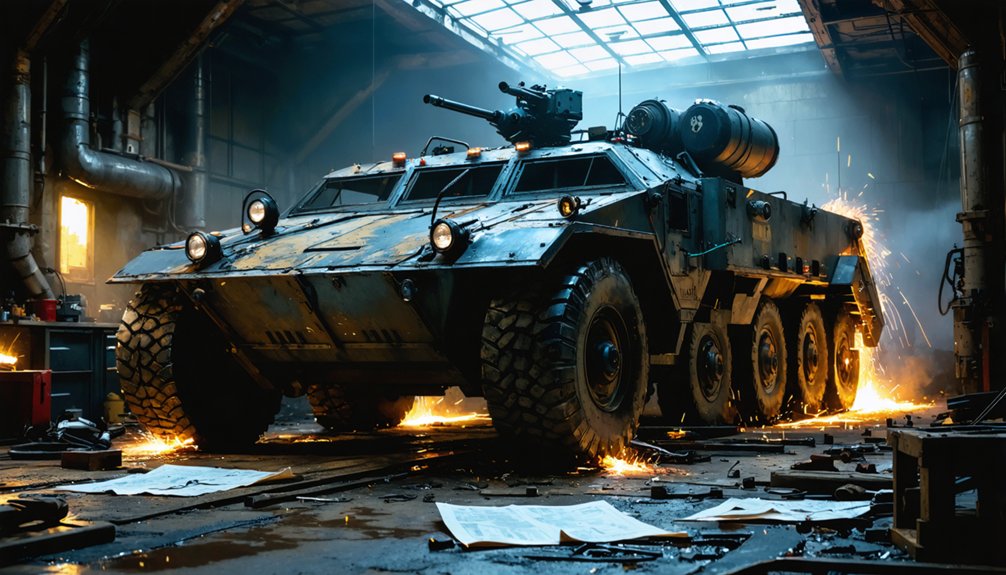
When the Dominator held its position through direct tornado contact, it validated a specific engineering hypothesis: that mass, low center of gravity, ground anchoring, and hardened armor could collectively defeat the aerodynamic and debris-impact forces a tornado generates.
The hydraulic lowering system eliminated lift vulnerability. The ground spikes resisted lateral displacement. The steel plating and polycarbonate windows absorbed debris impact without structural failure.
Each survived intercept confirmed that the engineering logic held under real conditions, not just theoretical modeling.
Beyond survival mechanics, the Dominator’s aesthetic design and vehicle branding communicated a deliberate message: this wasn’t improvised equipment. The angular armored profile signaled engineered intention.
That combination of proven field performance and purposeful visual identity demonstrated that surviving a direct tornado strike was an achievable, repeatable outcome rather than blind luck.
Frequently Asked Questions
How Much Did It Cost to Build Each Dominator Vehicle?
The price tag’s anyone’s guess—exact costs aren’t publicly documented. You’d factor in storm safety armor, hydraulic systems, and vehicle customization, likely running hundreds of thousands per build given specialized steel, sensors, and fabrication work.
Was the Dominator Ever Permanently Damaged During a Tornado Intercept?
The knowledge base doesn’t confirm permanent damage from a tornado intercept, but you’ll appreciate that the Dominator’s vehicle durability and storm safety engineering successfully withstood intense encounters, proving its armored, low-profile design remained operationally resilient under extreme conditions.
How Long Did It Take to Fully Build One Dominator?
The exact build time isn’t documented, but records show vehicle customization spanning 2008–2013 across multiple versions. You’re looking at years of iterative refinement, where each rebuild strengthened storm safety through progressively heavier armor, anchoring systems, and sensor integration.
Could the Dominator Drive Normally on Public Roads Between Chases?
Yes, you could drive the Dominator on public roads between chases, as vehicle mobility wasn’t restricted, but public road legality varied due to its extreme weight, armor modifications, and specialized hydraulic systems altering standard compliance requirements.
Did Reed Timmer Hold Any Engineering or Fabrication Credentials Himself?
the knowledge doesn’t confirm Reed Timmer’s engineering credentials or fabrication expertise directly. You’ll find his team, led by Kevin Barton and Todd Dalley, actually handled the Dominator’s technical construction work.
References
- https://en.wikipedia.org/wiki/SRV_Dominator
- https://www.youtube.com/watch?v=Vfn5NRmDCkQ
- https://stormchasers.fandom.com/wiki/Dominator
- https://crazystormchasers.com/storm-chasing-vehicle-reveals-and-new-builds/
- https://www.wired.com/story/dominator-3-tornado-chaser/
- https://prairiechasers.com/vehicles
- https://motorstata.com/the-dominator-3-the-dollar750000-tornado-proof-tank-for-extreme-storm-chasing
- https://interestingengineering.com/innovation/storm-chaser-dominator-tornado
- https://www.businessinsider.com/how-storm-chasers-drive-in-tornadoes-2013-5
- https://dspace.bluehill.edu.ec/article/104peei/bluehill-dominator-the-ultimate-tornado-chasing-vehicle-1767647618