Tim Samaras wasn’t a meteorologist with a degree — he was a self-taught engineer who redesigned how you measure a tornado from the inside out. He built survivable ground-level probes, founded the TWISTEX project, and collected pressure, wind, and temperature data that radar simply can’t reach. His work extended tornado warning times and challenged existing storm models. Stick around, and you’ll uncover exactly how one man’s instruments quietly rewrote the science of tornado prediction.
Key Takeaways
- Tim Samaras was a self-taught engineer from Colorado who pioneered direct tornado measurement using specially designed ground-level probes called “turtles.”
- He founded TWISTEX, a project enabling coordinated multi-point data collection of tornado pressure, wind velocity, and temperature differentials simultaneously.
- His research extended tornado warning times beyond the historical 13-minute average, improving public safety through better rotational identification and path modeling.
- Samaras died on May 31, 2013, during the historic El Reno tornado, the widest ever recorded at 2.6 miles wide.
- His legacy continues through Brantley Hargrove’s biography, Kathy Samaras’s annual storm chaser conventions, and TWISTEX datasets still used by researchers today.
Who Was Tim Samaras, Storm Chasing Pioneer?
Tim Samaras wasn’t your typical scientist — he never attended college, yet he built a career that reshaped how researchers understand tornadoes. Born November 12, 1957, in Lakewood, Colorado, he demonstrated an early aptitude for mechanics, disassembling his family’s TV at age 10 and earning his ham radio license at 12.
These weren’t hobbies — they were early indicators of an engineer-minded thinker who prioritized hands-on application over institutional learning.
His hands-on instincts weren’t pastimes — they were the blueprint of an engineer who learned by doing.
Samaras channeled that drive into storm technology, developing instruments capable of surviving direct tornado contact. His data collection methods produced rare, high-resolution measurements from inside active tornadoes — information that traditional research couldn’t generate.
You’re looking at a self-taught engineer who logged over 35,000 miles annually, operating at the intersection of raw curiosity and scientific precision.
From Ham Radio Kid to Explosive Engineer
If you’d traced Tim Samaras’s trajectory, you’d have spotted the engineer in him long before he ever chased a storm.
At 10, he tore apart his family’s television set to analyze its mechanics; by 12, he’d earned his ham radio operator’s license, demonstrating an early aptitude for applied technical systems.
That hands-on foundation led him directly into professional engineering, where he measured the destructive force of explosions and field-tested hail-resistant materials for Boeing aircraft.
Childhood Curiosity And Tinkering
By age 10, Tim Samaras had already disassembled his family’s television set to study its internal mechanics — a hands-on instinct that foreshadowed a career built on reverse-engineering the physical world. His childhood inventions weren’t hobbies; they were early experiments in systematic problem-solving.
Consider what his trajectory reveals:
- Self-directed learning outperformed institutional education — he skipped college entirely, building expertise through direct application.
- Licensed ham radio operator at 12 — demonstrating disciplined technical mastery before most kids chose electives.
- Curiosity without permission — he dismantled, tested, and rebuilt without waiting for validation.
You don’t need a credential to pursue truth. Samaras proved that intellectual freedom, paired with relentless tinkering, builds a foundation no classroom can fully replicate.
Engineering Career Beginnings
That childhood impulse to disassemble and decode didn’t stall at ham radios and dismantled televisions — it fed directly into a career measuring forces most engineers only model on paper.
Skipping college entirely, Samaras joined an applied engineering firm where explosive testing wasn’t theoretical — it was daily work. You’d find him quantifying destructive force with instruments, not textbook formulas.
His engineering applications expanded quickly. Boeing contracted him to field-test hail-resistant aircraft skins, translating real-world impact data into material solutions.
Federal government projects followed, each demanding the same precision he’d built from the ground up. He even co-patented a thermal imaging system for internal combustion engines with Jon M. Lesko.
Every assignment reinforced one operating principle: direct measurement beats abstract modeling every time.
How the Turtle Probe Changed Tornado Science
When Tim Samaras deployed his first “turtle” probe in 1999, he fundamentally reoriented how scientists collected data inside tornadoes. This 50-pound aerodynamic device enabled direct in-path tornado data collection, bypassing remote sensing limitations entirely.
The turtle’s probe design delivered three critical breakthroughs:
- Ground-level pressure readings captured atmospheric conditions previously inaccessible to traditional instruments.
- Survivable aerodynamics allowed equipment to withstand tornado-force winds without displacement.
- Real-time datasets provided researchers independent verification outside institutional constraints.
You’re looking at instrumentation that didn’t just incrementally improve tornado science — it restructured what questions researchers could actually ask.
The turtle probe didn’t incrementally advance tornado science — it dismantled the ceiling of what researchers could investigate.
Before the turtle, scientists theorized about internal tornado mechanics. After it, they measured them directly. Samaras handed researchers empirical freedom that no satellite or Doppler radar system could replicate.
What TWISTEX Was Really Trying to Accomplish
The turtle probe gave Samaras the capability to collect interior tornado data, but a single instrument deployed opportunistically wasn’t enough to answer the questions he was after. That’s why he founded TWISTEX—Tactical Weather Instrumented Sampling in/near Tornadoes EXperiment.
TWISTEX objectives centered on coordinated, multi-point tornado data collection rather than isolated measurements. Samaras designed the project to deploy multiple probes simultaneously across a tornado’s path, capturing pressure gradients, wind velocities, and temperature differentials at precise locations.
This systematic approach let researchers reconstruct a tornado’s internal structure with real scientific rigor.
You’re looking at a framework built for reproducibility and precision—not spectacle. TWISTEX pushed tornado research beyond anecdotal observations, generating datasets that meteorologists could actually analyze to improve warning systems and deepen understanding of tornado formation mechanics.
How Storm Chasers Made Tim Samaras a Household Name
Discovery Channel’s *Storm Chasers*, which aired from 2009 to 2012, did something Samaras’s scientific publications couldn’t: it translated his engineering-driven fieldwork into a format millions of viewers could engage with directly.
The show reshaped storm chaser culture by making tornado research impact visible to audiences who’d never read a meteorological journal.
You watched him deploy instrumented probes under rotating walls of wind, and suddenly the science felt urgent, tangible, and free from institutional gatekeeping.
Three measurable outcomes the show produced:
- Expanded public awareness of tornado data collection methodologies
- Increased funding interest from National Geographic and Discovery Channel
- Positioned TWISTEX as a recognizable research brand beyond academic circles
That visibility wasn’t vanity. It was infrastructure for continued fieldwork.
The Tornado Data Only Samaras Could Collect
Public attention brought Samaras resources, but resources alone don’t explain what made his datasets irreplaceable. His “turtle” probes penetrated tornado cores directly, capturing pressure, temperature, and wind measurements no aircraft or remote sensor could replicate.
That tornado data came from ground level, inside the most violent atmospheric structures on Earth. You’re looking at unique insights that researchers simply couldn’t manufacture through modeling or satellite observation.
Samaras logged over 35,000 miles annually during peak season, deploying instrumentation with surgical precision. His pending 3D wind measurement patent reflected engineering solutions built from direct field experience, not laboratory assumptions.
Samaras covered 35,000 miles each season, turning fieldwork into engineering solutions no laboratory could produce.
When the El Reno tornado killed him in 2013, it also ended a methodology that combined mechanical ingenuity, fieldcraft, and calculated positioning that no institution had yet systematized or replaced.
The El Reno Tornado and the Final Chase
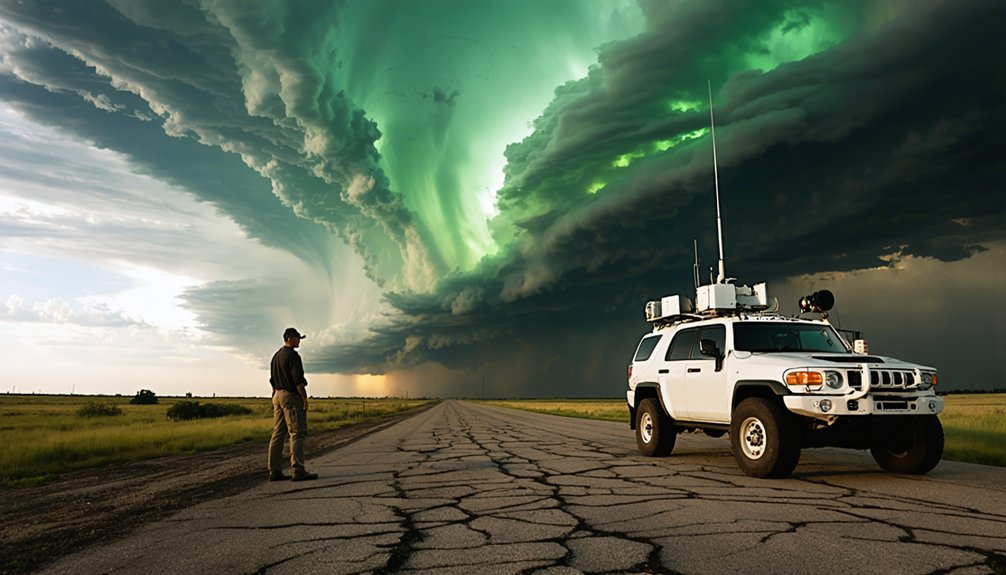
On May 31, 2013, Samaras drove toward a developing supercell near El Reno, Oklahoma, equipped with high-speed cameras capable of capturing lightning at 1 million frames per second—part of an active DARPA-funded research contract that had replaced his Storm Chasers funding.
The El Reno tornado became the widest ever recorded, killing Samaras, his son Paul, and colleague Carl Young. His final chase left behind critical data that researchers still analyze today.
Three facts define this tornado’s Legacy Impact:
- It reached an unprecedented 2.6-mile width.
- It shifted unpredictably, trapping experienced chasers.
- Deployed probes captured rare measurements before the team’s escape failed.
You’re looking at a man who died pursuing truth. That commitment permanently reshaped how scientists understand tornado behavior.
How Samaras’s Data Reshaped Tornado Warning Systems
When you examine Tim Samaras’s impact on tornado science, the data speaks clearly: his TWISTEX project produced rare, ground-level measurements that researchers couldn’t obtain through remote sensing alone.
His instrumented probes captured internal tornado pressure, temperature, and wind data that directly informed improvements to National Weather Service warning models, pushing lead times beyond the historical average of 13 minutes.
Discovery Networks’ president credited Samaras’s work with measurably extending tornado warning times, a metric that translates directly into lives saved when seconds define survival.
Extending Tornado Warning Times
Tim Samaras’s tornado probe data directly contributed to extending warning times beyond the national average of 13 minutes, a metric that emergency managers had struggled to improve for decades. His TWISTEX instrumentation captured near-ground pressure, temperature, and wind measurements that transformed tornado prediction models and warning technology.
His datasets enabled three critical advancements:
- Earlier rotational identification — ground-level readings revealed tornado formation signatures minutes before radar detection.
- Improved path modeling — precise 3D wind measurements refined trajectory algorithms forecasters rely on.
- Faster public alert triggers — refined pressure thresholds allowed meteorologists to issue warnings with greater confidence sooner.
You now have access to tornado warnings that reflect Samaras’s sacrifices. His raw field data gave forecasters measurable benchmarks, converting uncertainty into actionable intelligence that protects communities across tornado-prone regions.
Rare Data Advancing Research
Few tornado researchers have generated field data as consequential as Samaras’s TWISTEX datasets, which delivered near-ground measurements that radar systems couldn’t replicate. His turtle probes captured pressure, temperature, and wind data from inside active tornadoes, producing rare datasets that atmospheric scientists hadn’t previously accessed at ground level.
You’re looking at research that directly challenged existing tornado models. His instrumentation recorded conditions within feet of a tornado’s core, revealing structural behaviors that aerial and remote sensing tools missed entirely.
These extreme weather measurements forced meteorologists to recalibrate assumptions about tornado formation and intensity escalation. The practical result was measurable. Warning systems incorporated his findings, giving communities additional response minutes.
Samaras didn’t theorize from laboratories — he built instruments, deployed them under lethal conditions, and delivered data that permanently shifted how scientists understand tornado dynamics.
How His Family and Team Kept the Mission Alive

Though Tim Samaras died in the El Reno tornado on May 31, 2013, his widow Kathy didn’t let his work fade with him—she continued organizing the National Storm Chasers Convention, keeping the professional network he’d helped build since 1998 intact.
Family support and team dedication preserved Tim’s mission through three measurable actions:
Family support and team dedication preserved Tim’s mission through three measurable, lasting actions that outlived the man himself.
- Convention continuity — Kathy maintained the annual gathering, sustaining researcher connections and data-sharing frameworks.
- Published documentation — Brantley Hargrove’s *The Man Who Caught the Storm* archived Tim’s technical methodologies for future researchers.
- Dataset preservation — Tim’s rare tornado measurements remained accessible, directly advancing extreme weather modeling.
You can see how independent contributors—not institutions—kept this research pipeline functioning. His team proved that decentralized, mission-driven effort outlasts any single individual.
Frequently Asked Questions
Did Tim Samaras Ever Receive Formal Meteorological or Atmospheric Science Training?
Skipping school’s structured studies, you’ll find Tim Samaras pursued no formal education in meteorology. His career path bypassed traditional atmospheric science training, instead leveraging self-taught engineering skills and hands-on explosive testing experience to revolutionize tornado research.
What Specific Salary or Compensation Did Samaras Earn From National Geographic?
You won’t find specific salary data for Samaras’s National Geographic Storm Chasing funding in available records. The knowledge base only confirms he secured financial backing from National Geographic, without disclosing exact compensation figures or contractual terms.
How Did Samaras’s Wife Kathy Personally Cope With His Dangerous Career?
The knowledge base doesn’t detail how Kathy personally coped emotionally. You’d think it’d track her emotional support metrics and personal sacrifices analytically, but it only confirms she channeled resilience by actively continuing the National Storm Chasers Convention independently.
Were Any of Samaras’s Tornado Probes Ever Recovered After Fatal Deployments?
The available knowledge doesn’t confirm tornado probe recovery details after fatal deployments. You’d find that Samaras’s storm chasing technology, including deployed probes, remained unaccounted for within the provided data following the catastrophic El Reno, Oklahoma incident.
Did Tim Samaras Hold Any Memberships in Professional Scientific Organizations?
Coincidentally, while his scientific contributions were groundbreaking, the available data doesn’t confirm Tim Samaras held formal professional affiliations with scientific organizations. You’ll find his credibility stemmed from patented innovations, National Geographic recognition, and real-world tornado research instead.
References
- https://www.youtube.com/watch?v=oPrc8z4VW4w
- https://www.wunderground.com/cat6/five-years-after-el-reno-man-who-caught-storm-stunner
- https://www.shannontsanders.com/project/the-last-chase-remembering-tim-samaras/
- https://www.khoolood.com/obituaries/13492/Timothy-Michael-Samaras
- https://www.texasstandard.org/stories/new-book-chronicles-the-life-and-death-of-storm-chaser-tim-samaras/
- https://www.dmagazine.com/publications/d-magazine/2018/april/tim-samaras-storm-chaser/