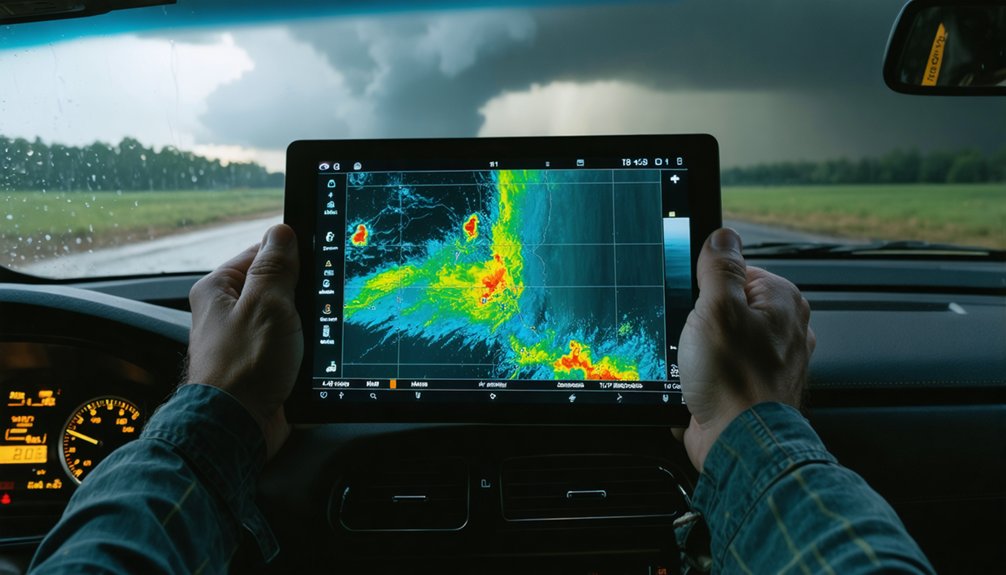
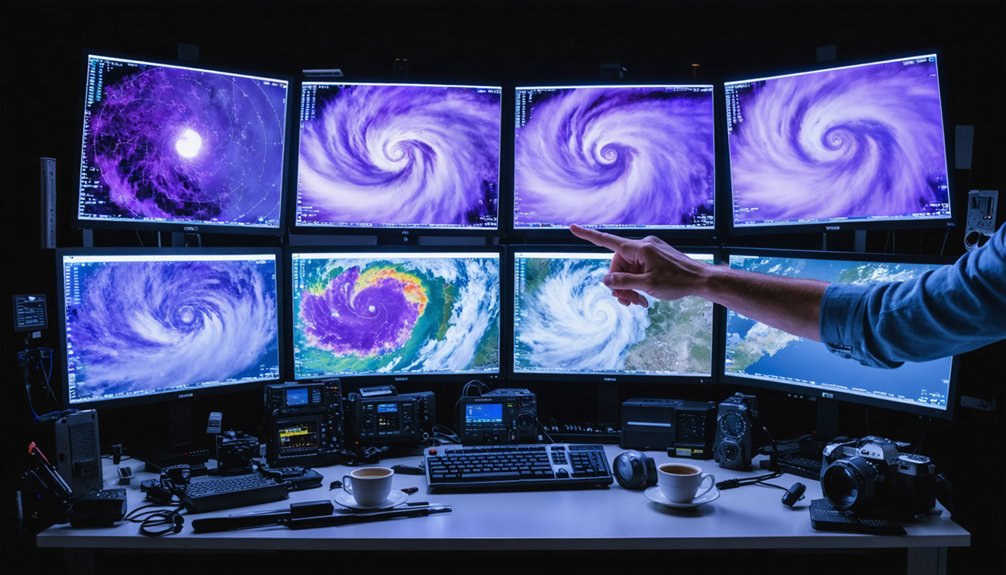
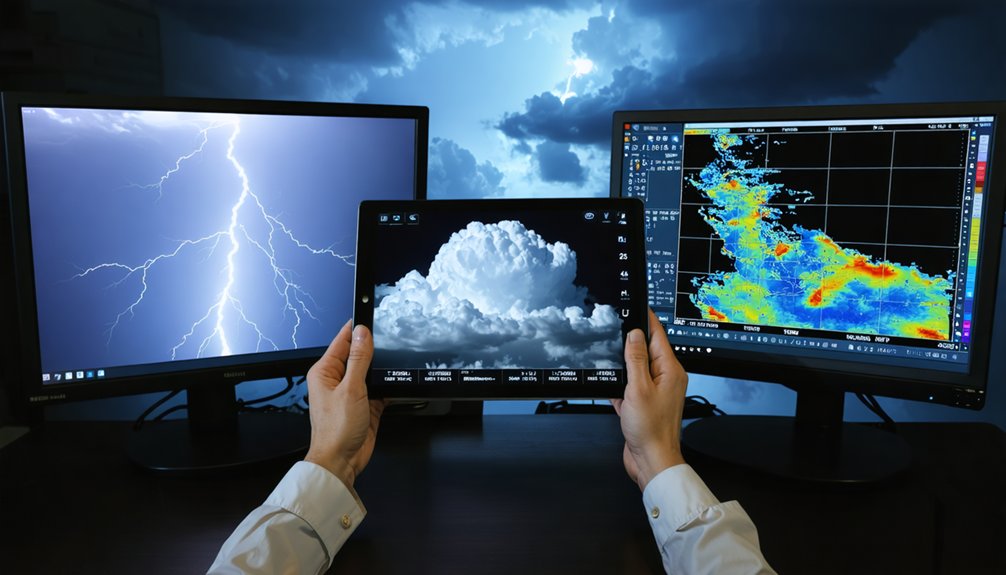
You’re storm chasing smarter when you replace gut instinct with real-time data analysis drawn from Doppler radar, GIS mapping, and AI-driven predictive models. Doppler radar identifies wind shear and mesocyclone signatures instantly, while GIS layers storm data onto terrain and road networks. Machine learning algorithms now achieve near-perfect tracking accuracy, and deep learning continuously refines predictions from terabyte-scale datasets. Keep exploring to see exactly how these tools work together to sharpen every decision you make in the field.
Key Takeaways
- Doppler radar and GIS tools convert raw atmospheric data into actionable spatial intelligence, enabling safer and more precise storm chaser positioning.
- Real-time data synthesis from radar, satellite, and surface observations prioritizes accuracy over model estimates during active storm events.
- Object-based probabilistic tracking algorithms, like MRMS, achieve 99% accuracy, significantly improving storm movement predictions across hourly intervals.
- AI and deep learning models identify complex nonlinear atmospheric patterns, delivering continuously refined, real-time storm intensity and behavior predictions.
- Data assimilation techniques generate consistent 3D storm analyses, strengthening evidence-based decision-making and reducing improvisation risks for storm chasers.
What Data Analysis Actually Does for Storm Chasers
When you’re out chasing storms, data analysis isn’t just a background process—it’s your primary decision-making engine. It converts raw atmospheric variables into actionable intelligence, letting you move freely and decisively across shifting terrain.
Through data visualization, you’re translating Doppler radar returns, GIS-mapped storm tracks, and surface observations into spatial patterns you can interpret instantly. You’re not guessing—you’re reading structured outputs that reveal wind rotation, reflectivity anomalies, and moisture boundaries in real time.
Data visualization doesn’t just display storm data—it transforms it into spatial intelligence you can act on instantly.
Predictive modeling then takes that interpreted data further, applying machine learning and statistical frameworks to historical patterns so you’re anticipating storm behavior before it unfolds.
Time-series analysis identifies trends and anomalies early, sharpening your route adjustments. Together, these tools give you the analytical independence to chase smarter, faster, and with measurable precision.
Doppler Radar, GIS, and the Core Tools Storm Chasers Use
Doppler radar and GIS form the operational backbone of modern storm chasing, giving you direct access to the atmospheric variables that determine your positioning and timing.
Doppler dynamics let you interpret wind shear, rotation, and reflectivity in real time, identifying hazard zones before they escalate. You’re reading velocity gradients and mesocyclone signatures that directly inform your approach angle and escape routes.
GIS applications layer spatial context onto that radar intelligence, enabling storm visualization across terrain, road networks, and boundary positions simultaneously.
You’re not guessing movement—you’re tracking it across mapped environments with precision. Data integration ties these tools together, merging surface observations, radar returns, and satellite feeds into a unified operational picture.
That convergence is what separates informed positioning from dangerous improvisation in the field.
Reading Real-Time Data: Radar, Satellite, and Surface Observations
Reading real-time data means moving beyond tool familiarity into active interpretation, where radar, satellite, and surface observations each carry distinct diagnostic weight.
You’re synthesizing three separate data streams simultaneously, and each one tells a different part of the story.
Radar confirms active convection, rain bands, and rotating cells.
Satellite imagery exposes boundary shifts, clearing regions, and new cumulus development that radar misses entirely.
Surface observations ground everything, revealing actual temperature, moisture, and pressure deviations from model expectations.
Real time updates matter because observational data overrides model estimates when conditions diverge.
Your data interpretation must prioritize what the atmosphere is actually doing over what any forecast predicted.
Mesoanalysis pages add a mid-level layer, exposing shortwaves and instability markers at 700 or 500 millibar levels that complete your situational picture.
Why Storm Tracking Algorithms Are Getting More Accurate
Storm tracking algorithms are getting more accurate because the underlying methods have shifted from simple correlation-based motion estimates to object-based probabilistic frameworks that weigh past motion, future motion, and climatological baselines simultaneously.
You’re now working with systems that don’t just track where a storm is—they calculate where it’s going with measurable confidence.
Three advancements are driving this precision:
- The SALdEdA procedure evaluates structure, amplitude, and location to refine tracking accuracy beyond legacy methods.
- MRMS object-based tracking achieved 99% accuracy across 600 hourly tracks, validating probabilistic approaches.
- Data assimilation generates dynamically consistent 3D analyses that capture both observed and unobserved storm intensity variables.
These tools give you autonomous, evidence-based decision-making power rather than dependence on outdated estimates.
How AI and Deep Learning Are Reshaping Storm Prediction
While traditional algorithms depend on predefined rules and historical correlations, AI and deep learning models learn directly from raw data, identifying nonlinear relationships that deterministic methods miss entirely. Through deep learning techniques, neural networks now estimate tropical cyclone intensity with measurably higher accuracy than legacy systems.
You’re working within a framework where predictive modeling continuously refines itself, processing terabyte-scale datasets that no human analyst could efficiently interpret alone. AI applications integrate Doppler radar, satellite imagery, and surface observations simultaneously, compressing complex data integration into actionable, real-time outputs.
Feature selection and hyperparameter tuning optimize model performance across diverse storm scenarios. Rather than accepting static forecasts, you gain dynamic predictions that adapt as atmospheric conditions evolve, fundamentally shifting storm chasing from reactive observation into precision-driven, scientifically grounded fieldwork.
Frequently Asked Questions
What Safety Protocols Should Storm Chasers Follow When Using Data Tools?
Sure, ignore all safety protocols—what could go wrong? You should pull over to check radar, maintain 0.5–2 miles from storm bases, guarantee communication devices stay active, and protect data privacy during real-time documentation.
How Far Should Storm Chasers Maintain Distance From a Storm Base?
You should maintain a distance estimation of 0.5 to 2 miles from the storm base, staying in clear, rain-free air. This range lets you analyze storm dynamics safely while preserving your freedom to reposition quickly.
How Does Observational Data Override Weather Model Estimates During Storms?
Models aren’t infallible—you’ll find observational significance exposes their limitations. Real-time adjustments rely on data accuracy from surface readings, revealing actual temperature, moisture, and pressure conditions that override flawed model estimates, empowering your independent, informed storm-chasing decisions.
What Is the Saldeda Procedure and How Does It Track Storms?
You’ll use the SALdEdA procedure for precise storm tracking by analyzing a storm’s structure, amplitude, location, eccentricity difference, and areal difference—giving you independent, data-driven control over monitoring storm movement with remarkable accuracy.
How Do Storm Chasers Make Real-Time Decisions During Storm Initiation?
You’ll use visual cues like cumulus towers and cloud lowering to guide your decision frameworks. Monitor convergence patterns and surface lows to understand storm dynamics, letting real-time observations override model estimates for precise, confident navigation.
References
- https://crazystormchasers.com/advanced-techniques-for-storm-chasers-data-analysis/
- https://www.youtube.com/watch?v=6otZLjSZvPU&vl=en
- https://pdfs.semanticscholar.org/4271/a78b907a5b6e72a63cb9b99c105373926377.pdf
- https://severeweather.wmo.int/TCFW/RAIV_Workshop2021/11_UW-CIMSSProducts_DerrickHerndon.pdf
- https://journals.ametsoc.org/view/journals/apme/54/2/jamc-d-14-0132.1.pdf
- https://science.osti.gov/ascr/Highlights/2018/ASCR-2018-03-b
- https://en.wikipedia.org/wiki/Storm_chasing
- https://www.ll.mit.edu/sites/default/files/publication/doc/2018-12/Chornoboy_1992_ATC-182_WW-15318(1).pdf
- https://ams.confex.com/ams/pdfpapers/97162.pdf
- https://repository.library.noaa.gov/view/noaa/58757/noaa_58757_DS1.pdf