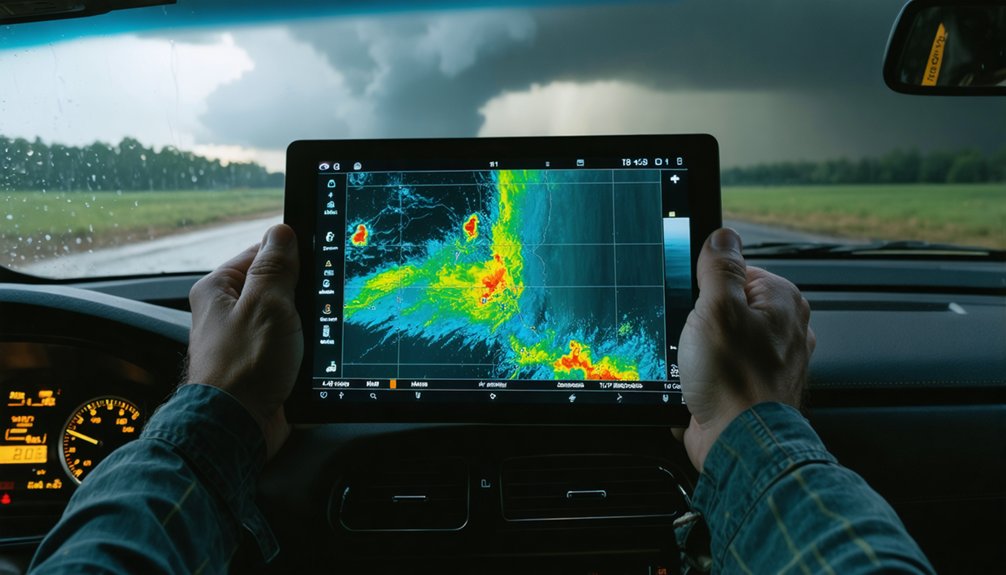
Leveraging machine learning for meteorological data analysis means you’re replacing computationally expensive Numerical Weather Prediction models with algorithms that extract statistical patterns from datasets like ERA5 reanalysis. You can deploy Random Forests, CNNs, and deep learning architectures to forecast temperature, precipitation, and hurricane intensity at 25km resolution in under two seconds. These systems already operate across ECMWF, FourCastNet, and DeepMicroNet pipelines, and there’s considerably more to unpack about how each algorithm performs.
Key Takeaways
- ML bypasses computational bottlenecks of traditional NWP models by learning statistical patterns directly from historical meteorological datasets like ERA5.
- Algorithms such as Random Forest, CNNs, and SVMs identify nonlinear atmospheric relationships, improving temperature, precipitation, and cyclone intensity forecasts.
- Operational systems like FourCastNet generate week-long, 25km-resolution global forecasts in under two seconds using neural network architectures.
- Random Forest combats overfitting, handles missing values, and manages high-dimensional meteorological data without introducing significant bias.
- Future ML meteorology will integrate foundation models, transfer learning, and statistical downscaling to extend reliable sub-seasonal-to-seasonal forecasting capabilities.
Why Traditional Weather Forecasting Falls Short
Traditional numerical weather prediction (NWP) models have long served as the backbone of meteorological forecasting, yet they struggle with fundamental computational and physical constraints that limit their effectiveness.
You’re dealing with traditional limitations rooted in model complexity — these systems require massive processing power to simulate atmospheric dynamics, creating significant computational constraints that slow output generation.
Spatial resolution and temporal resolution remain inadequate for capturing localized extreme events, while data sparsity across ocean and polar regions compounds forecast reliability issues.
Gaps in spatial and temporal resolution leave localized extreme events dangerously underrepresented — especially where data is scarcest.
Accuracy challenges persist because NWP models can’t fully represent multiscale atmospheric interactions without exponentially increasing computational demands.
These shortcomings create critical gaps in precipitation and temperature prediction, particularly for high-impact weather events where precise, timely forecasts aren’t just valuable — they’re essential for informed decision-making.
How Machine Learning Actually Works in Weather Forecasting
Where traditional NWP models rely on physics-based equations to simulate atmospheric dynamics, machine learning takes a fundamentally different approach — it learns statistical patterns directly from historical meteorological data. You’re no longer constrained by computational bottlenecks or rigid physical assumptions.
Here’s how ML operationalizes data-driven insights in forecasting:
- Training — Algorithms ingest ERA5 reanalysis datasets, extracting multiscale atmospheric patterns.
- Pattern Recognition — Random forests and CNNs identify nonlinear relationships between variables.
- Prediction — Models generate outputs like temperature, precipitation, and cyclone intensity forecasts.
- Validation — Model interpretability techniques verify accuracy against observed meteorological benchmarks.
Tools like FourCastNet deliver week-long, 25km-resolution forecasts in under two seconds — liberating forecasters from slow, expensive GFS computations while maintaining rigorous predictive precision.
The Weather Systems Already Running on Machine Learning
You’re no longer looking at experimental prototypes—several operational ML-driven weather systems are actively shaping real-world forecasts today.
FourCastNet, developed on the ERA5 reanalysis dataset, generates week-long global forecasts at 25km resolution in under two seconds, outpacing traditional systems like GFS by orders of magnitude.
Both ECMWF and the Met Office have integrated ML pipelines for data assimilation, bias correction, and model error estimation, marking a decisive shift from purely physics-based numerical weather prediction.
Current ML Weather Systems
Several major meteorological organizations have already deployed ML-based weather systems at operational scale. Current ML advancements have transformed predictive modeling beyond theoretical promise into real infrastructure you can track today:
- FourCastNet generates week-long, 25km-resolution global forecasts in under 2 seconds—orders of magnitude faster than GFS.
- ECMWF actively applies ML for data assimilation, model error estimation, and ERA5 reanalysis bias correction.
- DeepMicroNet extracts hurricane intensity estimates from 30 years of microwave satellite imagery with striking precision.
- Met Office and Google are advancing sub-seasonal-to-seasonal (S2S) ML predictions, extending your forecast horizon considerably.
These aren’t experimental tools—they’re operational systems reshaping how atmospheric data gets processed, interpreted, and delivered directly to decision-makers worldwide.
Real-World Forecast Applications
Machine learning isn’t just reshaping forecast methodology in research labs—it’s actively running the weather systems you depend on right now. The Met Office and ECMWF already leverage ML to extract forecasts from decades of historical observational data, delivering real world impacts across civilian and industrial sectors.
FourCastNet produces week-long, 25km-resolution global forecasts in under two seconds—orders of magnitude faster than conventional GFS models. DeepMicroNet quantifies hurricane intensity using thirty years of microwave satellite imagery, directly improving predictive accuracy for life-threatening storm events.
ML corrects systematic errors in reanalyses like ERA5, refines data assimilation pipelines, and downscales coarse outputs to localized resolutions. You’re not watching experimental prototypes—you’re benefiting from operational systems that have already displaced legacy numerical approaches in mission-critical forecasting environments.
Which Machine Learning Algorithms Dominate Weather Prediction?
When it comes to weather prediction, a handful of ML algorithms have emerged as dominant players, each suited to specific forecasting tasks. You’ll find these methods reshaping climate modeling with precision:
- Random Forest & Ensemble Methods — deliver low MSE, high R², and strong MAE scores across precipitation datasets.
- SVM Regression — excels in capturing nonlinear atmospheric patterns through rigorous feature engineering.
- Decision Trees & K-NN Applications — achieve top-tier temperature forecasting accuracy with transparent model interpretability.
- Neural Networks — power deep architectures like FourCastNet, enabling global-scale error analysis and multiscale dynamics.
Each algorithm reveals specific meteorological capabilities.
You’re no longer constrained by rigid physics-based limitations — these tools give you computational freedom to interrogate the atmosphere on your terms.
What Makes Random Forest So Effective for Climate Data?

When you work with climate data, you’re often dealing with dozens of interdependent variables — temperature gradients, humidity levels, atmospheric pressure, and precipitation rates — that interact nonlinearly across spatial and temporal scales.
Random forest handles this complexity by aggregating predictions from hundreds of decision trees trained on randomized feature subsets. This ensemble architecture directly combats overfitting, a persistent challenge in meteorological modeling where models trained on historical data fail to generalize to unseen atmospheric conditions.
You can confirm this robustness in practice through metrics like low MSE, high R² scores, and low MAE, all of which random forest consistently achieves on real-world datasets such as Manchester weather records.
Handling Complex Climate Variables
Climate data presents a uniquely formidable challenge: high dimensionality, nonlinear variable interactions, missing observations, and heavy-tailed distributions that routinely violate the assumptions underpinning parametric models.
Random forest conquers these obstacles through structural flexibility, making it indispensable for climate variability analysis and seamless data integration across heterogeneous sources.
You’ll appreciate why practitioners trust it:
- Handles missing values without imputation-induced bias distortion
- Captures nonlinear interactions between temperature, pressure, and humidity simultaneously
- Remains robust against outliers dominating extreme precipitation distributions
- Scales efficiently across ERA5’s massive hourly, multi-decadal observational archives
These capabilities aren’t incidental—they’re essential.
When you’re reconstructing atmospheric dynamics from incomplete ocean probe metadata or downscaling coarse reanalysis fields, random forest delivers where rigid parametric frameworks collapse entirely.
Reducing Overfitting In Forecasts
Random forest’s structural resilience against complex climate variables stems directly from its core mechanism for combating overfitting—a problem that cripples single decision trees when trained on noisy, high-dimensional meteorological datasets.
By aggregating predictions across hundreds of decorrelated trees, each trained on bootstrapped subsets with randomized feature selection, you eliminate variance without sacrificing bias. This ensemble architecture naturally deploys robust overfitting techniques that no single-model approach can replicate.
When applied to Manchester weather data, random forest demonstrated low MSE, high R², and minimal MAE—metrics that rigorous model validation confirmed across independent test sets.
You’re fundamentally forcing each tree to specialize on different signal patterns, then averaging out their individual errors. That distributed learning structure makes random forest exceptionally resistant to noise inherent in real-world meteorological datasets.
How Deep Learning Models Predict Hurricanes and Extreme Events
Deep learning models have transformed hurricane and extreme event prediction by extracting complex, nonlinear patterns from vast observational datasets that conventional physics-based models struggle to resolve.
Tools like DeepMicroNet leverage 30 years of microwave satellite data to sharpen hurricane prediction and extreme event modeling with unprecedented precision.
You’re now empowered by systems that can:
- Estimate real-time hurricane intensity from satellite microwave imagery
- Detect cyclone structural evolution across multiscale atmospheric dynamics
- Downscale coarse global forecasts to localized, actionable resolutions
- Quantify climate-driven shifts in extreme event frequency and magnitude
These capabilities aren’t abstract—they protect lives, infrastructure, and communities that depend on accurate early warnings.
Deep learning doesn’t replace physical intuition; it amplifies it, giving you forecasting power that rigid numerical models simply can’t match.
How Machine Learning Corrects Gaps in Historical Weather Data
Historical weather records are riddled with gaps—missing sensor readings, corrupted archives, and sparse ocean probe metadata that undermine reanalysis accuracy and climate trend detection.
You’re dealing with time series that contain missing values spanning decades, particularly in data-sparse oceanic regions where traditional instrumentation fails.
ML tackles this through systematic data preprocessing pipelines that apply bias adjustment and data infill techniques across incomplete datasets. Algorithms trained on ERA5 reanalysis reconstruct missing ocean probe readings—addressing roughly 50% metadata correction deficiencies—by identifying spatiotemporal correlations within surrounding observations.
Random forests and neural networks restore climate variability signals that conventional interpolation methods distort or discard entirely.
This restoration of historical data directly elevates predictive accuracy, giving you cleaner baselines for detecting long-term climate shifts and validating next-generation forecasting models.
Where Is Machine Learning in Meteorology Headed Next?
Everything points toward ML in meteorology converging on foundation models—large-scale, pre-trained architectures that ECMWF and partner organizations plan to adapt across weather prediction, climate projection, and subseasonal-to-seasonal (S2S) forecasting within a unified framework.
These future innovations will reshape your understanding of climate adaptability through:
- Unified S2S forecasting extending reliable predictions weeks beyond current operational limits
- ERA6 reanalysis improvements reconstructing data-sparse pre-2006 atmospheric records with unprecedented precision
- Statistical downscaling integration translating coarse global outputs into localized, actionable extreme-weather intelligence
- Foundation model deployment enabling cross-domain transfer learning across weather, ocean, and climate systems simultaneously
You’re witnessing ML evolution from supplementing NWP to independently governing forecasting pipelines—delivering computational freedom, scientific transparency, and climate system understanding that rigid physics-based models simply can’t match.
Frequently Asked Questions
How Does ML Handle Real-Time Data Streaming for Live Weather Monitoring?
Like a river never stopping, ML continuously ingests live feeds, applying data preprocessing to filter noise. You’ll get real-time predictions as algorithms instantly analyze streaming meteorological inputs, enabling dynamic, responsive weather monitoring without delays.
Can Machine Learning Models Be Trained on Regional Microclimates Effectively?
Yes, you can effectively train ML models on regional microclimates. By leveraging localized datasets, you’ll capture microclimate variability, boosting model accuracy. Algorithms like random forest and deep learning let you autonomously decode hyper-local atmospheric patterns with precision.
What Hardware Infrastructure Is Required to Run ML Meteorological Models?
You’ll need mountains of computational power, GPUs, and petabyte-scale data storage. Algorithm selection and model optimization demand high-performance computing clusters, enabling you to run intensive ML meteorological models efficiently and freely without infrastructural bottlenecks constraining your forecasting capabilities.
How Do Meteorologists Validate ML Predictions Against Traditional Forecast Outputs?
You’ll validate ML predictions by benchmarking prediction accuracy against NWP outputs using RMSE, MAE, and R² metrics. Run model comparison across ERA5 reanalysis datasets, contrasting ML-generated forecasts with GFS or ECMWF deterministic outputs systematically.
Are ML Weather Forecasting Tools Currently Accessible to Independent Researchers?
You’re in luck! You can tap into open source tools like FourCastNet, leveraging ERA5’s data accessibility for research collaboration. These resources let you independently validate predictive accuracy against established meteorological benchmarks without institutional constraints.
References
- https://www.youtube.com/watch?v=KI-LjVRDZ-A
- https://www.ijcaonline.org/archives/volume187/number9/predicting-meteorological-data-using-machine-learning/
- https://www.climatechange.ai/blog/2024-02-07-forecast-tutorials
- https://www.ecmwf.int/en/about/media-centre/news/2024/machine-learning-play-growing-role-weather-forecasting-says-dg
- https://news.wisc.edu/machine-learning-and-its-radical-application-to-severe-weather-prediction/
- https://rgu-repository.worktribe.com/OutputFile/2085853
- https://www.imsi.institute/activities/machine-learning-for-climate-and-weather-applications/