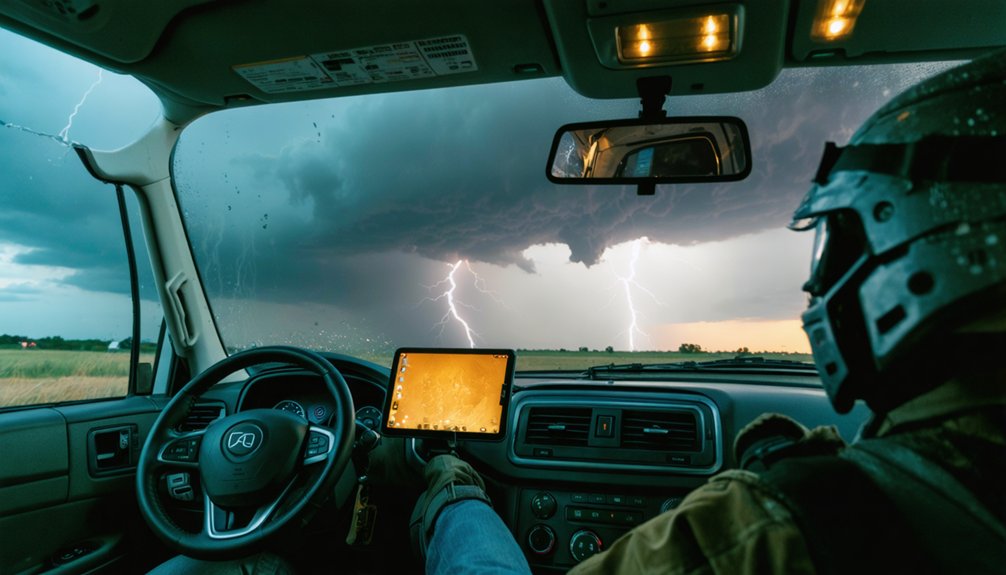
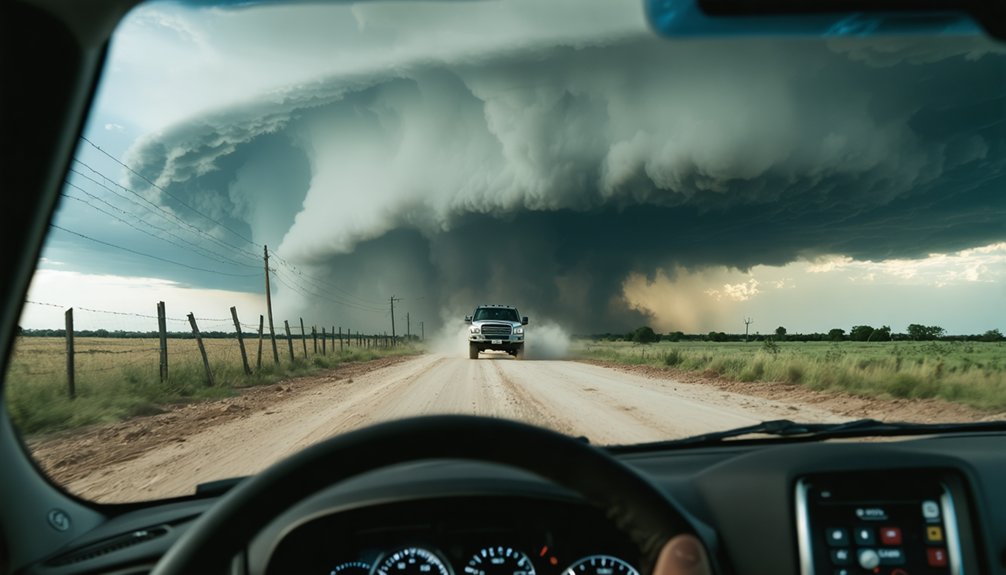
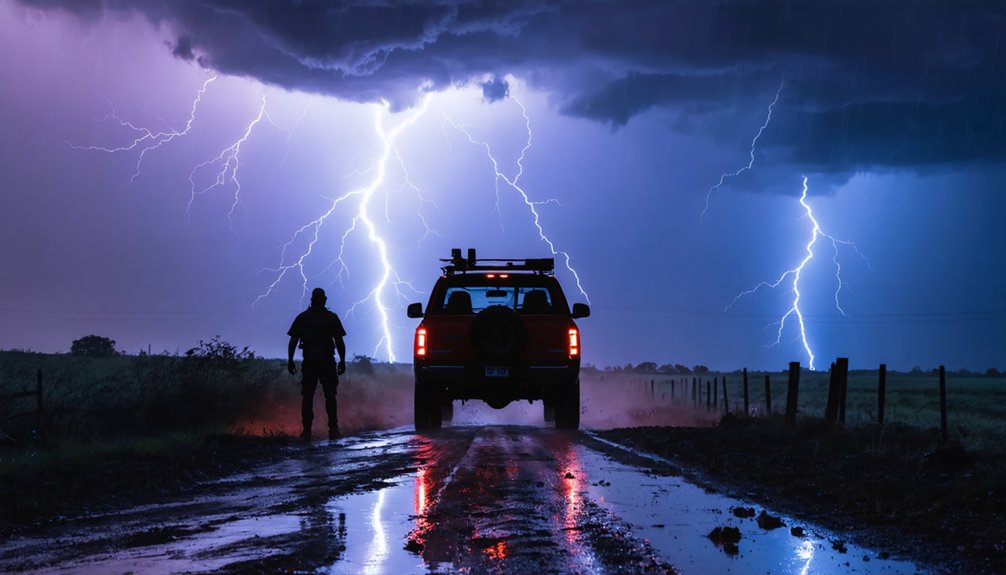
As a storm chaser, you’re constantly exposed to lightning that can strike miles beyond a storm’s visible boundaries. You need to recognize warning signs early—darkening anvil clouds, distant thunder, static interference, and sudden wind shifts. Seek an all-metal vehicle or substantial building immediately when threats escalate. Remove conductive gear, stay low if caught outdoors, and wait 30 minutes after the last thunder before resuming. The protocols below could save your life.
Key Takeaways
- Lightning can strike miles beyond visible storm boundaries, so storm chasers must continuously monitor anvil clouds, distant thunder, wind shifts, and radio static interference.
- Prioritize substantial buildings for shelter; use all-metal vehicles as secondary options, avoiding sheds, isolated trees, open water, and elevated terrain entirely.
- Remove metal jewelry, avoid touching tripods, antenna mounts, and vehicle exteriors, and wear rubber-soled boots to minimize personal conductivity risks.
- When caught outdoors, kneel low with feet together, spread out from teammates, and stay clear of tall objects, fences, and water sources.
- Wait a full 30 minutes after the last thunder, confirm storm movement via radar, and inspect all equipment for surge damage before resuming activities.
Why Storm Chasers Face Unique Lightning Dangers in the Field
Storm chasers operate in conditions that put them directly in lightning’s path, making their risk profile fundamentally different from that of the average outdoor enthusiast. You’re deliberately moving toward active storm systems, which means you’re consistently exposing yourself to environments where lightning detection becomes a critical survival skill rather than a precaution.
Unlike casual observers, you’re tracking storm patterns in real time while simultaneously managing equipment, communication, and positioning. That operational demand divides your attention precisely when environmental threats escalate fastest.
Lightning can strike miles ahead of a storm’s visible boundary, meaning your proximity to the core doesn’t define your actual danger zone. You’re vulnerable the moment you’re within range of an active cell, regardless of where the rain or rotation appears to be concentrated.
How to Read Lightning Risk Before the Storm Reaches You
Reading the environment before a storm reaches you is where your situational awareness either protects you or fails you. Lightning detection isn’t just about radar apps—it’s active risk assessment using every available input.
Reading the environment before a storm arrives is active risk assessment—not passive observation. Your situational awareness either protects you or fails you.
Watch for these pre-storm indicators:
- Darkening anvil clouds or towering cumulonimbus formations signal imminent electrical activity
- Distant thunder you can hear but not locate means lightning is already striking within 10 miles
- Sudden wind shifts or dramatic temperature drops indicate a storm’s leading edge is closing in
- Static interference on AM radio frequencies confirms active lightning production nearby
Don’t wait for rain. Lightning routinely strikes 10 to 15 miles ahead of visible precipitation. Your risk assessment window closes faster than most chasers anticipate. Act on early indicators—not confirmed threats.
The Safest Shelter Options When You’re Chasing Storms
When you’re actively chasing, your shelter hierarchy determines whether a close strike kills you or doesn’t. Prioritize substantial buildings first — they offer the highest lightning safety margin.
A hard-topped, all-metal vehicle is your secondary emergency shelter option when buildings aren’t accessible.
Once inside either, stay away from windows, corded phones, plumbing, and electrical appliances. Don’t lean against concrete walls reinforced with metal — current travels through that infrastructure.
Avoid small sheds, open garages, and picnic shelters entirely. They offer false security with zero real protection.
If you’re mobile and a cell approaches faster than expected, get into your vehicle immediately — don’t wait for rain.
Remain in your chosen shelter for a full 30 minutes after the last thunder rumble before resuming operations.
What to Do If You’re Caught in the Open During a Storm
If you’re caught in the open with no shelter available, your immediate priority is minimizing both your vertical profile and ground contact. Shifting weather patterns can accelerate storm development faster than anticipated, leaving you exposed. Act decisively.
- Kneel or squat low with feet together, reducing ground current exposure.
- Avoid lying flat—it increases your surface area contact with potentially charged ground.
- Stay clear of tall isolated objects, water, fences, and elevated terrain.
- Maintain emergency communication capability using battery-powered devices only.
Never cluster with other chasers—spread out to prevent a single ground strike from affecting multiple people. Keep twice the distance from any tree as the tree’s height. Your survival depends on disciplined execution of these protocols, not hesitation.
What Conductors and Metal Gear to Avoid While Chasing
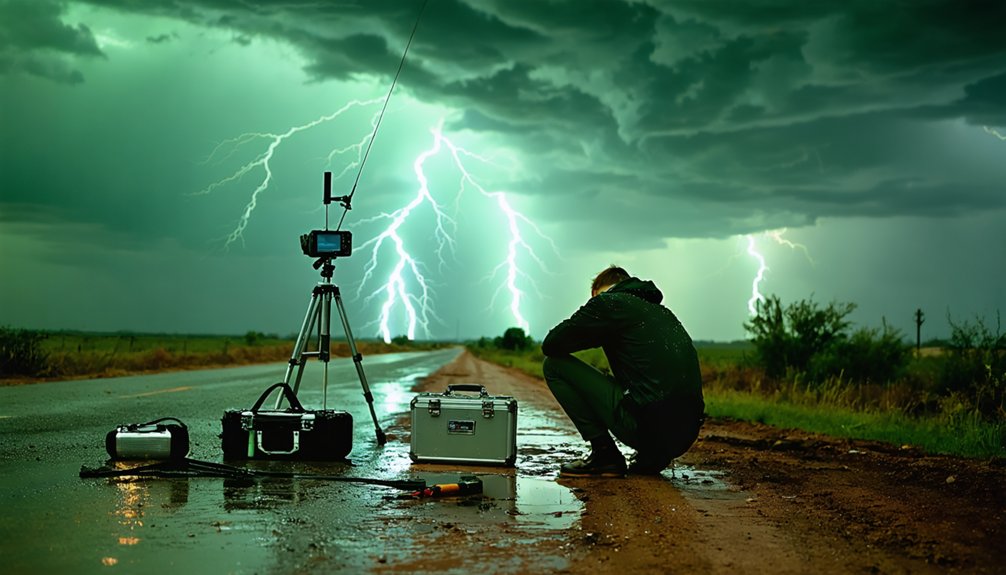
Storm chasing exposes you to a range of conductive materials that markedly increase your lightning strike risk. Remove conductive jewelry before heading into the field — rings, chains, and metal watches create localized burn pathways during a strike. Swap metallic footwear for rubber-soled boots, which reduce ground current transfer considerably.
Keep your hands off metal backpacks, tripod frames, antenna mounts, and vehicle exteriors during active storms. Don’t lean against fences, guard rails, or conductive piping — ground current travels through all of them. Avoid handling camera equipment with metal housings when lightning is within striking distance.
Unplug and secure electronic gear before storms arrive. Power surges destroy equipment and create secondary hazards. Discipline around conductive materials isn’t optional — it’s what keeps you chasing another day.
How to Shield Your Equipment and Yourself From Lightning Strikes
Before a storm rolls in, unplug all non-essential electronic equipment to prevent power surges from frying your gear or sparking fires.
Once you’re outdoors chasing, ditch any metal-framed backpacks, avoid contact with fences or railings, and stay clear of conductive piping.
These precautions protect both your equipment and your body from becoming an unintended path for electrical discharge.
Unplugging Equipment Before Storms
When a storm approaches, you should unplug unnecessary electronic equipment before it arrives, since power surges from lightning can cause fires or serious equipment damage. Monitor your storm forecast closely so you’re never caught off guard by a sudden lightning bolt.
Protect your gear and yourself by following these key steps:
- Unplug all non-essential electronics before the storm reaches your location
- Use only battery-powered devices to monitor weather updates during active storms
- Avoid touching metal backpacks, clothing lines, or fences during electrical activity
- Never bathe, shower, or stand near plumbing while a storm is overhead
Taking these precautions keeps your equipment intact and reduces your personal risk. You’ve invested heavily in your storm-chasing setup — don’t let a preventable power surge destroy it.
Avoiding Metal Gear Outdoors
Beyond unplugging your gear, you’ll also need to think carefully about the metal equipment you carry into the field. Metal gear—backpacks, tripods, antenna mounts, and camera rigs—dramatically increases your lightning risk during active storms.
Keep these outdoor protection principles in mind:
- Drop or distance yourself from metal equipment immediately when lightning threatens
- Never hold metal rods, poles, or conductive framing during a storm
- Avoid touching fences, railings, or conductive piping that could transmit a strike’s current
- Don’t lean against vehicles or structures with exposed metal reinforcement
Your mobility in the field depends on making fast, disciplined decisions. Leaving your gear behind is always the right call—equipment is replaceable; you aren’t. Prioritize your survival over protecting any piece of hardware.
The Non-Negotiable Lightning Rules Every Storm Chaser Must Know
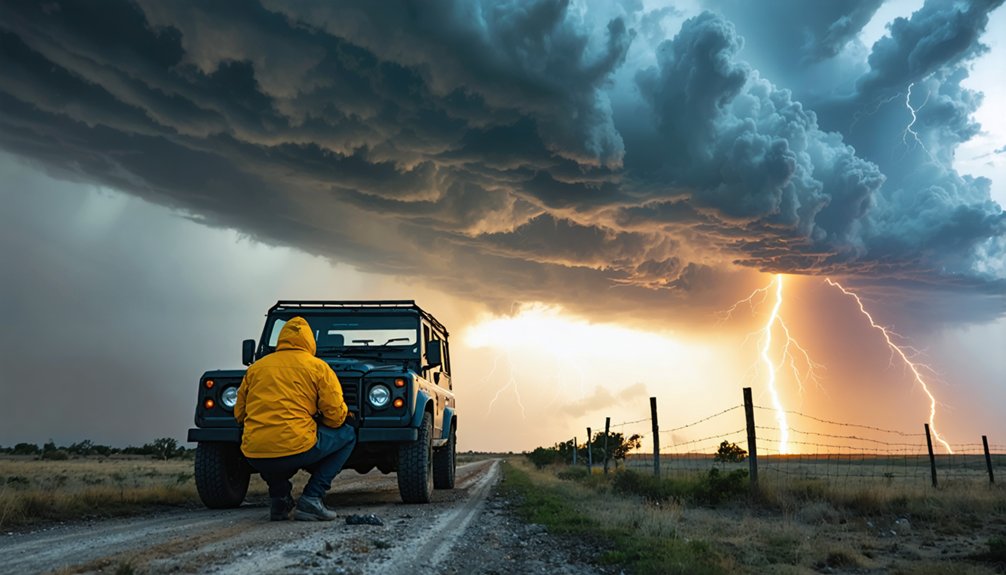
Though storm chasing demands calculated risk-taking, lightning safety isn’t negotiable. Thunderstorm preparedness separates experienced chasers from statistics. Don’t let lightning safety myths convince you that proximity to the storm equals acceptable risk. Follow these rules without compromise:
Storm chasing rewards the bold — but lightning doesn’t negotiate. Preparedness separates the experienced from the statistics.
- When thunder roars, go indoors immediately — lightning strikes miles beyond visible storm cells.
- Wait 30 minutes after the last thunder rumble before resuming outdoor activity.
- Never shelter under isolated trees, open sheds, or small structures — seek hard-topped vehicles or substantial buildings.
- Stay off open water, beaches, and elevated terrain during active electrical storms.
You’ve chosen a pursuit that demands discipline. These rules aren’t suggestions — they’re the baseline that keeps you operational. Violate them, and no amount of skill or experience protects you from a direct strike.
How to Help a Strike Victim in Your Chasing Group
If someone in your group takes a direct strike, act immediately — lightning victims carry no electrical charge after impact, so you can touch them safely. Call 911 without hesitation, then assess breathing and pulse. Begin CPR if the victim isn’t breathing or has no pulse; initiate rescue breathing if the pulse remains but respiration has stopped.
Don’t let storm safety protocols lapse during the rescue. Keep your lightning detection app active — another strike can occur in the same zone. Assign one team member to monitor conditions while others administer aid.
Move the victim only if the current location presents continued danger. Document the strike time and circumstances for emergency responders. Every second counts, so execute these steps with precision and zero hesitation.
How to Resume Chasing Safely After a Lightning Threat Passes
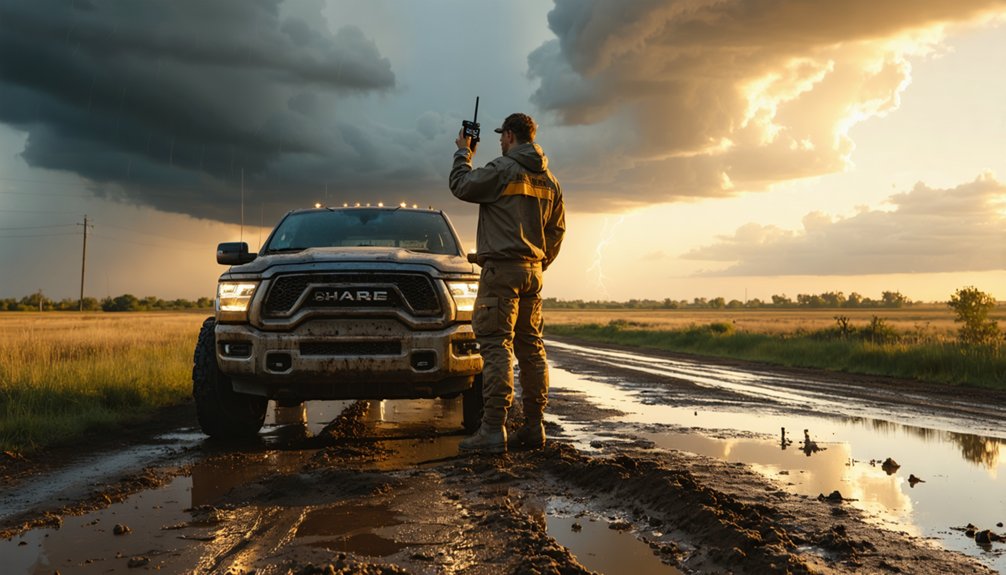
Once the last thunder rumble fades, you must wait a full 30 minutes before exiting shelter, as lightning can still strike miles ahead of a retreating storm.
Before resuming your chase, scan the surrounding terrain for residual hazards—downed power lines, flooded roads, or debris that may have shifted during the storm.
You should also recheck all electronic equipment for moisture intrusion or surge damage before powering up your chase systems.
Wait 30 Minutes First
After the last rumble of thunder fades, you still can’t resume chasing immediately—the 30-minute rule requires you to wait a full half-hour before leaving shelter.
Lightning can strike miles ahead of a storm’s visible weather pattern, and shifting cloud formation can regenerate electrical activity without warning. Reset your timer every time thunder sounds again.
- Wait 30 full minutes after the last thunder rumble before exiting shelter
- Monitor radar actively to confirm the storm cell is moving away
- Watch cloud formation for signs of regenerating convective activity
- Verify the weather pattern shows no secondary storm development nearby
Skipping this window is how chasers get caught exposed. Discipline here isn’t caution—it’s operational protocol that keeps you mobile, healthy, and chasing the next storm.
Assess Surrounding Conditions
The 30-minute timer clears your immediate lightning exposure—but it doesn’t automatically greenlight a return to the field. Before repositioning, you need to assess surrounding conditions systematically.
Monitor lightning frequency in all directions—not just overhead. Residual cells can still produce ground strikes several miles from their visible core. Check your weather radar for storm cell movement, speed, and regeneration patterns before stepping out.
Scan cloud formation actively. Towering cumulonimbus structures, anvil-shaped tops, or rapid vertical development signal continued electrical activity regardless of local calm. A quiet sky isn’t a safe sky.
Verify that no new storm cells are tracking toward your position. Cross-reference multiple data sources—mobile radar, lightning detection apps, and visual observation. Only when lightning frequency has dropped and cloud formation confirms dissipation should you resume chasing operations.
Recheck Equipment Safety
With conditions confirmed clear, your next step is a systematic equipment inspection before resuming any field operations. Lightning exposure can compromise electronics, connectors, and power systems without visible damage. Don’t skip this step—equipment maintenance directly affects your operational safety and data integrity.
- Check all electronic devices for unexpected resets, error codes, or erratic behavior indicating surge damage.
- Inspect cables, connectors, and antennas for burns, melting, or corrosion from nearby strike activity.
- Verify battery levels and backup power systems are functioning within operational parameters.
- Confirm gear storage containers sealed properly, protecting sensitive instruments from moisture infiltration during the storm.
Once you’ve completed your inspection, document any anomalies before continuing. A compromised instrument can deliver false readings, putting you in greater danger.
Methodical rechecks keep you operationally sharp and independently mobile in the field.
Frequently Asked Questions
Can Lightning Strike the Same Location Twice During a Single Storm?
Yes, lightning can strike the same location multiple times during a single storm. You must factor lightning frequency into your risk assessment, as repeated strikes intensify danger—don’t underestimate repeated exposure when you’re traversing storm environments.
How Does Storm Chasing Insurance Cover Lightning-Related Injuries or Damages?
Storm chasing insurance covers roughly 60% of lightning-related claims. You’ll find insurance claims vary widely, as coverage exclusions often apply to high-risk activities. Always review your policy’s fine print before chasing storms.
Are Rubber-Soled Boots Effective Protection Against Ground Lightning Currents?
Rubber-soled boots don’t provide reliable electromagnetic shielding or ground current mitigation. You should minimize ground contact by keeping feet together, squatting low, and avoiding conductive surfaces—your best defense against dangerous step-potential currents.
What Psychological Effects Do Lightning Strike Survivors Commonly Experience Afterward?
Like Odysseus haunted after surviving the storm, you’ll often face post-trauma anxiety and survivor guilt following a lightning strike. You may experience memory loss, depression, chronic pain, and personality shifts requiring immediate professional psychological intervention.
How Do Storm Chaser Teams Communicate Lightning Risk Across Multiple Vehicles?
You’ll coordinate lightning risk using real-time weather updates shared across communication technology like two-way radios and mobile apps. Designate one vehicle to monitor radar, broadcasting strike proximity and storm movement instantly to keep your entire team synchronized and protected.
References
- https://www.atms.unca.edu/cgodfrey/courses/swfex/pdf/ChasingSafety.pdf
- https://weather.cod.edu/chasing/assets/documents/safety.pdf
- https://ztresearch.blog/education/lightning-for-storm-chasers/
- https://stormtrack.org/threads/how-do-storm-chasers-spotter-stay-safe-with-lightning.27112/
- https://www.hobbyfarms.com/practice-lightning-safety/
- https://www.youtube.com/watch?v=e8G9n-hDHtI
- https://texasstormchasers.com/lightning-safety/
- https://ztresearch.blog/2024/06/25/assumed-risk-a-discussion-on-lightning-safety-for-storm-chasers-and-field-researchers/
- https://www.stormchasingusa.com/storm-chasing-and-safety/
- https://www.tempesttours.com/safety-tips