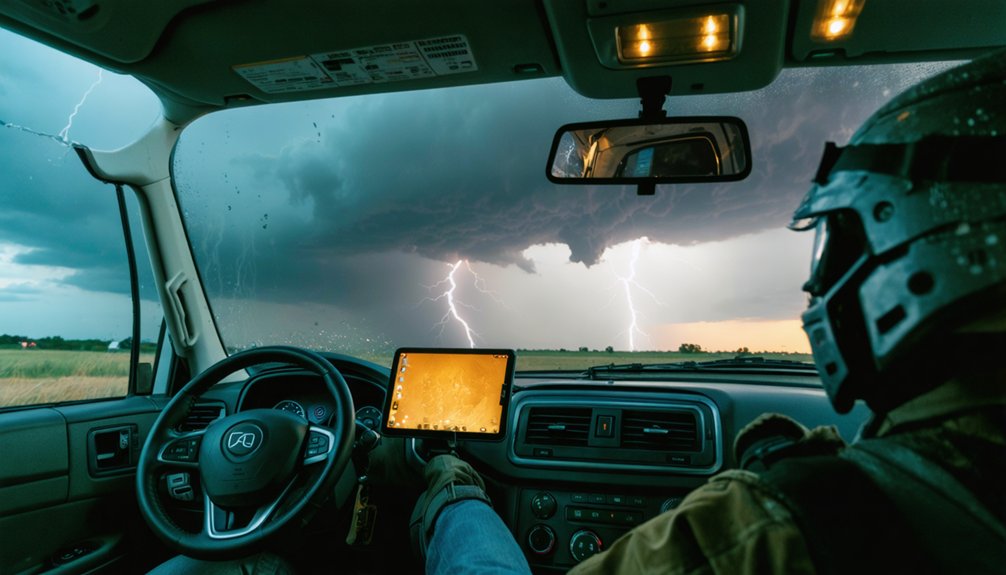
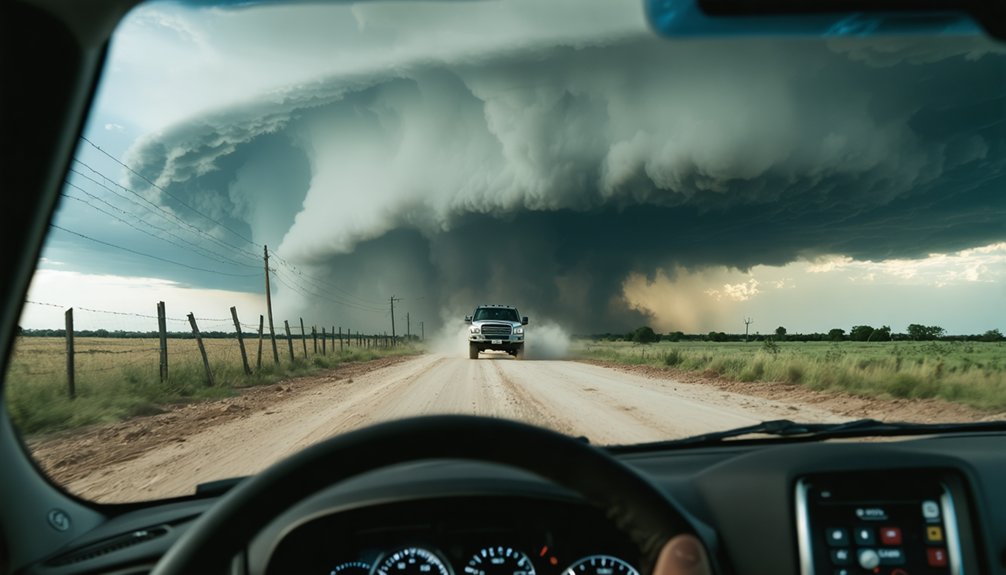
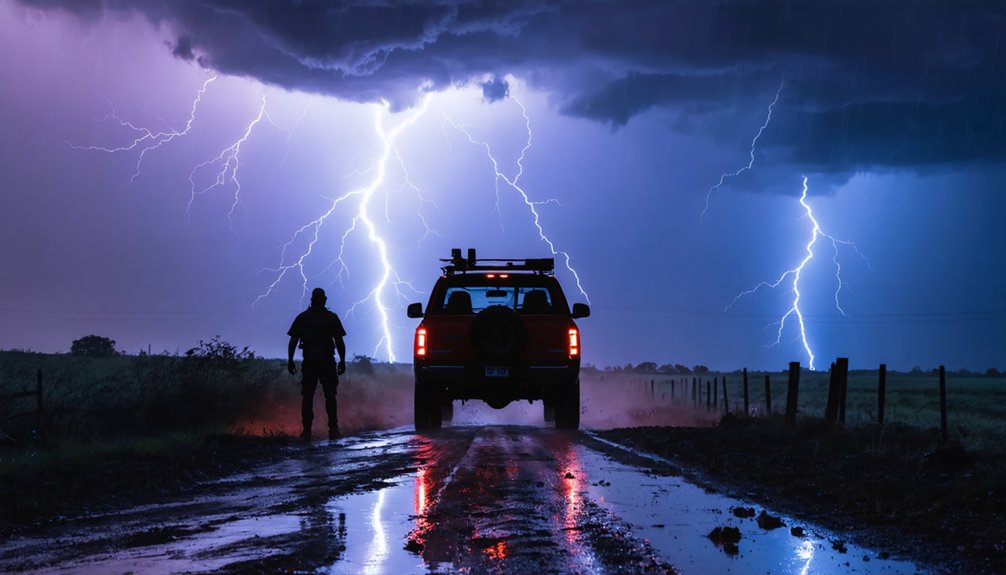
Maximizing storm chasing success through effective teamwork starts with locking in defined roles before you hit the road. You need a dedicated driver, navigator, and storm spotter — role confusion costs critical seconds. Predefined communication signals, proper gear verification, and mental resilience training aren’t optional; they’re operational necessities. Document every mistake to convert failures into tactical intelligence. The strategies ahead will sharpen your team’s edge when conditions deteriorate fast.
Key Takeaways
- Define clear team roles—driver, navigator, storm spotter—before each chase to maintain decision speed and prevent role confusion under pressure.
- Use predefined communication signals like radio codes and hand gestures to eliminate ambiguity during rapidly deteriorating storm conditions.
- Verify all equipment, including radar, GPS, and emergency kits, before departure to prevent critical failures during active chases.
- Build team trust through severe weather simulations and structured debriefs to strengthen coordination and emotional resilience in the field.
- Document decision failures, communication breakdowns, and timing errors post-chase to convert mistakes into actionable operational intelligence.
How Team Structure Prevents Fatal Storm Chasing Mistakes
A well-defined team structure isn’t just a convenience in storm chasing—it’s a critical safety mechanism that directly reduces the likelihood of fatal errors. When you assign distinct roles—driver, navigator, and storm spotter—each member executes focused tasks without cognitive overload.
Hierarchical leadership ensures decisive authority during rapidly evolving scenarios, eliminating hesitation when seconds determine survival.
You’ll also need role flexibility, because conditions shift unpredictably. A navigator who can’t adapt when the primary driver becomes incapacitated creates dangerous gaps.
Predefined communication signals cut through chaos, while staggered vehicle formations preserve sightlines and prevent dangerous groupthink.
Structured teams don’t restrict your autonomy—they protect it. By distributing responsibility intelligently, you maintain operational freedom precisely because everyone knows their function before the storm demands it.
Assign Storm Chasing Roles Before You Hit the Road
Before you start the engine, you’ve got to lock in each team member’s role—driver, navigator, and storm spotter—so that every critical function has a designated owner when pressure peaks.
Storm role allocation isn’t optional; it’s the structural backbone that keeps decisions clean and fast when conditions deteriorate rapidly.
Storm role allocation is the structural backbone that keeps decisions clean and fast when everything deteriorates rapidly.
Team leadership challenges emerge when roles blur under stress. If your driver’s also calling escape routes, your response time collapses.
Assign navigation duties to one member, radar monitoring to another, and driving exclusively to someone who won’t get distracted by the spectacle.
Predefined roles eliminate the dangerous negotiation that kills reaction time. You’re buying autonomy through structure—every member operates within their lane, maximizing collective efficiency while preserving individual accountability when the storm demands immediate, coordinated action.
Find a Storm Chasing Mentor Before You Chase Solo
Locking in roles gives your team structure, but structure alone won’t protect you if you’ve never read a storm in real conditions—that’s where mentorship fills the gap.
Storm chase mentorship accelerates your learning curve by exposing you to real-time decision-making before the stakes become life-or-death. Find someone experienced, sensible, and technically sharp—not someone chasing adrenaline.
Their team guidance helps you recognize when to reposition, when to abort, and when your data interpretation is off. You’ll absorb situational awareness that no manual delivers.
Document everything you observe during joint chases: storm behavior, route adjustments, communication breakdowns. Those field notes become your operational reference.
Chasing solo before you’ve built that experiential foundation isn’t freedom—it’s unnecessary exposure to preventable risk.
Set Up Team Communication That Works Under Pressure
When your team operates under storm-chasing pressure, ambiguous communication creates dangerous hesitation. You eliminate that risk by establishing predefined signals—hand gestures, radio codes, or horn patterns—so every team member responds instantly without misinterpretation.
Assigning fixed roles like navigator, driver, and spotter further reduces cognitive load, ensuring each person focuses on one task rather than competing for decision-making authority.
Predefined Signals Ensure Clarity
Establishing predefined signals before a chase launch eliminates ambiguous communication when storm dynamics escalate rapidly. You can’t afford misinterpretation when a tornado shifts track unexpectedly.
Assign color coding to threat levels—green for repositioning, yellow for immediate caution, red for abort—so every team member responds instantly without verbal confirmation.
Integrate hand signals for close-range coordination when radio interference or engine noise disrupts transmission clarity. Each signal must carry a singular, unmistakable meaning agreed upon during pre-chase briefings.
Drill these signals repeatedly until execution becomes automatic under psychological pressure. You’ll find that standardized, non-verbal communication frameworks compress decision-making timelines considerably.
When your team operates from shared signal literacy, you eliminate the dangerous lag between observation and coordinated action, preserving both mission integrity and personal safety.
Roles Reduce Communication Stress
Defined roles eliminate the cognitive overhead that fractures team communication when storm conditions deteriorate fast. When you assign a navigator, driver, and storm spotter before deployment, you’re distributing decision-making load across specialized functions. Role clarity prevents information bottlenecks and removes ambiguity from critical exchanges.
Your communication protocols must reflect these divisions. The navigator relays positional data; the spotter interprets atmospheric behavior; the driver executes without distraction. Each member processes their domain independently, then feeds filtered intelligence upward. That structure cuts response latency when seconds matter.
You’ll also notice reduced conflict. When everyone knows their operational boundary, territorial disputes over decisions disappear. Stress contracts your team’s cognitive bandwidth—defined roles compensate by automating authority.
Structure doesn’t restrict your freedom; it protects it by ensuring coordinated, precise action under maximum pressure.
The Right Gear Keeps Your Storm Chasing Team Safe
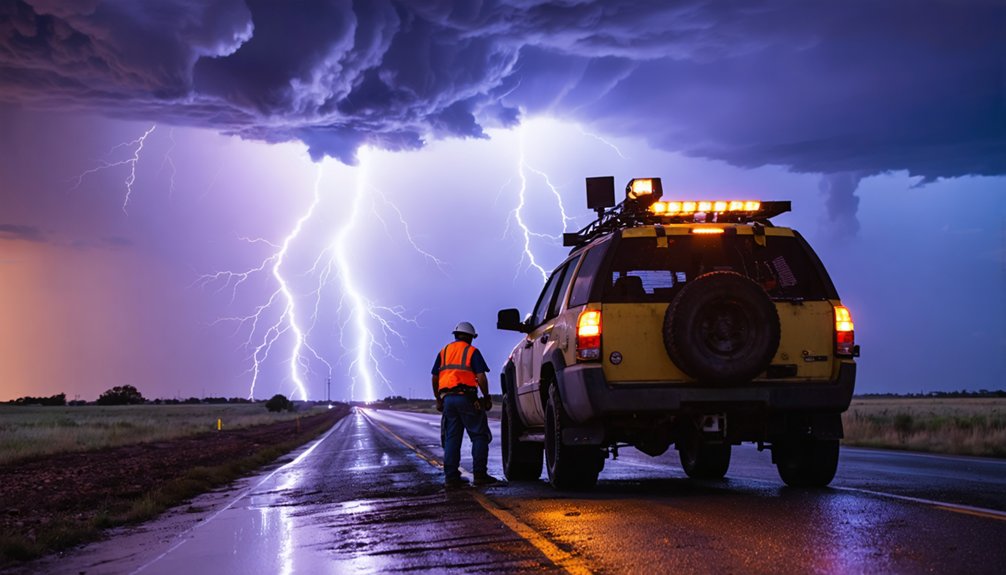
Having the right gear isn’t just a convenience—it’s an operational necessity that directly determines your team’s safety margin in the field. Protective clothing shields you from debris, hail, and wind-driven projectiles, while safety harnesses prevent dangerous falls during rapid vehicle exits or elevated terrain operations. Every piece of equipment you carry directly impacts your decision-making speed and survival probability.
Deploy high-definition radar systems for precise, real-time storm tracking. Maintain GPS devices, two-way radios, and weather radios to guarantee uninterrupted situational awareness. Keep emergency kits stocked and accessible.
Equipment failures during critical moments aren’t acceptable—verify everything before departure.
Your gear isn’t passive protection; it’s an active tactical asset. Treat it accordingly, inspect it consistently, and you’ll maintain the operational freedom necessary to chase effectively and exit safely.
Build the Mental Toughness Your Chase Team Depends On
When you chase storms, uncertainty isn’t a flaw in the plan—it’s a constant variable you must learn to process without hesitation.
You build unshakable team trust by assigning clear roles, committing to predefined decisions, and eliminating ambiguity before the chase begins.
Strengthen your emotional resilience through mindfulness and cognitive-behavioral strategies so that high-pressure conditions sharpen your focus rather than fracture your team’s coordination.
Embrace Uncertainty Boldly
Storm chasing strips away the illusion of control, forcing you and your team to operate in conditions where variables shift faster than any forecast can predict.
Weather psychology confirms that chasers who resist uncertainty experience cognitive paralysis during critical decision windows. Instead, train yourself to treat ambiguity as operational data rather than a threat.
Storm symbolism runs deep here — the storm doesn’t negotiate, and neither should your hesitation.
Sharpen your data analysis protocols before each chase so that when conditions deviate, your team executes adjustments rather than debates them.
Embracing uncertainty means you’ve pre-mapped decision trees that activate automatically under pressure.
You’ll communicate more precisely, position more strategically, and exit more safely when uncertainty becomes your team’s sharpest operational tool rather than its greatest liability.
Build Unshakable Trust
Trust isn’t built in calm conditions — it’s stress-tested in the field, where split-second decisions reveal whether your team’s cohesion holds or fractures. Deliberate trust building demands consistent action, not passive goodwill.
Strengthen your team cohesion through these proven strategies:
- Assign clear roles so every member owns their responsibilities without overlap or confusion.
- Agree on decision-making protocols before deployment to eliminate mid-chase arguments.
- Run severe weather simulations that pressure-test your team’s coordination under realistic stress.
- Establish predefined communication signals to maintain clarity when verbal communication breaks down.
- Network with experienced chasers who reinforce accountability and model disciplined behavior.
When trust is structurally embedded into your team’s operations, you’re not just chasing storms — you’re navigating them with calculated, collective confidence.
Strengthen Emotional Resilience
Emotional resilience isn’t a personality trait — it’s a trainable operational asset that directly determines your team’s performance under pressure. When conditions deteriorate rapidly, stress management failures cascade into poor decisions, fractured communication, and compromised safety. You can’t afford that.
Develop emotional intelligence deliberately through mindfulness practices and cognitive-behavioral techniques that rewire your threat-response patterns. Train yourself to recognize stress indicators in teammates before performance degrades. Build structured debrief routines after each chase to process high-intensity experiences analytically rather than reactively.
Freedom in the field requires discipline in your mental conditioning beforehand. Uncertainty won’t disappear — but your team’s capacity to operate effectively within it will sharpen considerably. Resilience isn’t about suppressing emotion; it’s about channeling it into precise, coordinated action when seconds matter most.
Document Every Chase Mistake to Sharpen Future Operations
Every chase operation generates raw data that’s far more valuable than most teams realize—and documenting mistakes systematically turns that data into a strategic asset.
Every chase operation is a data goldmine—but only teams that document their mistakes systematically know how to spend it.
Historical data reveals recurring errors tied to specific weather patterns, letting you correct course before consequences escalate.
Build a post-chase documentation habit using these critical focus areas:
- Decision failures: Record where judgment broke down and why
- Equipment gaps: Note any gear that underperformed during critical moments
- Route miscalculations: Log positioning errors relative to storm movement
- Communication breakdowns: Identify moments where coordination collapsed under pressure
- Timing missteps: Track when you entered or exited zones too late or too early
You’ll transform each mistake into operational intelligence.
Teams that audit their errors honestly gain a compounding tactical advantage that no single chase experience alone can provide.
Frequently Asked Questions
How Do You Handle Disagreements About Chase Decisions Mid-Pursuit?
You’ll prevent mid-pursuit conflicts by establishing decision-making protocols before the chase begins. Pre-agreed communication strategies eliminate arguing, ensuring your team acts decisively, maintains focus, and executes safe, data-driven choices without hesitation when conditions rapidly evolve.
What Insurance Coverage Do Storm Chasers Typically Need for Protection?
Like Odysseus preparing for the unknown, you’ll need robust insurance policies covering liability, vehicle damage, and medical expenses. Explore coverage options tailored to high-risk pursuits, ensuring you’re financially protected against storm chasing’s unpredictable, costly consequences.
How Many Vehicles Should a Storm Chasing Team Ideally Operate With?
You’ll want at least two vehicles in your chase strategy, enabling effective vehicle coordination. Stagger formations so neither blocks storm sightlines, you maintain escape flexibility, and you’ve got backup if one vehicle encounters mechanical failure.
What Physical Fitness Level Is Recommended for Storm Chasing Team Members?
A healthy body hosts a sharp mind. Conduct a fitness assessment to guarantee you’ve got storm endurance—you’ll need cardiovascular strength, agility, and mental resilience to handle physically demanding, high-stress chase conditions effectively.
How Do You Vet and Select Trustworthy Storm Chasing Team Members?
You’ll want to evaluate candidates by appraising their team communication skills, verifying member training certifications, and reviewing past chase experience. Trust’s built through simulations, role assignments, and observing how they perform under high-pressure, unpredictable field conditions.
References
- https://time.com/7317970/storm-chasing-weather-leadership-lessons/
- https://riskculturebuilders.com/articles/stormchasing-success-in-the-effective-management-of-risk/
- https://www.atms.unca.edu/cgodfrey/courses/swfex/pdf/ChasingSafety.pdf
- https://crazystormchasers.com/chasing-supercell-storms-solo-vs-in-a-group/
- https://crazystormchasers.com/how-storm-chasing-changed-lives/
- https://en.wikipedia.org/wiki/Storm_chasing