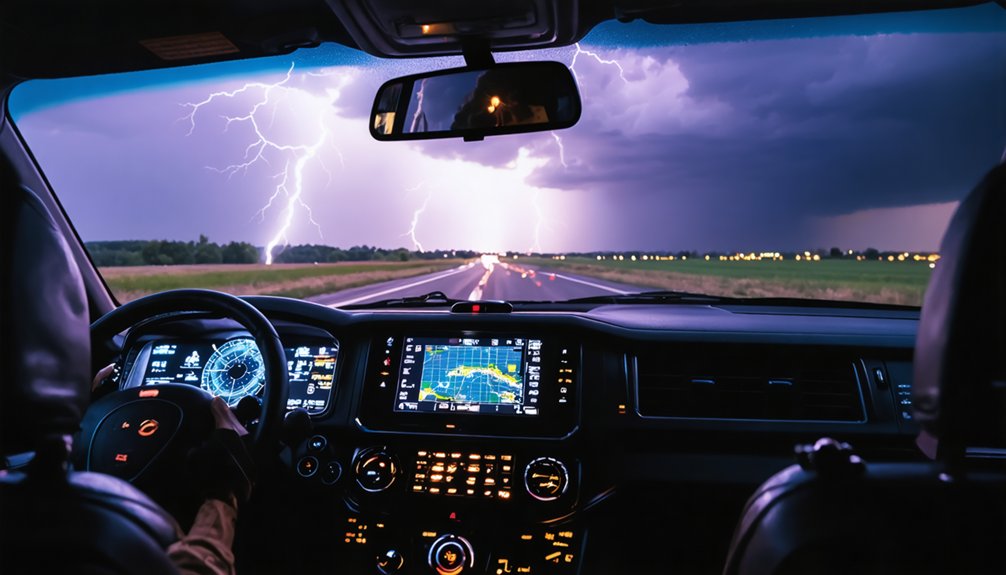
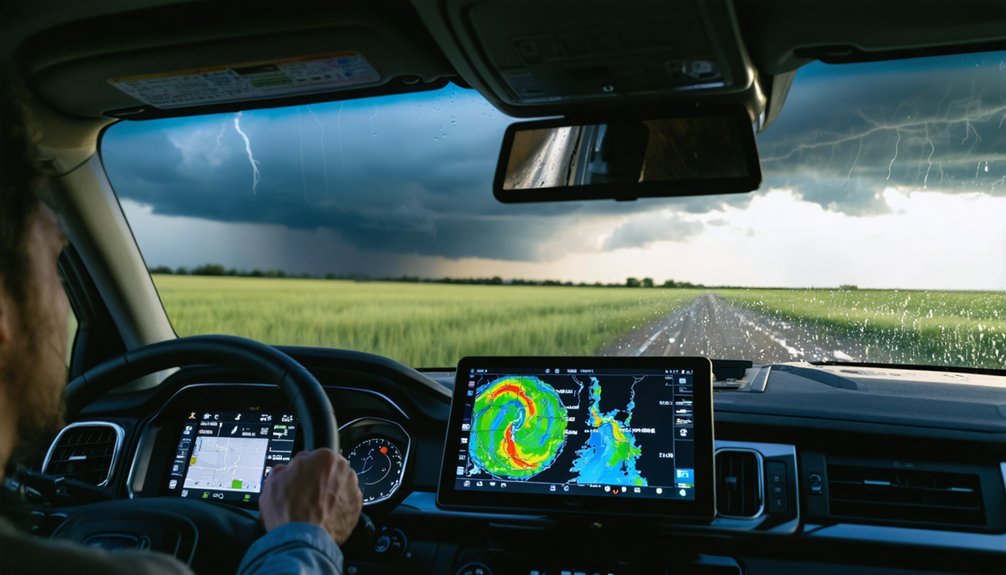
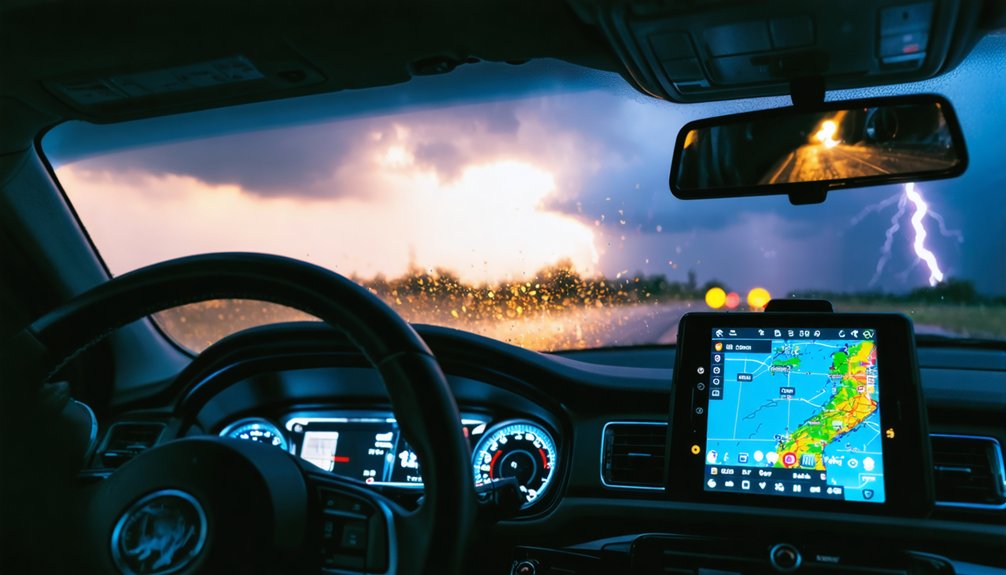
Storm chasing today means you’re working with a powerful stack of real-time tools. Dual-polarization Doppler radar detects rotation and hail signatures instantly, while apps like RadarScope stream live data directly to your device. GOES satellite imagery updates every 30 seconds, and GPS systems overlay warning polygons onto road networks for safer repositioning. In-vehicle sensors measure pressure drops and wind gusts at ground level. Each tool layer reveals something the others can’t—and there’s far more to unpack about each one.
Key Takeaways
- Dual-polarization Doppler radar scans precipitation in real time, enhancing storm awareness and detecting tornadoes, rotation zones, and hail probability.
- Mobile apps like RadarScope deliver live radar data, active chaser locations, and GPS-based severe weather alerts in a single interface.
- GOES-East and GOES-West satellites provide rapid-scan imagery every 30 seconds, helping chasers track storm development continuously.
- GPS mapping technology overlays radar returns, warning polygons, and road networks, enabling precise navigation as storm tracks shift.
- In-vehicle instruments measure real-time pressure, humidity, and wind data, revealing actual storm behavior within the boundary layer.
Real-Time Radar Tools Every Storm Chaser Depends On
When you’re intercepting a supercell, dual-polarization Doppler radar is your most critical data source. Dual polarization benefits your situational awareness by scanning both horizontal and vertical precipitation particles, sharply improving radar accuracy across precipitation types—rain, hail, snow, and debris fields.
Algorithm advancements have transformed storm detection considerably. Tools like the Mesocyclone Detection Algorithm and Tornado Detection Algorithm flag tornado signatures and rotation zones in real time, giving you seconds that matter.
The Hail Detection Algorithm estimates hail probability and maximum size, most reliable when you’re positioned 35–70 miles from the radar site.
MRMS composites and TDWR products update faster than standard scans, delivering ground-level views essential for spotting low-level tornadoes before they’re visually confirmed.
You need these layers active and understood before you ever leave your staging point.
Mobile Weather Apps Storm Chasers Use in the Field
Once you’re mobile and radar is streaming, your phone becomes a critical data terminal—and RadarScope stands as the industry-standard tool for that role, delivering real-time radar, active chaser locations, and current position mapping in a single interface. Its app features pull directly from NEXRAD and GOES networks, giving you high-resolution, near-real-time imagery without delay.
Beyond RadarScope, apps like Storm Shield extend your situational awareness by pushing GPS-based severe weather notifications calibrated to your precise location.
User experiences consistently highlight lightning detection integration as a standout capability—strike distance estimates arrive instantly, letting you react before threats escalate.
Customizable alert thresholds mean you’re not chained to your screen; the app monitors evolving conditions and notifies you when parameters cross your defined limits, keeping you mobile and informed simultaneously.
How Storm Chasers Use Satellite and Model Data to Find Storms
Before you ever load into a chase vehicle, satellite and model data shape where you’re going.
GOES-East and GOES-West deliver rapid-scan satellite imagery every 30 seconds, letting you track storm initiation and explosive convective growth in near real time. Infrared channels reveal cloud-top temperatures—colder tops mean taller, more intense cells worth targeting.
Model forecasting through the HREF ensemble averages convection-allowing runs like the HRRR and NAM 3 km into a stable, high-confidence targeting solution.
You’re not guessing a chase region; you’re narrowing it down to a corridor with measurable atmospheric support. Overlay that model output onto GIS mapping systems, and you’ve got storm tracks, severe-weather corridors, and intercept angles mapped before you turn the key.
GPS and Mapping Tech That Keeps Storm Chasers on Safe Routes
As the storm closes in, GPS technology locks your exact position in real time, even when visibility collapses inside a rain-wrapped supercell. You overlay that position directly onto radar returns, warning polygons, and GIS-mapped road networks, enabling precise route optimization as storm tracks shift by the minute.
GIS tools display county lines, highway corridors, and projected storm trajectories simultaneously, letting you calculate safe intercept angles ahead of rotating supercells.
Spotter Network broadcasts your coordinates alongside other chasers, preventing dangerous convergence in narrow escape corridors.
Coordinate-based navigation enforces your safety protocols by flagging blocked routes and identifying alternative exits before conditions deteriorate.
Together, these systems give you real freedom of movement—calculated, data-driven positioning that keeps you ahead of the storm rather than trapped inside it.
In-Vehicle and Aerial Tools Storm Chasers Use to Capture Ground-Level Data
Everything radar and satellite capture happens miles above the action, which is exactly why ground-level instrumentation matters. When you mount in-vehicle instrumentation like the AcuRite Atlas on your chase vehicle, you’re pulling real-time temperature, humidity, pressure, and wind data that no remote sensor can replicate at street level.
Those pressure drops and wind-gust spikes tell you what’s actually happening inside the storm’s boundary layer.
Pressure drops and wind-gust spikes reveal the storm’s true behavior where it matters most — at ground level.
Pair that with aerial surveillance via GPS-tagged drones, and you’ve got eyes on storm structure without physically entering the most dangerous zones.
Dash-cams with geo-tagged timestamps add another data layer, documenting conditions as they evolve.
Together, these tools give you precise, localized measurements that feed directly into mesoscale analysis, sharpen warning decisions, and let you document severe weather with scientific-grade accuracy.
Frequently Asked Questions
How Do Storm Chasers Legally Operate Drones Near Active Severe Weather?
You’ll need FAA waivers and must follow drone regulations strictly. Apply for Part 107 authorizations, maintain visual line‑of‑sight, and enforce safety protocols—keeping your UAV clear of manned aircraft operating within active severe‑weather zones.
What Certifications or Training Do Professional Storm Chasers Typically Need?
Pursuing professional preparedness, you’ll need certification programs like NWS SkyWarn and training courses covering meteorology, radar interpretation, and safety protocols—equipping you with data-driven skills to chase freely, responsibly, and with precision in severe weather environments.
How Do Storm Chasers Fund Their Equipment and Chase Operations?
You’ll typically fund operations through sponsorship opportunities with weather tech firms and crowdfunding strategies via platforms like Patreon. You can also leverage research grants, media licensing deals, and live-stream monetization to cover radar subscriptions, GPS systems, and vehicle costs.
Can Storm Chasers Share Real-Time Data Directly With Emergency Management Agencies?
Yes, you can share, sync, and stream real-time data directly with emergency management agencies. Through Spotter Network and emergency communication platforms, data sharing flows instantly, fueling faster warnings, sharper decisions, and stronger community protection.
How Do Storm Chasers Stay Mentally Prepared for Life-Threatening Situations?
You build mental resilience through rigorous scenario training, debriefing protocols, and psychological strategies like stress inoculation. You’re constantly analyzing real-time data, maintaining situational awareness, and trusting your decision-making frameworks to stay composed during life-threatening, rapidly evolving severe weather events.
References
- https://crazystormchasers.com/leveraging-technology-for-response-coordination/
- https://wickedwxlive.com/chasing-the-future-how-advancing-weather-technology-is-changing-storm-tracking/
- http://nwafiles.nwas.org/ej/pdf/2009-EJ2.pdf
- https://ams.confex.com/ams/39BROADCAST/webprogram/Manuscript/Paper189399/AMSSTORMSPOTTER2011PaperJJ_Final.pdf
- https://www.psu.edu/news/academics/story/weathering-storm
- https://www.acurite.com/blogs/who-uses-acurite/how-acurite-atlas-helps-a-storm-spotter
- https://www.oreateai.com/blog/beyond-the-app-what-radar-powers-a-storm-chasers-quest/066eddee6e76886721d12dc79c72549e
- https://en.wikipedia.org/wiki/Storm_chasing
- https://crazystormchasers.com/storm-spotting-network-resources-and-tools/
- https://tracking-technologies.com/blog/benefits-of-gps-for-storm-chasing-and-how-it-improves-safety/