For storm chasing, you need a dual-band VHF/UHF radio with IP67 weatherproofing, a battery exceeding 1500 mAh, and sealed port covers. Program 146.550 MHz as your primary national simplex frequency, all five MURS channels, and regional backups like 146.46 MHz. Pair your radio with a 5/8-wave whip antenna for at least 3 dB gain. Every spec and protocol covered here can mean the difference between staying connected and going dark when conditions turn critical.
Key Takeaways
- Dual-band radios with IP67 weatherproofing and 1500+ mAh batteries are essential for reliable storm chasing communication in harsh conditions.
- Program 146.550 MHz as the primary national simplex frequency, with 146.46 MHz and 146.52 MHz as backups.
- Include all five MURS frequencies (151.820, 151.880, 151.940, 157.420, 158.020 MHz) for flexible, license-free roaming communication options.
- Upgrade to a 5/8-wave whip or magnetic mount antenna targeting minimum 3 dB gain for enhanced transmission range.
- Conduct pre-field equipment inspections and frequency coordination briefings to ensure team safety and prevent communication failures.
Best Ham Radios for Storm Chasers and Spotters
When selecting a ham radio for storm chasing, you’ll need a dual-band handheld unit with a minimum 1500 mAh battery, IP67 weatherproofing, and frequency accuracy within ±0.005 MHz.
Storm chasing demands a dual-band radio with IP67 weatherproofing, 1500 mAh battery, and precise frequency accuracy.
These specs aren’t optional—they’re your lifeline in severe conditions.
Top storm chaser tips include prioritizing 3 dB antenna gain for ideal signal transmission and ensuring your unit scans 146.550 MHz, the national simplex frequency, alongside MURS frequencies.
You’ll want programming software loaded with these channels before you’re ever in the field.
Radio etiquette demands disciplined communication—keep transmissions brief, identify your station clearly, and avoid cluttering critical frequencies during active storm events.
Your radio isn’t just equipment; it’s your connection to coordinated, reliable field operations when conditions deteriorate fast.
The Specs That Make a Ham Radio Storm-Chaser Ready
When choosing a ham radio for storm chasing, you’ll need to prioritize specs that directly impact field performance under extreme conditions.
Your radio must support dual-band operation, maintain frequency accuracy within ±0.005 MHz, and deliver an antenna gain of 3 dB for reliable signal transmission in severe storm environments.
Beyond performance, you’ll also need to confirm that your unit meets IP67 weatherproofing standards and carries a battery capacity exceeding 1500 mAh to sustain extended operations in the field.
Essential Technical Performance Standards
Choosing the right ham radio for storm chasing means understanding the specs that separate field-ready gear from equipment that’ll fail you mid-chase. You need frequency accuracy within ±0.005 MHz — any deviation compromises reliable connectivity when conditions deteriorate fast.
Antenna gain optimized to 3 dB delivers clear signal transmission through storm zones without unnecessary interference.
Your radio must also meet IP67 weatherproofing standards. Rain, hail, and mud are constants in the field, and your equipment can’t tap out when conditions intensify.
Battery capacity should exceed 1500 mAh to sustain extended operations across long chase days.
Finally, prioritize dual-band capability — it gives you flexible frequency scanning across critical storm-chasing channels. These aren’t optional upgrades; they’re baseline requirements for staying connected when it matters most.
Weatherproofing And Battery Requirements
Storm chasing puts your radio through punishment that lab benchmarks rarely simulate — and two specs determine whether your unit survives a full chase day: weatherproofing rating and battery capacity.
Your radio must meet these non-negotiable thresholds:
- IP67 minimum weatherproof ratings — guarantees full dust protection and withstands submersion up to 1 meter for 30 minutes.
- 1500 mAh battery longevity floor — anything below this capacity won’t sustain extended scanning and transmission cycles.
- Sealed port covers — exposed charging ports fail during heavy rainfall, cutting your operation short.
- Hot-swap battery compatibility — lets you swap cells in the field without powering down or losing programmed channels.
Own these specs, and you’ll keep transmitting when conditions deteriorate fastest.
Must-Have Frequencies Every Storm Chaser Should Program
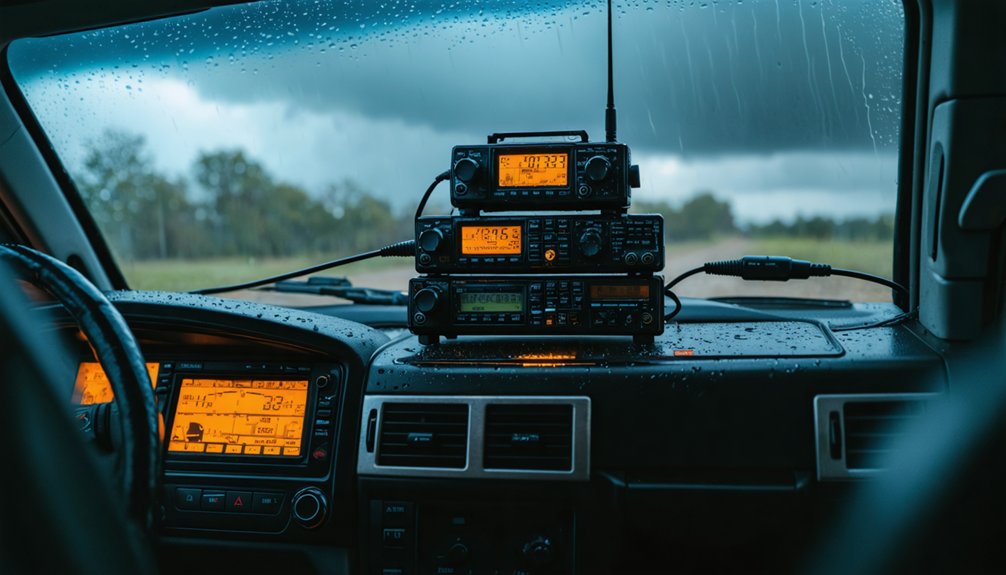
Programming the right frequencies into your radio before you hit the field can mean the difference between staying connected and losing contact when it matters most.
You’ll want to start with 146.550 MHz as your primary national simplex frequency, then add all five MURS channels (151.820, 151.880, 151.940, 157.420, and 158.020 MHz) for roaming flexibility.
Round out your setup with regional and backup options like 146.46 MHz, 146.52 MHz, and 204.2 MHz to cover contingency scenarios across different spotting regions.
Primary National Simplex Frequencies
Whether you’re coordinating with spotters or staying connected across hundreds of miles, having the right simplex frequencies programmed into your radio is non-negotiable.
Simplex advantages include direct, repeater-free communication that keeps you operational when infrastructure fails. Effective frequency coordination starts with knowing exactly which channels matter most.
Program these four primary national simplex frequencies immediately:
- 146.550 MHz – The national primary simplex frequency for storm chasers and spotters.
- 146.46 MHz – Secondary alternate simplex channel for active field communication.
- 146.52 MHz – Backup simplex option pre-programmed in most ham radios.
- 204.2 MHz – Recommended for specific regional storm spotting operations.
These frequencies give you flexible, independent communication without relying on repeater networks during critical chase scenarios.
MURS Roaming Channel Options
Beyond national simplex, you’ll want MURS frequencies locked into your radio for roaming flexibility across open terrain.
These five channels—151.820, 151.880, 151.940, 157.420, and 158.020 MHz—deliver reliable MURS frequency options without licensing restrictions, giving you operational freedom when coordinating across multiple field teams.
Your roaming channel capabilities strengthen considerably when you program all five MURS channels alongside 146.550 MHz.
Scanners covering 150 MHz to 200 MHz will detect active spotters operating on these frequencies, keeping your situational awareness sharp during rapidly evolving storm events.
Program these channels before deployment—not during.
Frequency accuracy must stay within ±0.005 MHz to maintain solid connectivity.
Pair that precision with dual-band hardware, and you’ve built a communication setup that won’t fail you when conditions deteriorate fast.
Regional And Backup Frequencies
Regional frequencies like 146.46 MHz and 204.2 MHz aren’t optional extras—they’re operational necessities that fill coverage gaps when primary channels get congested or terrain limits your range.
Smart regional frequency planning keeps you mobile and connected across diverse storm environments. Solid backup communication strategies mean you’re never without a lifeline when conditions deteriorate fast.
Program these four frequencies immediately:
- 146.46 MHz – Secondary simplex channel when 146.550 MHz traffic peaks
- 146.52 MHz – Factory-programmed backup recognized across most ham radios
- 204.2 MHz – Designated for specific regional spotting zones requiring dedicated coverage
- 150 MURS channels – License-free roaming options bridging gaps between ham frequencies
You control your communication redundancy. Load every frequency before you deploy—not after you’ve lost contact.
Dual-Band vs. Single-Band Ham Radios for Storm Spotting
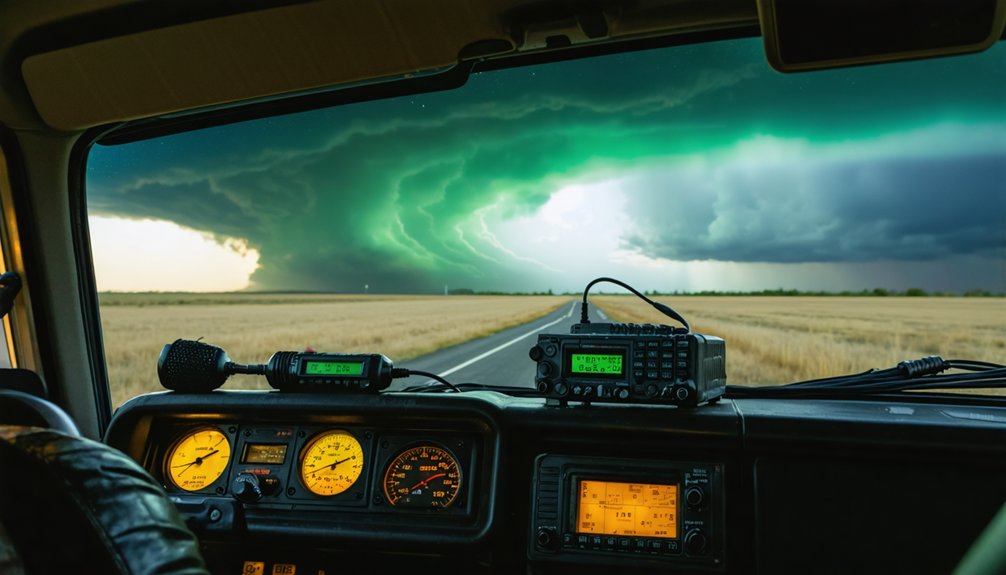
Choosing between a dual-band and single-band radio directly impacts your ability to monitor critical storm-spotting frequencies.
Dual band advantages are clear: you’ll simultaneously cover VHF and UHF bands, letting you monitor 146.550 MHz while accessing local repeater networks between 150–200 MHz. This flexibility keeps you connected across multiple communication layers without switching equipment.
Dual-band radios keep you connected across VHF and UHF simultaneously — no switching, no gaps, no compromises.
Single band limitations become costly during active chases. A VHF-only unit locks you into one spectrum, cutting off UHF repeater access when conditions deteriorate. If a storm disrupts your primary frequency, your backup options shrink considerably.
Your radio must support dual-band operation per field equipment standards. Portable units meeting this requirement give you the operational freedom to scan MURS frequencies, maintain simplex contact, and adapt instantly when storm communication demands shift unexpectedly.
How to Program MURS and 146.550 MHz for Field Use
Programming your radio correctly before heading into the field separates functional communication from failure when storms develop fast.
Solid frequency management keeps you connected when conditions deteriorate rapidly.
- Load 146.550 MHz as your primary national simplex channel for spotter-to-spotter contact.
- Program all 5 MURS frequencies — 151.820, 151.880, 151.940, 157.420, and 158.020 MHz — for roaming flexibility.
- Add 146.46 MHz and 146.52 MHz as secondary backup simplex options your scanner cycles through automatically.
- Include 204.2 MHz if you’re operating within designated regional spotting zones.
These programming tips guarantee your radio’s ready before you leave the driveway.
Don’t wait until a tornado’s on the ground to discover a missing channel. Pre-program everything, verify accuracy within ±0.005 MHz, and own your communication setup completely.
Ham Radio Antenna Upgrades That Extend Storm Zone Range
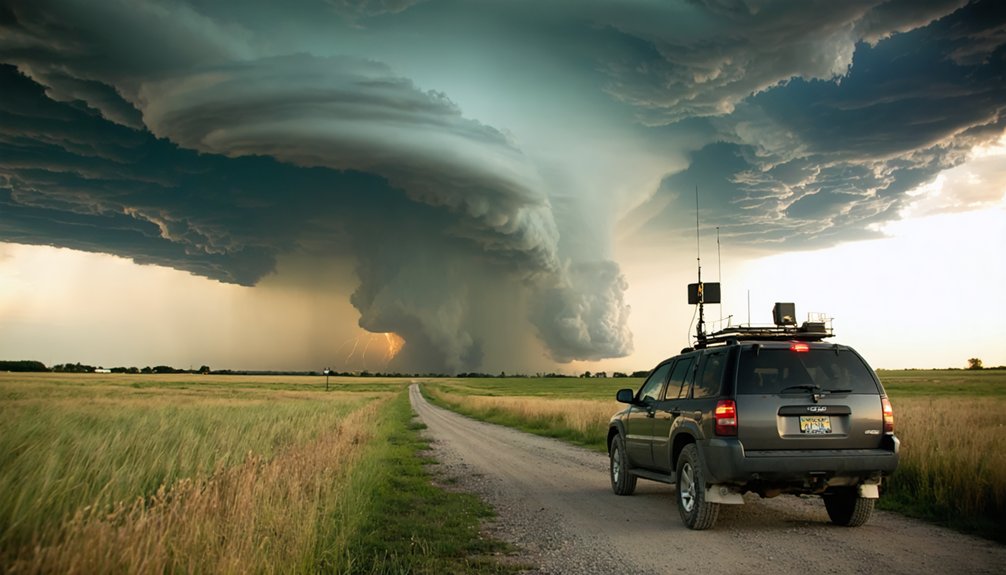
When your antenna underperforms, no amount of careful frequency programming compensates for weak signal transmission deep in storm zones. Upgrading your antenna directly extends your operational reach across unpredictable terrain.
Start by evaluating antenna types suited for mobile storm chasing. A 5/8-wave whip antenna delivers stronger gain than standard rubber duck units, pushing signal clarity across greater distances. Magnetic mount antennas offer quick vehicle deployment without permanent installation commitments.
Upgrade your mobile antenna first — a 5/8-wave whip outperforms rubber duck units when storm zones demand reliable signal reach.
Conduct thorough range testing before entering active storm zones. Drive measured distances while monitoring signal degradation at 146.550 MHz and MURS frequencies. Document drop-off points to identify coverage gaps.
Target 3 dB antenna gain as your baseline specification. Exceeding that threshold improves transmission without violating operational standards, keeping your communication reliable when severe conditions demand absolute signal integrity.
Why IP67 Weatherproofing Is Non-Negotiable for Storm Chasers
Storm chasing exposes your radio equipment to rain, hail, and violent wind-driven moisture that’ll destroy unprotected electronics within a single deployment.
IP67 importance becomes immediately clear when you’re operating in tornado-warned conditions where weatherproofing features determine whether your gear survives.
IP67-rated radios withstand these four critical threats:
- Complete dust ingress prevention — zero particulate penetration during high-wind debris events
- Submersion tolerance up to 1 meter — protecting against flash flooding and standing water contact
- Hail impact resistance — rugged design absorbs repeated strikes without compromising internal components
- Moisture-sealed port covers — preventing connector corrosion that silently kills storm durability over multiple deployments
You can’t recover lost communication when you’re tracking a wedge tornado. Your radio must outlast the storm, not surrender to it.
Battery and Power Solutions for Extended Ham Radio Use
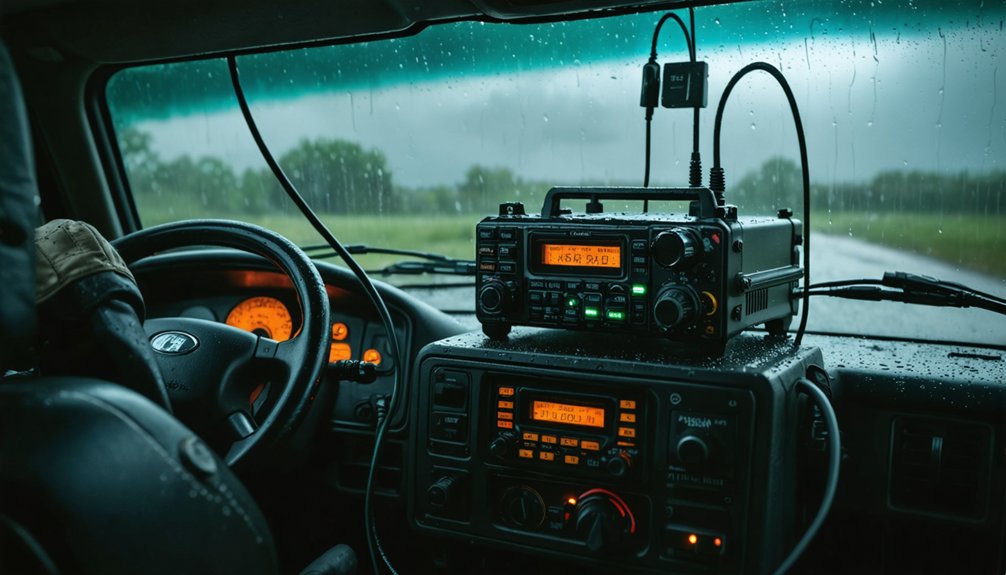
When you’re chasing storms for extended periods, your radio’s battery capacity must exceed 1500 mAh to sustain reliable field operations without interruption.
You’ll want to carry spare battery packs and a vehicle-based charging solution to maintain power continuity across long deployments.
Managing your radio’s power draw by minimizing unnecessary scanning and adjusting transmit power levels will greatly extend your operational runtime in the field.
Battery Capacity Requirements
For extended field operations, your radio’s battery capacity must exceed 1500 mAh to sustain reliable communication throughout a full chase session.
Prioritizing battery longevity and portable charging solutions keeps you independent in remote environments.
- Minimum threshold: Select batteries rated above 1500 mAh to handle continuous transmission demands.
- Extended packs: High-capacity extended battery packs push operation time beyond 12 hours under active use.
- Charging solutions: Carry solar panels or vehicle-based DC chargers to replenish power without grid dependency.
- Redundancy: Pack at least two fully charged battery units to eliminate communication gaps during critical storm tracking moments.
These steps guarantee your setup remains operational when conditions deteriorate and reliable communication matters most.
Power Management Strategies
Beyond selecting the right battery capacity, managing that power effectively separates a successful chase from a communications failure mid-storm.
You’ll want to monitor your radio’s power consumption actively, dropping to low-power transmission modes when distance allows. This single habit dramatically improves power efficiency during extended deployments.
Carry at least two fully charged battery packs and rotate them deliberately.
Solar charging panels and vehicle-mounted DC adapters give you flexible charging solutions that keep you independent from grid infrastructure — critical when you’re operating deep in rural storm corridors.
Disable unused features like Bluetooth, backlighting, and unnecessary scanning cycles.
Every milliamp you conserve extends your operational window.
In severe weather, your radio isn’t just equipment — it’s your lifeline, so treat power management as a non-negotiable discipline.
How Storm Chasers Use Repeater Networks in the Field
Repeater networks form the backbone of reliable field communication for storm chasers, operating between 150 MHz and 200 MHz to keep roaming spotters connected across wide geographic areas.
You’ll rely on repeater functionality to extend your radio’s range far beyond simplex limitations, ensuring emergency communication reaches coordination teams instantly.
Here’s how you maximize repeater networks in the field:
- Program 150 MURS and 146.550 MHz into your radio before deploying.
- Monitor repeater output frequencies between 150–200 MHz continuously during operations.
- Switch to 146.550 MHz immediately when emergency communication becomes critical.
- Identify regional repeaters along your chase route using updated frequency databases.
You’re operating in unpredictable environments, so knowing your repeater infrastructure beforehand keeps you autonomous and connected when conditions deteriorate rapidly.
Ham Radio Mistakes Storm Chasers Keep Making
Even experienced storm chasers make critical radio errors that compromise safety and coordination when conditions turn severe.
Communication errors often stem from frequency confusion when you neglect programming 146.550 MHz and MURS channels before deployment.
Frequency confusion kills coordination—program 146.550 MHz and MURS channels before you ever leave the driveway.
Equipment failures accelerate when battery issues arise from units under 1500 mAh capacity during extended operations.
Signal interruptions compound when antenna misalignment reduces your gain below the ideal 3 dB threshold.
Programming mistakes leave you scrambling mid-chase when backup simplex channels aren’t pre-loaded.
Weather impacts degrade IP67-rated equipment faster when you skip pre-field inspection protocols.
Operational misunderstandings emerge when teams skip frequency coordination briefings entirely.
Ignoring emergency protocols around 146.550 MHz during critical scenarios creates dangerous communication gaps.
Audit your setup before every chase—your safety depends on disciplined preparation, not improvisation.
Frequently Asked Questions
Can Ham Radios Integrate With Weather Apps for Real-Time Storm Tracking?
Can you imagine seamless storm tracking at your fingertips? Yes, you can integrate ham radios with apps via Bluetooth or data bridges, enabling real-time app integration that’ll enhance your field awareness and keep you ahead of severe weather.
Are Ham Radio Licenses Required Specifically for Storm Chasing Operations?
You’ll need a valid ham radio license for storm chasing techniques involving licensed frequencies. It’s non-negotiable for emergency preparedness operations. Without one, you can’t legally transmit on 146.550 MHz or other designated channels.
How Do Storm Chasers Coordinate Frequencies With Local Emergency Management Agencies?
Like a well-oiled machine, you’ll coordinate frequency coordination by programming 146.550 MHz and MURS channels, aligning your emergency communication protocols with local agencies to guarantee seamless, real-time storm reporting across all critical networks.
What Legal Restrictions Apply to Transmitting on Storm Chasing Frequencies?
You must hold an FCC amateur radio license to legally transmit on storm frequency regulations channels. Amateur radio laws require you to follow Part 97 rules, maintain frequency accuracy, and adhere to national simplex standards like 146.550 MHz.
Can Ham Radios Communicate Directly With National Weather Service Meteorologists?
Can you bridge the gap between field and forecast? You can’t directly reach NWS meteorologists via ham radio, but you’ll enhance storm safety through emergency communication networks like SKYWARN, linking spotters to local NWS offices efficiently.
References
- https://www.youtube.com/watch?v=9FpJ7RGsV3Q
- https://www.facebook.com/groups/2454081528094611/posts/3351419888360766/
- https://stormtrack.org/threads/what-amateur-radio-to-get.18038/
- https://www.reddit.com/r/stormchasing/comments/1d17gg7/does_anyone_know_what_type_of_radios_the_chasers/
- https://www.reddit.com/r/stormchasing/comments/1jtktsi/hey_yall_im_just_wondering_what_radio_i_should_be/
- https://stormtrack.org/threads/new-to-ham-radio.29257/
- https://www.youtube.com/watch?v=TyvpdFmktRE
- https://stormtrack.org/threads/new-ham-radio-equipment-questions.31530/
- https://www.reddit.com/r/amateurradio/comments/gqzqbg/50w_dualband_for_storm_spotter/
- https://www.youtube.com/watch?v=JIx3xjf7aGM