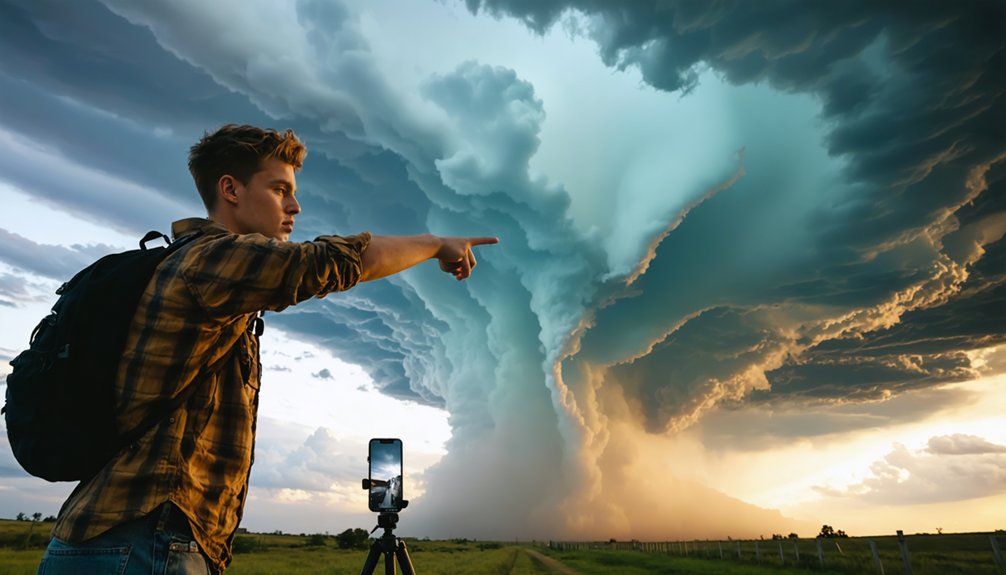
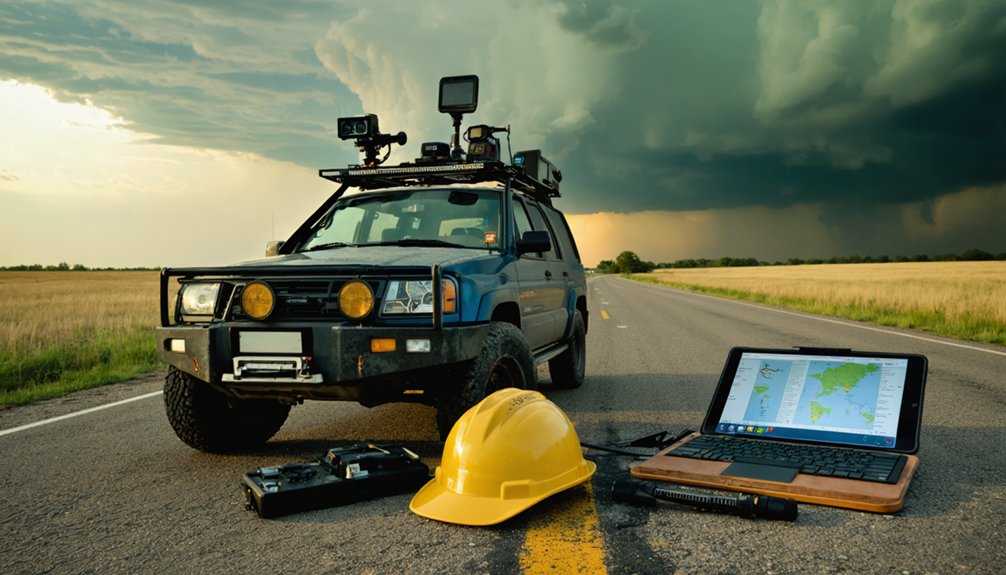
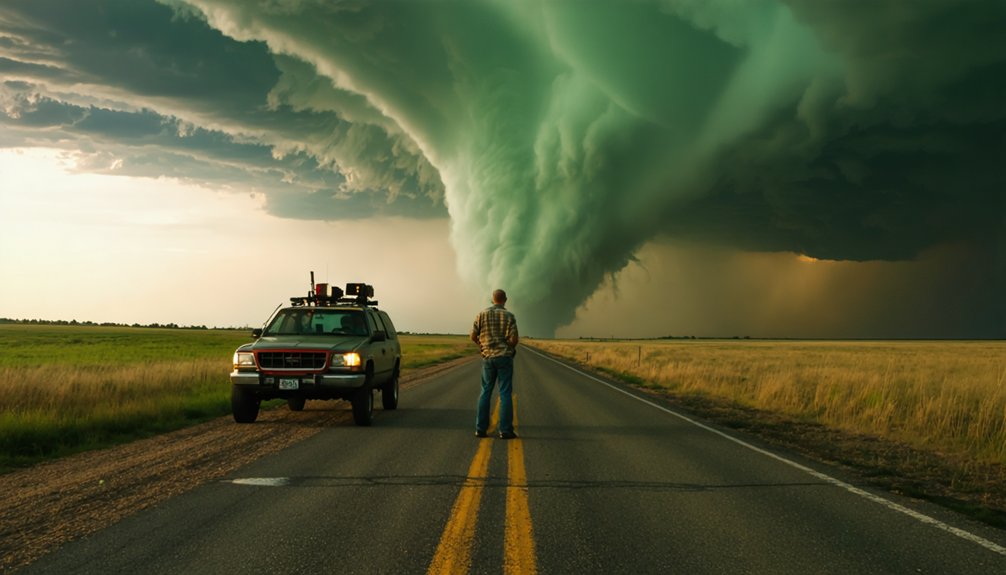
Reed Timmer and Pecos Hank represent two fundamentally opposite storm chasing philosophies. Timmer uses armored vehicles to intercept tornadoes at close range, prioritizing scientific data collection and meteorological research. Hank takes a patient, observational approach, using cinema-grade optics to capture atmospheric structure and visual storytelling. Your preference depends on whether you’re drawn to data-driven, high-risk pursuit or precise cinematic documentation. There’s far more technical and stylistic contrast between these two chasers than you’d initially expect.
Key Takeaways
- Reed Timmer pursues close-range tornado intercepts for scientific data, while Pecos Hank prioritizes patient observation and cinematic storm documentation.
- Timmer uses armored vehicles like the Dominator; Hank relies on cinema-grade optics for visual clarity and composition.
- Timmer’s approach is reactive and data-driven; Hank reads storm moods and waits for optimal visual conditions.
- Timmer is motivated by meteorology and storm dynamics; Hank focuses on atmospheric storytelling, light, and structure.
- Choosing between them depends on whether your interest is scientific data collection or artistic storm documentation.
Reed Timmer and Pecos Hank: Two Opposite Approaches to Storm Chasing
While both Reed Timmer and Pecos Hank have built careers around severe weather, their approaches couldn’t be more different. Timmer operates as a field scientist, driving armored intercept vehicles directly into tornado cores and prioritizing close-range data collection. His technical equipment is purpose-built for extreme conditions, and storm safety is engineered into the vehicle rather than achieved through distance.
Pecos Hank takes the opposite position. He frames storms as subjects to be observed and composed, not intercepted. His technical equipment favors cinematic quality, capturing structure, light, and atmosphere with patience rather than aggression.
You’re fundamentally looking at two legitimate but contrasting philosophies: one optimized for scientific penetration of dangerous systems, the other for documentary storytelling that respects the storm’s visual and natural complexity.
Reed Timmer’s Intercept-First Storm Chasing Style
Reed Timmer’s chasing methodology is built around a single core principle: get inside the storm. His intercept-first approach combines meteorological expertise with calculated positioning, putting him directly in the path of violent tornadoes rather than observing from a safe distance.
He uses armored vehicles like the Dominator to survive conditions that would destroy standard equipment.
This isn’t reckless behavior—it’s disciplined risk management applied to extreme environments. Timmer’s Ph.D. in meteorology from the University of Oklahoma backs every deployment decision he makes.
He’s reading atmospheric data in real time, adjusting his intercept angle, and collecting close-range observations that passive documentation simply can’t produce.
If you value hard data gathered under pressure, Timmer’s style delivers exactly that. He trades comfort for proximity, and proximity for information no one else can capture.
Pecos Hank’s Cinematic Approach to Storm Chasing
Pecos Hank’s storm chasing runs on an entirely different operating logic—one built around composition, patience, and visual narrative rather than data collection under pressure.
Where Timmer moves toward the storm, Hank positions himself to frame it. His work prioritizes atmospheric composition—reading light, structure, and movement to capture footage that functions as documentary art rather than raw intercept data.
Hank doesn’t chase the storm—he waits for the storm to become something worth watching.
You’re watching someone who blends music, filmmaking, and field observation into a unified creative practice. His visual storytelling approach treats severe weather as subject matter worthy of careful, long-form documentation.
That philosophy demands restraint and timing over aggression and proximity. Hank’s chasing career stretches back to 1994, and that experience shows—not in how close he gets, but in how deliberately he sees.
Reed Timmer vs Pecos Hank: How Their Approaches Differ in the Field
Set those two philosophies side by side in the field, and the operational contrast becomes immediate. Timmer’s equipment preferences reflect his intercept-first mindset — armored vehicles, forward-deployed instruments, and close-range positioning designed to penetrate storm cores.
His weather psychology is reactive and pursuit-driven, prioritizing data capture under maximum pressure.
Hank’s equipment preferences trend toward cinema-grade optics, stabilized rigs, and positioning that maximizes structural visibility over proximity.
His weather psychology is observational — he reads a storm’s mood before committing to a location, favoring patience over aggression.
You’re essentially (fundamentally) watching two different professionals solve the same problem differently. Timmer asks how close he can get.
Hank asks how clearly he can document what’s unfolding. Both approaches demand skill, but they operate from fundamentally opposite field disciplines.
Which Storm Chasing Style Suits You?
Choosing between these two chasing philosophies comes down to your core motivations in the field. If you’re drawn to meteorology, weather forecasting, and direct data collection under extreme conditions, Timmer’s intercept-first model fits your drive.
Your chasing philosophy starts with your motivation. Science and data collection point directly toward Timmer’s intercept-first model.
You’ll need strong storm safety protocols, technical vehicle preparation, and a high tolerance for risk.
If you’re more invested in visual storytelling, cinematic composition, and long-form documentation, Pecos Hank’s patient approach aligns with your goals.
You’ll prioritize positioning, light, and atmosphere over proximity.
Ask yourself what you’re chasing for. Science and field data push you toward Timmer’s framework.
Art and documentation pull you toward Hank’s. Neither style is wrong, but your answer clarifies which path gives you the most purposeful work in the field.
Frequently Asked Questions
Has Reed Timmer Ever Chased Storms Alongside Pecos Hank?
Shared storm chasing sessions aren’t confirmed in available records. You can track their storm chasing gear and social media presence separately—both boldly broadcast breathtaking footage, but documented collaborative chases between Timmer and Pecos Hank remain unverified.
How Does Each Chaser Fund Their Storm Chasing Operations?
You’ll find Timmer’s storm chasing equipment and operations are funded through television deals and meteorological research, while Pecos Hank’s funding sources lean on music, filmmaking revenue, and documentary-style content monetization across independent platforms.
Have Either Chaser Ever Been Injured During a Tornado Intercept?
Like Icarus flying too close to the sun, storm chase safety has real limits. Timmer’s suffered injuries during intercepts; Pecos Hank’s cinematic, patient thunderstorm forecasting approach has kept him significantly clear of serious documented harm.
Does Pecos Hank Have Any Formal Meteorology Training or Certifications?
Pecos Hank doesn’t hold formal meteorology credentials or a notable certification background. His expertise comes from decades of fieldwork, filmmaking, and direct storm observation — you’re looking at self-taught mastery rather than academic meteorological training.
How Many Tornadoes Has Each Chaser Documented Throughout Their Careers?
Exact counts aren’t publicly verified for either chaser. Timmer’s meteorology credentials and aggressive chasing techniques have yielded hundreds of intercepts, while Pecos Hank’s cinematic chasing techniques have documented fewer but visually compelling tornadoes throughout his career.
References
- https://en.wikipedia.org/wiki/Reed_Timmer
- https://www.nytimes.com/interactive/2024/07/19/magazine/tornado-alley-storm-chaser.html
- https://en.wikipedia.org/wiki/Hank_Schyma
- https://alchetron.com/Reed-Timmer
- https://www.mlive.com/living/grand-rapids/2010/10/profile_meteorologist_discover.html
- https://de.wikipedia.org/wiki/Reed_Timmer_(Meteorologe)
- https://scoutingalumni.org/about/notable-scouting-alumni/reed-timmer/
- https://www.allamericanspeakers.com/celebritytalentbios/Reed+Timmer/386324
- https://www.wolfmanproductions.com/reed-timmer
- https://insheepsclothinghifi.com/pecos-hank/