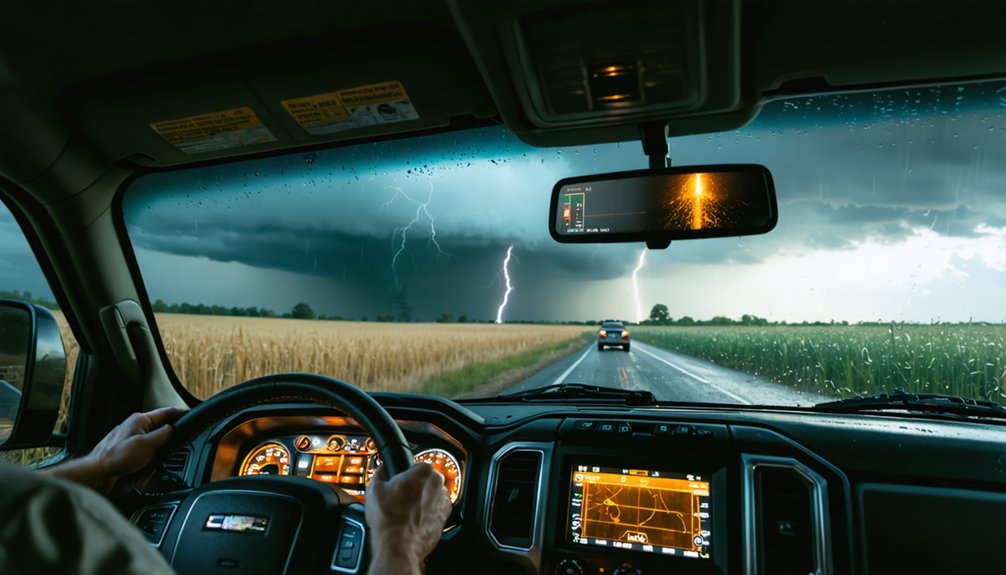
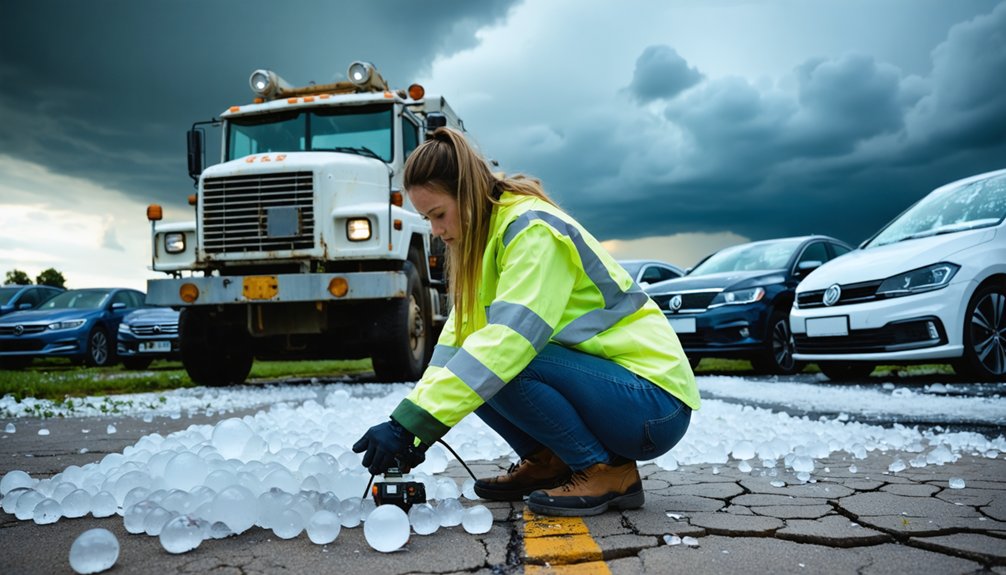
Hailstorm research is undergoing a technological revolution, and you’re at the center of it. U.S. hail losses exceed $10 billion annually, driven by forecasting gaps that traditional instruments can’t bridge. Today’s researchers deploy high-speed 4K cameras, 24-gram HailSonde probes, 3D laser scanners, and CT imaging to capture storm dynamics at unprecedented resolution. The ICECHIP campaign spans 15 universities, integrating AI-driven modeling and advanced sensor arrays. Explore further to uncover how these breakthroughs are reshaping everything from storm prediction to structural engineering.
Key Takeaways
- High-speed cameras recording 4K footage at 330 frames per second capture precise hailstone size, depth, and velocity data during storms.
- HailSondes, lightweight 24-gram sensors, infiltrate mesocyclone environments to collect real-time hailstone growth data inaccessible to ground instruments.
- The ICECHIP campaign, the first U.S. hail-focused effort in 40 years, deploys cutting-edge sensors across the Front Range and Central Plains.
- 3D laser scans, CT imaging, and 6-axis force transducers provide detailed structural and impact data to improve building material simulations.
- AI-driven algorithms and multi-university data integration are outperforming legacy radar systems, significantly advancing hail prediction and climate impact modeling.
Why Hailstorm Science Has Been Flying Blind Until Now
The consequences are real: U.S. hail losses exceed $10 billion annually over the past 14 years, driven partly by predictive gaps.
Traditional instrumentation simply couldn’t survive the violent updrafts, wind speeds exceeding 120 km/h, and extreme conditions where hailstones actually form and grow.
How High-Speed Hail Cameras Capture Storms in 4K
When you examine the hail camera system’s design, you’ll find high-speed cameras encased in bullet-resistant polycarbonate, mounted on a diesel pickup truck within a protective metal cage.
These cameras record 4K footage at 330 frames per second, capturing pre-impact hail behavior in real time while LED lights operating 30 percent brighter than sunlight guarantee sharp imaging through violent storm conditions.
Camera System Design Details
Mounted on a diesel pickup truck within a reinforced metal cage, the high-speed hail camera system encases its optics in bullet-resistant polycarbonate to withstand direct hailstone impacts. This camera durability guarantees uninterrupted data collection even in the most violent storm conditions.
You’re looking at a platform engineered for extreme environments, where structural compromise isn’t an option.
Recording precision defines this system’s core value. It captures 4K footage at 330 frames per second, giving you frame-by-frame visibility of hailstone behavior immediately before impact.
Integrated LED lights operate at 30 percent greater intensity than direct sunlight, eliminating exposure limitations during dark, turbulent conditions. Together, these design elements give researchers—and ultimately you—reliable, high-resolution storm data that drives meaningful improvements in hail size prediction accuracy.
Storm Footage Capture Capabilities
Capturing storm footage at this resolution demands more than durable hardware—it requires a system built around precise data acquisition. When you’re tracking live storm conditions, the camera records 4K footage at 330 frames per second, giving you granular control over footage analysis.
Each recorded frame delivers three critical data outputs:
- Hailstone depth — measured precisely across sequential frames
- Physical size — calculated without physical contact or interference
- Three-dimensional velocity — tracked through spatial frame comparison
You’re not simply recording weather events—you’re generating structured datasets that transform raw storm tracking into actionable science.
The LED lighting system, running 30 percent brighter than sunlight, guarantees no detail gets lost inside the storm’s chaos, keeping your footage analysis sharp and scientifically defensible.
How HailSondes Probes Fly Into the Storm
The HailSondes probe is a hailstone-shaped sensor weighing just 24 grams, designed to infiltrate the very updrafts that build destructive hailstones. You’re looking at probe technology that attaches directly to balloons, releasing into mesocyclone environments where storm dynamics become measurable data.
During an Alberta hailstorm deployment, HailSondes ascended seven kilometers through winds exceeding 120 km/h. Once inside the storm, the probe detaches from its balloon, mimicking an actual hailstone’s free trajectory. It captures pathway measurements, environmental conditions, and ice growth data from within the mesocyclone itself.
This detachment mechanism is critical. It lets you gather real-time hailstone growth conditions that ground-based instruments simply can’t access.
The probe’s 2022 Harry Otten Prize for Innovation in Meteorology nomination confirms its breakthrough standing in atmospheric research.
Inside the ICECHIP Field Campaign
ICECHIP—short for In-situ Collaborative Experiment for Collection of Hail in the Plains—marks the first U.S. hail-focused field campaign in over 40 years, funded by the National Science Foundation.
You’re looking at meteorological collaboration spanning 15 universities and international partners, deploying cutting-edge sensor technology across the Front Range and Central Plains for six weeks.
The campaign targets hailstone dynamics, updraft analysis, and storm trajectory through:
- Mobile radars and unpiloted aerial systems capturing real-time ice growth patterns
- Person-sized collection funnels preserving pristine hailstones in refrigerated containers for hailstone morphology analysis
- Lofted drifters and high-resolution cameras delivering precise meteorological data
This research funding opens up unprecedented storm interior access, sharpening your understanding of how hailstones develop, travel, and intensify inside active supercells.
How Scientists Build Digital Models of Every Hailstone

When scientists collect hailstones in the field, they don’t just measure them by hand—they run 3D laser scans to generate precise digital models suitable for materials science analysis.
You can then apply that data to an omni-directional disdrometer prototype, which uses a 6-axis force transducer to measure hail impact angles with high accuracy.
Together, these tools sharpen simulations that test how siding, windows, and other building materials hold up against real hailstorm conditions.
Laser Scanning Hailstone Models
Every hailstone that survives the chaos of a supercell carries a frozen record of its growth history—and scientists are now using 3D laser scanning to extract that record with precision.
Digital modeling transforms each hailstone into a detailed geometric dataset, enabling materials science analysis that wasn’t previously possible.
Here’s what that process reveals:
- Structural mapping: Laser scanning captures exact surface topology, revealing asymmetries and protrusions formed during turbulent updraft cycling.
- Materials testing data: Digital models sharpen simulations used to test siding, windows, and roofing resilience against real-world impact scenarios.
- Scalable documentation: Researchers build comparative libraries across entire hailswaths rather than analyzing isolated stones.
You’re no longer limited to a single measurement.
You’ve got a replicable, three-dimensional record that drives smarter engineering and stronger predictive frameworks.
Force Transducer Impact Analysis
Measuring a hailstorm’s destructive force used to mean counting dents on a car hood—now a 6-axis force transducer embedded in an omni-directional disdrometer captures impact angle, magnitude, and directional loading simultaneously.
These force transducer mechanics eliminate guesswork by resolving every strike into precise vector components, giving you complete spatial data rather than a single scalar measurement.
You’re no longer limited to post-storm damage surveys. Modern impact measurement techniques deploy networked instrument arrays across full hailswaths, collecting five quality swath cases as early as 2017.
That dataset feeds directly into materials simulations, stress-testing siding, windows, and roofing under realistic multi-directional loading conditions. You gain actionable engineering benchmarks without waiting for the next billion-dollar storm to expose structural vulnerabilities.
Digital Data Improves Simulations
Force transducer data tells you how a hailstone hits, but 3D laser scanning tells you exactly what hit—capturing every contour, lobe, and asymmetry of the stone itself.
These digital models feed directly into materials testing simulations, sharpening simulation accuracy for siding, windows, and roofing systems.
Your data visualization pipeline transforms raw scans into actionable engineering inputs:
- Shape profiles reveal irregular geometries that standard spherical assumptions miss entirely
- Surface topology maps expose impact edges most likely to concentrate stress
- Multi-stone datasets reflect real hailswath variability rather than isolated samples
You’re no longer testing against idealized assumptions—you’re testing against reality.
That shift fundamentally changes how manufacturers and researchers evaluate material resilience under genuine hailstorm conditions.
What CT Scans Reveal About How Hailstones Form

When researchers repurpose CT scanning equipment from dental offices, they reveal a cross-sectional view of a hailstone’s internal architecture that no surface measurement can provide.
These CT scan insights expose alternating layers of clear and opaque ice, each ring documenting a distinct growth cycle within the storm’s updraft. You can trace exactly how a hailstone structure develops as the stone repeatedly ascends through supercooled water zones and descends into drier air pockets.
Each layer’s density, thickness, and composition tells you the precise atmospheric conditions present during formation. This internal mapping eliminates guesswork, giving researchers quantifiable data about updraft intensity, temperature gradients, and moisture levels that shaped every individual stone from its embryonic core outward.
Climate Trends Driving the Surge in Hailstorms
As industrial emissions accelerated global temperatures, hailstorm frequency in China surged along a trajectory researchers can now quantify with precision. Climate influences tied to human-driven warming have reshaped severe weather patterns dramatically.
A September 2025 Nature Communications study, led by Peking University researchers, combined historical records, meteorological data, and AI to expose these shifts.
Key findings you should understand:
- A convolutional neural network trained on historical data predicts continued increases in hailstorm frequency
- Industrial Revolution-era emissions directly correlate with China’s escalating hail activity
- U.S. hail losses have exceeded $10 billion annually over the past 14 years
These numbers aren’t abstract—they represent real financial and structural consequences. Understanding climate influences on hailstorms empowers you to anticipate risks and demand better forecasting infrastructure.
How This Research Is Changing Hail Forecasting Models
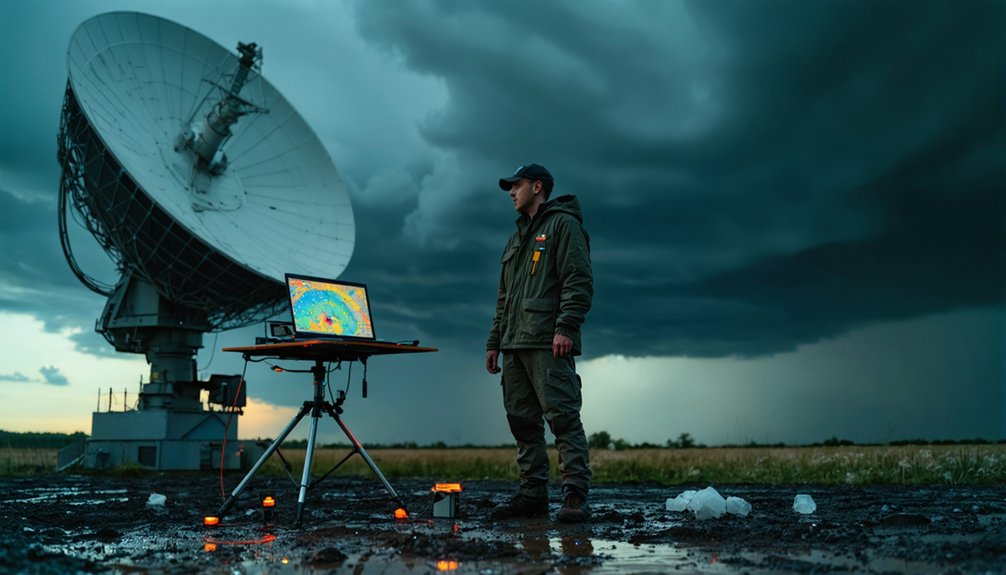
The data pouring in from ICECHIP, HailSondes, and high-speed camera systems isn’t just filling research gaps—it’s directly recalibrating how forecasters model hail formation and intensity.
You’re seeing data integration across 15 universities transform model accuracy in real time.
Sensor technology now captures three-dimensional hailstone velocity, trajectory, and growth conditions inside live mesocyclones—variables that previous models estimated poorly.
Research collaboration between NOAA, NSF, and international partners accelerates storm evolution analysis at unprecedented resolution.
These inputs directly address longstanding forecast challenges, particularly around hail size prediction.
Hail prediction algorithms trained on this granular field data outperform legacy radar-based methods.
Meanwhile, climate impact modeling incorporates AI-driven trend analysis, giving you forecasting frameworks that account for industrialization-linked hailstorm surges confirmed across multi-decadal observational records.
How New Hail Technology Is Sharpening Forecast Accuracy
Bridging raw field data with operational forecasting, new hail technologies are closing gaps that radar alone couldn’t resolve.
You’re now working with instruments that feed precise, actionable metrics directly into hail prediction techniques.
Key advances sharpening forecast accuracy include:
- HailSondes capturing internal mesocyclone conditions at seven kilometers altitude, revealing hailstone growth trajectories radar misses
- 4K high-speed cameras recording 330 frames per second, calculating three-dimensional hailstone velocity for sharper impact modeling
- Omni-directional disdrometers measuring hail impact angles via 6-axis force transducers, strengthening storm damage assessment accuracy
These tools don’t just collect data—they transform it into refined simulations.
With $10 billion in annual U.S. hail losses, tightening forecast precision isn’t optional. It’s the operational standard you need driving every storm response decision.
Frequently Asked Questions
How Much Does Deploying a Hailsondes Probe System Typically Cost Researchers?
The provided knowledge doesn’t specify deployment costs. You’ll need to research budget considerations and funding sources independently, exploring grants, institutional support, and NSF-backed programs like ICECHIP, which actively funds hail research initiatives you can leverage.
Can Hail Camera Systems Operate Effectively During Nighttime Storm Conditions?
Yes, you can rely on hail camera systems during nighttime storm conditions. Their LED lights, 30% brighter than the sun, maximize nighttime visibility and camera sensitivity, ensuring sharp 4K footage at 330 frames per second.
Which Universities Are Specifically Involved in the ICECHIP Field Campaign Partnership?
The ICECHIP collaboration doesn’t name specific institutions, but you’ll find 15 universities actively driving university partnerships across the Front Range and Central Plains, alongside international partners, deploying cutting-edge instruments to advance hail research freely.
How Long Does 3D Laser Scanning of a Single Hailstone Take?
The provided knowledge doesn’t specify how long 3D laser scanning of a single hailstone takes. You’ll find that this hailstone analysis scanning technology creates detailed digital models, but the exact duration isn’t captured here.
Are Disdrometer Networks Permanently Installed or Relocated Between Storm Seasons?
You’d deploy disdrometer installation as a flexible, relocatable network—not permanent fixtures. Researchers actively move these instruments between storm seasons, enabling seasonal relocation across hailswath regions to capture five quality cases, maximizing your data collection freedom and precision.
References
- https://inside.nssl.noaa.gov/nsslnews/2025/06/revolutionizing-hail-forecasts-one-falling-stone-at-a-time/
- https://interestingengineering.com/innovation/tiny-sensors-hailsondes-can-be-unleashed-into-a-hailstorm
- https://www.preventionweb.net/news/movie-inspired-technology-successfully-collects-hail-data-eye-storm
- https://icechip.niu.edu
- https://ibhs.org/hail/hailstones/
- https://phys.org/news/2025-11-historical-uncover-climate-impacts-future.html
- https://www.roofingcontractor.com/articles/100920-understanding-hail-project-icechip-is-finally-measuring-it
- https://vocal.media/education/shielding-the-skies-innovative-approaches-to-hail-suppression
- https://eos.org/articles/ct-scans-show-how-giant-hailstones-grow