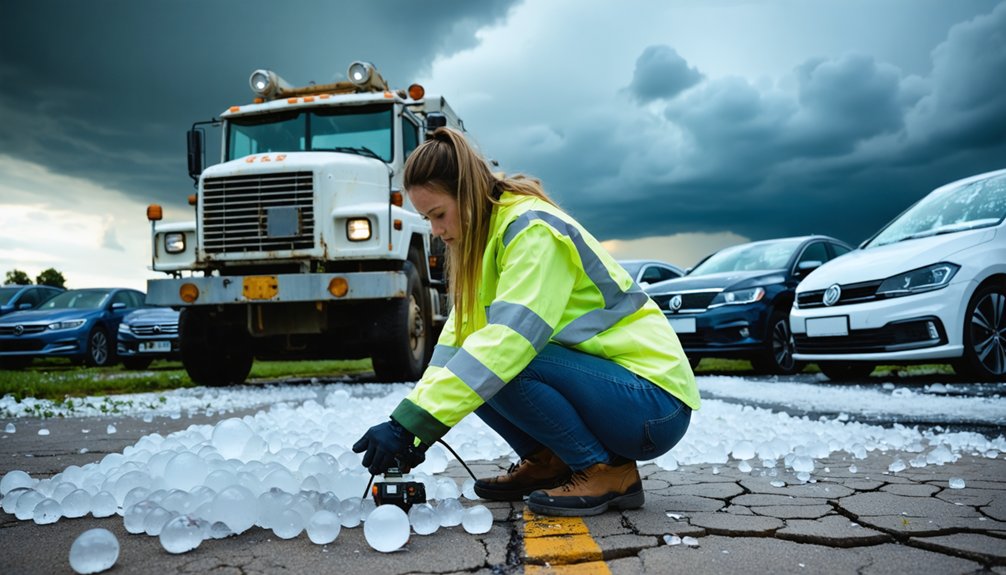
To improve hailstorm research accuracy, you’ll need to address three critical areas. First, close the radar-to-ground validation gap using distributed sensor networks across urban and rural environments. Second, apply 3D scanning and holographic imaging to capture precise hailstone morphology and internal growth structures. Third, integrate multi-source datasets—including balloon-borne videosondes and ground-truth measurements—to build vertically coherent storm profiles. Each technique sharpens your predictive models, and the details behind each method reveal just how transformative this approach can be.
Key Takeaways
- Ground validation techniques, like HailNet’s monitoring stations, bridge the critical gap between radar detection and actual ground-level hail impact data.
- Integrating balloon-borne videosondes with ground sensors creates vertically coherent storm data, significantly improving hailstorm forecasting accuracy.
- 3D scanning and holographic imaging of hailstones provide precise morphological data, replacing oversimplified geometric approximations in predictive models.
- Combining datasets from multiple organizations over long periods, like HailNet’s 7-year collection, sharpens forecast model reliability.
- Localized damage pattern analysis from distributed urban, semi-rural, and rural sensors enhances risk assessment and storm understanding.
Why Hail Is So Hard to Track From Radar to Ground
Radar excels at detecting hailstorms at altitude, but what it captures high in a storm cell doesn’t always match what strikes the ground.
You’re dealing with a critical gap: radar limitations mean the system reads hail characteristics several kilometers up, while melting, wind drift, and trajectory shifts alter size and density before impact.
Radar reads hail kilometers above ground — but melting, wind, and drift rewrite the story before impact.
Ground validation bridges this disconnect, but it’s technically demanding. HailNet’s monitoring stations across South East Queensland address this directly, distributing sensors across urban, semi-rural, and rural environments to systematically record what actually lands.
Balloon-borne videosondes photograph precipitation mid-atmosphere, adding vertical-layer data that ground instruments can’t capture alone.
Without integrating both datasets, your models remain incomplete, producing forecasts that overestimate or underestimate real hailstone impact severity at surface level.
How Researchers Use 3D Scanning to Decode Hailstone Formation
Beyond what radar and ground sensors reveal, understanding hailstone formation requires examining the stones themselves. Researchers now apply 3D scanning technology to hailstone specimens, generating precise datasets that capture real-world hailstone morphology rather than relying on theoretical assumptions.
You can think of this process as forensic analysis: scientists physically slice hailstones in half, exposing internal layering that documents each growth stage. Combined with holographic imaging techniques, these methods produce detailed structural profiles across hundreds of samples.
The University of Queensland maintains physical specimens as reference materials, while collaborative work with Penn State standardizes documentation methodologies.
With 217 hail samples already processed, researchers integrate this morphological data directly into weather models, replacing simplified geometric approximations with accurate structural representations that measurably improve forecast precision.
How Multi-Layer Hailstorm Networks Close the Measurement Gap
Understanding hailstone structure at the sample level only solves part of the problem. Radar detects hail aloft, but that data doesn’t automatically translate to what’s hitting your infrastructure below. That gap costs you accuracy.
HailNet addresses this directly. Its 10 monitoring stations across South East Queensland span urban, semi-rural, and rural environments, capturing hail size, duration, and localized damage patterns over a 7-year window.
You get ground-truth measurement techniques that validate what radar observes at altitude.
Data integration then bridges both layers. The University of Queensland, Bureau of Meteorology, and Queensland Farmers’ Federation combine their datasets, giving researchers a vertically coherent picture of each storm event.
You’re no longer working from incomplete atmospheric snapshots—you’re working from synchronized, multi-source evidence that sharpens predictive models considerably.
Frequently Asked Questions
How Does Machine Learning Predict Which Storms Will Produce Damaging Hailstones?
You’ll find that machine learning analyzes tens of thousands of hail trajectories, focusing on storm modeling through internal storm structure rather than atmospheric conditions alone, enabling precise hail prediction of which storms generate damaging hailstones.
What Three Ingredients Are Essential for Hailstone Formation Inside Storms?
You’ll need three critical ingredients for hailstone formation: an adequate updraft, supercooled water availability, and ice nucleation particles. Understanding these storm dynamics empowers you to independently analyze why certain environments produce devastating hailstones.
How Does Climate Change Affect Hailstorm Frequency, Intensity, and Hailstone Size?
“What goes up must come down.” Climate change’s shifting hailstorm patterns remain uncertain, but you’ll find climate models simulating how warming atmospheres potentially intensify hailstone size while redistributing frequency across vulnerable regions unpredictably.
What Is the ICECHIP Project and Where Does It Conduct Research?
You’ll find ICECHIP’s methodology deploys aircraft, radars, and instruments for detailed hailstorm observations. Its research locations target the Great Plains and Front Range of Rocky Mountains, capturing extensive hailstone formation and characteristic data.
How Do Balloon-Borne Videosondes Contribute to Hailstorm Precipitation Research?
Balloon technology lets you photograph precipitation patterns directly within storm systems. Videosondes capture precipitation particles in lighted viewing chambers, validating ground-level observations and bridging critical data gaps between radar-detected hail and actual surface impacts.
References
- https://phys.org/news/2024-08-hailstone-library-extreme-weather.html
- https://www.nssl.noaa.gov/education/svrwx101/hail/forecasting/
- https://www.longdom.org/open-access-pdfs/understanding-patterns-and-trends-of-hailstorm-analysis.pdf
- https://news.uq.edu.au/2025-12-hailstorm-forecasting-set-improve-new-data-gathering-project
- https://news.ucar.edu/132863/hail-experts-highlight-progress-understanding-damaging-storms
- https://www.frontiersin.org/journals/environmental-science/articles/10.3389/fenvs.2025.1699216/full
- https://www.youtube.com/watch?v=PN2gwvje6jk
- https://www.youtube.com/watch?v=eQkx6yaK0Lo