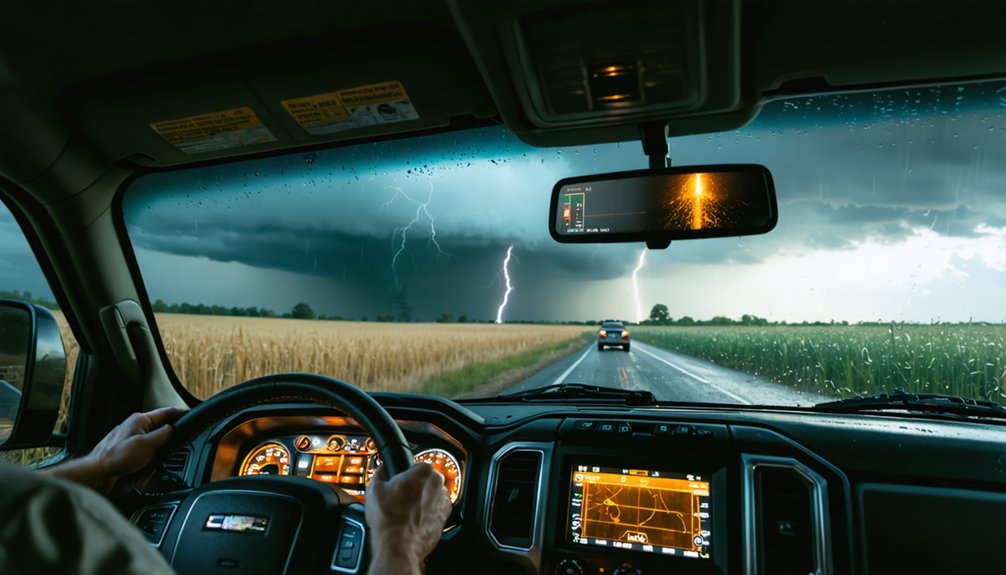
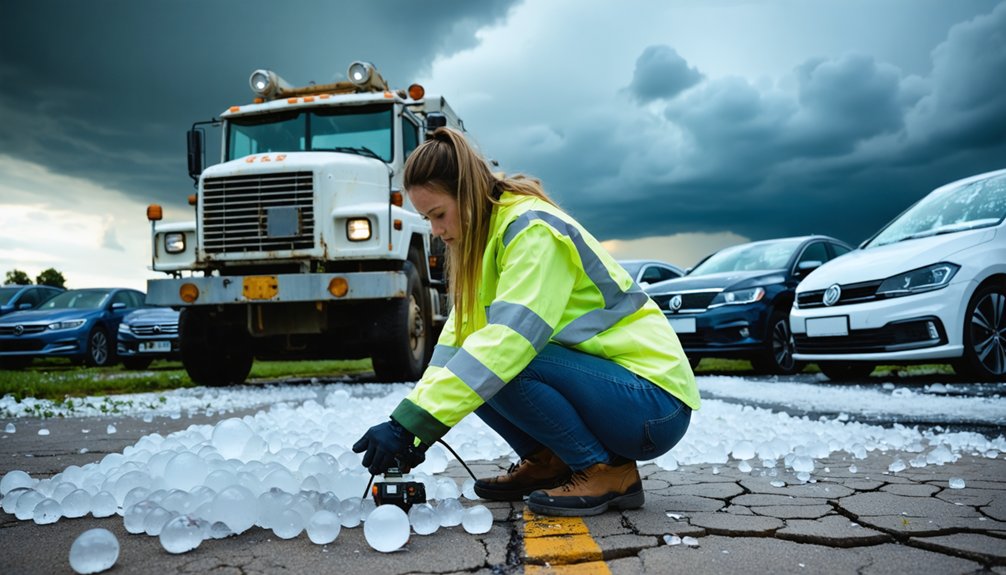
When you track hailstorms for climate research, you’re fighting a $10 billion annual damage problem. Scientists deploy mobile Doppler radar, hailsondes, and impact sensors directly inside storm cells to measure hailstone growth, velocity, and density in real time. Climate change is making this work more urgent — stronger updrafts are producing larger, more destructive hailstones. The ICECHIP campaign collected over 10,000 hailstones across 42 days, and what researchers discovered is reshaping forecasting, infrastructure, and insurance entirely.
Key Takeaways
- The ICECHIP campaign deployed ~100 researchers over 42 days, collecting 10,000+ hailstones to advance forecasting models and reduce economic damages.
- Storm chasers use reinforced vehicles, mobile Doppler radar, weather balloons, and hailsondes to track hailstone growth and storm dynamics.
- Climate change strengthens updrafts, suspending hailstones longer and producing larger, denser stones that cause greater structural damage.
- Field data connects airborne hail formation processes to ground-level impact signatures, enabling earlier warnings and more accurate prediction models.
- Research findings inform sectoral adaptations, including hail-resistant construction materials, adjusted agricultural practices, and redesigned infrastructure like solar panels.
Why Hailstorms Are a $10 Billion Problem
Hailstorms strike the United States with a financial force that’s easy to underestimate: they cause roughly $10 billion in damages annually, targeting roofs, vehicles, and agricultural crops with little warning. That economic burden justifies serious investment in storm preparedness and hail mitigation strategies across vulnerable regions.
Fatalities remain rare, but the structural and agricultural losses accumulate fast, straining insurance systems and disrupting communities. Climate change compounds the risk — warmer atmospheres support stronger updrafts, potentially producing larger, more destructive hailstones over time.
You can’t effectively reduce these losses without first understanding what drives them. Better forecasting gives you the lead time to protect property, adjust agricultural operations, and strengthen infrastructure decisions.
The science isn’t abstract — it directly determines how well individuals, industries, and institutions defend themselves against a measurable, recurring threat.
Inside ICECHIP: The Biggest Hail Study in 40 Years
When’s the last time a single field campaign mobilized roughly 100 researchers, 60 scientists, and an $11 million NSF-backed budget to chase storms across the Great Plains? That’s exactly what ICECHIP delivered — the largest hail research effort in 40 years.
Spanning Texas to North Dakota, the project gave you direct access to storm microphysics data that satellites and ground reports simply can’t capture.
Over 42 days, teams collected more than 10,000 hailstones, including one measuring 149 millimeters in diameter.
NIU alone received $3.2 million to advance hailstone morphology analysis and connect airborne storm processes to surface-level damage patterns.
ICECHIP isn’t just data collection — it’s a precision-driven push to overhaul hail forecasting models and reduce the $10 billion annual economic toll hailstorms inflict.
What Storm Chasers Actually Do in the Field
When you’re out in the field with an ICECHIP team, you’re operating from reinforced vehicles built to withstand direct hail strikes while housing mobile Doppler radar systems that capture close-range storm structure data.
You’ll launch weather balloons to profile atmospheric conditions, deploy hail pads and impact sensors to measure stone size and force, and release hailsondes directly into storm cells to track hailstone growth, melting, and wind influence in real time.
Every instrument you’re running targets a specific data gap, connecting airborne storm processes to measurable ground-level hail impacts.
Tools and Equipment Used
To study hailstorms from the inside out, ICECHIP researchers deploy an arsenal of specialized tools across the Great Plains. You’ll find reinforced vehicles built to withstand direct hail strikes, mobile Doppler radar units capturing real-time storm dynamics, and weather balloons measuring atmospheric conditions that drive hail formation.
Teams also launch hailsondes directly into active storms, tracking hailstone growth, melting, and freezing cycles from within the storm shaft. Drones, hail pads, and impact sensors round out the instrumentation suite, measuring hailstone size, velocity, and ground-level impact force.
Each instrument targets a specific variable, giving scientists a precise, layered picture of what’s happening inside a supercell. Together, these tools transform raw storm data into actionable forecasting models that improve hail prediction accuracy and ultimately reduce economic losses.
Data Collection Methods
Having the right tools is only half the mission — knowing how to deploy them under rapidly changing storm conditions is where field methodology becomes the real science.
You’re coordinating balloon launches to profile atmospheric instability, positioning mobile Doppler radar to capture real-time storm dynamics, and releasing hailsondes directly into active cells to track hailstone morphology through growth, freezing, and melting cycles.
Timing drives everything. You’re logging impact sensor readings, recovering hail pads, and documenting hailstone size, shape, and density immediately after collection to prevent melt distortion.
Each data point connects airborne storm processes to surface-level damage patterns. You’re not passively observing — you’re executing a synchronized, multi-instrument protocol where every decision directly shapes the quality of what the models ultimately receive.
The Instruments Scientists Use to Measure Hail Mid-Storm
Capturing hail data mid-storm requires a layered toolkit that no single instrument can replace. You’re working with systems built for precision under extreme conditions, where sensor calibration directly determines the reliability of your data analysis.
Precision instruments. Calibrated sensors. Because mid-storm hail data is only as reliable as the systems collecting it.
Core instruments deployed mid-storm include:
- Hailsondes – released into active storms to track hailstone growth, melting, and wind interaction in real time
- Impact sensors – measure strike force and frequency to quantify ground-level damage potential
- Hail pads – record size and density of hailstone impacts across a defined surface area
- Mobile Doppler radar – maps internal storm structure from close range, linking updraft behavior to hail formation zones
Each instrument captures a distinct data layer. Together, they let you connect what’s happening inside the storm shaft to what’s hitting the ground.
What Scientists Are Learning About Hail Formation and Storm Damage
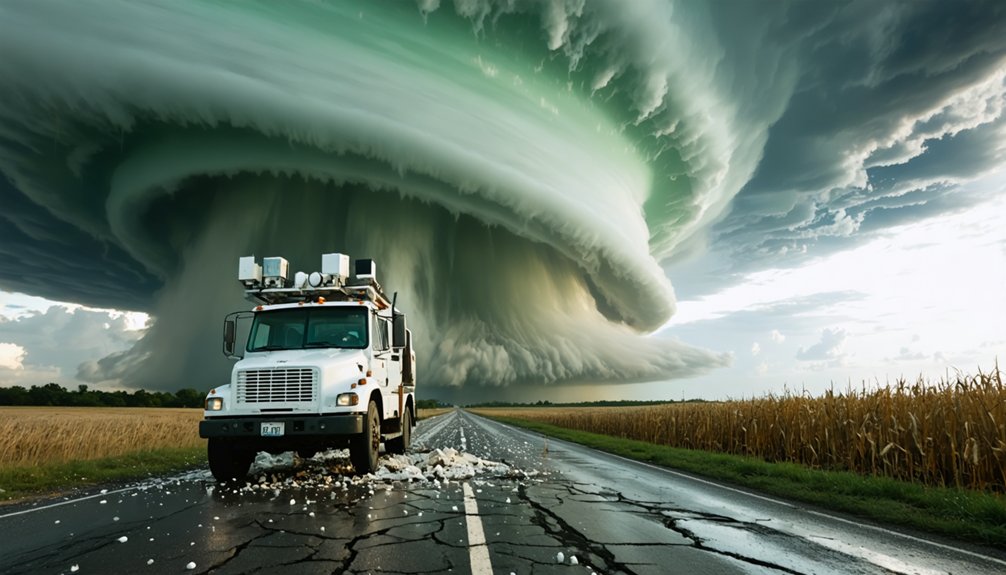
With instruments now feeding data from inside active storms, researchers are piecing together how updraft strength, hailstone composition, and storm shaft dynamics combine to drive surface damage.
You can think of hailstone formation as a feedback loop — stronger updrafts suspend stones longer, allowing more ice layering and greater mass. That added mass directly amplifies storm damage on impact.
ICECHIP data shows that peak hail intensity concentrates within the storm shaft, meaning damage patterns aren’t random — they’re structurally predictable.
Scientists are now connecting airborne formation processes to ground-level impact signatures, giving forecasters sharper tools to predict not just whether hail will fall, but how large and how destructive it’ll be.
That precision translates directly into earlier warnings and measurable reductions in economic loss.
Why Warmer Skies Are Producing Bigger, More Destructive Hailstones
As the atmosphere warms, you’re looking at stronger updrafts capable of suspending hailstones longer inside storm cells, allowing more ice to accumulate before stones fall.
That added growth time directly connects warmer air to larger, heavier hailstones with greater damage potential.
Climate change isn’t just shifting storm patterns—it’s altering the physical mechanics inside storms in ways that amplify the destruction hail delivers to roofs, crops, and vehicles.
Warmer Air, Stronger Updrafts
Climate change is reshaping hailstorm dynamics in ways researchers can now measure directly. Warmer air holds more energy, fueling stronger updrafts that carry hailstones higher and longer, allowing them to grow larger before falling. These meteorological anomalies are shifting storm patterns across the Great Plains in measurable ways.
Here’s what warmer atmospheres are producing:
- Stronger updrafts that suspend hailstones longer inside storm cells
- Larger hailstones exceeding 149 millimeters in diameter
- More destructive impact forces hitting roofs, vehicles, and crops
- Shifting storm patterns that expand hail risk zones northward
You’re looking at a direct physical chain: rising temperatures drive stronger convection, stronger updrafts grow bigger hail, and bigger hail multiplies economic damage well beyond the current $10 billion annual threshold.
Hailstone Growth Explained
Understanding how hailstones grow inside a storm cell explains why warmer skies are producing increasingly destructive hail.
A hailstone’s composition reveals its growth history — alternating layers of clear and opaque ice form as the stone cycles through wet and dry growth zones within the updraft.
Storm environmental factors, particularly atmospheric moisture and temperature gradients, determine how many times a stone recirculates before falling.
Warmer air holds more moisture, feeding stronger updrafts that suspend hailstones longer, allowing them to accumulate mass.
ICECHIP researchers confirmed this process by collecting over 10,000 hailstones, including one measuring 149 millimeters in diameter.
You can see the direct link: as baseline temperatures rise, storm environments increasingly support the conditions that manufacture larger, more damaging hailstones with greater frequency.
Climate’s Role In Damage
Larger hailstones don’t just fall from stronger storms by coincidence — they’re the direct output of a warming atmosphere that’s systematically reconfiguring storm structural dynamics. Warmer air fuels stronger updrafts, keeping hailstones suspended longer and allowing hailstone chemistry to shift toward denser, more destructive compositions.
Here’s what that means practically:
- Bigger updrafts = longer suspension time = larger hailstones reaching the ground
- Altered hailstone chemistry produces harder, denser ice structures that transfer more impact energy
- $10 billion in annual U.S. damages reflects current conditions — warming accelerates that trajectory
- Manitoba’s 40,000+ insurance claims demonstrate how hail damage scales across entire regions
You’re living under skies that are actively changing storm mechanics, making better forecasting tools not optional — they’re essential infrastructure.
Why Better Hail Forecasting Can Cut Billions in Annual Losses
When hail strikes without warning, the financial toll adds up fast—roughly $10 billion in annual damages across the U.S. alone, hitting roofs, vehicles, and crops hardest.
Historical patterns show these losses aren’t random; they cluster around predictable storm corridors where improved forecasting delivers the greatest protective value.
Better hail prediction gives you, your community, and emergency preparedness systems the lead time needed to act—securing vehicles, alerting farmers, and mobilizing response teams before impact.
Manitoba alone logged over 40,000 hail-related insurance claims, demonstrating how forecast accuracy directly affects financial outcomes.
ICECHIP’s direct storm observations are strengthening radar-based detection models, enabling more precise predictions of when, where, and how large hail will fall—cutting unnecessary losses before the first stone hits the ground.
How Hail Research Is Changing Buildings, Crops, and Insurance
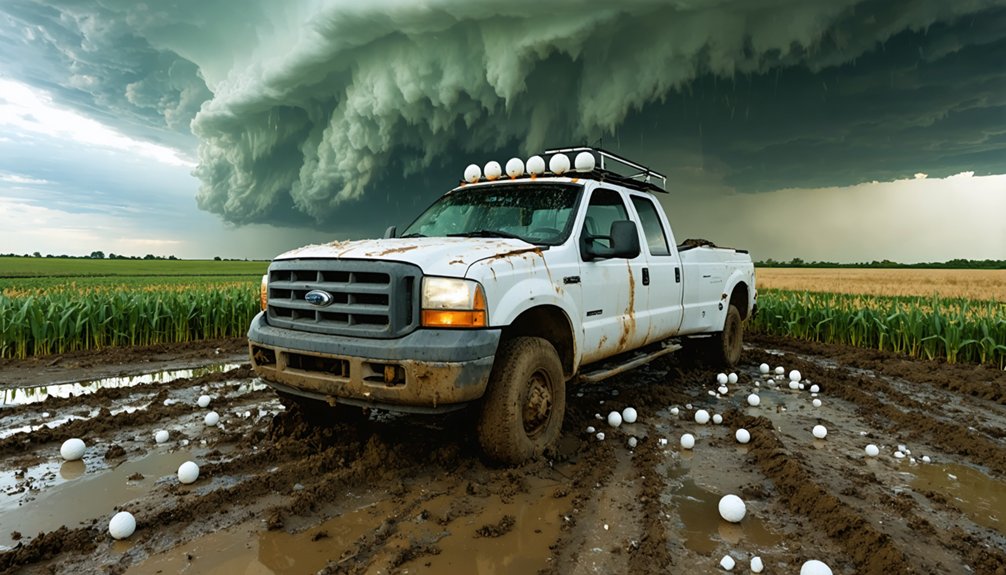
Forecast accuracy alone doesn’t close the loop on hail losses—what you build, grow, and insure has to adapt alongside the science. ICECHIP’s storm impact data is already reshaping decisions across multiple sectors. When researchers connect hailstone size, velocity, and density to real-world damage, industries can respond with precision.
- Construction: hail resistant materials get tested against documented stone sizes, not assumptions
- Agriculture: planting schedules and crop covers adjust based on refined regional hail probability models
- Insurance: Manitoba’s 40,000+ claims signal why actuaries need better storm frequency and severity data
- Infrastructure: roads, vehicles, and solar panels get redesigned using direct impact measurements
You’re not waiting on theory—you’re getting field-validated numbers that drive smarter engineering, tighter coverage models, and stronger harvests.
Frequently Asked Questions
How Do Storm Chasers Stay Safe While Chasing Dangerous Hailstorms?
You’ll rely on reinforced vehicles and mobile Doppler radar for storm safety and hazard mitigation. These tools let you monitor hail trajectories precisely, maintaining safe distances while collecting critical, data-driven storm measurements during active hailstorm pursuits.
Can Members of the Public Volunteer or Participate in Hail Research?
You can explore volunteer opportunities and public participation in hail research by submitting hailstone reports, deploying hail pads, or joining citizen science networks that feed observational data directly into forecasting models like ICECHIP’s research framework.
How Long Does a Typical Storm Chasing Shift or Deployment Last?
You’d typically spend six weeks on a full deployment. Storm chasing logistics demand sustained commitment, with 42-day campaigns recorded in ICECHIP. You’re actively refining hailstorm prediction through continuous, data-driven pursuits across the Great Plains each shift.
Have Any ICECHIP Researchers Been Injured During Field Campaigns?
The available data doesn’t confirm any ICECHIP researcher risks resulting in injuries. You’ll find that field safety protocols guide every deployment, keeping teams protected while they chase violent storms and collect critical hailstone data across the Great Plains.
What Happens to the Hailstones After They Are Collected and Measured?
After collection, you’d send hailstones through rigorous post-collection analysis, examining hailstone composition to decode growth patterns and layering. Researchers actively extract data on freezing cycles, size distribution, and structural properties to refine predictive models and sharpen future forecasting accuracy.
References
- https://www.youtube.com/watch?v=DIu3ADKpwJc
- https://www.nbcnews.com/science/climate-change/hail-chasers-rcna219122
- https://www.yahoo.com/news/niu-storm-chasers-researcher-team-041407547.html
- https://www.independent.co.uk/news/world/americas/us-hailstorms-damage-study-texas-b2768939.html
- https://en.wikipedia.org/wiki/Storm_chasing
- https://www.youtube.com/watch?v=u_Ci6-t249o
- https://apnews.com/article/storm-chasers-hailstorms-severe-weather-climate-change-da4a31e572da571afdd57fea8a6a62ba
- https://www.youtube.com/watch?v=UCHaO-MJ3uY
- https://apnews.com/article/hailstorm-chaser-damage-severe-weather-tornado-4f9b0cf8dd088508ca2ddf40d01b6519