Storm chasing in the 1970s wasn’t the high-tech pursuit you see today. You can trace it back to a few determined scientists armed with film cameras, surface weather maps, and raw instinct. Pioneers like David Hoadley laid the groundwork, while the University of Oklahoma and NSSL formalized the discipline. The landmark 1973 Union City tornado intercept changed everything, validating chasing as a true science. Stick around, and you’ll uncover exactly how those early days shaped the modern storm chasing world.
Key Takeaways
- The 1972 Tornado Intercept Project, launched by the University of Oklahoma and NSSL, marked a turning point in organized, scientific storm chasing.
- In 1973, chasers documented the Union City tornado from birth to dissipation, validating storm chasing as a legitimate scientific discipline.
- Early chasers relied on surface data, atmospheric soundings, and primitive models to select targets and track storms.
- The Union City findings directly contributed to the global deployment of Doppler radar, dramatically improving tornado warning lead times.
- Pioneers like David Hoadley and Roger Jensen established methodical, curiosity-driven approaches that laid the foundation for modern storm chasing practices.
Who Were the First Storm Chasers of the 1970s?
While storm chasing is now a recognized scientific pursuit, it grew from the efforts of a few determined individuals who took to the Plains long before it had a name. David Hoadley began chasing in North Dakota in 1956, and Roger Jensen worked alongside him as one of the earliest pioneers.
Neil B. Ward advanced scientific research chasing in the 1950s and 1960s, enlisting the Oklahoma Highway Patrol before his death in 1972. Forget the urban legends — myth busting reveals these weren’t reckless daredevils but methodical observers driven by curiosity and purpose.
How Government Labs and Universities Got Involved in Storm Chasing
As individual chasers were logging miles across the Plains, government agencies and universities were recognizing that systematic data collection required more than one person and a camera. In 1972, the University of Oklahoma and the National Severe Storms Laboratory launched the Tornado Intercept Project, sending instrumented vehicles into the field guided by radar controllers communicating via radio.
Their first major breakthrough came in 1973, when they intercepted the Union City, Oklahoma tornado from birth to dissipation. That single event transformed weather prediction permanently, directly driving the global installation of Doppler radar and extending tornado warning lead times considerably.
The data collected also advanced storm safety protocols that protect communities to this day. You can trace modern severe weather infrastructure directly back to that coordinated institutional effort.
The Tools and Tactics That Made Early Storm Chasing Possible
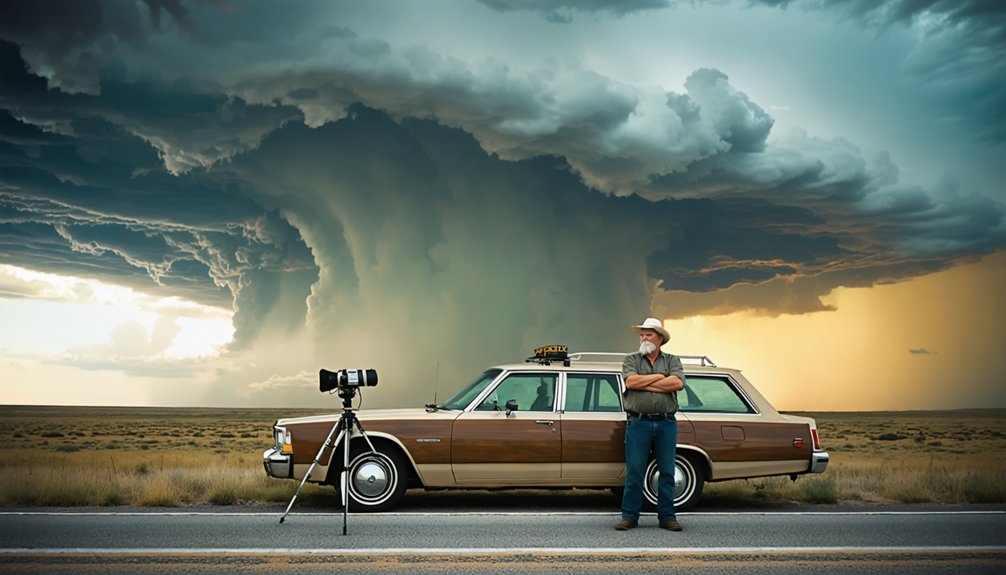
Before GPS, Doppler radar, or smartphone apps, early storm chasers relied on morning surface data, atmospheric soundings, and primitive model output to identify promising targets at the start of each day. You’d commit to a target early, drive hard, and trust your instincts once visual cues took over.
Innovative equipment like film cameras and mass-produced video recorders transformed raw encounters into scientific documentation. Community networking, accelerated by *Storm Track* newsletter, let chasers refine shared visual storm models season after season.
Key tactical pillars that defined the era:
- Arriving ahead of storm formation using sounding data
- Capturing tornadoes on film to build repeatable methodology
- Coordinating intercepts via radio communication with radar-site controllers
These weren’t just tools — they were the foundation of a discipline built on freedom, discipline, and determination.
The 1973 Union City Tornado and What It Proved
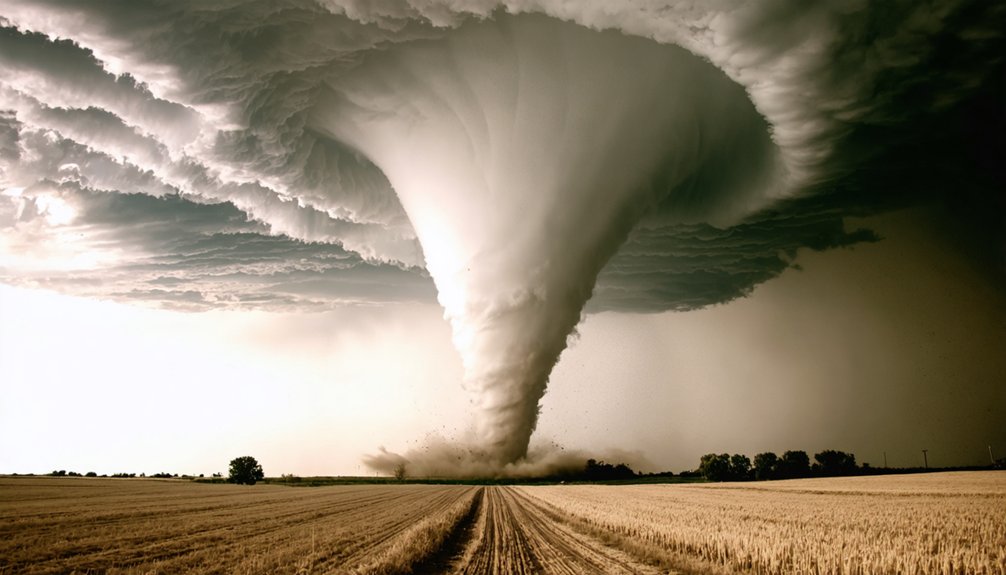
Those tools and tactics came together in a defining moment on May 24, 1973, when the Tornado Intercept Project caught lightning in a bottle near Union City, Oklahoma. You’re witnessing history here — researchers tracked an F4 tornado from birth to dissipation, achieving the first complete tornado documentation of its kind.
Their storm chasing techniques, refined through years of field work, finally delivered what science desperately needed: hard data on supercell and tornado morphology. That single intercept validated the entire enterprise.
The Union City findings drove the global installation of Doppler radar networks, dramatically extending warning lead times and saving countless lives. Two lives were lost that day, but the research bought time for generations afterward.
Storm chasing had proven its worth beyond any reasonable doubt.
How the 1970s Laid the Foundation for Modern Storm Chasing
What the 1970s built wasn’t just a methodology — it was an entire foundation that modern storm chasing still stands on. Meteorological innovations like Doppler radar deployment and instrumented intercept vehicles transformed guesswork into science.
Community development followed through *Storm Track*, giving independent chasers a shared identity and purpose.
You’re standing on the shoulders of pioneers who’d no GPS, no smartphones, and no guarantee of survival — just raw commitment to understanding violent weather.
Here’s what the decade locked in permanently:
- Standardized intercept methodology using morning surface data and soundings
- Institutional credibility established through NSSL-backed field research
- A unified chaser community driven by collaboration, not competition
The 1970s didn’t just document tornadoes — they built the entire framework you now operate within.
Frequently Asked Questions
Was Storm Chasing Legal in the United States During the 1970S?
Yes, you could legally chase storms in the 1970s U.S., provided you followed traffic laws and didn’t block emergency roads. Capturing historical storm footage was your right, though chasing safety remained your personal responsibility.
What Training Did Skywarn Storm Spotters Receive in the 1970S?
Just two hours — that’s all it took! As a Skywarn volunteer, you’d complete meteorological training to spot dangerous storms. This volunteer coordination empowered free-spirited citizens like you to actively report severe weather directly to the National Weather Service.
When Did Storm Chasing First Appear on National Television?
You’d trace storm chasing’s national television debut to 1978, when *In Search of…* captivated audiences, reflecting meteorological advancements and weather forecasting innovations that empowered you to witness nature’s raw, untamed power broadcast freely nationwide.
How Did *Storm Track* Magazine Help Unify the Chasing Community?
Like a beacon in the night, *Storm Track* pulled you into a tight-knit world of community camaraderie, where you’d share storm chasing technology, coordinate efforts, and finally feel connected to fellow chasers who craved the same open-road freedom.
Did Computers Play a Role in Enabling 1970S Storm Chasing?
Yes, computer advancements from the 1960s sharpened forecast reliability, giving you the freedom to chase with confidence. That improved accuracy, combined with advancing radar technology, directly enabled storm chasing’s explosive growth throughout the thrilling, groundbreaking 1970s.
References
- https://en.wikipedia.org/wiki/Storm_chasing
- https://www.rmets.org/metmatters/history-storm-chasing
- https://www.ustornadoes.com/2013/02/25/the-early-days-of-storm-chasing-video/
- https://journals.ametsoc.org/view/journals/wefo/14/4/1520-0434_1999_014_0558_ahossi_2_0_co_2.xml
- https://www.weathergraphics.com/chasing/0970684088_ebook_sample_body.pdf
- https://www.youtube.com/watch?v=NQDfS3DMCHc
- https://www.youtube.com/watch?v=uRQ-nTTCazo
- https://www.bbc.com/news/world-us-canada-47720417