Standard insurance policies exclude storm chasing because insurers classify it as a high-risk hazardous activity. You’ll need specialized coverage that includes hazardous sports liability ($500–$2,000 annually), all-encompassing vehicle protection ($1,200–$3,500 annually), and dedicated gear coverage ($200–$800 annually). Your liability insurance must cover third-party bodily injury, property damage, and legal defense costs. Providers like Markel Insurance and Global Underwriters specialize in this space. Everything you need to build a thorough protection strategy is ahead.
Key Takeaways
- Standard insurance policies exclude storm chasing, requiring specialized hazardous activity coverage to address medical, equipment, vehicle, and evacuation-related financial risks.
- Essential vehicle coverage includes liability, comprehensive, and collision insurance, protecting against weather damage, debris impacts, and third-party bodily injury claims.
- Hazardous activity liability insurance costs $500–$2,000 annually, while vehicle and gear coverage adds $1,200–$3,500 and $200–$800 respectively.
- Liability insurance must cover third-party claims, property damage, and legal defense costs arising from storm chasing operational errors or accidents.
- Selecting insurers experienced in high-risk activities, like Markel Insurance, and building layered coverage ensures all storm chasing exposures are adequately protected.
Why Standard Insurance Policies Exclude Storm Chasing
Standard insurance policies exclude storm chasing because insurers classify it as an inherently risky activity that falls outside the scope of everyday coverage. When underwriters conduct risk assessment, they evaluate probability and severity of loss. Storm chasing registers as unacceptably high on both measures, triggering automatic insurance exclusions in standard plans.
You’re fundamentally operating in environments where vehicle damage, medical emergencies, and equipment loss aren’t anomalies — they’re expected outcomes. Insurers won’t absorb that exposure under conventional terms. Your standard auto, health, or homeowner’s policy contains explicit language rejecting claims tied to voluntary participation in hazardous activities.
Understanding these exclusions isn’t optional — it’s foundational. If you chase without specialized coverage, you carry 100% of the financial risk yourself, with no contractual safety net.
What Hazardous Sports Travel Insurance Covers
When standard coverage fails you, hazardous sports travel insurance steps in as the financial mechanism specifically engineered for high-risk environments like storm chasing. It targets the specific risks you’ll face in the field — medical bills from storm surge encounters, equipment destruction, and emergency evacuation costs.
This coverage addresses what conventional policies deliberately exclude. You’re protected against accidental gear damage, theft, and replacement costs for specialized equipment critical to tornado safety operations. Medical expenses from field injuries won’t drain your resources when proper coverage is active.
Beyond personal protection, hazardous sports travel insurance covers vehicle incidents tied directly to weather exposure — the exact scenarios standard auto policies reject. You’re fundamentally buying operational freedom: the ability to chase without financial catastrophe dictating your risk tolerance in the field.
Three Vehicle Coverage Types Every Storm Chaser Needs
When you’re operating a chase vehicle, you’ll need three core coverage types to manage your exposure: liability, all-encompassing, and collision.
Liability coverage protects you against bodily injury claims, property damage costs, medical expenses, and legal fees if you cause an incident during a chase.
All-encompassing coverage addresses non-collision losses—weather damage, theft, and vandalism—while collision coverage absorbs repair or replacement costs when your vehicle makes direct contact with another object.
Liability Coverage Explained
Storm chasing puts you, your vehicle, and bystanders at significant financial risk, making proper vehicle coverage non-negotiable. Liability coverage specifically addresses bodily injury, property damage, medical expenses, and legal fees arising from incidents during a chase. If your vehicle strikes another car or injures a bystander, liability coverage absorbs those costs rather than your personal finances.
Think of liability insurance the way you’d approach contractor licensing and insurance verification — it’s a non-negotiable baseline that protects everyone involved. Without it, you’re personally exposed to lawsuits and catastrophic out-of-pocket expenses.
Standard auto policies often exclude high-risk activities, so you’ll need specialized coverage explicitly designed for storm chasing environments. Verify your policy’s language carefully, confirm exclusions, and guarantee your liability limits reflect the elevated risks you’re actively taking on.
Comprehensive Weather Protection
Beyond liability coverage, how you structure your remaining vehicle protection determines whether a single storm chase wipes out your equipment investment entirely. Two additional coverage types complete your protection framework: comprehensive and collision.
Extensive coverage handles non-collision losses — hail strikes, flying debris, flooding, theft, and vandalism. For storm safety, this isn’t optional. You’re deliberately driving into high-damage environments where weather incidents are statistically probable.
Collision coverage addresses impact-related damage when emergency preparedness fails and evasive maneuvers don’t work. Roads become unpredictable near active storm systems.
You should also confirm your policy covers vehicle customizations — chase-specific modifications like reinforced mounts and communication equipment often require separate endorsements. Standard policies exclude aftermarket components.
Structure each coverage layer intentionally, because gaps in one area compound losses across all three.
Collision Coverage Benefits
Collision coverage activates when your vehicle makes contact with another object — a guardrail during an emergency evasion, a ditch exit gone wrong, or debris-forced impact near an active system. Storm chasers operate under elevated collision risk because weather monitoring demands rapid repositioning, often on compromised rural roads.
You’re making split-second route decisions while tracking rotating systems, and that environment produces accidents that standard drivers rarely encounter. Emergency preparedness means securing collision coverage before you’re ever in that position.
This coverage handles repair or replacement costs regardless of fault, keeping your operation financially viable after an incident. Without it, a single impact event eliminates your ability to chase entirely.
Treat collision coverage as operational infrastructure, not optional protection.
How to Protect Your Gear Against Damage, Theft, and Loss
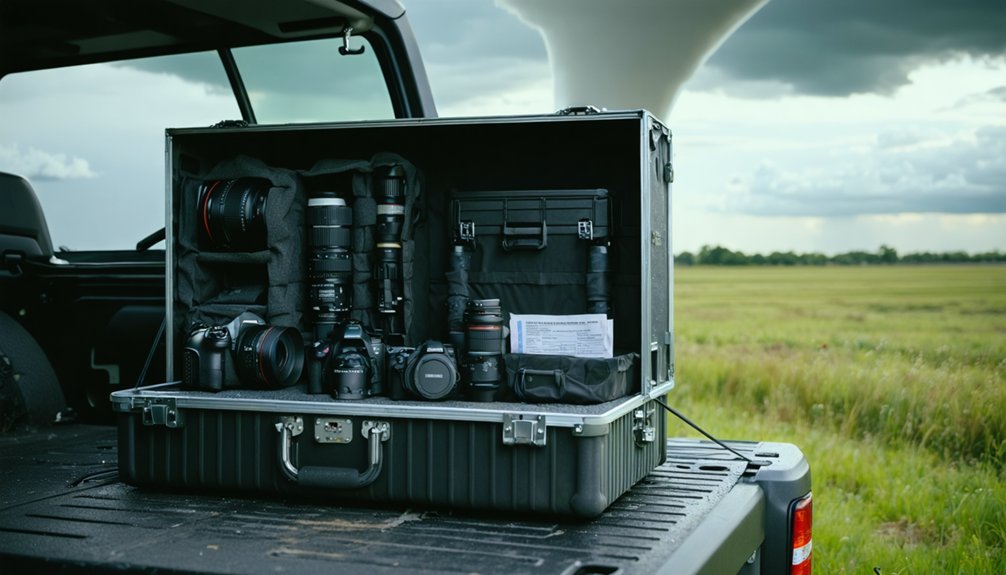
Your gear represents a significant financial investment, and without proper coverage, a single chase event can leave you absorbing thousands in replacement costs.
You’ll need a policy that specifically addresses theft and vandalism protection, since standard plans routinely exclude equipment stolen from vehicles or damaged by third parties in remote locations.
Accidental damage safeguards are equally critical, covering drops, electrical failures, and weather-related destruction that can render expensive instruments and cameras non-functional mid-chase.
Gear Replacement Coverage Options
Storm chasers rely on three core gear coverage options to protect against financial loss: replacement coverage, accidental damage protection, and theft safeguards. Each option addresses a distinct risk exposure you’ll encounter in the field.
Replacement coverage guarantees damaged or destroyed equipment gets restored to operational status without significant out-of-pocket costs. This matters especially for weather forecasting instruments, which carry high replacement values.
Accidental damage protection covers equipment failures resulting from drops, collisions, or sudden environmental impacts — risks inherent to active chase scenarios.
Theft safeguards protect your investment when gear disappears from vehicles or temporary staging areas. Don’t overlook drone maintenance costs either; drones used for aerial reconnaissance represent significant capital that standard policies frequently exclude.
Verify your policy explicitly covers each equipment category before committing to coverage.
Theft And Vandalism Protection
Beyond replacement and accidental damage coverage, theft and vandalism protection addresses a separate but equally significant risk vector — one that operates outside your direct control. When you’re deployed in remote areas tracking storm damage or repositioning based on weather forecasting data, your unattended vehicle becomes a target.
Standard auto policies rarely extend coverage to specialized chase equipment stored inside. You need explicit theft and vandalism riders that cover both the vehicle and its contents. Verify that your policy specifies itemized gear lists, since generic language often creates claim disputes.
Vandalism coverage should activate regardless of whether forced entry occurs. Document all equipment with serial numbers and photographs before each deployment. That documentation becomes your primary defense when filing claims after a loss event.
Accidental Damage Safeguards
Accidental damage safeguards address the most operationally frequent loss category storm chasers face — gear failure and environmental destruction that occurs during active deployment rather than theft or vandalism.
When you’re running equipment in volatile environments, debris impact, flooding, and even wildlife encounters can compromise sensors, cameras, and calibration instruments instantly. Your policy must explicitly cover accidental damage to field-deployed equipment, not just gear in transit or storage.
Pay close attention to equipment calibration costs — recalibrating precision instruments after impact events isn’t cheap, and many base policies exclude it entirely. Confirm your coverage includes replacement and repair for storm-specific scenarios.
Without this protection, a single deployment mishap can financially ground your operation indefinitely, eliminating the operational independence you’ve built your chasing setup to achieve.
What Liability Insurance Actually Covers During a Chase
When you’re actively chasing a storm, liability insurance functions as your primary financial shield against third-party claims arising from bodily injury, property damage, medical expenses, and legal fees.
Whether your weather forecasting miscalculates a storm’s trajectory or your storm tracking operation disrupts traffic, liability exposure is real and immediate.
Your coverage typically addresses three critical risk categories:
- Bodily injury claims from bystanders or other drivers affected by your chase activity
- Property damage liability covering structures, vehicles, or infrastructure you inadvertently impact
- Legal defense fees protecting you if a third party pursues litigation
Without proper liability coverage, a single incident can financially devastate your operation.
You’re operating in unpredictable environments where split-second decisions carry legal consequences, making this coverage non-negotiable for responsible chasers.
How Much Storm Chasing Insurance Typically Costs
Understanding what liability insurance covers sets the stage for the next practical question: what does it actually cost to put that coverage in place? Costs vary based on several risk factors insurers assess, including historical storm data from your chase region and the accuracy of available weather forecasting tools you rely on.
Expect hazardous activity liability premiums to range from $500 to $2,000 annually, depending on coverage limits and deductible thresholds.
Comprehensive vehicle protection adds another $1,200 to $3,500 per year for modified chase vehicles.
Gear coverage typically runs $200 to $800 annually.
Insurers price risk precisely, so high-frequency chase zones drive premiums up. You’ll secure better rates by documenting your safety protocols, training credentials, and equipment maintenance records before submitting your application.
Which Insurance Providers Offer Storm Chaser Coverage
Finding an insurer willing to cover storm chasing isn’t straightforward, since most standard carriers exclude high-risk meteorological activities from their core policies. Don’t fall for insurance myths suggesting your existing auto or travel policy provides adequate protection—it likely doesn’t.
Specialized providers worth researching include:
- Markel Insurance – offers hazardous activity and extreme sports coverage adaptable for storm chasers
- Global Underwriters – provides adventure travel policies covering medical emergencies and equipment loss
- Specialty surplus lines carriers – accessible through independent brokers who understand high-risk coverage structures
Coverage myths often mislead chasers into assuming exhaustive auto policies protect chase vehicles during active pursuits. They typically don’t.
You’ll need to work directly with brokers specializing in non-standard risks to build layered protection that actually holds up when conditions turn dangerous.
How to Choose the Right Coverage Level for Your Risk
Once you’ve identified providers capable of underwriting storm chaser risk, the next step is calibrating your coverage level against your actual exposure profile. Start with a structured risk assessment—evaluate chase frequency, geographic zones, vehicle modifications, and equipment value.
Don’t let insurance myths drive your decisions; all-encompassing coverage isn’t automatically excessive, and minimal coverage rarely protects your financial position when a tornado intercept goes wrong.
Match liability limits to your asset exposure. If you’re operating customized chase vehicles with specialized gear, you’ll need collision, all-encompassing, and equipment replacement provisions.
Factor in medical evacuation costs, which standard plans exclude entirely. Your coverage should reflect operational reality—not optimistic assumptions.
Align each policy component with a specific, documented risk rather than purchasing broad coverage without understanding what it actually protects.
What to Do Immediately After a Storm Chasing Incident
When a storm chasing incident occurs, your immediate actions directly affect both your safety outcomes and your insurance claim viability. Storm damage documentation must begin instantly—delays weaken your position against potential insurance exclusions your provider may invoke.
Prioritize these critical steps:
- Document everything immediately: Photograph vehicle damage, equipment losses, and environmental conditions with timestamps before moving anything.
- Contact your insurer within 24 hours: Late reporting triggers policy exclusions that can invalidate otherwise legitimate claims.
- Preserve all receipts and records: Medical bills, towing invoices, and repair estimates establish the financial paper trail adjusters require.
Failing to act decisively hands insurers justification to deny coverage. Your policy’s protections only activate when you follow proper claim procedures precisely and without hesitation.
How to File an Insurance Claim After a Chase Gone Wrong
When a chase goes wrong, you’ll need to act fast to document all incident evidence—photos, videos, witness statements, and equipment damage reports form the foundation of a defensible claim.
You must then contact your hazardous sports travel insurer directly, providing a clear timeline of events and itemized loss documentation to initiate the coverage claim process.
Gaps in documentation or delayed reporting can trigger claim denials, so you should treat evidence collection with the same urgency as the incident itself.
Documenting Chase Incident Evidence
After a chase incident goes wrong, your ability to recover losses hinges directly on the quality and completeness of your documentation. Insurers scrutinize every detail, so your storm safety protocols and equipment maintenance records directly strengthen your claim’s credibility.
Capture evidence immediately using these critical steps:
- Photograph all damage to your vehicle, gear, and surroundings from multiple angles before moving anything
- Record timestamps and GPS coordinates to establish your exact location during the incident
- Preserve equipment maintenance logs showing your gear was properly serviced prior to the chase
File a detailed incident report with your insurer within 24 hours. Delays weaken your position. Keep all receipts, repair estimates, and correspondence in a dedicated claims folder. Your documentation discipline determines your financial recovery outcome.
Navigating Coverage Claim Process
Filing a claim after a storm chasing incident demands speed, precision, and a clear understanding of your policy’s coverage triggers. Contact your insurer immediately, referencing your documented evidence to establish a clear incident timeline. Don’t let insurance myths mislead you—comprehensive policies do cover weather-related vehicle damage when properly structured for extreme conditions.
Submit all photos, repair estimates, and medical records simultaneously to prevent processing delays. Liability disputes arise when coverage gaps exist between personal and commercial policy boundaries, so identify your policy classification before filing.
Your insurer will assign an adjuster to assess damages against your declared coverage limits.
Review every settlement offer critically. If figures don’t align with documented losses, escalate formally. You’re entitled to challenge inadequate assessments without forfeiting your claim rights.
Frequently Asked Questions
Can Storm Chasers Get Coverage if They Chase Internationally Across Borders?
You’ll need specialized hazardous sports travel insurance that covers international permits and cross-border licensing requirements. Verify your policy explicitly includes foreign jurisdiction coverage, as standard plans won’t protect you against risks encountered while chasing storms across international boundaries.
Does Storm Chasing Insurance Cover Injuries to Passengers Accompanying the Chaser?
Your liability coverage can extend to passenger injuries, but you’ll need to verify your policy’s specific terms, as standard plans often exclude high-risk activities, requiring hazardous sports travel insurance for full protection.
Are There Age Restrictions That Affect Storm Chaser Insurance Eligibility or Premiums?
Age restrictions can affect your eligibility, as insurers view younger chasers as higher-risk. You’ll likely face premium adjustments based on driving history and experience level, so maintaining a clean record helps you secure better rates.
Can Homeowners Be Liable if a Storm Chaser Damages Neighboring Property During Activities?
You’re generally not liable for a storm chaser’s actions on neighboring property—they’re responsible. However, if you’ve authorized their activities, you’ll need liability coverage to protect against potential property damage claims filed against you.
Do Storm Chasing Insurance Policies Cover Mental Health Treatment After Traumatic Incidents?
Standard policies don’t typically include psychological support or trauma coverage for mental health treatment. You’ll need to verify specialized hazardous sports travel insurance terms carefully, as insurers often exclude mental health benefits, creating significant financial risk after traumatic incidents.
References
- https://www.acuity.com/the-focus/home/watch-out-for-storm-chasing-contractors
- https://www.nicb.org/news/blog/when-hail-hits-storm-chasers-arrive
- https://www.wisbuild.org/avoiding-storm-chasers
- https://www.insubuy.com/storm-chasing-travel-insurance/
- https://crazystormchasers.com/storm-chaser-chase-vehicle-coverage/
- https://stormhighway.com/blog/march1509a.php
- https://www.reddit.com/r/stormchasing/comments/113op80/will_car_insurance_deny_your_claim_if_they_find/
- https://enterpriserfg.com/the-dayton-roofing-guide/storm-chasers-insurance-trends-what-homeowners-need-to-know/