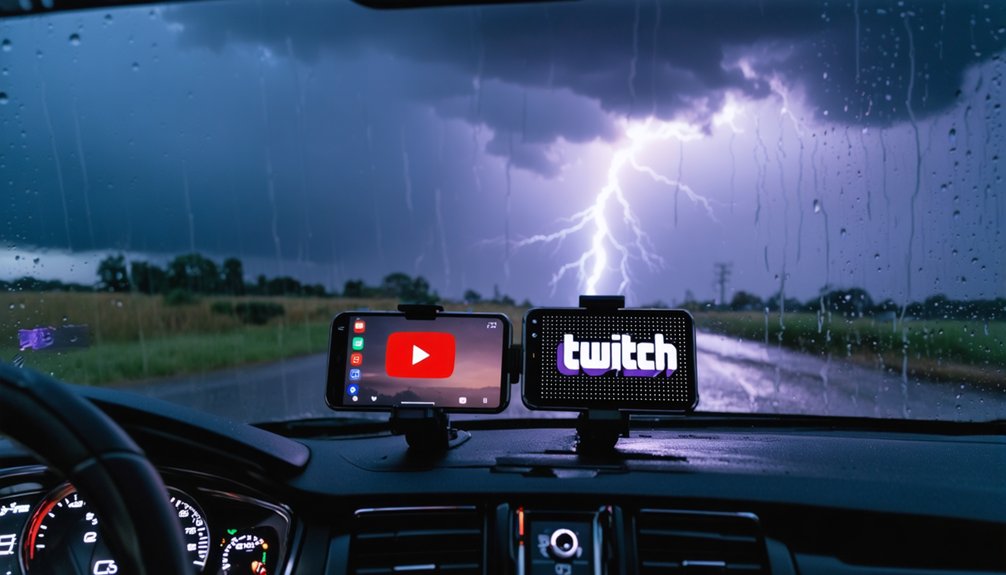
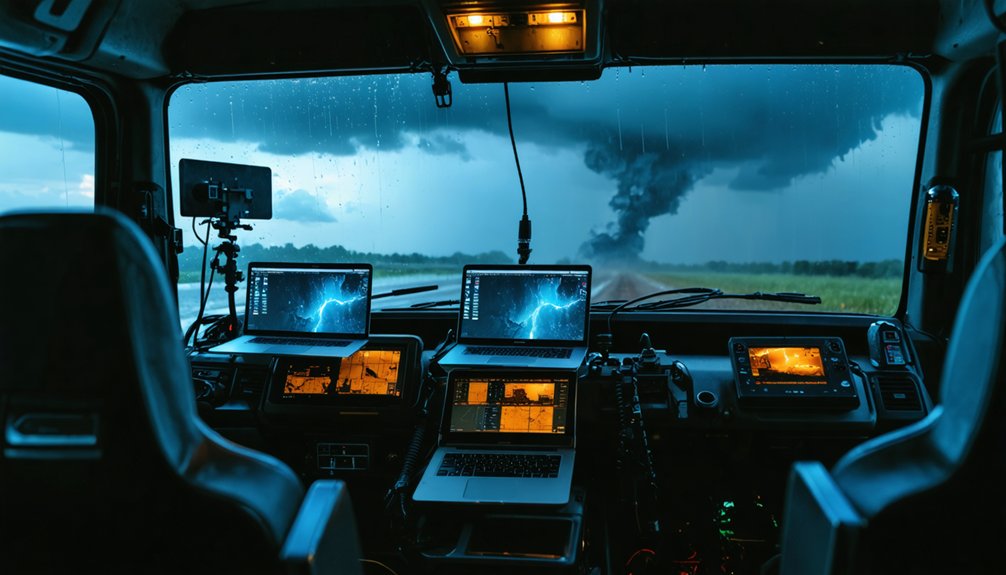
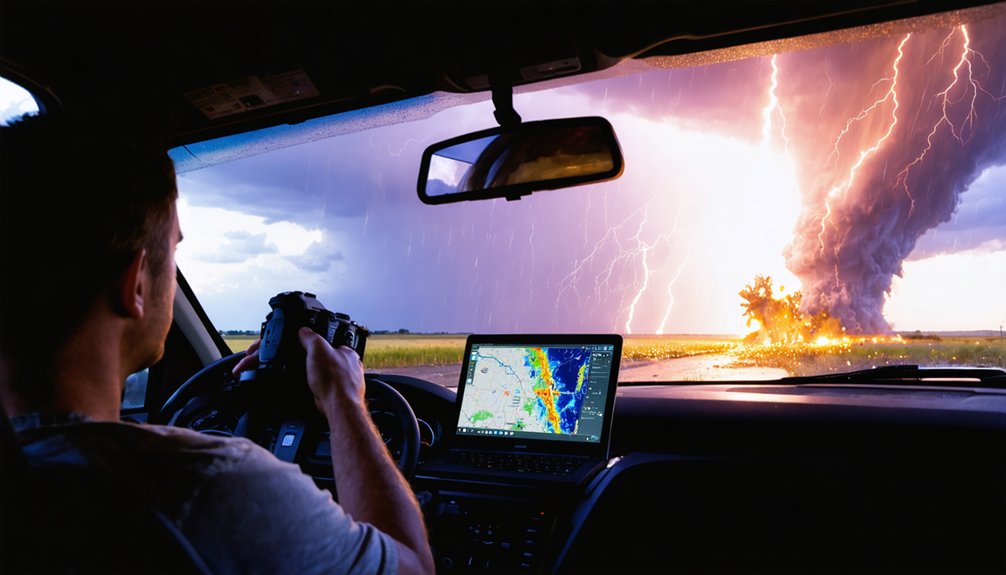
Storm chasing live streaming technology is advancing rapidly, and you’re entering an era where bonded 5G, LEO satellite uplinks, and mesh networks eliminate dead-zone dropouts. Onboard computers running multi-camera rigs deliver real-time radar overlays with sub-minute refresh cycles, while AI-powered scene recognition automates camera switching and hazard labeling. H.265 compression maintains resolution at reduced bandwidth, pushing stream quality toward broadcast standards. The full picture of where this technology is heading goes much deeper.
Key Takeaways
- Hybrid communication stacks combining bonded LTE/5G, LEO satellite, and mesh networks will ensure uninterrupted storm chasing streams despite rural coverage gaps.
- AI-powered scene recognition and hazard labeling will automate camera switching and deliver georeferenced threat markers for real-time risk communication.
- 5G networks and network bonding hardware will aggregate multiple carrier connections, preventing single-tower failures from disrupting live streams.
- Real-time radar overlays with sub-minute refresh cycles will integrate GPS and warning polygons, enhancing spatial context for viewer engagement.
- Advanced monetization through simultaneous ad revenue, memberships, and licensing fees will improve financial sustainability for independent storm chasing media.
How Storm Chasers Go Live Today
When a storm chaser goes live today, the workflow typically runs through a chain of hardware and software packed into a single vehicle. Multiple mounted cameras feed an onboard computer running OBS or similar encoding software, which handles switching, overlays, and transmission simultaneously.
Mobile technology, specifically 4G LTE or 5G where available, carries the signal to streaming platforms like YouTube, Facebook, or Twitter/X. Automated overlays display GPS position, radar data, and active warnings, boosting audience engagement without manual editing.
Real time interaction happens through live chat, while content monetization runs through ads, memberships, and donations. Social media amplifies reach instantly.
Viewer expectations now demand continuous, high video quality feeds rather than occasional clips, pushing technology integration toward redundant networks and adaptive bitrate streaming to keep you connected when conditions deteriorate.
Why Cellular Coverage Still Breaks Chase Streams
Despite the sophistication behind today’s chase rigs, the weakest link in the entire streaming stack is often the cellular network itself. Rural coverage gaps, storm impacts on tower infrastructure, and data congestion collapse your stream before the tornado even touches down.
Three core cellular limitations hit hardest:
- Rural coverage voids leave mobile networks nonexistent across critical intercept corridors.
- Tower overload from competing chasers, residents, and responders creates severe bandwidth issues that throttle live streaming to unusable bitrates.
- Storm dynamics physically damage or power-down towers, severing connectivity challenges mid-broadcast.
These aren’t minor inconveniences. Degraded mobile networks directly tank video quality when your audience needs clarity most.
Degraded mobile networks don’t just frustrate — they kill your stream exactly when viewers need it most.
You can’t control the atmosphere, but understanding these failure points lets you build smarter, more resilient streaming infrastructure around them.
How 5G and Network Bonding Keep Chase Streams Online
As 5G networks expand into previously underserved rural corridors, you gain access to higher throughput and lower latency that directly stabilize live encode pipelines under high-motion, high-bitrate conditions.
When 5G coverage drops or congests, network bonding hardware lets you aggregate simultaneous connections across multiple carriers and protocols, distributing packets across LTE, 5G, and even satellite links to maintain a single continuous stream.
You’re no longer dependent on a single tower or a single provider, which means one overloaded cell site no longer kills your broadcast during a high-traffic severe weather event.
5G Coverage Expanding Chase Range
5G’s expanding footprint is reshaping what’s technically possible during a live chase, though its real impact depends on where towers are deployed and how your rig exploits them.
Coverage expansion along rural highway corridors is accelerating, directly extending your viable chase technology range.
Three deployment factors determine your operational advantage:
- Sub-6 GHz mid-band 5G delivers the best balance of range and throughput for sustained HD uploads across open plains.
- mmWave 5G offers extreme bandwidth but fails beyond 300 meters, making it useless for mobile chase operations.
- Carrier-specific buildout maps vary considerably, so cross-referencing multiple providers before entering a target area maximizes your uptime probability.
Where 5G towers exist, you’ll push higher bitrates with lower latency, fundamentally upgrading your broadcast quality without additional compression tradeoffs.
Bonding Multiple Networks Together
When a single cellular tower drops out mid-broadcast, your entire stream collapses—unless you’ve bonded multiple network connections into one logical pipe.
Network bonding tools like Speedify or Peplink’s SpeedFusion merge LTE, 5G, and satellite links through signal aggregation, delivering data redundancy across simultaneous transmission protocols. This technology convergence gives you streaming reliability even when individual carriers fail under congestion.
Your bonded connection constantly monitors performance metrics across each link, executing bandwidth optimization by routing packets through whichever path performs best.
Connectivity strategies that combine AT&T, Verizon, and T-Mobile simultaneously eliminate single-point failures. The result is uninterrupted network resilience that keeps your audience watching through the worst signal environments.
Better user experience follows directly from this architecture—continuous, high-quality video rather than buffering gaps when conditions deteriorate fastest.
Satellite and Mesh Networks as Cellular Backups
When cellular coverage fails in rural chase corridors or collapses under tower congestion during major outbreaks, you can fall back on low-Earth-orbit satellite uplinks—such as Starlink—to maintain a viable video feed without interrupting your stream.
You can extend that redundancy further by deploying LoRa or LoRaWAN mesh nodes across a chase area, letting relay gateways forward data through multiple hops when no single node has a direct cellular or satellite path.
Combining cellular, satellite, and mesh radio into a unified hybrid stack gives you automatic failover across all three layers, so your encoder keeps pushing frames to the platform regardless of which link degrades first.
Satellite Uplinks Fill Gaps
Cellular networks fail storm chasers at the worst possible moments—tower congestion spikes during major outbreaks as chasers, residents, and emergency responders simultaneously compete for limited bandwidth.
Storm damage can knock out wired backhaul entirely. Satellite uplinks solve this directly, delivering independent connectivity solutions that maintain video reliability regardless of ground infrastructure status.
Three capabilities make satellite uplinks mission-critical for storm tracking:
- Uninterrupted data transmission across rural communication dead zones where cellular towers never existed
- Redundant emergency response coordination when terrestrial networks collapse post-impact
- Sustained content monetization streams that protect revenue by keeping audience engagement intact and meeting rising viewer expectations
Low-Earth orbit constellations have dramatically cut latency, making real-time satellite-based livestreaming operationally viable for serious chase teams today.
Mesh Networks Relay Signals
Mesh networks extend your connectivity reach by creating decentralized relay chains where each node—whether a vehicle, a portable gateway, or a fixed repeater—forwards data packets toward an uplink point rather than depending on a single tower.
Among the core mesh network advantages: latency stays manageable across multi-hop paths, bandwidth aggregates across nodes, and no single failure point collapses your stream.
Protocols like LoRaWAN operate at sub-gigahertz frequencies, penetrating terrain obstacles that kill standard cellular signals.
However, signal relay challenges accumulate as hop count increases—each relay adds latency, and mobile nodes moving at highway speeds disrupt routing tables continuously.
You’ll need adaptive routing algorithms and low-latency mesh firmware to sustain acceptable video bitrates.
Combining mesh architecture with satellite and cellular bonding eliminates the single-point dependencies that rural chasing constantly exposes.
Hybrid Stacks Ensure Continuity
Relying on a single mesh network solves the rural coverage gap but leaves you exposed the moment node density drops or routing tables fragment under high-speed movement.
Hybrid communication stacks eliminate that vulnerability through multi-source integration across three prioritized layers:
- Primary: Bonded LTE/5G cellular for low-latency adaptive streaming
- Secondary: LEO satellite for continuous coverage when towers fail or congest
- Tertiary: LoRaWAN mesh for resilient broadcasting of telemetry and GPS synchronization
Your encoder monitors all three simultaneously, executing seamless shifts without dropping the stream.
This data redundancy architecture enables real-time feedback loops between field equipment and cloud ingest points.
Content synchronization stays intact across platforms because technology convergence lets your system auto-select the strongest available path, keeping you broadcasting independently of any single infrastructure failure.
How Multi-Camera Rigs Are Reshaping Chase Streams
Where a single forward-facing camera once defined the standard chase rig, modern setups now mount three or more cameras simultaneously—capturing road view, storm structure, and in-cabin commentary in parallel.
Multi-camera integration lets you execute dynamic perspective shifts without stopping or repositioning, keeping immersive storm experiences uninterrupted throughout the chase.
Onboard computers handle real-time switching, encoding, and overlay injection, delivering a production value increase that rivals broadcast television.
Advanced editing tools allow you to cut between angles live, while real-time commentary syncs directly with radar and GPS data on-screen.
Audience interaction features—polls, chat triggers, timestamp markers—amplify enhanced viewer engagement during active events.
Multi-angle storytelling and collaborative streaming efforts between chasers sharing feeds further expand coverage.
The result is a technically precise, continuous broadcast built for audiences demanding unrestricted, firsthand storm access.
Why Smaller Hardware Is Changing Chase Vehicles
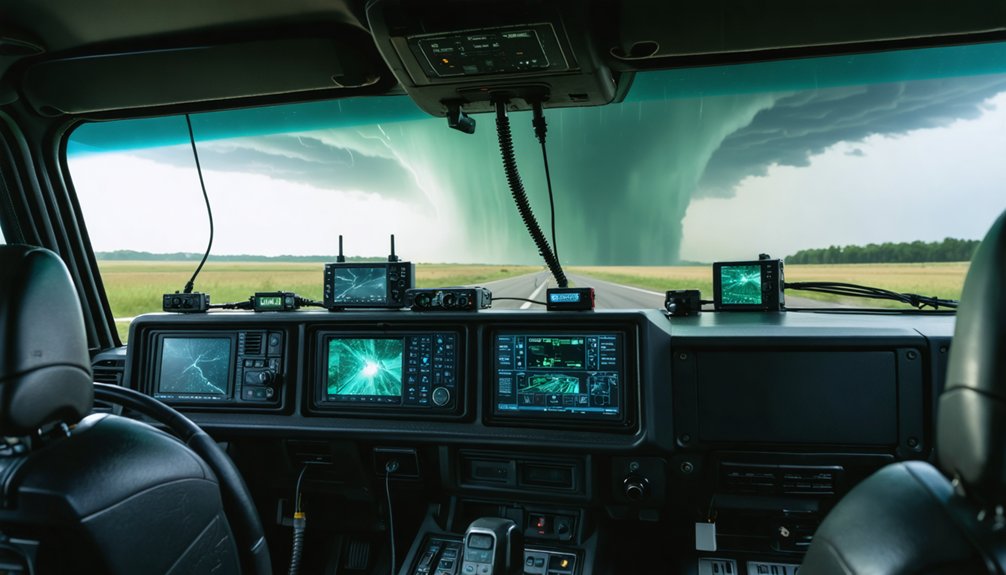
Running multi-camera rigs at broadcast quality demands serious processing power, yet the hardware enabling that output keeps shrinking. Smaller encoders now handle H.265 compression locally, cutting bandwidth requirements without sacrificing resolution.
Compact cameras mount anywhere, letting you cover structure, road, and cabin simultaneously. Lightweight rigs reduce vehicle load, improving fuel efficiency and handling during repositioning sprints.
Three critical shifts define this hardware evolution:
Three critical shifts are redefining broadcast hardware — and none of them involve adding more weight to your rig.
- Efficient power draw from integrated systems extends battery reserves during grid-down scenarios.
- Portable solutions replace rack-mounted gear, freeing cabin space for navigation and communications equipment.
- Streamlined setups with versatile mounts reduce deployment time from minutes to seconds.
You’re no longer anchored to bulky infrastructure. Smaller, smarter hardware gives you operational flexibility, letting you chase harder, transmit reliably, and adapt faster when conditions shift unpredictably.
Why Real-Time Radar Overlays Are Getting Smarter
Radar overlays have moved well beyond static range-ring maps painted on a chase screen. Today’s systems pull real-time integration of GRLevel3 vector data, GPS positioning, and warning polygons directly into your broadcast frame.
Radar accuracy now reflects sub-minute refresh cycles, letting viewers track mesocyclone rotation as it evolves. Data visualization layers combine velocity, reflectivity, and storm-relative motion without cluttering the feed.
Interactive maps give your audience spatial context that static screenshots never could. User feedback from live chats actively shapes content curation, prompting you to zoom, shift perspective, or highlight a developing wall cloud.
That audience interaction drives stronger viewer engagement and accelerates technology adoption across the chasing community. Storm tracking has become a collaborative, data-dense experience rather than a one-way broadcast.
AI Tools That Will Transform Storm Chase Streams
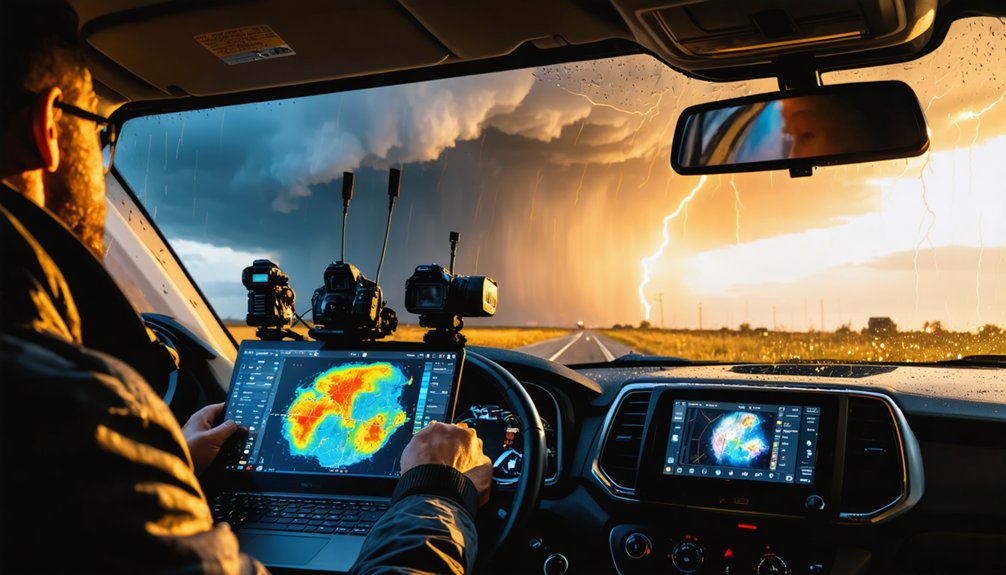
As you deploy AI-powered scene recognition on your chase rig, your software can classify storm features—wall clouds, mesocyclones, inflow bands—in real time and trigger automated camera switching based on detected visual priority.
Hazard labeling algorithms can then stamp your live feed with georeferenced threat markers, pulling from warning polygons and radar-derived rotation data to flag dangerous zones without manual input.
These systems reduce your cognitive load in the field while delivering your audience a contextually annotated stream that communicates risk more precisely than raw video alone.
AI-Powered Scene Recognition
Storm-chasing livestreams generate hours of continuous footage, and AI-powered scene recognition is poised to make that raw feed far more intelligent.
Through real-time processing, AI integration analyzes incoming frames, classifies storm structure, and triggers automated narration without manual intervention.
Scene analytics reveals three critical capabilities:
- Predictive modeling flags rotation signatures and wall cloud development before conditions escalate.
- Data visualization overlays hazard labels, storm mode classifications, and GPS coordinates directly onto your stream.
- Video enhancement sharpens low-light or rain-obscured footage, keeping user engagement high during chaotic conditions.
You’re no longer broadcasting raw, unstructured video. Instead, your stream delivers context-rich intelligence, letting audiences and emergency managers extract actionable information instantly.
This precision separates professional-grade coverage from amateur footage, and it’s rapidly becoming the new baseline.
Automated Hazard Labeling
Scene recognition lays the groundwork, but automated hazard labeling turns that awareness into actionable, on-screen intelligence.
Once your system identifies a debris cloud, power flash, or rain-wrapped wedge, hazard detection algorithms classify and timestamp each event, then push that data directly into your automated overlays without manual input.
Your stream displays real-time tags — “confirmed tornado,” “large hail core,” “RFD gust front” — anchored to GPS coordinates and radar-confirmed signatures.
Viewers and emergency managers receive structured, precise information instantly.
You’re no longer narrating hazards after the fact. The system flags, labels, and broadcasts simultaneously.
That speed matters when conditions shift in seconds. Automated hazard labeling eliminates the bottleneck between observation and communication, giving your audience verified, data-backed intelligence exactly when they need it most.
Why Viewers Now Expect Broadcast-Quality Storm Video
Viewer expectations have shifted dramatically over the past decade, driven by the same forces that reshaped broadcast journalism and live sports coverage. Streaming platforms like YouTube and TikTok have conditioned audiences to demand high production value, sharp storm visuals, and live interaction.
You’re competing against polished broadcasts, so mediocre video quality kills viewer retention fast.
Three factors now define audience expectations:
- Resolution standards — viewers expect 1080p minimum, with 4K becoming routine across major streaming platforms.
- Content curation — real-time radar overlays and GPS data elevate broadcast standards beyond raw footage.
- Engagement tools — live chat, alerts, and viewer engagement features drive audience expectations toward interactive experiences.
Meeting these benchmarks isn’t optional anymore — it’s the entry point for credible storm coverage.
How Better Streams Are Reshaping Chase Media Coverage
As livestream quality has climbed, traditional broadcast outlets have shifted from ignoring independent chasers to actively pulling their feeds for breaking coverage.
This streaming evolution has repositioned independent chasers as legitimate media sources, giving you direct leverage over how your content gets distributed.
Audience engagement metrics now drive editorial decisions, with real-time interaction through live chats and polls signaling which streams networks prioritize.
Content monetization has matured alongside technology integration, letting you capture ad revenue, memberships, and licensing fees simultaneously.
Viewer expectations now demand data visualization overlays, including radar loops and GPS tracks embedded directly into your feed.
Multimedia storytelling has replaced single-camera footage, with multi-angle rigs and automated switching creating broadcast-grade narratives.
You control the signal, the story, and increasingly, the revenue it generates.
Frequently Asked Questions
Can Storm Chasers Legally Livestream While Driving Through Active Tornado Warnings?
Legally livestreaming lacks limitations—you’re not explicitly prohibited, but legal implications and ethical considerations demand you prioritize safe driving. Distracted operation risks lives, so you’ll want a dedicated co-pilot managing your stream while you navigate.
How Do Storm Chasers Fund the Expensive Technology Needed for Professional Livestreaming?
You’ll fund your professional livestreaming gear through ads, memberships, donations, and sponsorship opportunities from weather-related brands. Crowdfunding strategies via Patreon or Kickstarter also generate capital, letting you maintain operational independence while deploying redundant, high-performance chase communication systems.
Are Storm Chasing Livestreams Ever Used as Legal Evidence After Tornado Damage?
Yes, you’ll find storm chasing livestreams carry real legal implications—courts and insurers actively use timestamped, GPS-tagged footage as evidence. Meeting evidence standards requires accurate metadata, unedited files, and verifiable chain-of-custody documentation.
How Do Chasers Protect Streaming Equipment From Hail and Extreme Storm Conditions?
You’re practically armoring a tank when you shield gear — chasers use equipment shielding like padded mounts, rubberized housings, and storm proof cases to protect cameras and encoders from golf-ball-sized hail and brutal wind-driven debris.
Do Streaming Platforms Ever Remove or Restrict Graphic Tornado Disaster Footage?
Yes, platforms do restrict graphic content under their platform policies. You’ll face ethical considerations balancing raw disaster footage against viewer sensitivity, so you’ve got to self-moderate proactively or risk automated flags removing your stream entirely.
References
- https://www.stormtours.com/information/storm-chasing-technology/
- https://en.wikipedia.org/wiki/Storm_chasing
- https://www.severestudios.com
- https://www.reddit.com/r/stormchasing/comments/1kez99e/stormchasing_technology_questions/
- https://makezine.com/article/science/storm-chasers-real-twister-tech/
- https://www.facebook.com/reedtimmer2.0/posts/its-happening-i-introduce-to-you-the-new-live-tornado-streaming-setup-on-steroid/1549177496564936/
- https://stormtrack.org/threads/will-tornado-chasing-eventually-become-passe.33137/
- https://www.youtube.com/watch?v=9XWHK9fphVY
- https://www.tornadotitans.com/p/a-new-path-for-live-storm-chasing
- https://www.bbc.com/future/article/20240715-the-scientists-who-chase-tornado-twisters-across-the-usa