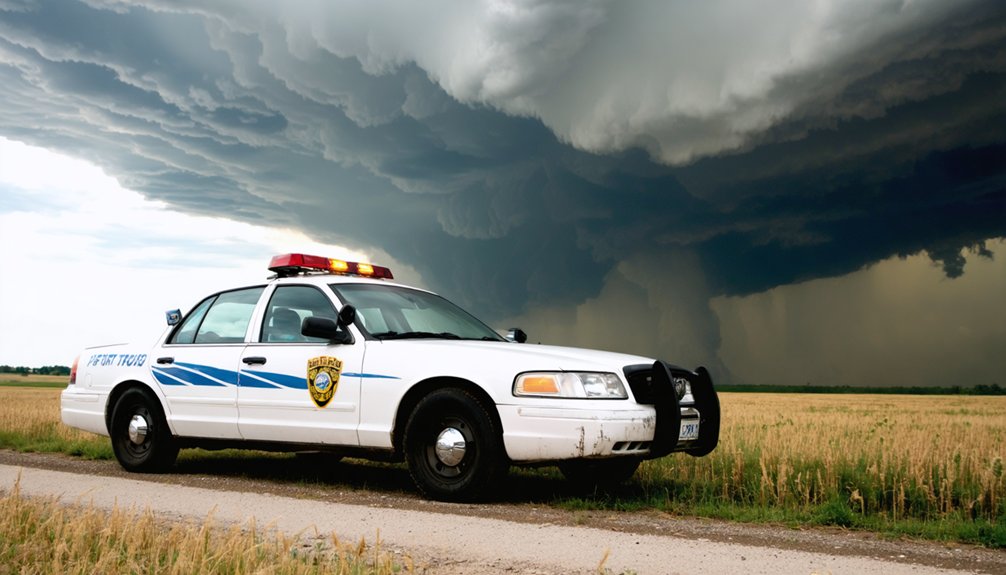
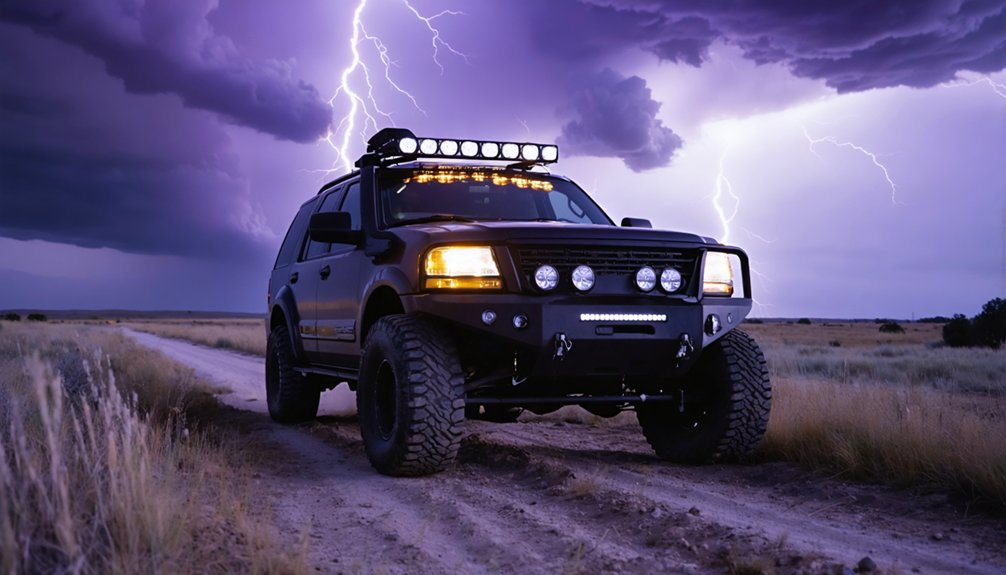
Investing in luxury storm chasing truck upgrades extends your operational range, reduces mechanical failure risk, and keeps you safer when you’re running intercepts within a few hundred yards of a violent tornado. You’ll gain reinforced structural protection, advanced communication systems, and off-road capability that standard builds simply can’t provide. These upgrades function as a cohesive system rather than isolated modifications, improving every aspect of your chase operation. The sections ahead break down exactly where that investment delivers the greatest return.
Key Takeaways
- Luxury storm chasing truck upgrades enhance structural integrity, protecting occupants from debris and violent weather through reinforced panels and impact-resistant glass.
- High-performance platforms like Ford F-250 or Ram 2500 provide the mechanical reliability needed for demanding, high-mileage chase seasons.
- Advanced communication systems, including HAM radios and radar-linked laptops, enable real-time decision-making and improved situational awareness during storms.
- Off-road upgrades like lift kits and all-terrain tires allow chasers to navigate washed-out roads and challenging terrain effectively.
- Investing in cohesive, functional builds over cosmetic improvements maximizes safety, operational capability, and long-term vehicle performance during storm chasing.
The Core Upgrades That Define a Purpose-Built Storm Chasing Truck
When outfitting a storm chasing truck, the upgrades that matter most fall into four interdependent categories: structural protection, mechanical reliability, mobility, and real-time data access. Each category reinforces the others, creating a cohesive platform rather than a collection of isolated modifications.
Chase Vehicle Innovations have shifted toward integrated builds where reinforced body panels, heavy-duty suspension, all-terrain tires, and onboard communication systems work as a unified system. You’re not adding features independently — you’re engineering operational capability.
Essential Tech Upgrades anchor this framework. HAM radios, radar-linked laptops, GPS navigation, and power management systems transform your truck into a mobile command unit.
Without these layers working together, you’re limiting your effectiveness and increasing your exposure in rapidly evolving storm environments. Prioritize function over appearance at every decision point.
Which Truck Platforms Hold Up Best Across Full Chase Seasons?
When you’re running a full chase season, platform selection directly affects how much stress your drivetrain, suspension, and frame can absorb before reliability becomes a liability.
Proven performers like the Ford F-250/F-350 Super Duty, Ram 2500/3500, and Toyota Tundra consistently hold up under high-mileage punishment, heavy payload loads, and repeated off-road stress that would degrade lighter platforms faster.
You’ll find that heavy-duty, truck-based architectures give you the structural margin needed to support both aggressive modifications and the sustained operational demands of multi-week deployments.
Proven Full-Season Performers
Across a full chase season, not every truck platform holds up equally under the sustained punishment of high-mileage deployments, rough terrain, and near-constant equipment loads.
Chase vehicle performance data consistently points toward the Ford F-250, Ram 2500, and Chevy Silverado 2500 as proven seasonal workhorses. Their heavy-duty frames, robust cooling systems, and available diesel powertrains handle extended operational demands better than half-ton alternatives.
Seasonal upgrade trends show experienced chasers prioritizing reinforced suspension, upgraded steering components, and transmission coolers early in the build process.
These platforms also support heavier payload configurations without compromising handling or mechanical integrity.
If you’re committing to full-season deployments across variable terrain, selecting a three-quarter-ton or one-ton platform gives you a measurable mechanical advantage that lighter trucks simply can’t match.
Platform Durability Under Stress
Platform stress accumulates fast once you’re deep into a chase season, and the trucks that survive it best share a short list of structural and mechanical traits.
Vehicle longevity depends heavily on platform selection before upgrades even begin.
Three performance metrics separate durable builds from failures:
- Material resilience — High-strength steel frames resist torsional flex across repeated off-road enhancements and rough terrain cycles.
- Mechanical stress testing — Proven platforms like the Ford Super Duty and Ram 2500 demonstrate consistent cooling, suspension, and drivetrain endurance under sustained chase loads.
- Upgrade importance — Safety features including reinforced undercarriage protection and heavy-duty axles compound platform strengths rather than compensate for weaknesses.
Choose your foundation deliberately.
Retrofitting a weak platform costs more and delivers less than building from proven structural integrity.
How Reinforced Builds Improve Survival Near Violent Storms
When you’re operating near violent supercells, your truck’s structural integrity becomes a direct survival variable.
Debris-resistant reinforcements, upgraded body panels, and laminated or polycarbonate glass reduce the probability of penetration from high-velocity projectiles common in tornado-producing environments.
You won’t eliminate risk entirely, but a properly reinforced build measurably improves your odds of surviving an intense tornado encounter with the vehicle intact.
Debris-Resistant Structural Upgrades
Storm chasers who operate near violent supercells face a debris field that can launch projectiles at speeds exceeding 100 mph, making structural reinforcement one of the most critical investments in a luxury chase build.
Upgrading your rig’s protective features with advanced materials and reinforced construction greatly improves debris impact resistance and overall structural integrity.
Consider these three core safety enhancements:
- Reinforced glass panels — laminated or polycarbonate glazing resists shattering under high-velocity impact.
- Upgraded body armor — hardened door panels and skid plates improve storm resilience against road-level projectiles.
- Weatherproof designs — sealed seams and corrosion-resistant coatings protect critical structural components under extreme conditions.
These upgrades won’t eliminate risk, but they’ll notably improve your vehicle’s capacity to absorb punishment and keep you operational.
Reinforced Glass And Panels
Reinforced glass and hardened body panels are where structural protection gets specific. When you’re operating near violent supercells, standard automotive glass won’t cut it. Laminated polycarbonate or multi-layered safety glass dramatically increases impact resistance against high-velocity debris that standard windshields simply can’t absorb.
Hardened body panels built from reinforced materials add another layer of defense, reducing penetration risk from flying wood, metal, and rock fragments. You’re not chasing in a controlled environment — debris fields near strong tornadoes are unpredictable and fast-moving.
These upgrades don’t make your rig invincible, but they meaningfully shift survival odds in your favor. When you choose reinforced materials strategically, you’re investing in a vehicle that performs closer to purpose-built protection rather than a modified consumer truck hoping for the best.
Surviving Intense Tornado Encounters
Even the most well-equipped chase vehicles face real destruction risk when they’re caught in the path of a violent, high-end tornado.
Reinforced builds improve your odds, but tornado survival strategies require layered preparation:
- Structural reinforcement reduces penetration from high-velocity debris, protecting occupants when wind loads exceed standard vehicle tolerances.
- Escape route planning demands real-time awareness — your storm encounter preparedness depends on knowing exit roads before positioning near a wedge or violent multivortex.
- Repositioning speed matters critically; upgraded suspension and off-road capability let you move fast when a tornado’s track shifts unexpectedly.
Upgrades reduce risk — they don’t eliminate it.
Violent tornadoes have destroyed purpose-built intercept vehicles. Your survival margin expands through combining structural protection, situational awareness, and disciplined decision-making under pressure.
Why Off-Road Capability Changes Everything on a Storm Chase?
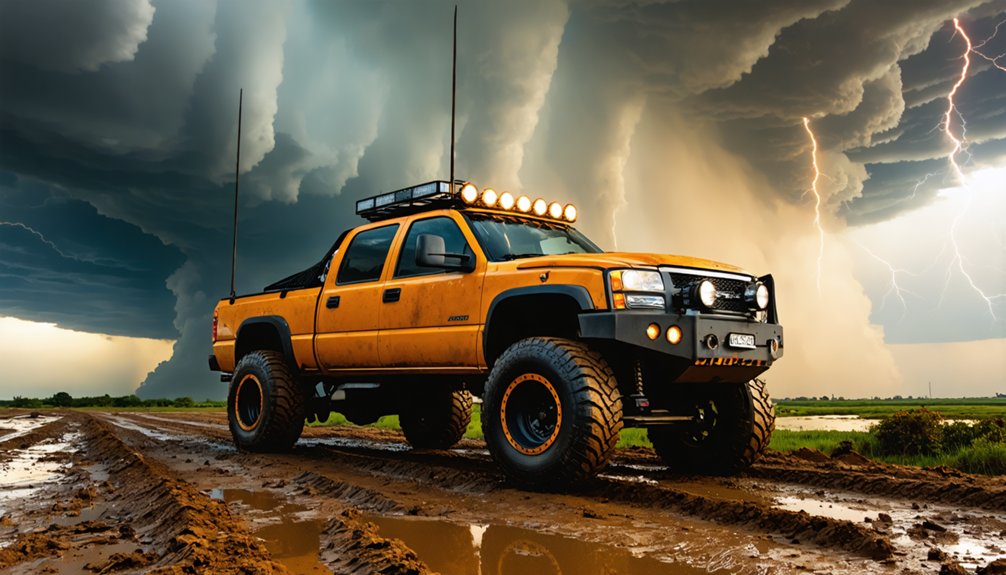
When gravel turns to mud and paved roads dead-end miles from your target storm, off-road capability stops being a luxury and becomes a tactical necessity. Lift kits, all-terrain tires, and upgraded suspension deliver the rugged performance you need when terrain navigation demands more than a stock build can handle.
Greater ground clearance lets you cross washed-out roads, cut through fields, and reposition without surrendering storm access. That vehicle versatility directly improves chase flexibility, letting you pursue the best viewing angles or escape deteriorating conditions without hesitation.
Ground clearance isn’t just convenience — it’s the difference between losing a storm and owning your position.
Off-road advantages compound quickly in rural environments where paved infrastructure is sparse or blocked. You’re not just gaining comfort — you’re gaining chase efficiency.
Every terrain obstacle a capable truck clears is one fewer barrier between you and the storm you’re tracking.
Why Mechanical Reliability Matters More in Remote Chase Territory
Storm chasing pushes vehicles far beyond typical consumer use, and breakdowns in remote territory don’t carry the same low-stakes consequences they’d near a city.
Repair accessibility drops sharply once you’re deep in rural chase corridors, making breakdown prevention a core operational priority rather than a convenience.
Invest in these mechanical reliability upgrades to protect your field performance:
- Heavy-duty cooling and suspension systems extend component longevity under sustained high-mileage stress.
- Reinforced drivetrain components strengthen terrain adaptability and off-road readiness across unpredictable surfaces.
- Upgraded steering and braking hardware supports weather resilience and remote reliability when emergency support isn’t reachable.
Mechanical maintenance isn’t optional when you’re operating where towing services don’t exist.
Precision upgrades keep you mobile, independent, and in control when conditions demand it most.
Communications Gear That Keeps Storm Chasers Ahead of the Weather
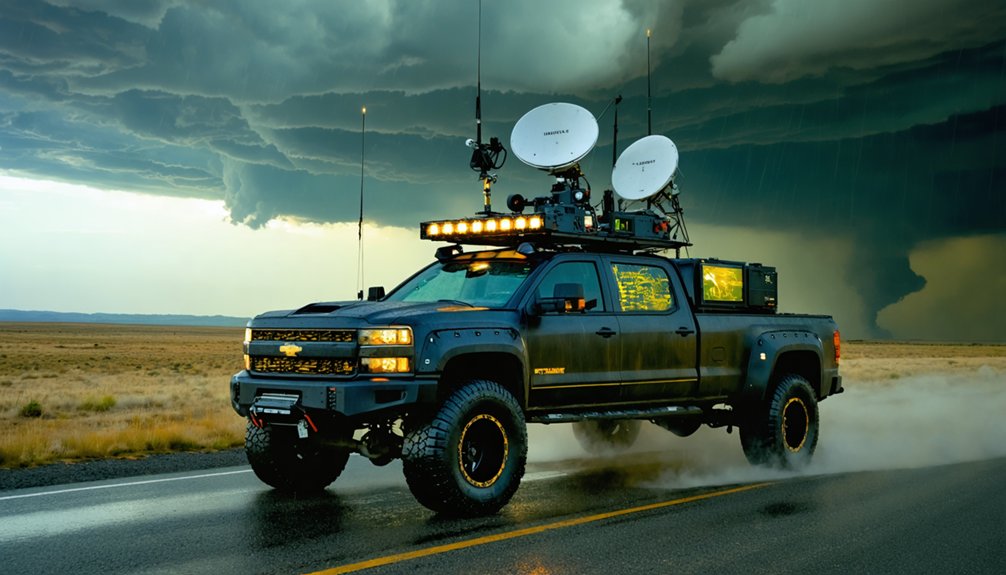
Mechanical reliability keeps you in the field, but it’s your communications setup that keeps you ahead of it. Effective storm tracking demands real-time data access, and that means equipping your rig with layered communication technologies — HAM radios, CB radios, integrated GPS, and laptop-mounted radar platforms.
Each system serves a distinct function. HAM gives you ground-level spotter coordination. CB connects you to local traffic and road hazards. Radar software delivers live storm motion data so you’re repositioning before conditions deteriorate.
Mounting these systems cleanly into your cab eliminates fumbling during fast-moving intercepts. Dedicated power inverters and charging infrastructure keep everything operational across long deployment days.
When storms reposition quickly, your ability to communicate, monitor, and respond without interruption separates a productive chase from a compromised one.
How a Fully Built Chase Truck Becomes a Mobile Command Center
A fully built chase truck stops being just a vehicle the moment every system integrates into a unified operational platform.
You’re no longer reacting — you’re commanding the field from a mobile command built around speed, awareness, and precision.
Three systems define that transformation:
- Storm monitoring hardware — radar feeds, atmospheric sensors, and real-time data displays give you continuous situational awareness.
- Power infrastructure — inverters and dedicated charging ports keep every device running through extended deployments.
- Communication arrays — HAM radios, GPS, and laptop mounts connect you to evolving storm data and team coordination instantly.
Each upgrade compounds the others.
When your platform operates as one cohesive unit, you’re not chasing blind — you’re making faster, sharper decisions from a position of genuine field control.
Storage and Workflow Upgrades That Save Time on a Chase
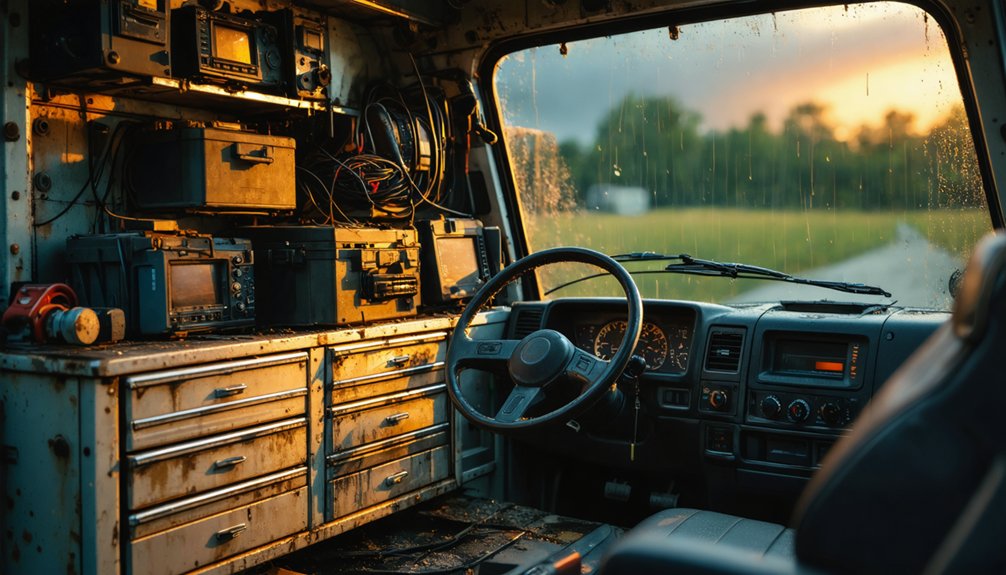
When seconds matter during a fast-moving storm, a disorganized interior slows your reaction time and forces costly decision delays.
A custom storage system places cameras, data gear, emergency supplies, and repair tools in fixed, accessible positions so you’re not searching under pressure.
Paired with a structured mobile workstation, you can monitor radar, log chase data, and coordinate communications without breaking operational focus.
Custom Storage System Benefits
Custom storage systems cut wasted motion during a chase, where every second you spend digging through loose gear is a second you’re not monitoring storm position or planning your next move.
Custom organization transforms your cab into a structured workspace where efficient access to every tool becomes automatic rather than reactive.
Three core advantages drive this investment:
- Dedicated compartments keep cameras, cables, and forecasting tools separated and immediately retrievable without visual searching.
- Secured mounting positions prevent gear shifts during aggressive repositioning maneuvers on rough terrain.
- Logical workflow layouts place high-priority equipment within arm’s reach while storing secondary supplies in lower-access zones.
You’re not just organizing gear — you’re engineering faster decisions.
When a tornado intensifies unexpectedly, a well-designed storage system keeps your response time sharp and your options open.
Mobile Workstation Setup Advantages
Organized storage sets the foundation, but a fully integrated mobile workstation takes that structure further by converting your cab into an active command center capable of supporting real-time decision-making.
Mounting systems for laptops, tablets, and displays keep critical radar feeds visible without sacrificing ergonomics. Power inverters and dedicated charging circuits eliminate downtime between deployments, keeping your mobile office fully operational during extended storm logistics.
Adjustable monitor arms and keyboard trays let you operate efficiently while repositioning under pressure. Integrated cable management prevents tangled equipment from slowing your response when storms shift quickly.
You’re not just organizing gear—you’re engineering a workflow that compresses decision cycles. Every second saved pulling up data or switching tools directly improves your positioning accuracy and overall field effectiveness.
Do Luxury Storm Chasing Upgrades Pay Off Over Time?
Whether luxury storm chasing upgrades actually pay off depends on how you define value across safety, durability, and operational output. When you treat each modification as a functional investment rather than cosmetic spending, the returns become measurable.
- Safety returns: Reinforced builds reduce injury risk near violent supercells, directly protecting your ability to keep chasing long-term.
- Durability returns: Heavy-duty components lower breakdown frequency across high-mileage seasons, cutting repair costs and downtime.
- Operational returns: Integrated communication and data systems sharpen your decision-making speed, improving storm intercept success rates.
Your luxury investment compounds when upgrades work together rather than independently. In storm chasing, redundancy and resilience aren’t luxuries — they’re operational necessities.
Choose upgrades that extend field capacity, reduce mechanical vulnerability, and strengthen your independence from support infrastructure.
Safety Versus Appearance: Where Your Storm Chasing Budget Should Go
Once you’ve established that luxury upgrades can deliver measurable returns, the next question becomes allocation — specifically, how much of your budget should chase aesthetics versus functional protection.
When prioritizing budget allocation, direct spending toward reinforced body panels, upgraded glass, and structural hardening first. Safety enhancements protect your life and your equipment when conditions deteriorate fast.
Direct spending toward reinforced body panels, upgraded glass, and structural hardening first — safety enhancements protect your life when conditions deteriorate fast.
Appearance-based modifications — custom wraps, polished trim, aesthetic lighting — contribute little when debris is airborne or terrain turns unpredictable.
Communication systems, heavy-duty suspension, and mechanical reliability upgrades should follow structural protection in your spending hierarchy.
Cosmetic improvements make sense only after functional systems are fully covered. You’re operating in environments where conditions can shift violently within seconds, so your budget should reflect that reality without compromise.
Frequently Asked Questions
Can Luxury Storm Chasing Truck Upgrades Qualify for Any Tax Deductions?
If you use your truck professionally, you can claim tax benefits on qualifying upgrades. You’ll want to review depreciation rules under IRS Section 179, which lets you deduct business-use vehicle expenses efficiently.
How Do Insurance Companies View Heavily Modified Storm Chasing Vehicles?
Like a medieval cartographer charting unknown seas, insurance assessments of your heavily modified storm chasing vehicle often flag vehicle modifications as high-risk, potentially raising premiums or requiring specialized commercial coverage to protect your freedom-driven build.
Are There Certification Programs Specifically for Professional Storm Chasing Vehicles?
No formal storm chasing certifications exist yet, but you’ll find that following vehicle safety standards from organizations like IVOR or NWS spotter training strengthens your build’s credibility and supports safer, more professional field operations.
What Permits Are Required for Operating a Storm Chasing Vehicle Professionally?
Permit requirements vary by state, but you’ll typically need a commercial vehicle registration, proper insurance, and compliance with storm chasing regulations governing vehicle modifications, communications equipment, and any media credentials if you’re conducting professional field operations.
How Do Extreme Temperature Swings Affect Luxury Upgrade Materials Over Time?
Scorching heat versus freezing cold—you’ll find temperature effects compromise material durability markedly. Luxury materials like vinyl, adhesives, and composites expand and contract repeatedly, reducing upgrade longevity. You’ve got to select weather-resistant, thermally stable components for lasting performance.
References
- https://stormtrack.org/threads/storm-chasing-vehicle-project-and-suggestions.27826/
- https://www.reddit.com/r/stormchasing/comments/1fyp45a/storm_chasing_vehicle_advice/
- https://acceleratedmt.com/tactical-news-trucks/
- https://www.facebook.com/mikesweatherpage/videos/the-storm-chaser-upgrade-is-complete-now-equipped-with-the-most-advanced-lightin/2065672387507202/
- https://www.thecooldown.com/outdoors/tornado-chasing-vehicle-overpowered-massive-twister/
- https://www.stormtours.com/information/storm-chasing-vehicles/
- https://www.facebook.com/groups/1821133111780534/posts/2065668000660376/
- https://www.gm-trucks.com/forums/topic/159034-stormchaser-project-storm-chase-truck-build/
- https://www.duramaxforum.com/threads/storm-chasing-truck-need-all-the-help-on-mods-i-can-get.149831/
- https://www.youtube.com/watch?v=xIte5xnIu7o