The golden age of storm chasing didn’t happen overnight. It grew from a handful of curious pioneers in the 1950s who used printed maps and sharp eyes to track severe weather. Over the decades, you’d see it evolve through organized science, groundbreaking tornadoes, portable Doppler radar, and Hollywood blockbusters into a collaborative, technology-driven pursuit. Each chapter of this history shaped what storm chasing is today, and there’s far more to this remarkable story ahead.
Key Takeaways
- Storm chasing began with pioneers like Roger Jensen and David Hoadley in the 1950s, relying on printed maps and direct observation.
- Neil Ward formalized storm chasing science in 1961, while the Tornado Intercept Project institutionalized it in 1972.
- The 1973 Union City tornado provided breakthrough data, validating organized, coordinated storm interception as a legitimate scientific method.
- Portable Doppler radar (1987), video cameras, and mobile mesonets revolutionized data collection, replacing guesswork with real-time storm analysis.
- The internet democratized storm chasing, enabling real-time collaboration, while *Twister* (1996) propelled it into mainstream cultural awareness.
The Pioneers Who Started Storm Chasing
Before radar, GPS, or any real-time data existed, a handful of determined individuals were already chasing storms out of pure curiosity and scientific instinct. Roger Jensen reportedly intercepted storms as early as 1953, driven purely by fascination. David Hoadley followed in 1956, reading weather patterns through printed maps, airport data, and direct observation — tools far removed from today’s data visualization technologies.
You’d recognize these men as true independents, unburdened by institutional pressure, chasing on their own terms. Hoadley eventually founded *Storm Track* magazine in 1977, building the first real chaser community.
Neil Ward formalized the science, beginning research chasing in 1961. Together, these pioneers transformed a solitary, instinct-driven pursuit into something larger — a legitimate field science built on freedom, observation, and relentless curiosity.
How Storm Chasing Became Serious Science
What began as solitary curiosity didn’t stay that way for long. By the 1950s and 1960s, Neil B. Ward was chasing storms with scientific intent, reshaping what the activity meant. He wasn’t just watching — he was documenting thunderstorm and tornado structure, laying the groundwork for real meteorological understanding.
Neil B. Ward wasn’t just watching storms — he was documenting them, laying the groundwork for real meteorological understanding.
Then in 1972, the University of Oklahoma and the National Severe Storms Laboratory launched the Tornado Intercept Project, making storm chasing an institutional discipline. You can trace modern storm chasing education directly back to that moment.
Field teams developed forecasting methods, intercept strategies, and documentation standards that defined the craft.
Storm chasing ethics also emerged here — because once lives and data were both on the line, accountability mattered. Science demanded it, and the best chasers answered that call.
The 1970s: When Storm Chasing Got Organized
If you trace storm chasing’s transformation into a discipline, you’ll find the early 1970s as its pivotal decade. In 1972, the University of Oklahoma and the National Severe Storms Laboratory launched the Tornado Intercept Project, sending teams into the field with a scientific mission that earlier hobbyists could only imagine.
The 1973 Union City tornado then handed researchers a landmark case study.
Tornado Intercept Project Launch
By the early 1970s, storm chasing had outgrown its hobbyist roots and stepped into something far more deliberate. In 1972, the University of Oklahoma and the National Severe Storms Laboratory launched the Tornado Intercept Project, marking the first organized effort dedicated specifically to severe convective storms. Its first outing on April 19, 1972, signaled a turning point — weather prediction and storm visualization were no longer confined to office forecasts and static charts.
You had teams deploying into the field with purpose, intercepting storms methodically rather than accidentally. Then came 1973 and the Union City, Oklahoma tornado — a case study that reshaped how researchers understood supercell morphology.
That single event validated everything the Tornado Intercept Project stood for, cementing field science as the most direct path to real answers.
Union City’s Scientific Impact
The Union City tornado of 1973 didn’t just give researchers a dramatic chase — it handed them a blueprint. You’re looking at a moment when historical data stopped being theoretical and became something tangible, earned in the field.
Teams documented the tornado’s full lifecycle, capturing atmospheric patterns that had never been systematically recorded before. That documentation reshaped how scientists understood supercell morphology and tornado formation.
It validated the entire premise of organized storm interception — that you could put trained eyes in the right place and extract real, meaningful science. Union City proved the model worked.
It transformed storm chasing from an ambitious experiment into a credible research discipline, giving future chasers a scientific foundation they could build on rather than starting from scratch.
Building The Chaser Community
This wasn’t just networking; it was the foundation of a movement. The Great Plains spring season became a shared calendar, a ritual.
Storm chasing had its science. Now, for the first time, it had its people.
The Union City Tornado That Changed Everything
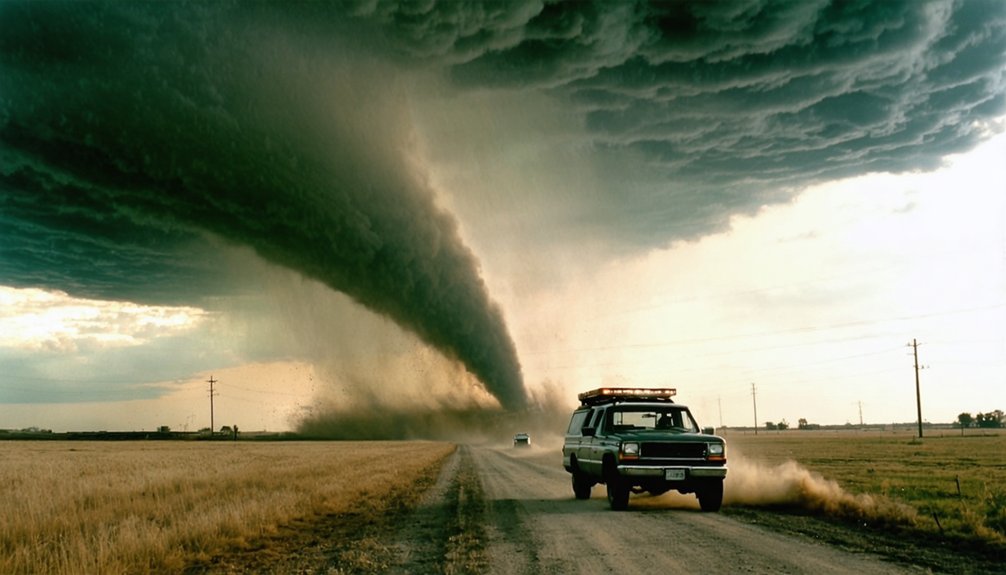
If you want to understand why the 1970s mattered, you start with Union City. On May 24, 1973, chasers intercepted an Oklahoma tornado that gave researchers their most complete look yet at supercell structure and tornado morphology.
That single event transformed storm chasing from a promising field program into a scientifically indispensable discipline.
Union City’s Scientific Impact
When the Union City, Oklahoma tornado touched down on May 24, 1973, researchers from the Tornado Intercept Project were ready—and what they captured changed storm science permanently. You can trace nearly every modern understanding of supercell and tornado morphology back to that single intercept.
The data collection from that day was unprecedented. Teams documented the tornado’s full lifecycle, giving meteorologists a complete structural record they’d never had before. Those findings drove meteorological advancements that reshaped forecasting models and field research protocols for decades.
What Union City proved was simple but powerful: disciplined, coordinated field science could release what lab models never could.
You were no longer guessing at tornado formation—you were watching it unfold in real time, with instruments running and cameras rolling.
Supercell Research Breakthroughs
The Union City intercept didn’t just confirm what researchers suspected about supercells—it rewrote the framework entirely. Before 1973, supercell dynamics remained largely theoretical.
That single storm gave researchers their first complete, documented lifecycle of a tornadic supercell, from initial rotation through dissipation.
You’re looking at a turning point where field observation finally matched forecasting intuition. Teams captured tornado genesis in real time, tracing the mesocyclone‘s descent and the precise moment a funnel touched ground.
That data dismantled older, oversimplified tornado models.
What emerged was a sharper, more honest picture of how supercells organize, intensify, and produce violent tornadoes.
Union City didn’t just advance meteorology—it liberated researchers from the constraints of radar-only analysis and handed them something irreplaceable: ground truth.
The Storm Chasers Who Built the Modern Methods
Before GPS, mobile radar, or real-time data feeds existed, a small group of determined chasers built the methodological foundation that modern storm chasing still rests on. You’d recognize their names — David Hoadley, Neil Ward — pioneers who treated every intercept as both a mission and a classroom.
Before GPS or mobile radar existed, pioneers like Hoadley and Ward built the foundation modern storm chasing still rests on.
Their data collection techniques were raw but disciplined: printed maps, direct observation, airport weather reports, and careful documentation. No shortcuts existed, so they invented the standards themselves.
Meteorological mentorship passed organically through field experience and Hoadley’s *Storm Track* magazine, which unified isolated chasers into a coherent community by 1977.
These chasers didn’t wait for institutions to validate them. They chased, documented, and shared — building frameworks that professional researchers and independent chasers alike still depend on today.
How Storm Chasing Technology Transformed the Chase
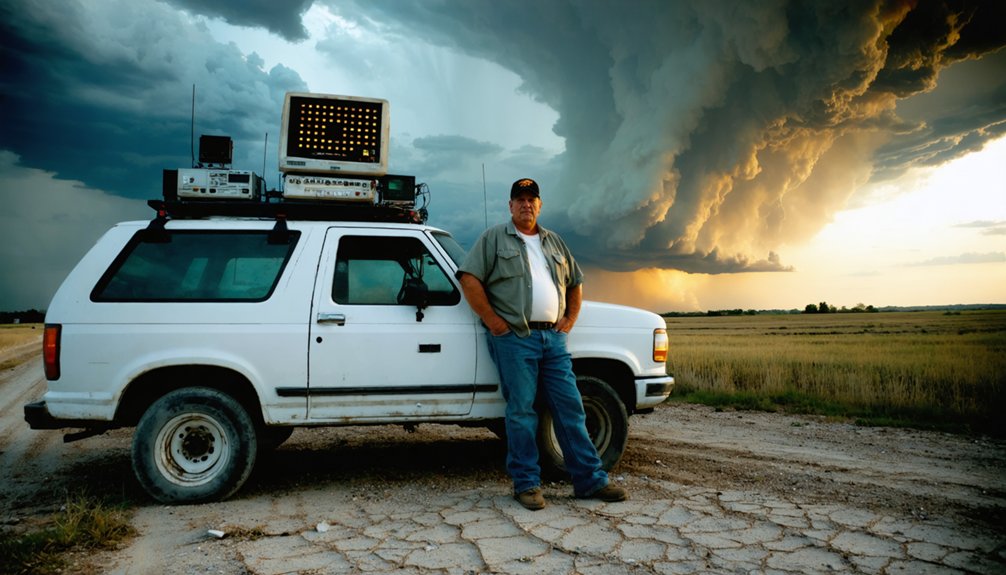
Portable Doppler radar didn’t arrive in storm probing until 1987, but its appearance marked a hard dividing line between two distinct eras of chasing. Before it, you relied entirely on your eyes, printed maps, and instinct.
After it, radar evolution reshaped every decision you made in the field.
Three shifts defined this transformation:
- Data visualization moved from static charts to real-time storm structure interpretation.
- Portable video cameras in the 1980s turned documentation from notes into undeniable visual evidence.
- Mobile mesonets gave you instrumented intercept capability, replacing guesswork with measurable data.
You weren’t just chasing storms anymore — you were studying them systematically.
Technology didn’t remove the danger or the freedom; it sharpened your ability to chase smarter, longer, and with far greater purpose.
When Storm Chasing Hit the Big Screen
Technology sharpened how you chased, but it couldn’t control who was watching. Storm chasing documentaries like the 1985 PBS *Nova* special quietly built awareness among curious audiences, planting seeds before the cultural explosion arrived.
Then *Twister* hit theaters in May 1996, and everything changed. Hollywood portrayals don’t always respect accuracy, and *Twister* was no exception — dramatic, distorted, and wildly effective.
Suddenly, thousands of people wanted to chase. The open road, the darkening sky, the freedom of pursuing something raw and unpredictable — the film captured that pull, even if it exaggerated the science.
You may have rolled your eyes at the Hollywood version, but you couldn’t deny what it did: it turned storm chasing from a niche pursuit into a cultural phenomenon.
How the Internet Turned Storm Chasing Into a Mass Movement
Three forces drove this shift:
- Online forums let independent chasers exchange forecasts and routes in real time, bypassing institutional barriers.
- Shared video and photography created challenger partnerships between hobbyists and researchers who’d never have otherwise collaborated.
- Real-time data access handed you the same forecasting tools professionals once monopolized.
You weren’t just watching storms anymore — you were tracking them, discussing them, and building a network that stretched across the Plains and beyond.
The internet didn’t just expand storm chasing; it fundamentally redistributed its power.
Frequently Asked Questions
What Dangers Did Early Storm Chasers Face Without Modern Safety Equipment?
You’d navigate violent storms without meteorological equipment or safety protocols, relying purely on instinct and printed maps. You’d face deadly debris, sudden path shifts, and zero real-time data—raw freedom, but terrifyingly unforgiving consequences awaited every chase.
How Did Storm Chasers Fund Their Expeditions During the Early Decades?
Imagine chasing storms on a shoestring! You’d have funded early expeditions through personal savings and university grants, driving meteorological innovations forward. Without storm chase technology, you relied on passion alone to bankroll your pursuit of nature’s fury.
Were There Any Fatalities Directly Linked to Organized Storm Chasing Research Programs?
The knowledge doesn’t confirm historical fatalities tied directly to organized chasing accidents in research programs. You’ll find the record’s incomplete here, but early chasers accepted real dangers chasing violent storms without today’s safety technologies protecting them.
How Did Storm Chasing Influence Changes in Public Tornado Warning Systems?
You’d find that storm chasing drove meteorological advancements that reshaped tornado warning systems, giving communities precious extra minutes to act. It fueled public awareness, transforming reactive alerts into proactive, life-saving forecasts you could genuinely trust and rely upon.
Did Any Early Storm Chasers Face Legal or Professional Consequences for Chasing?
You won’t find clear records of legal repercussions, but early chasers faced ethical debates and professional skepticism. Their bold, freewheeling pursuit of storms challenged institutional norms, risking credibility in an era that didn’t yet embrace their pioneering independence.
References
- https://en.wikipedia.org/wiki/Storm_chasing
- https://www.rmets.org/metmatters/history-storm-chasing
- https://journals.ametsoc.org/view/journals/wefo/14/4/1520-0434_1999_014_0558_ahossi_2_0_co_2.xml
- https://crazystormchasers.com/when-did-storm-chasing-start-the-history-of-the-hobby/
- https://www.tornadosimulator.net/storm-chasers-full-history/
- http://ndtornado.com/primary/history.htm
- https://collectiveweather.com/a-history-of-storm-chasers-and-storm-chasing/
- https://stormtrack.org/threads/history-of-storm-chasing-back-to-day-one.32873/
- https://neurje.si/StormSlo/History.html
- https://www.nature.com/articles/494312a