Chasing waterspouts puts you at the intersection of meteorological science and raw natural power. You’re tracking vortices driven by vorticity stretching, warm sea surfaces, and unstable air aloft — conditions that produce up to 500 waterspouts annually in the Florida Keys alone. Fair-weather types form upward from the water surface, peak between 12 PM and 5 PM, and move at roughly 10–15 knots. Understanding their formation mechanics, behavior, and your positioning makes the difference between a successful chase and a dangerous one.
Key Takeaways
- Fair-weather waterspouts form upward from the water surface beneath cumulus clouds, lasting under 20 minutes, combining meteorological complexity with stunning visual spectacle.
- The Florida Keys offer peak waterspout activity from May to September, with prime viewing between 12 PM and 5 PM.
- Chasers track formation cues—dark spots, spray rings, and funnel development—using tools like the Szilagyi Waterspout Index and sea surface temperature charts.
- Positioning your vessel at a 90-degree angle to the waterspout’s projected path optimizes both viewing opportunity and personal safety.
- Waterspouts behave unpredictably, stalling or shifting direction suddenly, requiring continuous monitoring and a clear escape route at all times.
What Makes Waterspouts Worth Chasing?
Waterspouts combine meteorological complexity with raw visual spectacle, making them one of the more compelling targets in severe-weather chasing. You’re drawn into a world where meteorological terminology like vorticity stretching, updraft dynamics, and boundary-layer convergence translates directly into what you’re witnessing over open water.
Historical sightings from hotspots like the Florida Keys and Great Lakes confirm repeatable, forecastable events, giving you actionable data rather than blind luck. The spiraling funnel, dark spot, and spray ring progression offer distinct visual confirmation points you can track in real time.
Unlike land-based tornado chasing, waterspouts grant you access to dramatic atmospheric events with relatively lower intensity thresholds, typically EF0-range winds. That combination of scientific precision, visual reward, and calculated risk makes waterspout chasing a uniquely satisfying pursuit for the independent-minded observer.
Fair-Weather vs. Tornadic Waterspouts
When you’re planning a waterspout chase, you need to distinguish between fair-weather and tornadic types because each demands a fundamentally different approach.
Fair-weather waterspouts build upward from the sea surface beneath ordinary cumulus clouds. They typically top out below EF0 thresholds (~67 mph) and last under 20 minutes—making them the accessible, more predictable target for most chasers.
Tornadic waterspouts, however, spawn from organized storm systems. They carry markedly greater intensity and instability, and require the same respect and caution you’d apply to land-based tornado chasing.
Key Differences Explained
Though they share a dramatic visual signature, fair-weather and tornadic waterspouts differ fundamentally in origin, intensity, and risk profile. Fair-weather variants build upward from the water surface beneath ordinary cumulus clouds, driven by vertical vorticity stretching and warm sea temperatures.
Tornadic waterspouts descend from organized storm systems, carrying markedly greater destructive potential.
Historical sightings document fair-weather waterspouts producing winds below 67 mph, roughly EF0 range, while tornadic versions can exceed that threshold substantially. Their cultural significance shapes how chasers assess approach decisions. You’re dealing with two distinct threat categories requiring separate protocols.
Fair-weather waterspouts typically last under 20 minutes and move at 10–15 knots. Tornadic waterspouts demand immediate repositioning.
Understanding this distinction keeps you mobile, informed, and positioned safely at that critical 90-degree angle to the projected path.
Chasing Each Type
Chasing fair-weather and tornadic waterspouts demands entirely separate tactical frameworks.
For fair-weather marine vortexes, you’ll monitor cumulus cloud formations between 12 PM and 5 PM, targeting warm-water coastal zones where sea-surface temperatures diverge sharply from 850 hPa air by roughly 13°C.
Position your vessel 90 degrees perpendicular to the projected path, since these vortexes shift unpredictably and last under 20 minutes.
Tornadic waterspouts require storm-system tracking, Doppler radar analysis, and considerably greater standoff distances. You’re dealing with supercell-driven dynamics rather than boundary-layer vorticity stretching.
Wind speeds exceed fair-weather thresholds substantially, eliminating close-approach options entirely.
Both pursuits reward disciplined forecasting using tools like the Szilagyi Waterspout Index.
Know which type you’re targeting before launching, because confusing the two tactically puts you in serious danger.
How Waterspouts Actually Form Over Water
Fair-weather waterspouts build upward from the sea surface rather than descending from a cloud, which flips the intuitive tornado model most chasers carry into the field. Vertical stretching of vorticity near the waterline drives the process as cumulus towers intensify overhead.
Watch for these sequential formation cues:
- Dark spot — a visible surface disturbance marking early vorticity concentration
- Spray rings — rotating mist bands confirming vortex tightening at water level
- Cloud rotation — upper-level organization connecting the column to the cumulus base
Three ingredients accelerate development: warm sea surface temperatures, cool unstable air aloft, and converging low-level winds.
A 13°C differential between sea surface and the 850 hPa level *considerably* raises formation probability. Recognizing these signals early puts you in position before the vortex fully matures.
The Best Places to Chase Waterspouts
In the Florida Keys, peak activity runs May through September, with prime observation windows between 12 PM and 5 PM. Warm surface water beneath cool, unstable air creates near-ideal vertical vorticity conditions.
Peak waterspout activity in the Florida Keys spans May through September, with optimal viewing conditions between 12 PM and 5 PM.
You’ll find multiple events forming simultaneously in the same area.
The Great Lakes generate waterspouts when cold air moves over warm water, particularly in late summer and early fall.
Position yourself with a clear sightline and prepare to reposition at a 90-degree angle to the projected path.
When to Go: Peak Season and Daily Timing
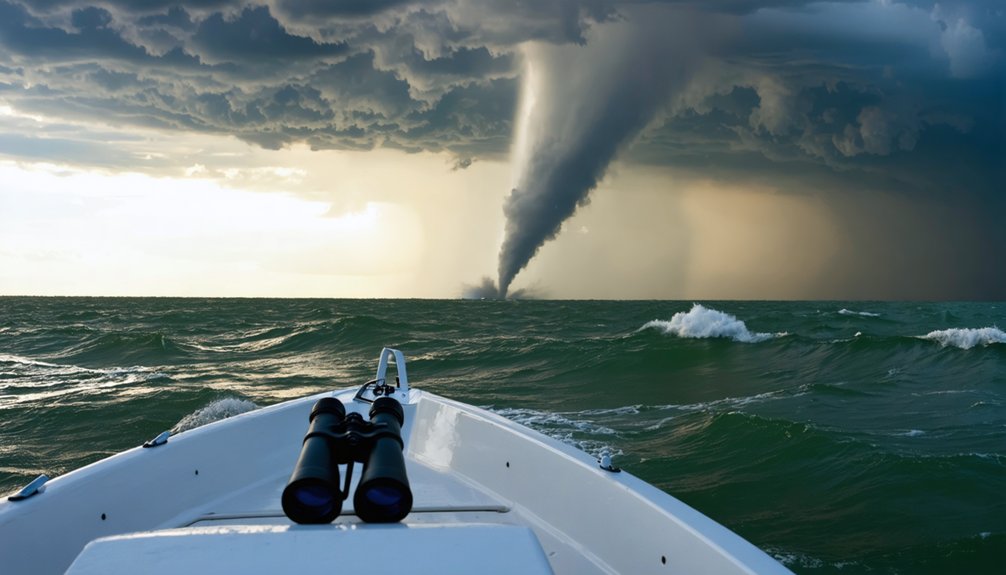
Knowing where to go only gets you halfway there — timing locks in the other half. Weather patterns and cloud formations shift fast, so you’ll need to align your chase window precisely.
Peak activity runs May through September, with daily opportunities concentrated between 12 PM and 5 PM, when surface heating maximizes instability. Watch for cumulus towers building rapidly — that’s your trigger.
Three conditions that sharpen your timing:
- A ~13°C temperature difference between sea surface and the 850 hPa level signals strong development potential
- Warm water beneath cool, unstable air accelerates vorticity stretching
- Rapidly developing cumulus cloud formations along subtle ocean boundaries indicate imminent waterspout activity
You’re chasing a narrow window. Miss the thermal peak, and you’ll likely miss the spout entirely.
Tools Serious Chasers Use to Forecast Waterspouts
Forecasting waterspouts demands more than watching the sky — you’ll need quantitative tools that translate atmospheric data into actionable probability. Start with the Szilagyi Waterspout Index, which calculates likelihood using measurable instability parameters. A temperature differential of roughly 13°C between sea surface and the 850 hPa level signals favorable development conditions.
Layer in historical records for your target area, since weather patterns repeat across seasons and locations with documented frequency. Cross-reference sea surface temperature charts, skew-T log-P diagrams, and upper-air soundings to confirm vertical instability.
Real-time radar helps you identify developing cumulus towers and surface boundaries.
Combining these tools gives you a decisive edge — you’ll move from passive observation to calculated positioning, maximizing your viewing opportunity while maintaining the situational awareness that keeps you mobile and safe.
Reading the Signs Before a Waterspout Appears
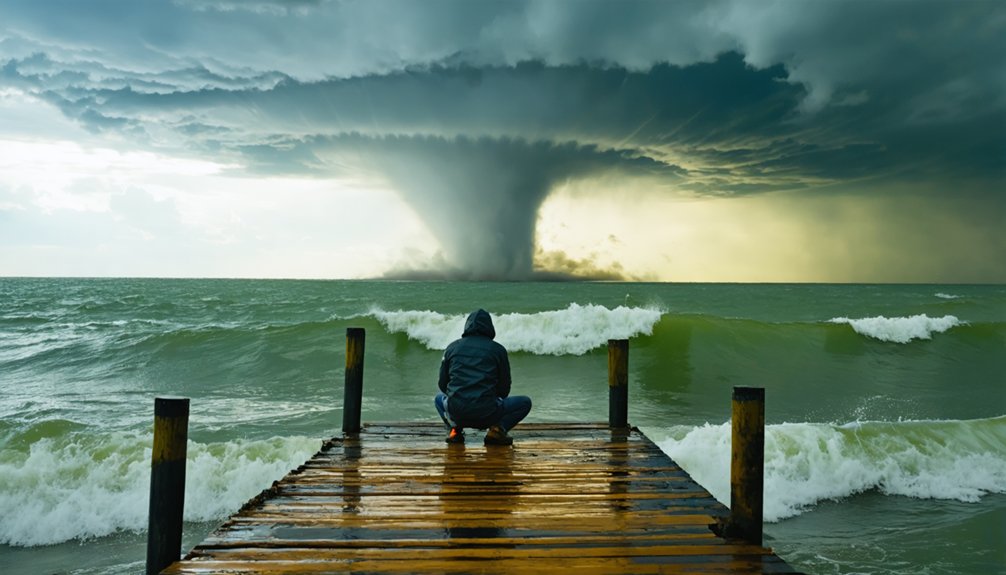
Your forecasting tools narrow the window — now your eyes close the gap. Like historical anecdotes passed between seasoned chasers, recognizing pre-waterspout signatures carries real cultural symbolism in the chasing community — it separates observers from operators.
Watch for these sequenced visual cues:
- Dark spot: A shadow-like patch forms on the water surface, marking the vortex anchor point
- Spray ring: Water spirals outward from the dark spot as surface convergence tightens
- Funnel development: A visible condensation tube builds upward from the surface toward the cumulus base
Each stage compresses fast — often under minutes. Converging surface winds, warm water beneath cool unstable air, and a strengthening updraft drive this sequence. You’re not waiting passively; you’re reading a dynamic system in real time.
Gear and Skills You Need to Chase Waterspouts Safely
Chasing waterspouts demands more than curiosity — you’ll need the right equipment and sharpened skills before you’re anywhere near open water. Equip your vessel with a VHF marine radio, GPS, and a reliable anemometer to monitor wind shifts near 35 knots. Carry polarized optics and a camera with a fast shutter speed to document formations accurately.
Study historical sightings to identify regional hotspot patterns — Florida Keys data and Great Lakes records both reveal repeatable seasonal windows. Understanding the cultural significance of storm chasing sharpens your situational awareness; experienced chasers treat positioning discipline as non-negotiable.
Always apply the 90-degree rule, moving perpendicular to a waterspout’s projected path. Master the Szilagyi Waterspout Index and monitor the 13°C sea-surface-to-850-hPa temperature differential before launching.
How to Position Your Boat Safely During a Waterspout Chase
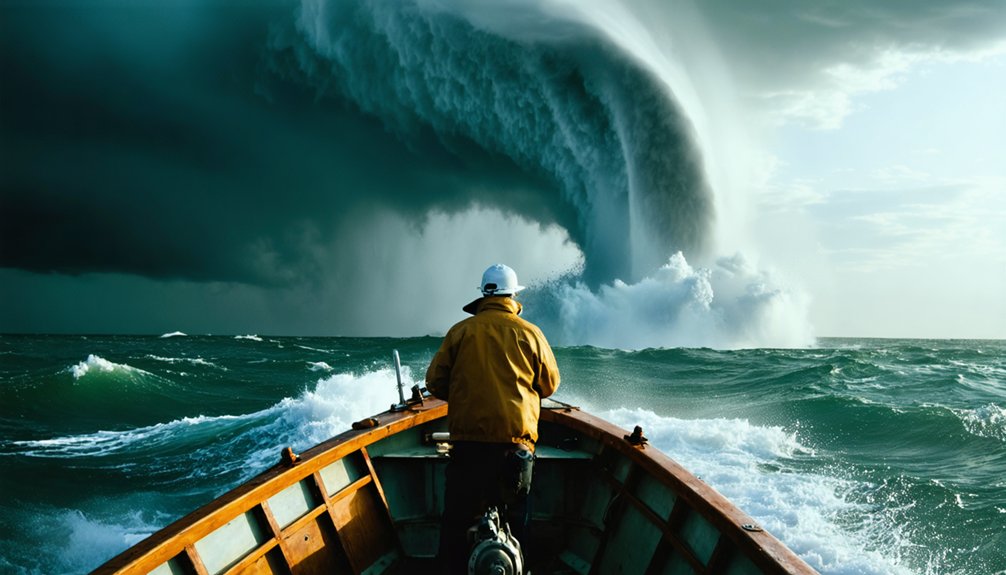
Once you’ve confirmed a waterspout’s projected track, move your vessel at a 90-degree angle to that path — it’s the single most reliable way to stay clear of the vortex without losing visual contact. Marine navigation skills and real-time weather forecasting data work together here, letting you react before conditions shift.
Move perpendicular to a waterspout’s track — navigation skills and live weather data keep you one step ahead.
Keep these positioning rules tight:
- Monitor movement speed — waterspouts travel roughly 10–15 knots, so calculate drift continuously
- Maintain escape distance — close approaches become dangerous fast since waterspouts shift with little warning
- Watch for families — multiple waterspouts can form along the same boundary simultaneously
Your boat’s maneuverability is your primary safety asset. Treat every positioning decision as dynamic, not fixed — the vortex won’t stay predictable, and your freedom depends on staying mobile.
Speed, Movement, and What Happens When One Gets Close
When one gets close, wind speeds can reach roughly 35 knots, generating dangerous spray and choppy seas.
Unlike aerial maneuvers where altitude provides separation, you’ve got no vertical escape on open water.
The waterspout can stall, juke sideways, or accelerate — all without warning.
Maintain your 90-degree angle to its projected path, watch the spray ring’s behavior for directional cues, and never assume a slowing vortex means a dying one.
Frequently Asked Questions
Can Waterspouts Move Onto Land and Become Tornadoes?
Yes, waterspouts can move onshore and evolve into tornadoes. As these marine phenomena reach land, atmospheric vortices maintain rotation, intensifying hazardously. You’ll notice wind speeds escalating beyond EF0 thresholds, so you must track movement and reposition immediately.
Have Any Chasers Ever Been Seriously Injured Pursuing Waterspouts?
Documented serious injuries remain rare, but you can’t ignore waterspout safety risks. Waterspout formation happens fast, leaving little warning time. Winds near 35 knots and sudden shifts can capsize vessels, threatening anyone positioned incorrectly.
Do Waterspouts Ever Pick up Fish or Other Marine Life?
Yes, waterspouts can lift fish, displace marine ecosystem inhabitants, and enable fish transportation across distances. You’ve likely heard of fish “raining” inland — that’s real, documented phenomenon tied directly to waterspout vortex intensity and suction dynamics.
Is a Special Boating License Required for Waterspout Chasing Activities?
No special license exists specifically for waterspout chasing, but you’ll still need to meet standard marine safety and licensing requirements for your vessel type, jurisdiction, and operating waters before you pursue any chasing activity.
Can Multiple Waterspouts Merge Together Into One Larger Vortex?
You won’t typically see waterspouts merge; vortex dynamics generally keep them separate. Waterspout formation favors independent circulations, and documented merging events remain rare. You’re more likely to encounter family outbreaks of distinct, simultaneous funnels instead.
References
- https://www.youtube.com/watch?v=EBGgnwwXO7k
- https://www.icwr.ca/top-waterspout-hunters.php
- https://www.pbs.org/wgbh/americanexperience/features/mr-tornado-thrill-chase/
- https://crazystormchasers.com/experiencing-waterspouts-a-professional-storm-chasers-journey/
- https://www.youtube.com/watch?v=Bqx9ZHKu9Z0
- https://www.youtube.com/watch?v=IHkCJGmhNG4
- https://www.youtube.com/watch?v=-FesZtXkZa4
- https://crazystormchasers.com/chasing-waterspouts-conservationist-guide/