Storm chasing traces back to 1953, when Roger Jensen first intercepted storms out of pure curiosity. By 1956, David Hoadley was using weather-office and airport data to systematically track storms. These early chasers relied on printed maps and direct observation — no radar, no GPS, no real-time data. The discipline formalized in the 1970s, eventually exploding into mainstream culture after 1996. If you want the full picture, there’s a lot more ground to cover.
Key Takeaways
- Storm chasing began in 1953 with pioneers like Roger Jensen, driven by scientific curiosity rather than fame or media attention.
- David Hoadley conducted systematic storm interception in 1956, using weather-office and airport data to track storms.
- The 1970s marked a major shift, transitioning storm chasing from a hobby to a formal scientific discipline.
- The University of Oklahoma and NSSL launched the Tornado Intercept Project on April 19, 1972, establishing organized storm research.
- The 1996 film “Twister” dramatically increased public interest, boosting hobbyist participation without formal meteorological training.
When Did Storm Chasing Actually Begin?
Pinpointing exactly when storm chasing began depends on whether you’re counting individual curiosity or organized pursuit. Roger Jensen identified himself as a recreational chaser as early as 1953, driven by hobbyist motivations rooted in direct observation rather than institutional research.
David Hoadley followed in 1956, systematically leveraging weather-office and airport data — early meteorological innovations that gave field observers a functional, if rudimentary, analytical foundation.
Neither operated within a formal program. They chased independently, relying on personal initiative and available surface data.
If you define storm chasing by organized, team-based fieldwork, the University of Oklahoma and the National Severe Storms Laboratory’s Tornado Intercept Project, launched April 19, 1972, marks the cleaner starting point.
The distinction matters because it separates individual passion from structured, repeatable scientific methodology.
The First Storm Chasers and What Drove Them
The earliest storm chasers weren’t chasing fame or viral footage — they were driven by raw scientific curiosity and a need to observe convective systems up close. You can trace the hobby’s roots to figures like Roger Jensen in 1953 and David Hoadley, who began systematic chasing in North Dakota in 1956 using weather-office and airport data as his primary tools.
These pioneers relied on rudimentary instruments, printed weather maps, and direct field observation — long before mobile radar or real-time data feeds existed.
Early Chasers And Motivations
Before storm chasing became an organized scientific discipline, a handful of individuals pursued severe weather out of personal curiosity with little more than road maps and a willingness to drive toward danger.
Historical misconceptions often frame these early chasers as reckless thrill-seekers, but their motivations were grounded in genuine observational interest. Roger Jensen began chasing recreationally in 1953, while David Hoadley started systematically intercepting storms in North Dakota in 1956, using weather-office and airport data to position himself effectively.
Cultural influences shaped their pursuits differently than today’s media-driven landscape. You’d find no mobile radar, no GPS, no livestreams — just raw field observation.
Neil B. Ward approached chasing scientifically during the 1950s and 1960s, establishing early frameworks for understanding thunderstorm structure that formal research programs would later build upon.
Key Pioneering Figures
Among the earliest figures to define storm chasing as a practice, David Hoadley, Roger Jensen, and Neil B. Ward shaped the field through independent drive and field observation — not institutional mandates.
These historical pioneers each contributed distinctly:
- Roger Jensen began recreational chasing in 1953, driven by personal curiosity
- David Hoadley started in 1956 in North Dakota, using airport and weather-office data systematically
- Hoadley founded *Storm Track* magazine, establishing early cultural influences and community identity
- Neil B. Ward pioneered scientific chasing in the 1950s–60s, coordinating with highway patrol for structured storm access
- Ward developed foundational ideas about thunderstorm and tornado structure, earning recognition as the first scientific storm chaser
You can trace today’s chasing culture directly back to their independent, curiosity-driven fieldwork.
Tools And Observation Methods
Early storm chasers worked without radar, mobile communication, or real-time satellite data — yet they still intercepted significant storms. You’d have relied on weather-bureau surface analyses, airport observations, and manual map plotting to position yourself. There was no remote sensing accessible in the field, no predictive modeling running on a laptop — just printed charts, telephone briefings, and educated instinct.
David Hoadley systematically gathered weather-office and airport data before each chase, building forecasts by hand. Neil B. Ward coordinated with highway patrol to extend his observational range. These methods demanded disciplined pattern recognition and precise spatial reasoning.
You’d to commit to a target location hours in advance, with no dynamic rerouting. The data was sparse, the margin for error was narrow, and the results still advanced storm science meaningfully.
How Scientists Took Storm Chasing Seriously
Though individual chasers had been observing storms since the 1950s, the scientific community didn’t formalize storm chasing until the early 1970s. Meteorological advancements and community collaborations made structured fieldwork possible, shifting chasing from solo curiosity to disciplined research.
Key milestones that legitimized scientific storm chasing:
- 1972: The University of Oklahoma and NSSL launched the Tornado Intercept Project
- April 19, 1972: The project’s first official storm-intercept outing occurred
- Neil B. Ward pioneered scientific chasing in the 1950s–1960s with highway patrol support
- 1973: The Union City, Oklahoma tornado became a landmark case study in supercell morphology
Team-based fieldwork replaced individual observation, establishing repeatable intercept methodologies.
These structured programs gave you a framework that transformed raw field data into actionable scientific understanding of tornado and supercell behavior.
The Tornado Intercept Project and the Science of Storm Chasing
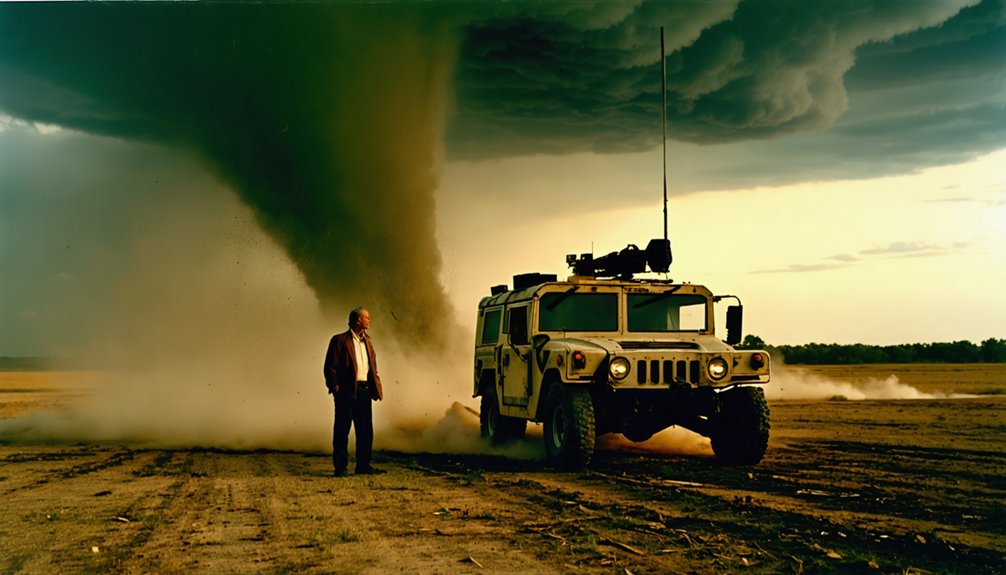
On April 19, 1972, you can trace the formal launch of organized tornado research to the University of Oklahoma and the National Severe Storms Laboratory’s Tornado Intercept Project.
The following year, the 1973 Union City, Oklahoma tornado became a critical case study, giving researchers their first systematic look at supercell morphology and tornado structure.
These events together established the field protocols and data-collection standards that you’d recognize as the foundation of all modern storm-intercept research.
Project Origins And Launch
By 1972, storm chasing had shifted from informal individual pursuits into structured, team-based scientific fieldwork. The University of Oklahoma and the National Severe Storms Laboratory launched the Tornado Intercept Project, a milestone in meteorological innovations that redefined field research.
The first official outing launched on 19 April 1972, establishing protocols that fueled community development among researchers and hobbyists alike.
Key project fundamentals included:
- Institutional backing from the University of Oklahoma and NSSL
- Targeted interception of severe convective storms and tornadoes
- Team-based coordination replacing solo observation
- Systematic data collection on storm structure and behavior
- Defined safety and approach protocols for field operations
You can trace nearly every modern chase campaign directly back to this foundational framework, which transformed chasing into a disciplined, repeatable scientific methodology.
The 1973 Union City Tornado
Just one year after the Tornado Intercept Project launched, the 1973 Union City, Oklahoma tornado handed researchers a defining case study that reshaped how scientists understood supercell morphology and tornado structure. The intercept teams documented the tornado’s full lifecycle with unprecedented field data, giving researchers concrete evidence of how storm patterns develop within supercell environments.
That documentation proved critical for analyzing how climate influence shapes the conditions that produce rotating thunderstorms across the central plains. You can trace much of modern tornado science directly back to what researchers recorded that day.
The Union City event didn’t just validate the Tornado Intercept Project’s methodology — it established a replicable scientific framework for studying severe convective storms, transforming storm chasing from field curiosity into a disciplined, data-driven research practice with measurable outcomes.
Shaping Modern Research Methods
What the Union City intercept proved wasn’t just scientific — it gave researchers a repeatable blueprint. Meteorological innovations that followed weren’t accidental; they emerged from structured fieldwork you can trace directly to that 1972–1973 framework. Community development accelerated as independent chasers adopted these methods.
The Tornado Intercept Project established core operational standards still referenced today:
- Coordinated multi-vehicle deployment around storm-relative positions
- Real-time data relay between field teams and laboratory analysts
- Systematic photographic and instrument-based documentation protocols
- Defined intercept corridors prioritizing both data collection and exit routes
- Shared debriefing structures that refined chase tactics after each event
These weren’t suggestions — they were field-tested procedures. You can draw a direct line from those early Oklahoma intercepts to every organized research campaign that followed.
Why the 1970s Turned Storm Chasing Into a Discipline
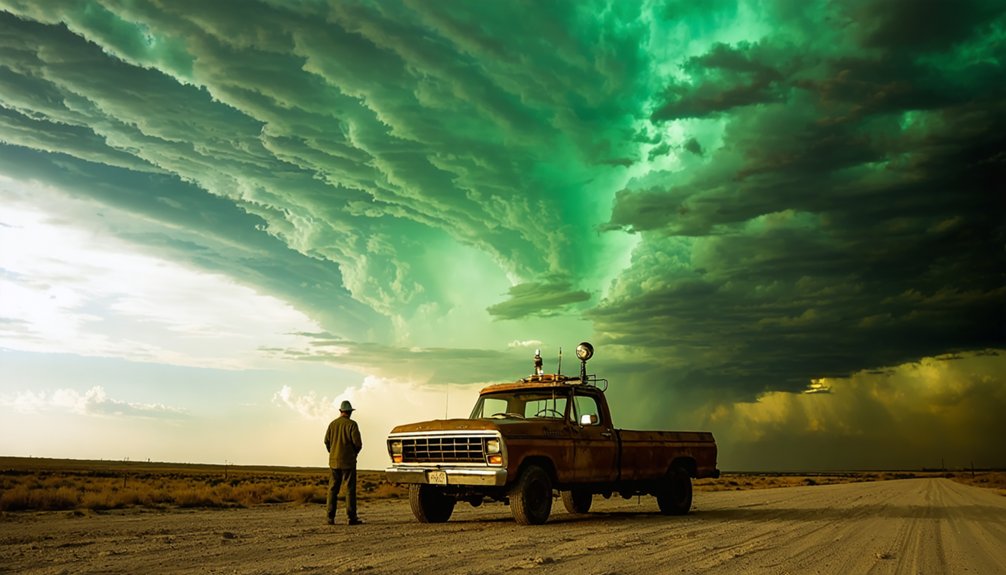
The 1970s didn’t just accelerate storm chasing—they restructured it entirely. Meteorological advancements gave researchers actual frameworks for interpreting supercell structure, and the 1973 Union City tornado delivered hard field data that validated those frameworks.
You’re no longer looking at scattered hobbyists guessing at storm behavior—you’re seeing coordinated teams applying defined intercept protocols.
The Tornado Intercept Project, launched in 1972, built the operational template every serious chaser still references. Community engagement grew alongside institutional backing, pulling independent observers into structured fieldwork rather than isolated pursuits.
That combination of university resources, federal support, and shared methodology transformed chasing from curiosity into discipline.
The decade handed you a repeatable science—documented intercepts, analyzed data, and standardized techniques that separated legitimate storm research from mere thrill-seeking.
How Twister Brought Storm Chasing Into the Mainstream
By the mid-1990s, storm chasing had built two decades of structured scientific methodology—then a single film rewired public perception overnight.
*Twister* (1996) leveraged meteorological advances as dramatic props, distorting field realities while igniting massive public curiosity. Its cultural influence reshaped who pursued chasing and why.
Key shifts following the film’s release:
- Hobbyist participation surged markedly beyond the established research community
- New chasers entered the field without foundational meteorological training
- Demand for storm-related media, photography, and video increased sharply
- Online forums and early internet platforms amplified the community’s reach
- Equipment access expanded as broader interest drove consumer-level technology forward
You can trace today’s crowded chase corridors directly to that moment. The film democratized access while simultaneously complicating the discipline’s scientific credibility.
How Better Tools Changed Who Could Chase Storms
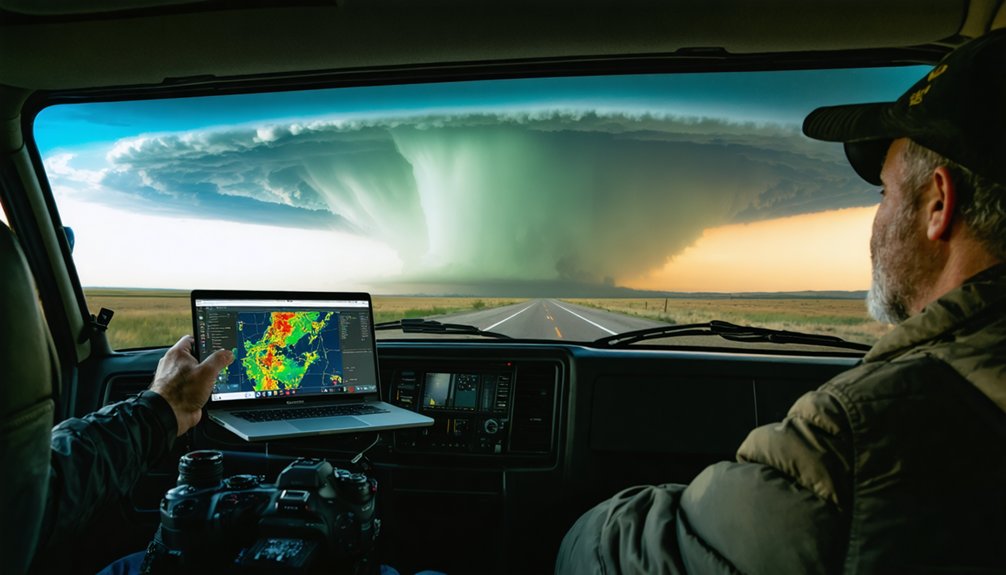
Once radar data moved from static National Weather Service terminals to mobile and internet-accessible platforms, the barrier to entry collapsed. You no longer needed institutional access or a university affiliation to track a supercell in real time.
Meteorological innovations like GR2Analyst, Spotter Network, and later RadarScope put WSR-88D Level-II data directly in your hands. GPS navigation eliminated the reliance on paper maps and local knowledge. Mobile hotspots kept you connected deep into rural terrain.
These tools didn’t just improve situational awareness — they redistributed power. Independent chasers could now operate with data quality matching research teams. That shift forced the community to develop clearer safety protocols, since more access meant more inexperienced people entering dangerous environments.
Better tools expanded freedom, but they also demanded greater personal responsibility.
Storm Chasing Then vs. Now
Putting all those tools together reveals just how sharply the practice has shifted since David Hoadley was pulling airport observation reports in 1956.
Meteorological innovations and community development have completely restructured what chasing looks like in the field.
Here’s a direct comparison:
- Navigation: paper maps vs. real-time GPS with storm-relative overlays
- Data access: delayed office reports vs. live NEXRAD radar on mobile devices
- Communication: CB radios vs. networked spotters sharing coordinates instantly
- Community development: *Storm Track* magazine’s small readership vs. global online chaser networks
- Documentation: handwritten notes vs. 4K video streamed live to thousands
You’re now operating with tools Hoadley couldn’t have imagined. The core drive remains identical, but your situational awareness, safety margins, and reach have expanded by every measurable standard.
Frequently Asked Questions
Is Storm Chasing Legal Everywhere in the United States?
Storm chasing is generally legal across the U.S., but you’re responsible for traffic laws. You can’t block roads during tornado safety events, and weather prediction tools don’t exempt you from local emergency restrictions.
How Much Does It Typically Cost to Go Storm Chasing?
Like chasing the wind, costs vary widely—you’ll typically spend $500–$1,500 per week on fuel, gear, and lodging. Storm chasing history shows hobby evolution shifting expenses higher as technology demands grow increasingly essential.
Are There Formal Certifications or Training Programs for Storm Chasers?
No formal certifications exist, but you’ll find training programs like Storm Spotter classes through SKYWARN. You can sharpen your storm chasing safety skills and storm chasing technology knowledge through workshops, online courses, and field mentorships independently.
Have Any Famous Storm Chasers Died While Pursuing Tornadoes?
Playing with fire, yes, famous storm chasers have died pursuing tornadoes. Storm chasing risks are real — Tim Samaras perished in 2013. You must follow tornado safety guidelines strictly to avoid fatal consequences.
Can Ordinary People Join Organized Storm Chasing Tours as Participants?
You can join organized storm chasing tours as a paying participant. You’ll experience real-time storm chasing technology, including mobile radar and GPS tracking, while trained guides manage storm chasing safety protocols, giving you freedom to observe tornadoes firsthand.
References
- https://en.wikipedia.org/wiki/Storm_chasing
- https://www.rmets.org/metmatters/history-storm-chasing
- https://survive-a-storm.com/blog/the-history-of-storm-chasing/
- https://www.youtube.com/watch?v=uRQ-nTTCazo
- https://www.tornadosimulator.net/storm-chasers-full-history/
- http://ndtornado.com/primary/history.htm
- https://collectiveweather.com/a-history-of-storm-chasers-and-storm-chasing/
- https://journals.ametsoc.org/view/journals/wefo/14/4/1520-0434_1999_014_0558_ahossi_2_0_co_2.xml
- https://www.pbs.org/newshour/science/inside-the-dangerous-and-unpredictable-science-of-storm-chasing
- https://stormtrack.org/threads/history-of-storm-chasing-back-to-day-one.32873/