When you trace tornado research back to its roots, you’ll find TOTO, a 1979 portable weather station designed to capture real-time pressure, wind speed, and humidity data directly inside a tornado’s path. Its high center of gravity caused it to topple in a 1985 Oklahoma field test, exposing critical structural flaws. Those failures directly inspired Dorothy in *Twister* and reshaped modern probe design. There’s far more to this story than one collapsed barrel.
Key Takeaways
- TOTO, developed in 1979, was a portable weather station designed to collect in-situ tornado data on pressure, wind speed, and humidity.
- TOTO’s high center of gravity caused it to topple during a 1985 field test near Ardmore, Oklahoma, revealing critical structural flaws.
- Dorothy, from the film *Twister*, was inspired by TOTO but featured hundreds of individual sensors, unlike TOTO’s single-barrel design.
- Tornado research probes evolved from single heavy instruments to lightweight, distributed sensor networks prioritizing safety and real-time data acquisition.
- Modern advancements include mobile Doppler radar and model rocket-launched sensors, improving wind structure resolution and live data streaming capabilities.
What Was TOTO and Why Did It Matter?
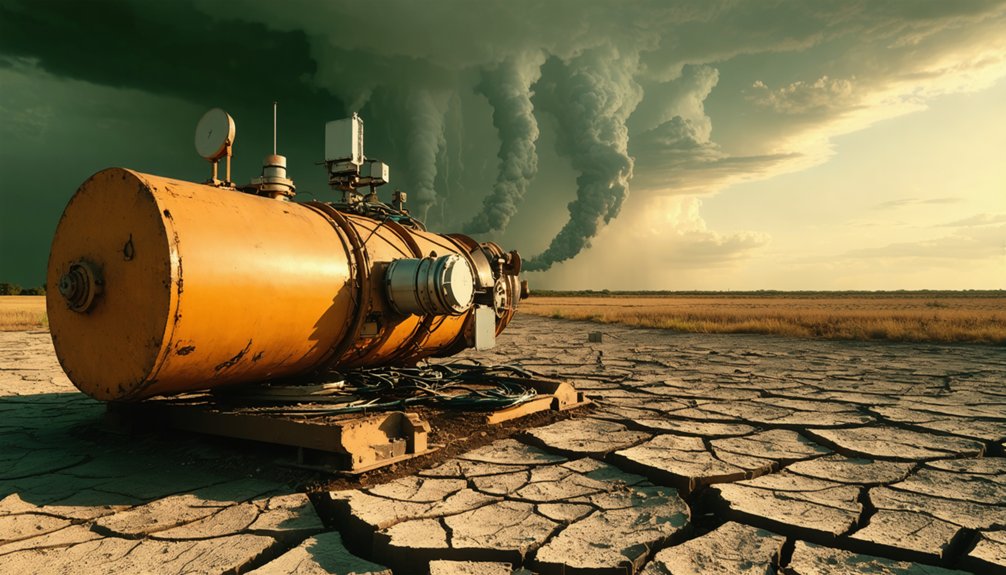
In 1979, Dr. Al Bedard and Carl Ramzy of NOAA’s Environmental Technology Laboratory, alongside Dr. Howard Bluestein at the University of Oklahoma, developed TOTO — the TOtable Tornado Observatory.
You can think of it as a 55-gallon, barrel-shaped portable weather station packed with anemometers, pressure sensors, and humidity detectors. Researchers designed it to sit directly in a tornado’s path and capture real-time tornado data on pressure, wind speed, wind direction, temperature, and humidity.
Before TOTO, scientists had no reliable method for obtaining direct in-situ measurements from active tornadoes. That gap made accurate tornado modeling nearly impossible.
The TOTO legacy matters because it represented the first serious engineering attempt to bring instrumentation inside one of nature’s most destructive forces, fundamentally shifting how researchers approached extreme storm observation.
The Sensors and Deployment Logistics Behind TOTO
When you examine TOTO’s internal architecture, you find a compact but capable array of anemometers, pressure sensors, and humidity sensors engineered to capture real-time atmospheric data from within a tornado’s core.
To deploy it, you’d position the 400-pound barrel-shaped unit directly in a tornado’s projected path, activate it, and retreat—leaving the device to record in-situ measurements as the storm passed over.
However, TOTO’s high center of gravity, recovery logistics, and the precision required to intercept a tornado’s narrow track made successful deployment far more operationally demanding than the concept initially suggested.
TOTO’s Built-In Sensors
TOTO packed five core sensor types into its 55-gallon barrel frame: anemometers to capture wind speed and direction, pressure transducers, temperature probes, and humidity sensors. Each instrument fed data into an onboard recording system designed to log measurements continuously as a tornado passed directly overhead.
The data collection strategy relied on direct in-situ sampling, meaning the device had to physically occupy the tornado’s path. You can appreciate why that mattered — remote sensing couldn’t yet resolve near-surface pressure drops or wind shear gradients at the scale researchers needed.
TOTO’s embedded sensors theoretically gave scientists ground-truth readings no radar could produce. The challenge wasn’t instrumentation design; it was survivability. Without stable ground contact during extreme wind loading, the sensors collected nothing useful.
Deployment Process Explained
Deploying TOTO required a narrow window of decision-making under extreme time pressure. You’d position the 400-pound barrel directly in a tornado’s projected path, activate its sensors, then evacuate immediately.
Deployment strategies centered on storm intercept angles, road grid limitations, and real-time tornado tracking — all variables shifting simultaneously.
Sensor placement determined data quality entirely. You needed the anemometers, pressure transducers, and humidity sensors oriented correctly before abandonment. Any misalignment compromised the dataset.
Once you set TOTO down and fled, you lost all control over the outcome.
The core problem was binary: either the tornado hit TOTO precisely, or it didn’t. There was no adjustment possible post-deployment.
That unforgiving operational reality, combined with TOTO’s dangerously high center of gravity, made consistent data collection nearly impossible.
Logistical Challenges Faced
Beyond the split-second decisions of storm intercept, the underlying logistics of TOTO’s sensor array created compounding operational failures. You’re working with a 400-pound barrel-shaped instrument package, embedding anemometers, pressure sensors, and humidity sensors into a single fixed unit. That design concentration created critical deployment difficulties — one failed placement meant zero data recovery.
The logistical hurdles extended beyond weight and positioning. TOTO’s high center of gravity made stable placement nearly impossible under extreme wind loads.
Recovery operations after deployment required dangerous re-entry into post-storm environments. You couldn’t distribute risk across multiple units because the entire sensor suite occupied one structure. Each attempted intercept demanded precise road positioning, rapid manual activation, and immediate vehicle retreat — variables that compounded failure probability with every field operation throughout the 1980s.
TOTO’s Closest Call and Why It Failed
On April 29, 1985, near Ardmore, Oklahoma, you’d witness TOTO’s most significant field test, as the team deployed the instrument package into the edge of a weak tornado.
The device toppled over almost immediately, its high center of gravity making it structurally incompatible with the extreme wind loads it was designed to measure.
That single failure exposed the core engineering contradiction in TOTO’s design: a 400-pound, barrel-shaped probe couldn’t maintain stable ground contact in the very conditions it needed to survive.
Ardmore’s Near Miss
Although TOTO logged several field deployments throughout the 1980s, its closest brush with a real tornado came on April 29, 1985, near Ardmore, Oklahoma. Researchers intercepted a weak tornado and managed to position the instrument package directly in its projected path.
However, the Ardmore tornado exposed critical deployment challenges almost immediately. TOTO’s high center of gravity made it structurally vulnerable, and the powerful winds knocked the device over before it could capture meaningful core data.
You can see the core problem here: a 400-pound instrument package becomes useless the moment it tips. The device failed to maintain an upright position, yielding incomplete measurements. That single mechanical flaw effectively nullified years of logistical effort, confirming that TOTO’s fundamental design couldn’t withstand the very conditions it was engineered to measure.
TOTO Topples Over
The April 29, 1985 deployment near Ardmore didn’t just expose a single bad outcome—it crystallized every structural weakness built into TOTO from the beginning.
When the weak tornado‘s winds struck, TOTO toppled, killing any chance of meaningful data collection.
Three core failures drove that collapse:
- Its high center of gravity made it structurally unstable under real tornado dynamics.
- Its 400-pound frame functioned as an oversized lightning rod, threatening anyone nearby.
- Recovery after deployment required dangerous close-range re-entry into active storm zones.
You’re looking at a device that couldn’t survive the exact conditions it was built to measure.
Design Flaws Exposed
When TOTO toppled near Ardmore on April 29, 1985, it didn’t just fail in the field—it exposed three interlocking design flaws that made operational success structurally impossible.
First, its elevated center of gravity made it inherently unstable against extreme rotational winds.
Second, its 400-pound metallic frame created serious safety concerns, fundamentally functioning as a stationary lightning rod in an electrically active storm environment.
Third, recovery logistics after deployment demanded dangerous close-range reentry into a post-tornado debris field.
These design limitations compounded each other: you couldn’t stabilize it, you couldn’t safely position it, and you couldn’t efficiently retrieve it.
TOTO’s architecture prioritized sensor capacity over operational survivability—a critical miscalculation.
Each deployment attempt didn’t just risk the equipment; it risked the researchers executing the mission.
Why TOTO’s Design Couldn’t Survive Tornado Conditions
Despite its innovative concept, TOTO’s physical design carried critical structural vulnerabilities that made survival in a tornado’s core nearly impossible.
Its design limitations became brutally apparent when you examine how tornado dynamics actually interact with large, top-heavy structures.
Three structural failures defined TOTO’s collapse:
- High center of gravity — The barrel-shaped, 400-pound frame couldn’t resist rotational wind forces.
- Insufficient anchoring — No ground-stabilization system existed to counter lateral wind loading.
- Lightning rod effect — Its metal construction attracted dangerous electrical discharge during storm penetration.
These compounding weaknesses meant TOTO couldn’t withstand the very environment it was engineered to measure.
You’re fundamentally placing an unstable instrument package directly into winds exceeding 100 mph — physics wins every time.
How TOTO Inspired Dorothy in *Twister
TOTO’s real-world failures didn’t kill the concept — they repackaged it for Hollywood. When screenwriters Michael Crichton and Ann Marie Martin developed *Twister* in 1996, they pulled directly from TOTO’s legacy to build Dorothy.
Unlike TOTO’s single-barrel design, Dorothy deployed hundreds of individual sensors into a tornado’s funnel, amplifying the original mission into something cinematically viable. That cinematic inspiration transformed a retired, 400-pound probe into a dramatic sensor array that resonated with millions.
Dorothy — and its successor D.O.T. — weren’t direct replicas; they were engineered escalations of TOTO’s core objective: get instrumentation inside the vortex.
You can trace every fictional data-capture sequence in *Twister* back to the same scientific ambition that drove Bedard, Ramzy, and Bluestein onto Oklahoma’s storm-swept plains decades earlier.
How Tornado Research Probes Work Today?
Since TOTO’s retirement in 1987, tornado research probes have evolved dramatically — shifting from single, heavy instruments to distributed networks of compact, lightweight sensors.
Today’s tornado detection methods prioritize coverage, safety, and real-time data acquisition over brute-force placement.
Modern sensor technology advances have produced three key operational improvements:
- Mobile Doppler radar now resolves wind structures at scales under 1 meter in select storm environments.
- Model rocket-launched sensors deployed in 2019 streamed live tornado data directly to armored vehicles.
- Wide-area sensor arrays replace single-probe dependency, dramatically increasing interception probability.
You’re looking at a field that’s moved from dangerous, low-yield deployments to agile, distributed systems that extract precise atmospheric measurements while keeping researchers out of immediate harm’s way.
Frequently Asked Questions
What Other Films or Media Have Featured Tornado Research Equipment as Inspiration?
You’ll find storm chasing cinematic realism primarily in *Twister* (1996), which directly adapted TOTO’s research technology. Tornado documentaries like IMAX’s *Stormchasers* also feature authentic instrument deployments, giving you analytically accurate portrayals of real data-driven field operations.
Did Any TOTO Researchers Face Serious Injuries During Field Deployments?
Like walking a tightrope, TOTO’s deployments kept researchers on edge, yet injury statistics don’t document serious harm. You’d find field safety concerns—not casualties—ultimately drove TOTO’s 1987 retirement, as logistical and safety risks outweighed its scientific returns.
How Much Did Developing and Building TOTO Originally Cost Taxpayers?
The available records don’t specify TOTO’s exact taxpayer funding costs. You can acknowledge, however, that the research benefits derived from NOAA’s investment helped advance tornado science, ultimately justifying whatever public resources supported its development.
Were There Competing Tornado Probe Designs Developed Alongside TOTO Simultaneously?
The knowledge base doesn’t confirm competing tornado probe designs or competing technologies developed alongside TOTO. You’d need external sources to verify parallel research efforts, as available data covers only TOTO’s development, deployments, and retirement timeline.
Did Howard Bluestein Consult Directly on the *Twister* Film Production?
The knowledge base doesn’t confirm Bluestein’s direct consultation. You’ll note Twister Accuracy drew from TOTO’s design conceptually, but Bluestein’s Influence appears indirect—screenwriters Crichton and Martin adapted the probe concept without documented direct technical advisory confirmation here.
References
- https://z94.com/toto-tornado-probe-oklahoma-history/
- https://en.wikipedia.org/wiki/TOtable_Tornado_Observatory
- https://twister.fandom.com/wiki/Dorothy
- https://www.accuweather.com/en/severe-weather/twister-1996-toto-inspired-dorothy/945075
- https://www.okhistory.org/qr/index.php?no=71
- https://www.reddit.com/r/weather/comments/20q4dv/serious_question_why_hasnt_anything_like_dorothy/
- https://screenrant.com/how-dorothy-works-in-twister-movie/
- https://www.tiktok.com/@twister_fanatics/video/7503648814289489182?lang=en
- https://www.noaa.gov/stories/noaa-tornado-scientists-inspired-twister-creators-20-years-ago
- https://www.facebook.com/groups/severewxupdates/posts/5000500770068200/