Three University of Oklahoma meteorology students—Nicholas Nair, Gavin Short, and Drake Brooks—didn’t die in a storm-chasing incident. They died when their vehicle hydroplaned on rain-soaked I-35, spun into a barrier wall, and became disabled crossways across the roadway. An oncoming tractor-trailer couldn’t stop in time, causing a catastrophic collision. Rescuers needed over five hours to reach them amid severe weather and heavy structural damage. There’s far more to this tragedy than the headlines captured.
Key Takeaways
- Three OU meteorology students—Nicholas Nair, Gavin Short, and Drake Brooks—died in a vehicle accident on Interstate 35 during a storm chasing trip.
- Their vehicle hydroplaned on wet roads, struck a barrier wall, and became disabled crosswise, leaving it directly in the path of oncoming traffic.
- A tractor-trailer collided with the immobilized vehicle, unable to stop in time, causing catastrophic and fatal impact.
- Classmates detected the crash in real time when a static GPS location indicated the students had stopped moving unexpectedly.
- The tragedy prompted the storm chasing community and OU to reassess safety protocols and acknowledge travel-related risks beyond severe weather itself.
What Happened to the Three OU Students?
Three University of Oklahoma meteorology students—Nicholas Nair, 20, Gavin Short, 19, and Drake Brooks, 22—died late Friday night after their vehicle hydroplaned on Interstate 35 near Tonkawa, Oklahoma, roughly 85 miles north of Oklahoma City.
The southbound vehicle struck a barrier wall, leaving it disabled across the roadway. A tractor-trailer then collided with the immobilized vehicle, trapping all three occupants for over five hours before first responders could extricate them. Authorities pronounced all three dead at the scene.
You should understand that storm safety extends beyond the chase itself—the return trip carries equal risk. The students had just documented a Kansas tornado near Herington, raising questions about meteorology ethics surrounding fatigue-driven travel decisions after high-intensity field operations.
Their classmates noticed the vehicle’s location stopped moving on I-35, triggering the initial alert.
Who Were Nicholas Nair, Gavin Short, and Drake Brooks?
Nicholas Nair, Gavin Short, and Drake Brooks were University of Oklahoma meteorology students whose backgrounds reflected both geographic diversity and a shared commitment to atmospheric science.
Nair, 20, came from Denton, Texas, and contributed weather reports to OU’s Nightly newscast, demonstrating early investment in meteorology careers.
Nair, a 20-year-old Denton, Texas native, reported weather for OU’s Nightly newscast, signaling his early dedication to meteorology.
Short, 19, traveled from Grayslake, Illinois, while Brooks, 22, came from Evansville, Indiana.
All three were actively developing field skills through storm chasing, a standard component of atmospheric science training.
Their Friday chase near Herington, Kansas, followed routine protocols classmates recognized immediately.
Nair and Short posted tornado footage to social media shortly before the crash.
Their deaths highlight the tension between pursuing meteorology careers and maintaining storm safety during active weather operations on open roadways.
What Storm Chasing Actually Looks Like for OU Meteorology Students
When you study meteorology at the University of Oklahoma, storm chasing isn’t a reckless hobby — it’s a structured, data-driven field exercise you undertake using tools like mobile Doppler radar, GPS tracking apps, and real-time atmospheric modeling software.
You monitor supercell development, track mesocyclone rotation, and position your vehicle to intercept storms at calculated angles while maintaining escape routes.
On the night of May 9, 2024, Nicholas Nair, Gavin Short, and Drake Brooks were doing exactly this — executing a textbook intercept near Herington, Kansas, before their southbound return ended in tragedy.
Chasing Storms for Class
For meteorology students at the University of Oklahoma, storm chasing isn’t a dramatic extracurricular thrill — it’s structured fieldwork embedded in their academic training.
Meteorology education at OU integrates real-world observation into coursework, meaning you’re expected to collect atmospheric data directly from active weather systems.
Storm chasing ethics guide how students operate in the field:
- You maintain safe distances while documenting tornadoes and severe convective systems
- You coordinate positioning using radar data, forecasting models, and team communication
- You document findings through video, sensor readings, and structured field notes
- You accept calculated risk as part of professional atmospheric science training
Friday chases in Oklahoma and Kansas weren’t unusual — they were routine.
Nair, Short, and Brooks operated within that exact framework when they tracked the Herington, Kansas tornado.
Tools Student Chasers Use
A laptop running GR2Analyst or Gibson Ridge software sits at the center of every student chaser’s setup — you’re pulling live Level II radar data, analyzing storm structure, and making real-time positioning decisions based on what the reflectivity and velocity scans show.
You’re also running Spotter Network to broadcast your GPS location, keeping the broader chasing community aware of your position. SiriusXM satellite weather feeds into your mobile setup, giving you real-time mesoscale data independent of cell coverage.
Safety measures demand you monitor multiple data streams simultaneously — storm motion vectors, forward speed, and escape routes. You’re cross-referencing surface observation networks while communicating through ham radio frequencies.
Every tool serves a precise function: storm chasing isn’t passive observation — it’s active, calculated field research requiring disciplined situational awareness at every moment.
Tracking Real-Time Weather Events
Storm chasing for OU meteorology students isn’t a casual field trip — it’s a structured, high-pressure exercise in real-time atmospheric analysis.
You’re continuously monitoring weather patterns, adjusting position, and making split-second decisions based on live radar data.
Core tracking methods include:
- Mobile radar apps like RadarScope for real-time storm cell movement
- Spotter Network to share and receive live positional data with other chasers
- Mesoscale Discussions from the Storm Prediction Center flagging severe storm safety threats
- Social media coordination — Nair and Short posted tornado footage near Herington, Kansas, minutes before the fatal crash
Your classmates track your location through shared updates.
When Nair’s vehicle stopped moving on I-35, that frozen position immediately signaled something was catastrophically wrong.
What Nair and Short Were Chasing in Kansas Before the Crash?
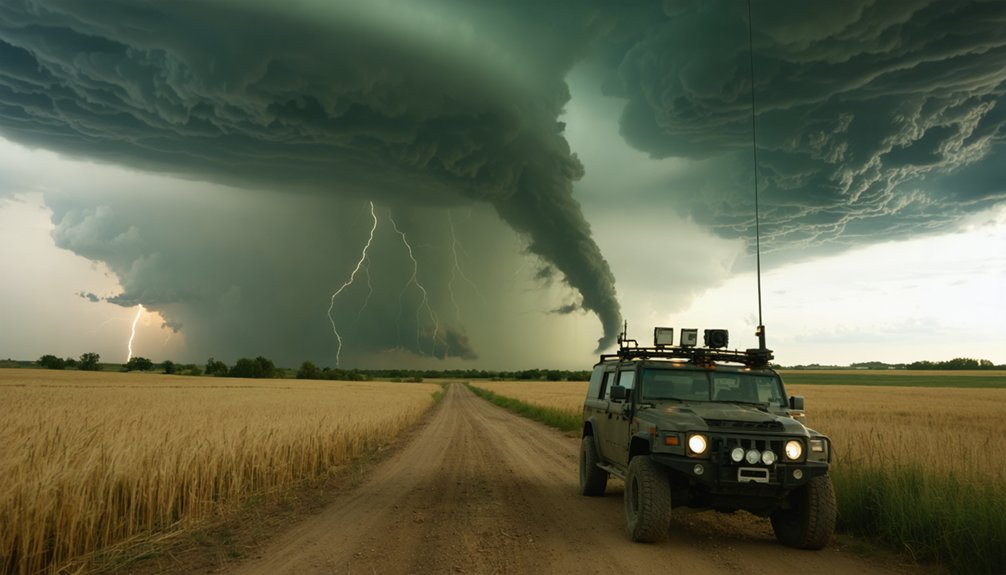
Before the fatal crash on Interstate 35, Nair and Short were chasing a powerful tornado near Herington, Kansas. You’d recognize this as serious fieldwork — both students documented tornado dynamics firsthand, capturing and posting videos of the twister on social media shortly before the crash occurred. Their data collection reflected standard meteorology student practice, combining direct observation with real-time documentation.
Understanding storm safety requires recognizing the calculated risks storm chasers accept. Nair and Short executed their chase responsibly, gathering valuable atmospheric data before heading southbound on I-35.
Their classmates tracked their location through shared storm chasing updates, a common safety protocol among field researchers. When their location stopped moving on the interstate, those same classmates immediately recognized something was critically wrong — a sobering reminder of how quickly conditions can shift.
How the I-35 Hydroplane Disabled Their Vehicle in the Roadway?
As you trace the sequence of events, you’ll find that wet road conditions triggered the hydroplane that ultimately disabled the vehicle in the roadway.
Nicholas Nair’s southbound vehicle lost traction on Interstate 35’s wet surface, sending it spinning into the barrier wall. The impact left the vehicle crossways in the lane, creating a deadly obstruction that the approaching tractor-trailer couldn’t avoid.
Wet Roads Caused Hydroplaning
When a vehicle hydroplanes, it loses contact with the road surface as a thin film of water builds between the tires and pavement, eliminating traction and steering control. Understanding hydroplane dynamics reveals how quickly road safety deteriorates in wet conditions.
Several factors likely contributed to the vehicle’s loss of control on I-35:
- Standing water from storm systems creates aquaplaning conditions at highway speeds
- Southbound travel following a Kansas chase meant driving through the same weather system
- Night conditions reduced visibility of water accumulation on pavement
- High-speed interstate driving amplifies hydroplaning risk markedly
Once Nair’s vehicle lost traction, it struck the barrier wall and came to rest crossways in the roadway — a catastrophic position exposing it to oncoming traffic with no time for the approaching tractor-trailer to stop.
Vehicle Spun Into Barrier
Hydroplaning stripped Nicholas Nair of steering authority in an instant, sending the vehicle into an uncontrolled rotation across the wet I-35 surface. Once traction disappeared, no corrective input could’ve prevented what followed.
The spin carried the vehicle directly into the concrete barrier wall — a barrier collision that transferred enormous kinetic energy into the chassis, crippling its structural integrity and disabling it completely.
The impact left the vehicle crossways in the southbound lanes, positioned perpendicular to oncoming traffic. Vehicle safety systems weren’t designed to address this specific failure sequence — aquaplaning followed by lateral barrier impact followed by total roadway obstruction.
The disabled car became an invisible hazard in dark, wet conditions. That positioning ultimately determined the outcome when the southbound tractor-trailer encountered it moments later.
Why It Took Rescuers More Than 5 Hours to Reach Them?
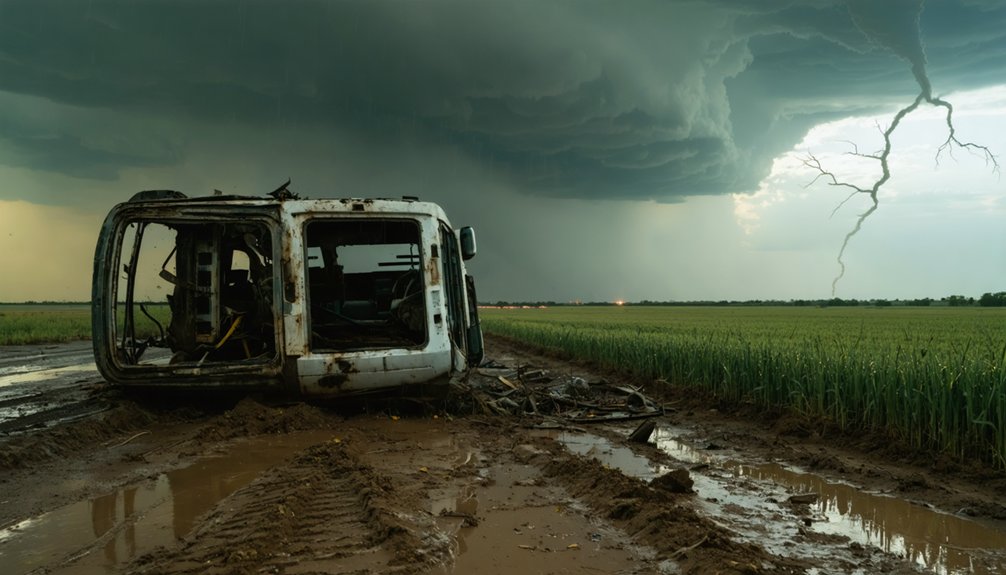
One of the most harrowing aspects of this tragedy is that rescuers took more than five hours to extricate the three victims from the wreckage. The severity of the collision created significant rescue challenges, leaving first responders working through difficult conditions to reach Nicholas Nair, Gavin Short, and Drake Brooks.
Several factors likely compounded the extraction difficulty:
- Heavy structural damage from the tractor-trailer impact trapped all three victims simultaneously.
- Late-night conditions reduced visibility and coordination capacity.
- Ongoing storm safety hazards from severe weather potentially complicated responder access.
- The vehicle’s crosswise position on the interstate created dangerous working conditions.
Understanding these obstacles helps you recognize how quickly a storm chasing trip can spiral into a fatal, complex emergency requiring extraordinary first-responder effort.
How Classmates Tracked the Crash as It Happened in Real Time?
Among the most striking details of this tragedy is how classmates detected the crash through the same digital tools the students used to document their storm chasing. Nair and Short had posted tornado videos on social media updates just minutes before the hydroplane occurred.
Fellow students were actively monitoring their real time tracking data, following shared location feeds as the team moved southbound on Interstate 35.
When the location data suddenly stopped moving, classmates immediately recognized something was wrong. That digital silence became the first alert. No emergency call, no direct message — just a static GPS point on a highway in northern Oklahoma.
The same interconnected system that let storm chasers share data freely also revealed, without warning, that three of their own weren’t coming home.
How OU Honored Nair, Short, and Brooks After Their Deaths?
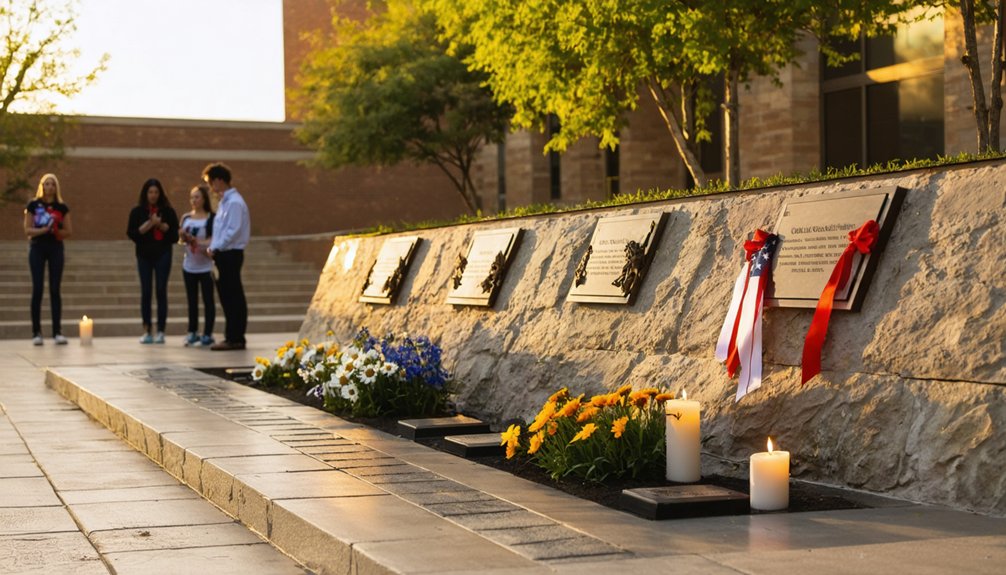
When news of the crash reached campus, the University of Oklahoma’s College of Atmospheric and Geographic Sciences moved quickly to coordinate grief support for students and faculty processing the loss.
Memorial services honored Nair, Short, and Brooks as individuals united by a shared calling to serve communities through meteorology. Student tributes reflected both personal grief and professional respect.
Key institutional responses included:
- The university president publicly acknowledged the students’ mission-driven work
- Grief counseling resources were immediately deployed across campus
- Nair’s contributions to the OU Nightly newscast were formally recognized
- Faculty emphasized the students’ commitment to public safety through storm science
OU’s response framed the three not simply as victims, but as emerging professionals who died pursuing work that directly benefits others.
How the Storm Chasing Community Is Remembering the Three Students?
The storm chasing community’s response to the deaths of Nicholas Nair, Gavin Short, and Drake Brooks has been immediate and deeply personal, reflecting how tightly knit that professional network is.
Fellow chasers recognized the storm impact these three students made through their documented pursuit near Herington, Kansas. You’ll find tributes across storm chasing forums and social media, where professionals acknowledge both their passion and the dangerous conditions that night.
The community isn’t just mourning — it’s actively reassessing safety protocols around post-chase travel, particularly during severe weather conditions that extend beyond the tornado itself.
Hydroplaning on rain-soaked highways represents a documented secondary risk chasers face. Their deaths have prompted direct conversations about mandatory rest periods and route assessments after extended field operations.
Frequently Asked Questions
Were the Students on an Official Ou-Sanctioned Storm Chasing Trip?
The knowledge doesn’t confirm an official OU-sanctioned trip. You should note that storm chasing ethics and student safety protocols remain unclear here, as classmates independently tracked their location during what appeared to be a routine, self-organized chase.
Did the Tractor-Trailer Driver Face Any Charges After the Crash?
Like Blind Justice herself, the available knowledge doesn’t confirm whether the tractor-trailer driver faced charges. You won’t find driver accountability or crash consequences details here — those facts remain beyond what’s been provided.
What Safety Protocols Do OU Meteorology Students Follow During Storm Chasing?
The provided knowledge doesn’t detail OU’s specific storm chasing safety protocols. You’d typically follow storm preparedness guidelines and weather awareness practices, but this tragic crash highlights that even trained meteorology students face unpredictable, life-threatening hazards during field operations.
Had Nair, Short, or Brooks Experienced Dangerous Situations While Chasing Before?
The available knowledge doesn’t confirm any previous incidents or dangerous encounters for Nair, Short, or Brooks before this crash. You can’t find documented records of prior close calls during their storm chasing activities in the provided information.
Will OU Change Its Storm Chasing Policies Following the Students’ Deaths?
Over 80% of storm chasing fatalities involve road accidents, not tornadoes. You’ll likely see OU push for storm safety policy changes, though officials haven’t formally announced specific protocol updates following the tragic crash.
References
- https://www.youtube.com/watch?v=gO8jKGr_ytE
- https://www.cbsnews.com/news/storm-chasers-killed-nicholas-nair-gavin-short-drake-brooks-oklahoma-meteorology-students/
- https://www.youtube.com/watch?v=mtFLBj7YrGo
- https://www.youtube.com/watch?v=BEWe1_hSfaA