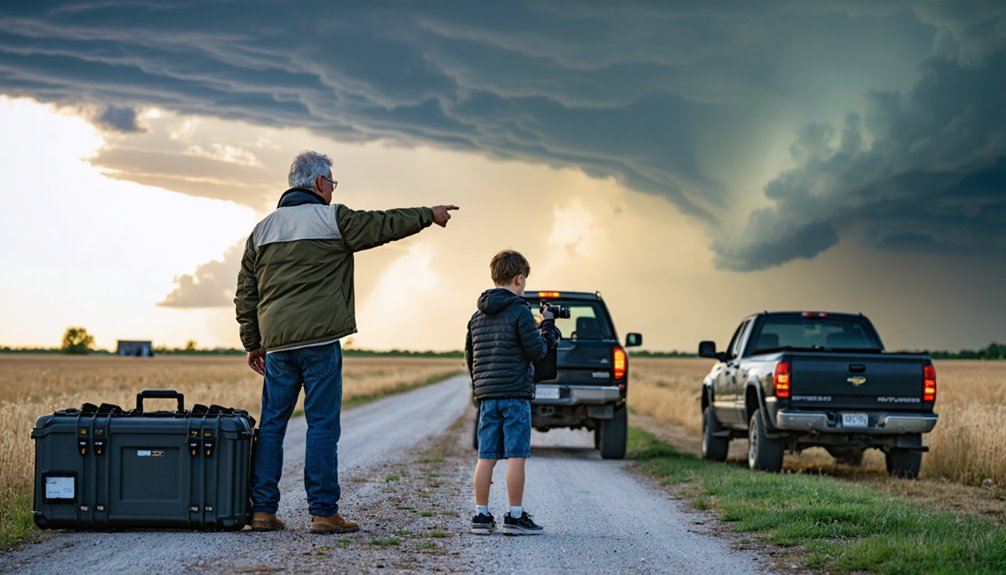
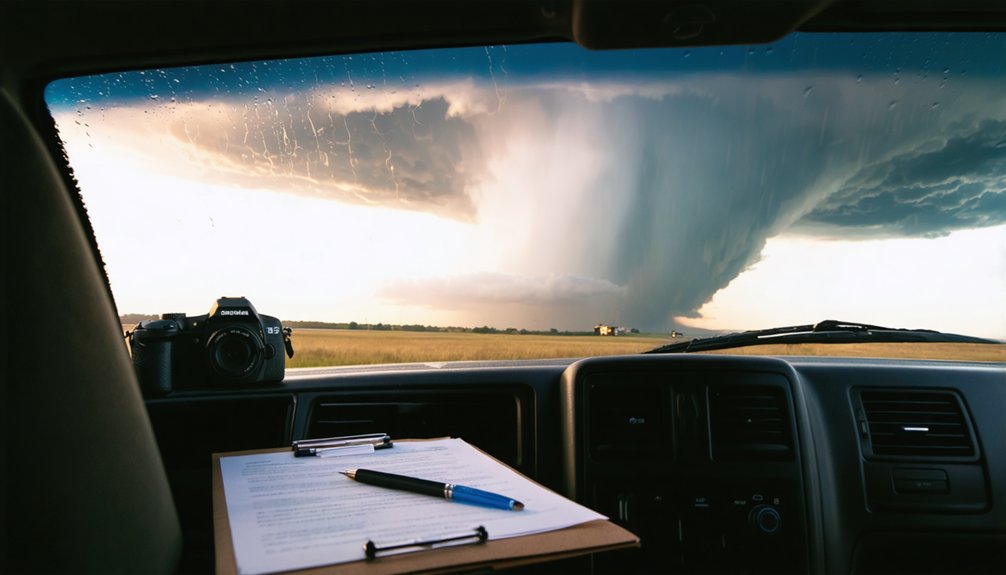
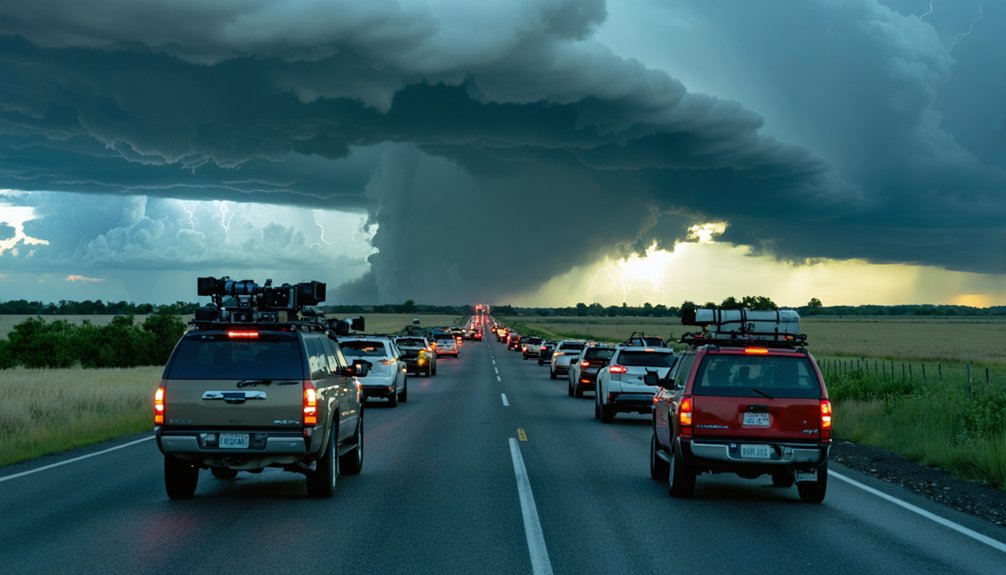
To maximize storm chasing‘s impact on climate change awareness, you need to do more than witness extreme weather—you need to document it systematically. Capture ground-level data like hail size, wind behavior, and precipitation density that satellites can’t collect. Validate radar signatures with real-time observations, and share findings through community outreach that builds public trust. When you combine sharp field techniques with strategic communication, your data transforms into climate evidence that actually changes minds—and there’s much more to unpack about how this works at every level.
Key Takeaways
- Storm chasers fill critical data gaps that satellites and radar miss, generating primary-source climate documentation that strengthens scientific accuracy.
- Ethical storm chasing transforms ground-level observations into climate advocacy, capturing hail size, wind behavior, and precipitation patterns algorithms cannot replicate.
- Programs like Girls Who Chase dismantle education barriers, expanding observer diversity and generating climate data from varied regions and conditions.
- Effective community communication plans ensure storm data translates into public understanding, converting meteorological knowledge into life-saving protective action.
- International initiatives like African SWIFT demonstrate how strategic collaboration and data accessibility maximize climate monitoring impact globally.
Why Storm Chasers Are Climate Change’s Most Valuable Field Reporters
When satellites and radar stations capture the broad strokes of a storm system, storm chasers fill in the critical details that stationary infrastructure simply can’t provide. Your field observations generate primary-source storm documentation that monitoring technology alone can’t replicate.
Storm chasers bridge the gap between radar signatures and ground truth, documenting what satellites simply cannot see.
You’re validating radar signatures with ground-level data, strengthening data validation processes that climate scientists depend on.
Storm chasing transforms you into a direct participant in climate advocacy. Your footage and measurements feed awareness campaigns, community engagement initiatives, and educational outreach programs that translate raw atmospheric data into public understanding.
Organizations like Girls Who Chase demonstrate how observer training expands this network, bringing more trained eyes into regions where extreme weather patterns are shifting fastest.
You’re not just chasing storms—you’re building irreplaceable scientific infrastructure from the ground up.
What Storm Chasers Capture That Satellites and Radar Miss
Satellites and radar paint weather systems in broad strokes—electromagnetic signatures, reflectivity gradients, and pressure differentials that algorithms interpret from thousands of feet above or miles away.
Storm chasing fills the critical gaps. You’re capturing ground-level climate indicators that remote sensors simply can’t detect: actual hail size, surface wind behavior, precipitation density, and damage patterns revealing real time observations no algorithm replicates. This ground-truth data performs essential data validation, confirming or correcting what satellites estimate. Your documentation strengthens observational accuracy across entire regional datasets.
Beyond raw data, storm chasing creates natural opportunities for community engagement and educational outreach—turning extreme weather events into teachable moments that build public awareness. When you invest in skill development, you’re expanding humanity’s capacity to understand and respond to increasingly unpredictable atmospheric systems.
Why Education Barriers Are Shrinking the Storm Observer Network
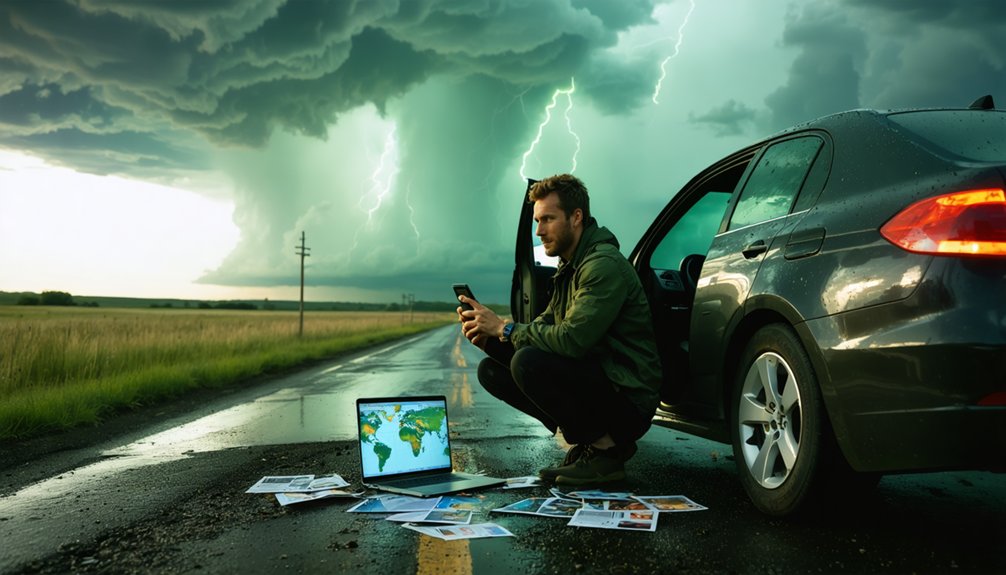
Despite the urgent need for trained storm observers, education barriers are quietly hollowing out the network that climate science depends on. When training remains inaccessible, you lose observer diversity, and that gap directly weakens climate literacy across entire regions.
Girls Who Chase tackled this problem head-on by partnering with COMET and the American Meteorological Society in 2022 to build training accessibility infrastructure through their Spring Training program. Their community engagement model prioritizes education equity, ensuring storm chasing isn’t gatekept by geography, income, or background.
Outreach strategies like these expand who participates in documenting extreme weather, strengthening the observer network climate science urgently needs. Educational outreach isn’t optional—it’s a force multiplier. Without it, you’re systematically excluding the very people whose observations could fill critical data gaps.
How Girls Who Chase Is Expanding Who Gets to Document Extreme Weather
Girls Who Chase isn’t just training storm chasers—it’s systematically dismantling the barriers that have long determined who gets to document extreme weather. Through intentional girls empowerment and chasing inclusivity initiatives, Jennifer Walton’s organization partners with COMET and the American Meteorological Society to deliver structured weather education to anyone willing to learn.
You don’t need institutional connections or geographic privilege to access their Spring Training program. That training access levels the field, bringing diverse perspectives into storm observation roles previously dominated by narrow demographics.
This matters scientifically. Broader community engagement generates more extensive climate data across varied regions and conditions.
When climate advocacy expands the observer network, the documentation of extreme weather events becomes statistically richer, ultimately strengthening the evidence base that informs preparedness decisions worldwide.
How Storm Chasers Turn Field Observations Into Climate Data the Public Can Use
Expanding who chases storms directly expands what gets recorded. When you apply structured observation techniques in the field, your data accuracy strengthens regional databases tracking shifting storm patterns.
Ground-level field data captures what satellites and radar miss—texture, intensity, and behavioral anomalies that redefine climate awareness.
Ground-level observers catch what technology cannot—the raw, unfiltered truth of a storm in motion.
Programs like Girls Who Chase and COMET’s training initiatives equip you with protocols converting raw observations into usable scientific records. Real time monitoring during active storm events generates primary source climate data that traditional weather stations can’t produce alone.
Your participation isn’t passive. Through community engagement and outreach strategies, you help translate documented storm behavior into public understanding.
Impact assessment of these expanding observer networks confirms a clear reality: more trained eyes in the field means better science reaching more people.
Why Perfect Forecasts Still Fail to Save Lives Without Community Communication Plans
Even the most accurate tornado forecast fails to save lives if the communities in its path don’t receive, understand, or act on the warning.
NOAA’s Vortex Southeast project recognizes this gap, dedicating roughly half its resources to social science research on how warnings reach people and whether those people respond effectively.
You can’t separate meteorological precision from communication strategy—both components must work together, or the science loses its life-saving purpose.
Forecasts Failing Without Outreach
A perfect forecast means nothing if the people who need it most never act on it. NOAA’s Vortex Southeast project recognizes this reality, dedicating roughly half its resources to social science research on outreach effectiveness.
You can generate the most accurate tornado prediction in history, but without community engagement strategies that translate that data into understood, trusted warnings, lives remain at risk.
Communication isn’t supplementary to storm science—it’s inseparable from it. Research consistently shows that public response depends less on forecast precision than on how warnings are delivered and received.
When you combine rigorous meteorological knowledge with targeted outreach protocols, protective action increases dramatically. Without that integration, advanced forecasting technology simply doesn’t reach its full life-saving potential.
Bridging Science And Communities
The gap between scientific accuracy and community action defines where forecasting systems succeed or fail. You can’t protect people who don’t understand or trust the warnings they’re receiving.
NOAA’s Vortex Southeast project recognizes this, dedicating roughly half its resources to social science research on warning communication. Community engagement transforms raw meteorological data into actionable decisions.
Science outreach and awareness campaigns build climate literacy, ensuring forecasts resonate locally. Storm advocacy organizations leverage grassroots initiatives to connect observational training with public education, giving communities real ownership over their safety.
Data transparency matters here—when people understand how forecasts are generated, local involvement increases naturally. Bridging science and communities isn’t optional; it’s the mechanism that converts sophisticated atmospheric knowledge into lives actually saved.
Communication Saves More Lives
Perfect forecasts mean nothing if communities don’t act on them. NOAA’s Vortex Southeast project dedicates roughly half its resources to social science research precisely because communication barriers kill people, not inadequate data.
You can generate the most accurate tornado warning ever recorded, yet risk perception failures and poor information dissemination will still leave populations unprepared.
Effective messaging requires understanding your audience’s specific fears, languages, and trust networks. Public trust isn’t automatic—it’s built through consistent outreach strategies and sustained awareness campaigns that reach communities before disasters strike.
When you integrate community engagement directly into forecasting operations, warnings transform from technical outputs into actionable directives.
Storm chasers collecting ground-level data amplify their impact exponentially when paired with structured communication protocols.
Science without outreach simply doesn’t save lives.
How African SWIFT Proves Storm Tracking Saves Lives and Advances Climate Data at Scale
Backed by roughly £8 million from the UK Global Challenges Research Fund, African SWIFT demonstrates how targeted investment in storm tracking infrastructure directly translates into saved lives and expanded climate data.
This initiative bridges African infrastructure gaps by delivering satellite observations to forecasters within 15 minutes, enabling hour-by-hour nowcasting previously unavailable across the continent.
You’re witnessing research innovations that extend technology integration beyond traditional radar-dependent regions.
Partnerships between universities in Leeds and Reading alongside meteorological agencies in Ghana, Kenya, Nigeria, and Senegal embed community engagement and training resources directly into emergency preparedness frameworks.
Cross-continental academic and governmental partnerships weave training and community engagement into the foundation of emergency preparedness.
This model champions environmental stewardship through data accessibility, turning observational techniques into actionable forecasts.
Climate resilience isn’t theoretical here—it’s measurable in reduced death tolls and strengthened local capacity to document extreme weather patterns independently.
How Global Partnerships Bring Climate Monitoring to Regions That Need It Most
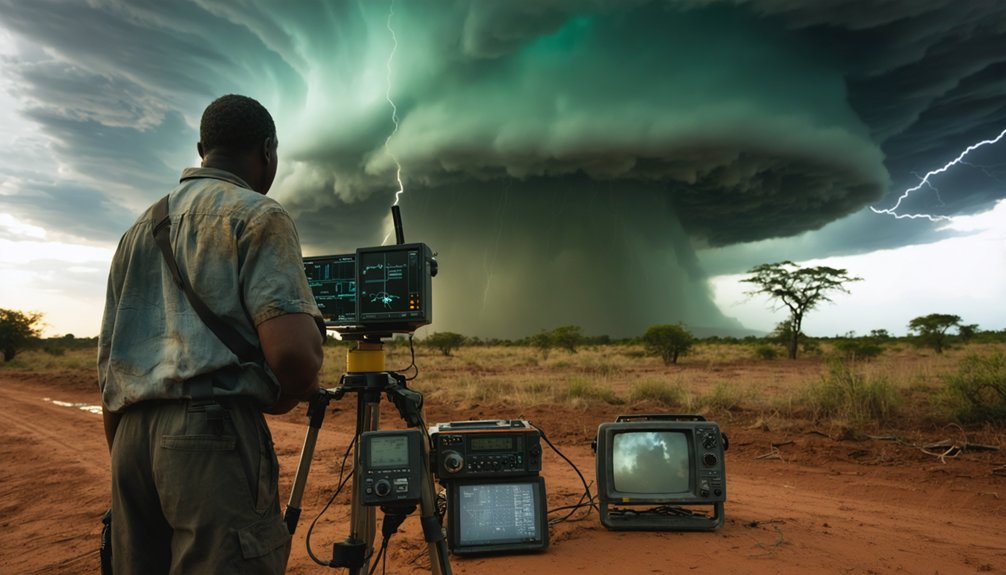
When you look at initiatives like African SWIFT, you see how international partnerships directly close the gaps in global climate monitoring infrastructure.
The collaboration brings together universities, national meteorological agencies, and funding bodies across multiple continents, channeling resources and expertise into regions where ground-based radar systems simply don’t exist.
You can trace the model’s effectiveness through its measurable outcomes: satellite data reaching forecasters within 15 minutes, enabling the same nowcasting capabilities that have long protected populations in the US, Europe, and Asia.
Bridging Global Monitoring Gaps
Although advanced storm monitoring has long been standard practice across North America, Europe, and Asia, vast regions of Africa have historically lacked the radar infrastructure needed to track severe weather in real time. That gap is closing.
The African SWIFT initiative deploys satellite technology to deliver hour-by-hour forecasts across African regions, transmitting atmospheric data to forecasters within 15 minutes of observation.
You’re seeing observational techniques once unavailable to these communities now reaching meteorologists in Ghana, Kenya, Nigeria, and Senegal through partnerships with the University of Leeds, University of Reading, and the UK Met Office.
Understanding storm dynamics across these regions protects lives and economies simultaneously.
Backed by roughly £8 million in funding, African SWIFT proves that strategic international collaboration can dismantle the infrastructure barriers separating vulnerable populations from life-saving weather intelligence.
Collaborative Climate Data Networks
Global partnerships don’t just expand access to weather data—they restructure how climate intelligence flows to the communities that need it most.
When you examine initiatives like African SWIFT, you see collaborative platforms connecting the University of Leeds, University of Reading, and meteorological agencies across Ghana, Kenya, Nigeria, and Senegal. These networks process satellite observations through Chilbolton Observatory, then distribute actionable forecasts via structured data sharing channels reaching forecasters within 15 minutes of atmospheric events.
You’re witnessing a fundamental shift in who controls climate knowledge. Previously, advanced nowcasting belonged exclusively to regions with established radar infrastructure.
Today, international research frameworks transfer technology directly to underserved nations, enabling hour-by-hour severe weather forecasts where none previously existed. Distributed knowledge protects lives and preserves economic infrastructure simultaneously.
Build Storm Chasing Skills That Generate Real Climate Data
Storm chasing isn’t just about the thrill of witnessing extreme weather—it’s a direct pathway to generating primary-source climate data that satellites and ground stations can’t capture alone.
You’ll need sharp storm observation techniques and reliable data collection methods to contribute meaningfully. Programs like Girls Who Chase and COMET’s Spring Training offer volunteer training initiatives that remove traditional access barriers.
Master real-time reporting tools to transmit observations instantly, complementing radar networks. Community engagement strategies and educational outreach programs expand observer networks, multiplying data quality across regions.
Technology integration challenges exist, but structured training resolves most gaps. Storm chasing ethics demand accuracy over sensationalism—your documentation serves science first.
Every field observation you record strengthens the climate dataset researchers depend on to understand shifting storm behavior globally.
Frequently Asked Questions
What Legal Permits Do Storm Chasers Need Before Pursuing Extreme Weather Events?
Like a explorer charting new frontiers, you’ll find storm chasing has no universal legal regulations or mandatory permit applications—you’re free to pursue extreme weather, though local road laws and private property rules still apply.
How Do Storm Chasers Fund Their Equipment and Extended Field Operations?
You’ll fund storm chasing through crowdfunding strategies, sponsorship opportunities, grant applications, and equipment rentals. Partner with climate organizations, apply for research grants, and leverage public support to sustain extended field operations documenting critical atmospheric data.
What Insurance Coverage Protects Storm Chasers During Dangerous Weather Documentation Missions?
You’ll need specialized liability coverage designed for high-risk field operations, as standard policies exclude storm-related incidents. Seek storm insurance providers who understand documentation missions, covering equipment damage, medical emergencies, and third-party claims during active weather pursuit.
How Long Does It Typically Take to Become a Certified Storm Chaser?
You’ll typically complete storm chasing certifications within weeks to months through structured training programs. Girls Who Chase’s Spring Training offers accessible operational education, letting you build essential skills at your own pace regardless of background.
What Physical Fitness Requirements Exist for Professional Storm Chasing Careers?
There’s no universal physical fitness standard for professional storm chasers, but you’ll need strong weather resilience and storm preparedness capabilities—including sustained alertness, quick mobility, and endurance to handle long field hours in demanding, unpredictable environments.
References
- https://www.youtube.com/watch?v=uFGdZeKtYnI
- https://www.comet.ucar.edu/increasing-awareness-and-understanding-severe-weather-through-storm-chasing-education
- https://environment.leeds.ac.uk/icas-research-impact/doc/storm-chasers-making-life-saving-forecasts
- https://undark.org/2018/06/28/podcast-28-co2-tornadoes-ginamccarthy/
- https://www.aces-alliance.org/post/weathering-the-storm