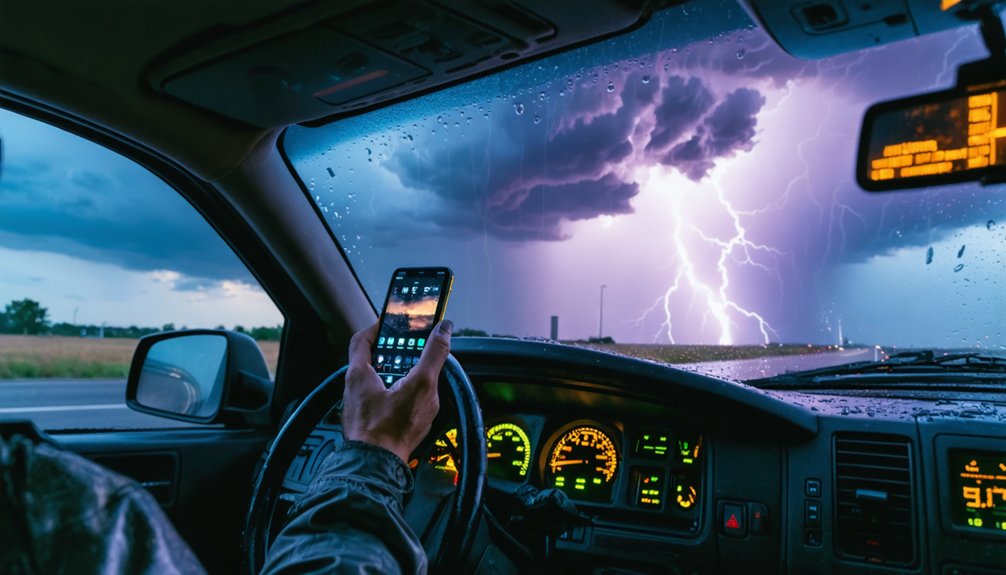
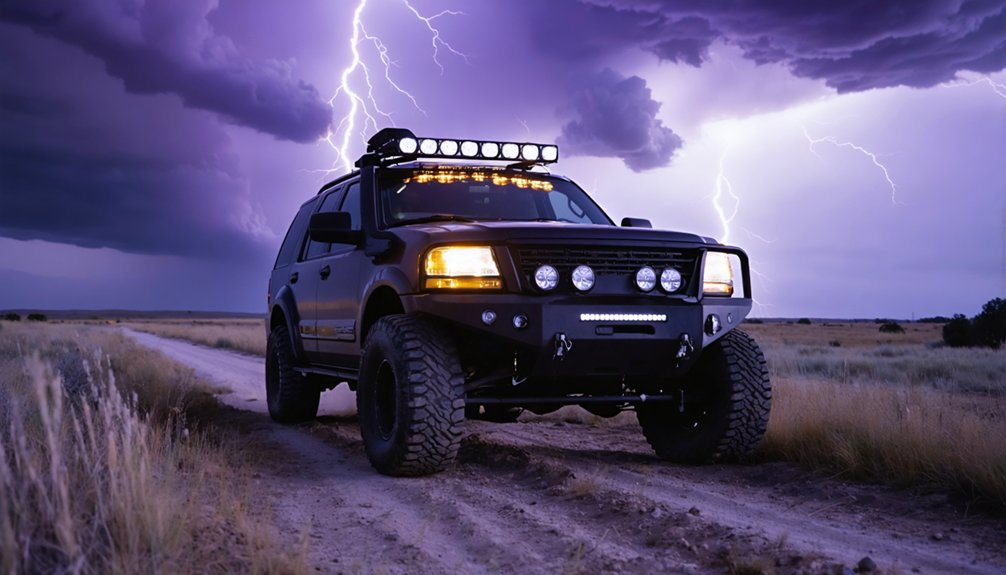
The Tornado Intercept Vehicle started as a stripped 1997 Ford F-450 Super Duty frame that Sean Casey transformed over eight months at a cost of $81,000. You’ll find 2-inch square steel tubing forming its skeleton, with 1/8-inch steel plating welded on as armor. Its floors use 1/4-inch steel plate, and bullet-resistant polycarbonate windows handle 200 mph winds. The 16,500-pound machine runs on six wheels and ten tires for stability. Every engineering decision tells a deeper story.
Key Takeaways
- The TIV was built on a modified 1997 Ford F-450 Super Duty, stripped to its bare frame and converted to a 6×6 configuration.
- The armored cabin uses a skeleton of 2-inch square steel tubing welded with 1/8-inch steel plating, providing strong tornado-force protection.
- Bullet-resistant polycarbonate windows, including a 1.5-inch-thick windshield, protect occupants against winds reaching 200 mph.
- The vehicle weighs 16,500 pounds, with ten tires and a third axle lowering its center of gravity for enhanced stability.
- Advanced technology includes a 360° rotating IMAX camera turret, high-speed cameras, and telemetry sensors measuring pressure, temperature, and wind velocity.
The Origins of the Tornado Intercept Vehicle
The Tornado Intercept Vehicle (TIV) traces its origins to December 28, 2002, when filmmaker and storm chaser Sean Casey began construction on a heavily modified 1997 Ford F-450 Super Duty.
Over eight months, Casey transformed the stripped frame into a purpose-built storm chasing platform, investing US$81,000 into the project.
ATS Diesel Performance converted the chassis into a 6×6 configuration, powered by a 7.3-liter Powerstroke Turbo Diesel engine.
The completed vehicle weighs 14,000 lb (6,400 kg), engineered to intercept tornadoes ranging from EF0 to EF3 intensity.
You can appreciate how deliberately Casey designed the TIV — not just for survival, but for advancing tornado research through onboard filming and atmospheric measurements.
It gave storm chasing a new dimension of scientific precision and capability.
How Sean Casey Chose the Base Truck and Frame
When you examine the TIV’s construction, you’ll find that Sean Casey selected a 1997 Ford F-450 Super Duty as the base platform, stripping it to its bare frame before converting it to a 6×6 configuration through ATS Diesel Performance.
You’re looking at a build that cost $81,000 over eight months, powered by a 7.3-L Powerstroke Turbo Diesel engine and weighing in at 14,000 lb.
Casey then constructed the armored shell by welding 1/8-inch steel plating onto a 2-inch square steel tubing frame, reinforcing it further with a skeleton of 1/4-inch steel tubing and I-beams.
Choosing the Base Truck
Building a vehicle capable of withstanding tornado-force winds starts with choosing the right foundation, and Sean Casey made a deliberate choice when he selected a 1997 Ford F-450 Super Duty as the base truck for the TIV.
Its heavy-duty frame provided the structural integrity essential for extreme vehicle modifications and tornado adaptability.
Key reasons this base truck worked:
- Robust chassis — capable of supporting 14,000 lb after full armoring
- 6×6 conversion potential — ATS Diesel Performance successfully expanded the drivetrain
- 7.3-L Powerstroke engine — delivered reliable torque under demanding field conditions
- Bare frame flexibility — stripping it completely allowed engineers to rebuild every system precisely
You’re looking at a platform engineered for freedom of movement directly inside a tornado’s path.
Frame Construction Decisions
Once Casey stripped the F-450 down to its bare frame, every subsequent construction decision depended on that foundation holding up under extreme armoring loads. He welded 2-inch square steel tubing throughout the structure, then reinforced that skeleton with 1/4-inch steel tubing and I-beams to distribute stress across multiple load points.
For frame materials, Casey chose steel deliberately — aluminum couldn’t handle the compressive and torsional forces a tornado environment generates. The 1/8-inch steel plating welded directly onto that tubing framework created a unified, rigid shell rather than a bolted assembly that could loosen under impact.
Every decision protected structural integrity without unnecessary mass. You’re fundamentally engineering a mobile bunker that still needs to move fast — and that balance starts entirely at the frame level.
How the TIV’s Steel Frame and Armor Were Built
The TIV’s frame and armor rely on two core materials working in tandem: 2-inch square steel tubing forms the primary structural skeleton, while 1/8-inch steel plating is welded directly onto that skeleton to create the armored shell.
Steel durability and armor effectiveness depend on precise layering throughout the build.
Every layer of steel placed with precision determines how well the armor holds when it matters most.
Key construction specifications include:
- Floors use 1/4-inch steel plate for maximum debris resistance.
- Doors receive double-layered 1/8-inch steel plating for reinforced protection.
- Wheel wells are covered by hinged 1/8-inch steel flaps.
- Skeleton reinforcement integrates 1/4-inch steel tubing alongside I-beams.
Aluminum replaces steel in less critical zones, reducing overall weight without compromising structural integrity.
Heavy steel bolts lock the doors securely when closed.
What Protects the TIV Cabin From 200 Mph Winds?
When you’re inside the TIV cabin during a tornado intercept, three core systems keep you alive against 200 mph winds.
You’re protected by bullet-resistant polycarbonate windows — a 1.5-inch-thick windshield and 0.5-inch side panels — while rubber Kevlar polycarbonate composite layers reinforce the hollowed inner body.
Heavy steel bolts lock the doors shut, preventing wind pressure from breaching the cabin at critical moments.
Bullet-Resistant Polycarbonate Windows
Protecting the cabin from 200 mph winds required more than just reinforced steel — it demanded a layered window system engineered for ballistic and wind-load resistance.
Polycarbonate durability drives every window installation decision on the TIV.
Here’s what makes the system work:
- Windshield thickness reaches 1.5 inches of bullet-resistant polycarbonate, absorbing massive impact forces.
- Side windows use 0.5-inch polycarbonate panels, balancing visibility with structural integrity.
- Inner body layers are hollowed and reinforced with a rubber Kevlar polycarbonate composite for multi-layer protection.
- Wind coverage extends to 200 mph, protecting you across 75% of all U.S. tornadoes.
You’re not just looking through glass — you’re looking through an engineered barrier built to keep you alive inside the storm.
Reinforced Steel Door Locks
Polycarbonate windows seal the cabin visually, but steel door locks are what physically hold the TIV’s structure together under 200 mph wind loads.
When you close the TIV’s doors, heavy steel bolts engage automatically, creating a mechanically reinforced closure that resists violent pressure differentials generated by tornado vortices. This door security system isn’t decorative — it’s structural.
The doors themselves feature double-layered 1/8-inch steel plating, but without the reinforced locks, that plating means nothing. Wind at 200 mph doesn’t push uniformly; it pulses, hammers, and exploits weak points.
The bolt system distributes that load across the door frame rather than concentrating stress at a single point. You’re not relying on a latch — you’re relying on engineered steel resistance designed to keep you alive inside a direct intercept.
Kevlar Composite Inner Layers
The TIV’s cabin walls don’t rely on steel plating alone — a rubber Kevlar polycarbonate composite fills the hollowed inner body layers, creating a multi-material barrier engineered to absorb and deflect what 200 mph wind loads throw at the structure.
Kevlar benefits include tensile strength and impact absorption that steel alone can’t provide. Composite durability extends the cabin’s service life under repeated high-stress deployments.
Here’s what this layered system delivers:
- Impact absorption — rubber dampens shockwave energy from airborne debris
- Tensile reinforcement — Kevlar resists tearing under extreme pressure differentials
- Structural rigidity — polycarbonate bonds the composite into a unified barrier
- Wind coverage — this design addresses roughly 75% of U.S. tornado classifications
You’re getting a cabin built for survivability, not just occupancy.
Why the TIV Runs on Six Wheels and Ten Tires
When engineers converted the TIV-2 to six-wheel drive, they weren’t just adding traction—they were solving a fundamental weight distribution problem. At 16,500 pounds, the vehicle demands more contact points with the ground to maintain six wheel stability across unpredictable terrain.
Ten tires spread that load efficiently, reducing individual tire stress while improving tire performance under extreme lateral wind forces.
The third axle, added to the strengthened Dodge Ram 3500 chassis, also lowers the vehicle’s center of gravity effect by distributing mass longitudinally.
This configuration works alongside the hydraulic flaps and torsion bar suspension, keeping the body level when traversing uneven terrain.
You’re fundamentally looking at a purpose-engineered platform where every mechanical decision directly counters tornado-force dynamics.
How TIV-2 Improved on the Original TIV Design
Every design decision in the TIV-2 addressed a specific structural or operational shortcoming of its predecessor.
Every design decision in the TIV-2 existed for a reason — each one a direct answer to a failure the original couldn’t survive.
When you examine the upgrades in tornado technology and storm interception capability, four clear improvements stand out:
- Chassis strength – Built on a reinforced Dodge Ram 3500 with a custom third axle added for load distribution.
- Weight and stability – TIV-2 weighs 16,500 lb, making it markedly harder to tip over in violent winds.
- Welding quality – Professional welding throughout delivers greater structural integrity than the original build.
- Hydraulic flap system – Active hydraulic flaps prevent the vehicle from flipping, a critical vulnerability the original TIV lacked.
You’re looking at a machine rebuilt from hard-earned field experience, not theory.
The Cameras, Sensors, and Anchor Systems Inside the TIV
Structural toughness gets the TIV into the storm — but what it captures once it’s there defines its scientific value.
You’ll find a 360° rotating turret housing an IMAX-capable camera, giving you full directional coverage without repositioning the vehicle. Camera technology extends further with on-board high-speed cameras that record debris behavior and wind dynamics in real time.
Sensor integration pulls in telemetry data — pressure, temperature, and wind velocity — feeding you precise atmospheric measurements directly from within the vortex.
Anchor mechanics deploy ground anchors that resist tornado-force uplift, keeping the TIV planted when winds exceed 200 mph.
Together, these systems transform the vehicle from a survival platform into a mobile data collection station, delivering the kind of raw, unfiltered storm data no remote instrument can replicate.
What Did It Actually Cost to Build the TIV?
Building the TIV from the ground up cost Sean Casey a total of US$81,000 — a figure that reflects eight months of intensive fabrication starting December 28, 2002.
Understanding the cost breakdown and construction timeline gives you a clearer picture of what independent engineering truly demands.
Here’s what drove those costs:
- Base platform — A 1997 Ford F-450 Super Duty, stripped to its bare frame
- Drivetrain conversion — Six-wheel-drive modification by ATS Diesel Performance
- Armor fabrication — Steel plating, I-beams, and reinforced tubing welded throughout
- Specialized components — Bullet-resistant polycarbonate windows and interior systems
You’re looking at a vehicle built without corporate backing — just calculated decisions, raw materials, and disciplined execution across every phase of construction.
Frequently Asked Questions
Has the TIV Ever Been Seriously Damaged Inside a Tornado?
The knowledge doesn’t confirm serious tornado damage to the TIV. You’d appreciate its storm resilience — it’s engineered to withstand tornado damage up to EF3, featuring 1/8-inch steel plating, bulletproof windows, and reinforced hydraulic systems protecting you.
How Many Tornadoes Has the TIV Successfully Intercepted Since Its Debut?
Sure, just count the tornadoes yourself! The knowledge base doesn’t specify how many tornado interceptions the TIV’s vehicle technology has achieved. You’d need external sources to find that precise, analytical figure on tornado interception success.
Can the TIV Be Driven Normally on Public Highways Between Storm Chases?
Yes, you can drive the TIV on public highways between storm chases. Its tiv specifications include a 92-gallon tank giving 750-mile range, making storm chase logistics flexible and your operational freedom unrestricted across open roads.
How Many Crew Members Can Safely Fit Inside the TIV?
Like a steel fortress on wheels, the knowledge doesn’t specify exact crew capacity. However, the TIV’s safety features—armored plating, reinforced doors, and bullet-resistant windows—ensure you’d ride protected against nature’s fury.
Has the TIV Design Influenced Other Storm Chasing Vehicles Built Afterward?
The TIV innovations have shaped storm safety across the chasing community. You’ll find its armored plating, hydraulic flaps, and reinforced frameworks directly influencing how subsequent pursuit vehicles are engineered for maximum crew protection and operational freedom.
References
- https://www.youtube.com/watch?v=seatF_0hOXc
- https://science.howstuffworks.com/nature/climate-weather/meteorological-instruments/tiv.htm
- https://stormofpassion.com/history/
- https://www.youtube.com/watch?v=3pw17k8jqJY
- https://livestormchasers.com/tiv2/
- https://steamcommunity.com/sharedfiles/filedetails/?l=vietnamese&id=2748273187/1000