Your best affordable tornado intercept vehicles include the Subaru Forester, Toyota 4Runner, Jeep Grand Cherokee, Ford F-150 4×4, Chevrolet Silverado 1500, Ram 1500, and Volkswagen Touareg—all available under $20,000 used. You’ll need full-time AWD or 4×4, four-wheel disc brakes, ABS, and electronic stability control as non-negotiables. Budget an additional $2,000–$6,000 for radar mounts, reinforced laminated glass, and communication gear. The right platform combined with strategic upgrades determines whether your build actually performs when it counts.
Key Takeaways
- Used Ford F-150, Chevrolet Silverado 1500, and Ram 1500 trucks often cost under $20,000 and offer essential towing capacity for radar equipment.
- The Subaru Forester provides reliable full-time AWD and affordability around $19,000, with factory roof rails for easy storm gear mounting.
- Toyota 4Runner and Jeep Grand Cherokee offer strong off-road capability with prices under $20,000 depending on mileage and trim level.
- Beyond purchase price, budget $2,000–$6,000 for storm preparedness essentials, including reinforced glass, radar arrays, and wind-rated mounting brackets.
- Prioritize vehicles with four-wheel disc brakes, ABS, electronic stability control, and a low roofline to minimize rollover risk during intercepts.
The Real Cost of Going Affordable on a Tornado Intercept Vehicle
When you’re weighing the true cost of an affordable tornado intercept vehicle, the purchase price is only the starting point.
You’ll need to budget for storm preparedness essentials: reinforced glass, roof-mounted antennas, weather radios, navigation systems, and hail protection. These affordable upgrades add roughly $2,000–$6,000 depending on your platform.
A used Ford F-150 4×4 at $18,000 sounds lean until you factor in upgraded tires, a roof rack, emergency fuel storage, and communication gear.
Reliability matters more than armor—mechanical failure during intercept is a fatal risk.
Mechanical failure kills. Prioritize drivetrain health and braking over armor—reliability is your true lifeline in the field.
Prioritize drivetrain condition, braking performance, and parts availability over cosmetic features.
Your real operational cost combines acquisition, equipment, fuel, maintenance, and insurance.
Freedom in the field depends on thorough, honest accounting before you ever chase.
What TIV-2 Gets Right That Budget Builds Should Copy
The TIV-2 sets a clear engineering benchmark—14,000 pounds, 600 horsepower, reinforced windshields, armored steel plating, and ground anchor spikes—that budget builders can’t replicate dollar-for-dollar, but they can extract its core principles.
TIV 2 Innovations prioritize three transferable elements: structural rigidity, low center of gravity, and rapid repositioning speed. Your budget design should mirror these priorities proportionally.
Choose a 4×4 platform with a low roofline rather than a tall SUV, reducing rollover risk during sudden evasive maneuvers. Reinforce glass with aftermarket laminate film to improve hail resistance without full replacement costs.
Prioritize braking upgrades and all-terrain tires over cosmetic armor. At nearly 90 mph, the TIV-2 escapes bad positioning fast—your vehicle must match that mobility principle, even if the horsepower doesn’t.
AWD, Braking, and Hail Protection: What Your Chase Vehicle Must Have
Your chase vehicle must prioritize all-wheel drive or four-wheel drive, since dirt roads, mud crossings, and rapid repositioning under dynamic storm conditions demand consistent traction across all four wheels.
Beyond drivetrain capability, strong braking performance matters more than horsepower for most intercept scenarios, where controlled deceleration and stable handling determine whether you escape or overshoot a dangerous position.
Finally, you’ll want hail protection through reinforced glass, protective film, or deployable covers, because large hail — often exceeding 2 inches in diameter near a tornado’s forward flank — causes costly damage and can compromise visibility at the worst possible moment.
AWD Priority for Chasers
Storm chasing demands specific vehicle capabilities that directly affect your odds of staying safe—and three rise above the rest: all-wheel drive, braking performance, and hail protection.
AWD delivers continuous torque distribution across all four wheels, keeping you planted on muddy county roads and unstable terrain when a tornado forces rapid repositioning. The all-wheel benefits extend beyond traction—you’ll maintain directional control during emergency maneuvers that two-wheel-drive platforms simply can’t match.
Subaru advantages are particularly relevant here: the Symmetrical AWD system operates full-time, requiring zero driver input to engage. You’re never caught flat-footed on a gravel backroad. Unlike part-time 4×4 systems requiring manual switching, Subaru’s setup responds instantly.
That immediacy keeps your escape window open when storm conditions deteriorate faster than forecasts predicted.
Braking Performance Matters
Braking performance ranks just below AWD in storm-chase priority, and the data supports why: a vehicle traveling 60 mph requires roughly 180 feet of stopping distance under ideal conditions—that number climbs fast on wet gravel or debris-covered pavement.
You can’t afford brake fade when a tornado shifts direction unexpectedly. Prioritize vehicles with four-wheel disc brakes, ABS, and electronic stability control—these systems directly support vehicle stability during hard stops and evasive maneuvers.
Practice threshold braking techniques in controlled environments before chasing; panic braking without technique costs you distance and control.
Trucks like the F-150 and Silverado 1500 carry heavier curb weights, so factor brake system condition carefully when buying used. Upgraded brake pads and fresh fluid aren’t optional—they’re operational requirements.
Hail Protection Essentials
Stopping in time keeps you alive, but hail can destroy your vehicle before you ever need to brake. Golf-ball-sized hail, roughly 1.75 inches in diameter, strikes with enough force to shatter unprotected glass and dent body panels instantly.
Hail damage isn’t cosmetic — it compromises structural integrity and disables sensors you depend on.
For real storm safety, prioritize laminated side glass over standard tempered glass, which shatters on impact. Polycarbonate hail blankets rated for 2-inch stones offer field-deployable protection without permanent modification.
Reinforce your hood and roof with magnetic protective pads rated for high-velocity impact.
You need equipment that survives the storm, not just the drive to it. Protect your vehicle aggressively, and you preserve your freedom to chase another day.
The Best Used SUVs for Storm Chasing on a Budget
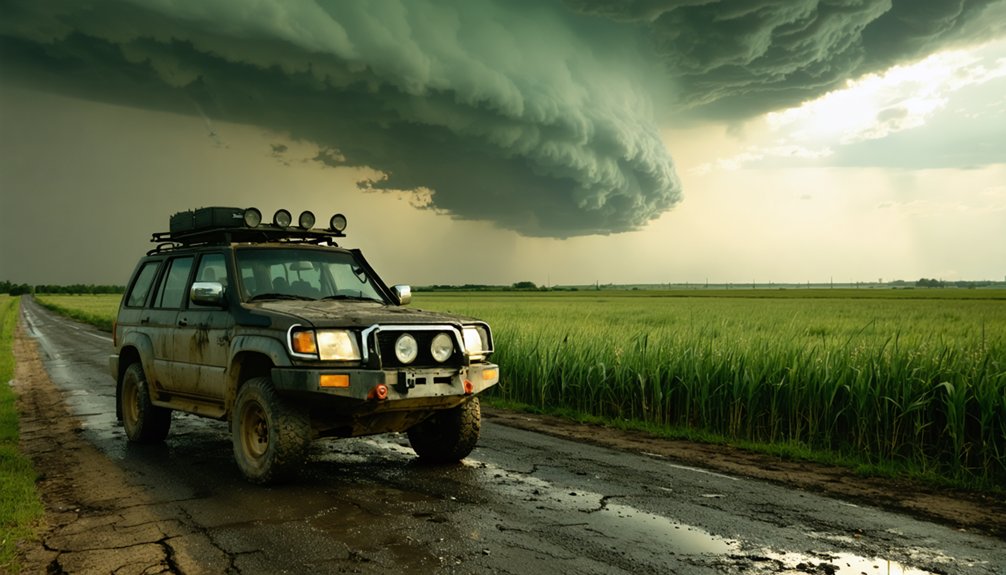
Several used SUVs stand out as strong budget platforms for storm chasing, each offering a practical mix of all-wheel drive, ground clearance, and reliability without the cost of purpose-built intercept rigs.
The Subaru Forester delivers a compelling entry point, with used examples around $19,000 and straightforward Subaru upgrades like reinforced glass, roof-mounted antenna brackets, and budget modifications keeping total costs manageable. Its symmetrical all-wheel drive system handles muddy rural roads confidently. You can mount storm gear directly to factory roof rails without structural compromise.
The Volkswagen Touareg offers greater stability and a lower center of gravity but carries higher ownership costs. For pure value, the Forester remains your most efficient balance of purchase price, platform versatility, and storm-readiness without sacrificing everyday drivability.
Subaru Forester and Mid-Size Crossovers as Intercept Vehicles
If you’re building an affordable intercept platform, the Subaru Forester’s symmetrical all-wheel drive system delivers consistent torque distribution across all four wheels, giving you reliable traction on muddy chase roads and unpaved rural routes without the bulk of a full-size truck.
You can find a used 2013 Forester 2.5X Premium near $19,000, making it one of the most cost-effective entries into storm-capable mobility.
Mid-size crossovers like the Forester prioritize a lower center of gravity over raw ground clearance, which improves high-speed handling when you’re executing rapid storm repositioning or escape maneuvers ahead of a closing tornado.
Forester All-Wheel Drive Advantages
When you need confident traction on rain-soaked dirt roads or soft shoulders during a rapid storm repositioning, the Subaru Forester’s symmetrical all-wheel drive system delivers consistent power distribution across all four wheels without the driver toggling any manual selectors.
This architecture directly supports off-road capabilities when unpaved county roads turn treacherous mid-chase.
Strategic Forester upgrades amplify that baseline:
- All-terrain tires cut stopping distance on loose gravel by improving contact patch grip
- Skid plates protect the undercarriage against rock strikes on rural escape routes
- Raised suspension kits add approximately one to two inches of clearance for deeper ruts
The system responds automatically to wheel slip within milliseconds, keeping you moving forward when conditions deteriorate fastest and evacuation timing is most critical.
Mid-Size Crossover Storm Capability
Mid-size crossovers like the Subaru Forester occupy a practical middle ground between car-based efficiency and light truck capability, making them a legitimate intercept platform when your priority is rapid repositioning over stationary armored deployment.
Among crossover advantages, the Forester’s symmetrical AWD system delivers torque to all four wheels simultaneously, reducing understeer during emergency directional changes on rain-slicked county roads. Its 8.7-inch ground clearance supports basic off road performance across rutted farm tracks and flooded intersections without compromising highway stability at sustained speeds.
You’re not getting TIV-2 protection, but you’re gaining a nimble, reliable platform that exits a storm corridor faster than heavier rigs. A used 2013 Forester 2.5X Premium, priced around $19,000, delivers measurable capability without destroying your operational budget.
4Runner and Jeep Grand Cherokee: Underrated Budget Chase Picks
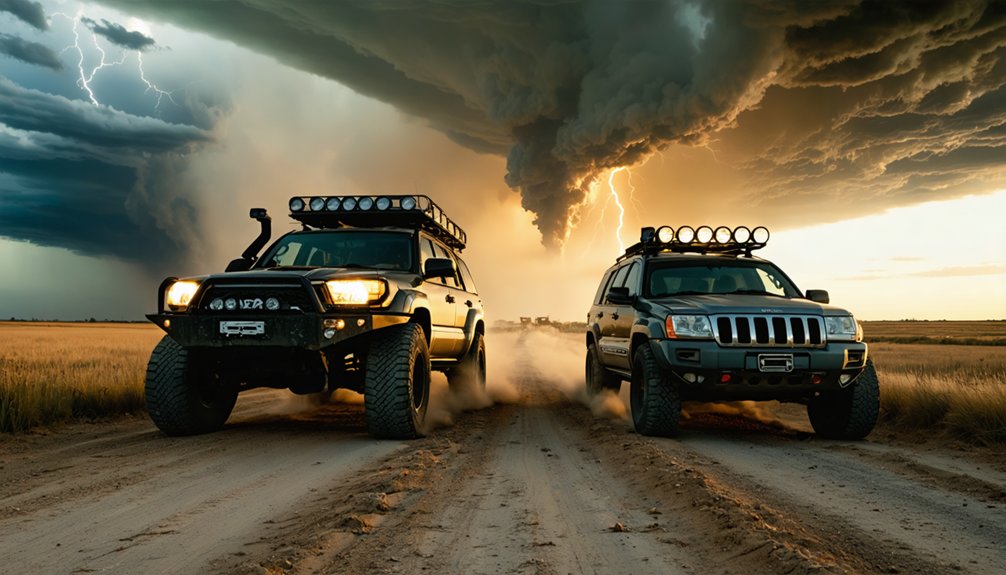
Both the Toyota 4Runner and Jeep Grand Cherokee 4×4 are frequently overlooked in budget storm-chase discussions, yet each delivers a well-rounded combination of off-road capability, structural durability, and used-market affordability that rivals more commonly cited platforms.
4Runner reliability stems from a proven solid rear axle and body-on-frame construction that withstands debris impacts and rough terrain repositioning.
Grand Cherokee performance benefits from available Quadra-Drive II, delivering serious traction across compromised road surfaces.
Key advantages you’ll find in both platforms:
- Used pricing frequently falls under $20,000 depending on mileage and trim
- Strong aftermarket support for skid plates, lift kits, and roof-mount equipment
- Proven mechanical simplicity reduces field-repair complexity during active chase operations
Both platforms give you genuine operational flexibility without surrendering financial independence.
Best Budget Pickup Trucks for Tornado Intercept Builds
SUVs like the 4Runner and Grand Cherokee cover a lot of ground, but pickup trucks reveal a different set of operational advantages that matter once your equipment list grows.
A used Ford F-150 4×4, Chevrolet Silverado 1500, or Ram 1500 frequently falls under $20,000, giving you serious towing capacity for trailers carrying radar arrays, fuel reserves, or recovery gear.
Used F-150s, Silverados, and Ram 1500s under $20,000 deliver the towing muscle serious storm chasers need.
You’re not locked into one configuration. Bed space lets you mount roof racks, secure equipment cases, and carry spare tires without sacrificing cabin room.
Affordable upgrades like skid plates, all-terrain tires, and reinforced suspension dramatically improve dirt-road performance without inflating your budget.
Parts availability for F-150s especially remains unmatched, cutting downtime during active chase seasons when you can’t afford mechanical delays holding you stationary.
Ford F-150 4×4: The Most Capable Affordable Intercept Truck
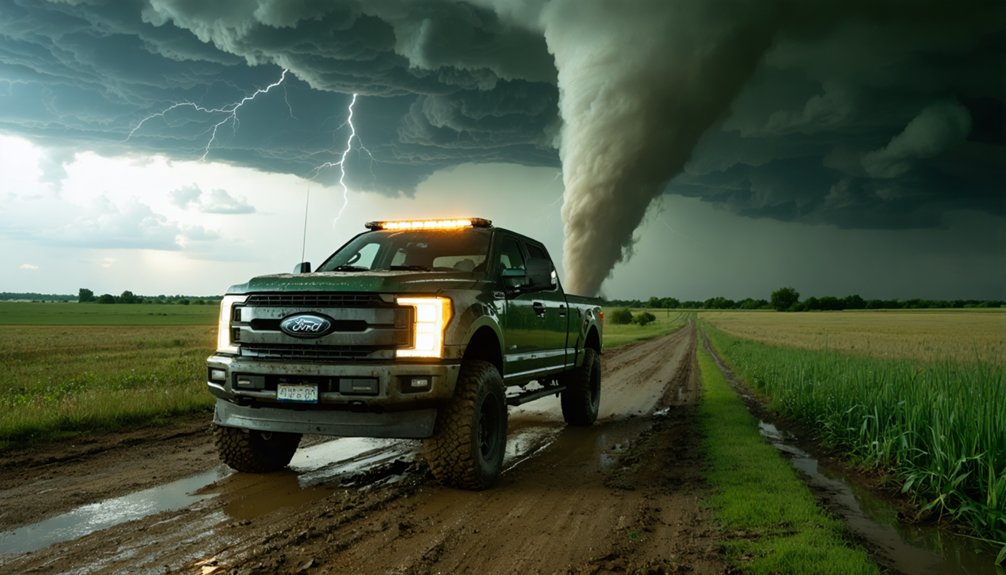
When budget and capability have to align under a single platform, the Ford F-150 4×4 consistently outperforms most competitors in its price class. Used models frequently fall under $20,000, delivering serious storm readiness without draining your build budget.
Key advantages you’ll rely on in the field:
- Off-road capabilities and towing capacity handle gear-loaded escapes across compromised terrain
- Technology integration supports roof-mounted radar, GPS navigation, and radio equipment seamlessly
- Reliability features backed by widespread parts availability keep downtime minimal
Targeted F-150 upgrades—reinforced suspension, skid plates, and hail-resistant coverings—sharpen your intercept readiness further.
Interior space accommodates full equipment loadouts comfortably. Fuel efficiency varies by engine choice, but the 2.7L EcoBoost balances range and power effectively for extended chase operations.
Silverado 1500 and Ram 1500: Storm-Chase Value
The F-150 dominates storm-chase conversations, but the Chevrolet Silverado 1500 4×4 and Ram 1500 4×4 deliver comparable intercept capability at similar or lower price points in many regional used markets.
Both platforms support four-wheel drive, strong payload ratings, and broad aftermarket support for Silverado upgrades like skid plates, roof racks, and auxiliary lighting. You’ll find used examples frequently priced under $18,000, depending on mileage and trim.
Ram reliability is well-documented across high-mileage fleets, and the Ram 1500’s coil-rear-spring suspension gives you a noticeably smoother ride over rough dirt roads during rapid repositioning.
The Silverado’s proven LS-based engines offer straightforward maintenance and strong long-term durability.
Either truck gives you real operational freedom without locking your budget into a single manufacturer’s ecosystem.
Radar Mounts, Reinforced Glass, and Radio Installs That Make a Chase Vehicle
Once you’ve chosen your chase platform, you’ll need to configure it with functional hardware that directly improves situational awareness and structural resilience.
Roof-mounted radar arrays typically require low-profile brackets rated for sustained winds above 100 mph, and you should bolt them to reinforced crossbars rather than factory rack systems to prevent instrument loss during high-wind repositioning.
Reinforced laminated glass, often rated to withstand 2-inch hail impact at 70 mph, replaces standard OEM glazing and markedly reduces the risk of cab penetration during close-range hail cores.
Essential Radar Mount Options
Three core upgrades separate a capable storm-chase vehicle from an ordinary 4×4: radar mounts, reinforced glass, and radio installs.
Radar mounting demands precise installation techniques to guarantee stable data collection at highway speeds and in turbulent winds.
Your mount options include:
- Roof rail mounts: Bolt-on systems compatible with most 4×4 trucks and SUVs, distributing load across factory rail points
- Magnetic base mounts: Fast-deploy option rated for winds up to 80 mph, ideal for repositioning quickly
- Custom fabricated brackets: Welded to roof racks for maximum rigidity during high-vibration chase conditions
Prioritize mounts with stainless steel hardware and rubber vibration dampeners.
Loose radar equipment introduces data errors and creates dangerous projectiles during rapid evasive maneuvers.
Secure installation techniques aren’t optional—they’re mission-critical.
Reinforced Glass Installation Benefits
Reinforced glass transforms your chase vehicle’s vulnerability profile, blocking hail impacts that standard automotive glass fails at roughly 1.5 inches in diameter.
Laminated polycarbonate composites rated to 2.5-inch hailstones absorb impact energy across multiple bonded layers, preventing penetration and shattering. Installation benefits extend beyond hail resistance—reinforced glass reduces interior wind noise measurably, improving radio communication clarity during pursuit operations.
You’ll gain structural rigidity as well, since upgraded windshields contribute to overall cab integrity under severe wind loading near 100+ mph.
Proper installation requires adhesive bonding rated for high-flex environments, not standard urethane sealants. Professional fitting guarantees correct pressure distribution across the frame.
Expect installation costs between $800–$2,400 depending on glass grade and vehicle type—a direct investment in operational survivability you can’t afford to skip.
Frequently Asked Questions
Can a Regular Car Insurance Policy Cover Storm-Chasing Vehicle Damage?
Standard policies won’t fully cover you — storm damage from chasing voids most claims. Your vehicle modifications and liability coverage require specialized commercial insurance, so you’ll need dedicated storm-chase riders protecting your freedom to operate safely.
Are There Storm-Chasing Training Courses Recommended Before Purchasing an Intercept Vehicle?
Yes, you should complete storm safety courses before buying an intercept vehicle. Programs like Storm Chasing Adventure Tours teach you critical vehicle features, positioning data, escape routing, and meteorological decision-making that’ll protect you effectively in active tornado environments.
What Legal Permits Are Required for Operating a Tornado Intercept Vehicle?
You don’t need special permits, but you’ll want to guarantee your vehicle modifications comply with local legal regulations, including lighting, signage, and equipment laws. Check your state’s DOT requirements before hitting tornado alley.
How Do Professional Storm Chasers Fund Their Vehicle Builds and Expeditions?
You’ll secure funding sources through sponsorships, crowdfunding, research grants, and media partnerships. These revenue streams finance your vehicle modifications, equipment upgrades, and expedition logistics, giving you the financial independence to chase storms on your own terms.
Can Solo Drivers Safely Operate a Tornado Intercept Vehicle Without a Co-Pilot?
Like a lone sailor steering through stormy seas, you can operate solo, but it’s risky. Prioritize vehicle modifications like heads-up displays and automated alerts to enhance solo driving safety without compromising your freedom to chase independently.
References
- https://www.youtube.com/watch?v=NGE6h6RYOuQ
- https://www.reddit.com/r/TornadoInterceptors/comments/1d168ql/what_is_the_best_tornado_intercept_vehicle/
- https://www.jalopnik.com/i-need-an-affordable-car-that-can-outrun-a-tornado-wha-1788380072/
- https://www.forbes.com/sites/jimclash/2025/05/21/tornado-intercept-vehicle-readies-to-saddle-up-to-ferocious-twisters/
- https://ccdiscussion.com/t/every-storm-intercept-vehicles/58227
- https://www.facebook.com/groups/413414438697407/posts/25866985712913596/
- https://www.facebook.com/Mathewnicholsphotography/posts/the-2-most-capable-tornado-chasing-vehicles-in-the-world-tiv-2-and-the-dominator/797052272706486/
- https://www.youtube.com/watch?v=5E7KkUNLJpU
- https://autos.yahoo.com/people-and-culture/articles/tiv-2-intercepts-penetrates-cone-134903999.html
- https://livestormchasers.com/tiv2/