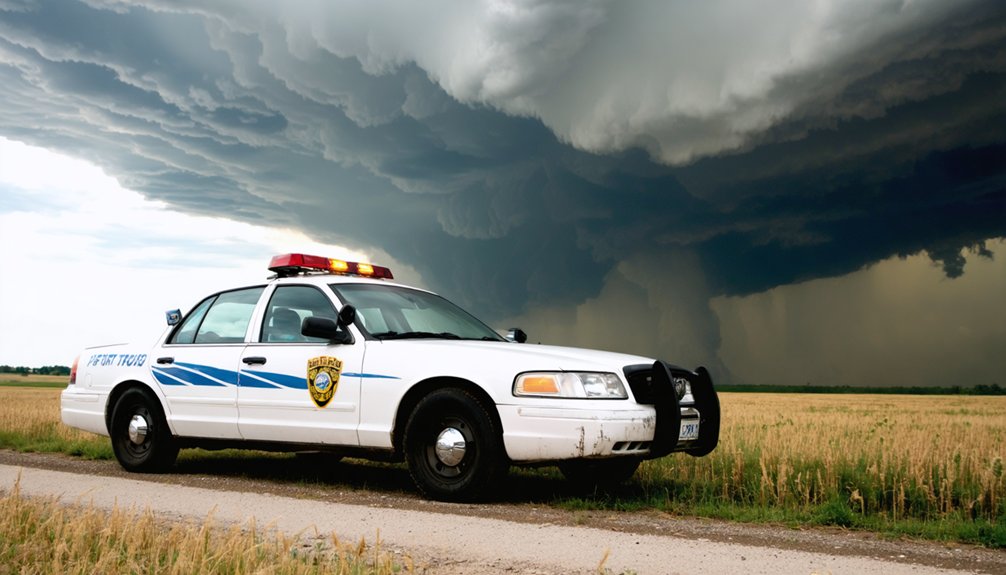
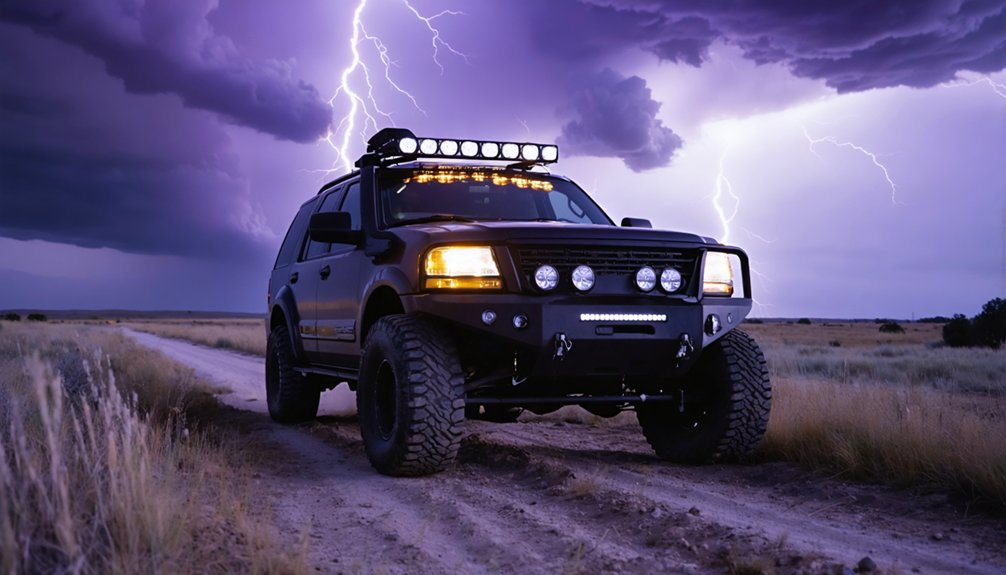
Your top custom storm chasing van options include iconic builds like the Ford E-350-based Dorothy, armored platforms like the SRV Dominator 3, TIV-2, and Titus, and utility-focused rigs like the Toyota Stormtrooper and Ford F-150 Flash. Each model balances protection, mobility, and equipment capacity differently. You’ll need to match your build type to your specific intercept strategy, chassis load ratings, and armor requirements—and the distinctions between these platforms run deeper than they first appear.
Key Takeaways
- The SRV Dominator 3, TIV-2, and Titus are top armored platforms scaled to resist extreme wind speeds and debris impacts.
- Dorothy, built on a Ford E-350, is an iconic model prioritizing shielding, interior practicality, and crew protection.
- The Toyota Stormtrooper and Ford F-150 Flash excel as utility-based vans emphasizing mobility and equipment density.
- Ford E-350 and F-350 chassis are preferred starting points for custom builds due to reliability and aftermarket support.
- Each top model balances protection, mobility, and equipment capacity based on specific storm chasing objectives.
What Makes a Storm Chasing Van Worth Building?
Before committing to any storm-chasing build, you need to understand what separates a purpose-built van from a stock vehicle pressed into service. A true chase van integrates structural reinforcement, sealed equipment bays, and debris-resistant body protection into a single cohesive platform.
Your interior layout must prioritize crew workspace, instrument mounting, and cable management without sacrificing weight distribution. Every component placement decision affects vehicle stability under high-wind loading.
Exterior paint choices matter beyond aesthetics. High-visibility colors improve situational awareness for other chasers and emergency crews during low-light intercepts, while durable coatings protect panels from hail impact and abrasion.
You’re not modifying a van for comfort. You’re engineering a mobile observation platform capable of operating at close range to violent weather while keeping occupants and instruments fully protected.
Dorothy: The Storm Chasing Van That Set the Standard
If you’re studying practical van-based intercept builds, Dorothy gives you a concrete starting point. The Iowa Storm Chasing Network constructed this five-ton Ford E-350-based platform specifically for close-range storm work, prioritizing crew protection, enclosed equipment space, and debris shielding over raw speed.
Analyzing Dorothy’s chassis selection, weight distribution, and protective design choices gives you a replicable framework you can scale to your own build budget and mission requirements.
Dorothy’s Origin Story
When the Iowa Storm Chasing Network set out to build a capable intercept platform, they chose a Ford E-350 van as the foundation—and the result was Dorothy, a five-ton machine that redefined what a van-based chase rig could accomplish.
The team engineered the van to function as a mobile storm shelter, prioritizing crew protection against hail, debris, and violent gusts during close-range intercepts. Equipment customization drove every design decision—interior layouts accommodated mounted instrumentation, camera systems, and operational workstations without compromising structural integrity.
You’ll find Dorothy’s build philosophy straightforward: select a proven commercial chassis, reinforce it deliberately, and configure the interior around mission-specific hardware. That disciplined approach produced a platform that balanced protection, functionality, and real-world operability in conditions most vehicles simply can’t handle.
Key Protective Features
Dorothy’s protective design starts with the Ford E-350’s commercial-grade chassis, which the Iowa Storm Chasing Network reinforced to handle the structural demands of close-range tornado intercept. The van’s enclosed shell functions as a mobile storm shelter, giving you sealed crew space that open-bed rigs simply can’t match.
Debris shielding comes from reinforced body panels and fortified door frames engineered to absorb hail impact and projectile debris at violent wind speeds. The roof structure adds rollover protection, keeping your equipment and crew intact if conditions deteriorate rapidly.
Interior packaging benefits from the van’s rectangular footprint, letting you mount instruments, cameras, and communication systems without compromising structural integrity. You’re getting a purpose-built protective envelope that prioritizes survival and data collection over raw speed or off-road flexibility.
Build Lessons Learned
Building Dorothy taught the Iowa Storm Chasing Network hard lessons that go well beyond protective panel thickness and chassis reinforcement. Weight distribution directly affects handling under crosswinds, so you’ll need to balance equipment loads front-to-rear before you finalize any interior mount layout.
Electrical systems demand dedicated circuit planning early — retrofitting power management into a finished build wastes time and creates reliability gaps that hurt storm safety in the field. You’ll also find that sealed equipment bays trap heat faster than open-air racks, requiring active ventilation solutions.
Vehicle durability under repeated hail strikes depends on weld quality at every structural junction, not just primary armor panels. Document every modification as you build. That record becomes your diagnostic baseline when something fails during an active intercept.
Top Custom Storm Chasing Van Models Ranked by Build Type
When evaluating custom storm chasing vans, you’ll find it’s most useful to organize them by build type: iconic van builds, armored intercept platforms, and utility-based chase vans.
Each category reflects a distinct engineering philosophy, balancing protection, mobility, and equipment capacity against weight, cost, and operational range.
Understanding where a specific build falls within this spectrum lets you match the right platform to your chase objectives and budget constraints.
Iconic Van Builds
Few storm-chasing platforms demonstrate van-based engineering as clearly as Dorothy, a five-ton intercept build constructed by the Iowa Storm Chasing Network on a Ford E-350 chassis. Its historical innovations reshaped how chasers approached close-range tornado intercepts, proving that enclosed van platforms could protect crews and equipment without requiring exotic specialty rigs.
You’ll notice Dorothy prioritizes shielding over speed, using the E-350’s enclosed body to house instrumentation, reduce debris exposure, and simplify interior packaging. That practical design philosophy still influences modern van builds today.
However, maintenance challenges are real. A five-ton modified platform demands rigorous attention to suspension load ratings, braking capacity, and chassis stress points.
If you’re studying Dorothy as a build reference, factor those mechanical demands into your planning from the start.
Armored Intercept Platforms
Armored intercept platforms scale far beyond the van category, but studying them sharpens your understanding of what structural protection actually demands. The SRV Dominator 3 resists 200-mph winds at 10,000 lbs. The TIV-2 deploys hydraulic spikes and skirting against 250-mph forces at 14,300 lbs.
The Titus runs 24 external cameras and hydraulic stabilizers on a 12,000-lb Dodge platform.
These specs translate directly into your van build decisions. Reinforced panels reduce debris penetration and support vandalism prevention when your rig sits unattended between deployments.
Heavier armor also shifts your insurance considerations, since carriers assess custom structural modifications differently than stock vehicles.
Analyze each platform’s chassis choice, anchoring system, and camera coverage, then extract the principles that scale down into a practical, buildable van configuration.
Utility-Based Chase Vans
Utility-based chase vans trade maximum armor for mobility, equipment density, and operational flexibility—a deliberate tradeoff that suits chasers who prioritize repositioning speed over close-range intercept shielding. Platforms like the Toyota 4Runner-based Stormtrooper and Ford F-150 Flash demonstrate how lighter builds deliver 360-degree camera coverage, off-road suspension upgrades, and fuel-efficient powertrains without the structural overhead of a 10,000-lb intercept rig.
For van-specific builds, interior customization becomes your primary engineering decision. You’re configuring rack systems, sensor mounts, radio consoles, and workstations within a fixed envelope—every cubic foot matters.
Branding opportunities are also stronger here; a clean exterior wrap paired with a purpose-built interior signals professionalism to collaborators and media contacts. If mobility and adaptability define your mission profile, utility-based vans deliver a compelling, buildable answer.
When Does a Chase Van Need Full Armor vs. Lightweight Protection?
Choosing between full armor and lightweight protection depends on how close you plan to get to the tornado’s circulation and what debris loads your route is likely to generate. If you’re running close-range intercepts, you need reinforced panels, sealed equipment bays, and rollover protection rated for violent debris impact. Builds like the TIV-2 and Dominator 3 exist precisely for that threat level.
If you’re prioritizing off-road versatility and fuel efficiency over maximum shielding, a lighter platform keeps you mobile and repositionable. Vehicles like the Stormtrooper 4Runner demonstrate that maneuverability often outweighs armor when your strategy relies on speed and route flexibility.
Match your protection level to your operational role — full armor for stationary intercepts, lightweight protection for dynamic, high-mobility chase patterns.
Which Chassis Works Best for a Custom Storm Chasing Van Build?
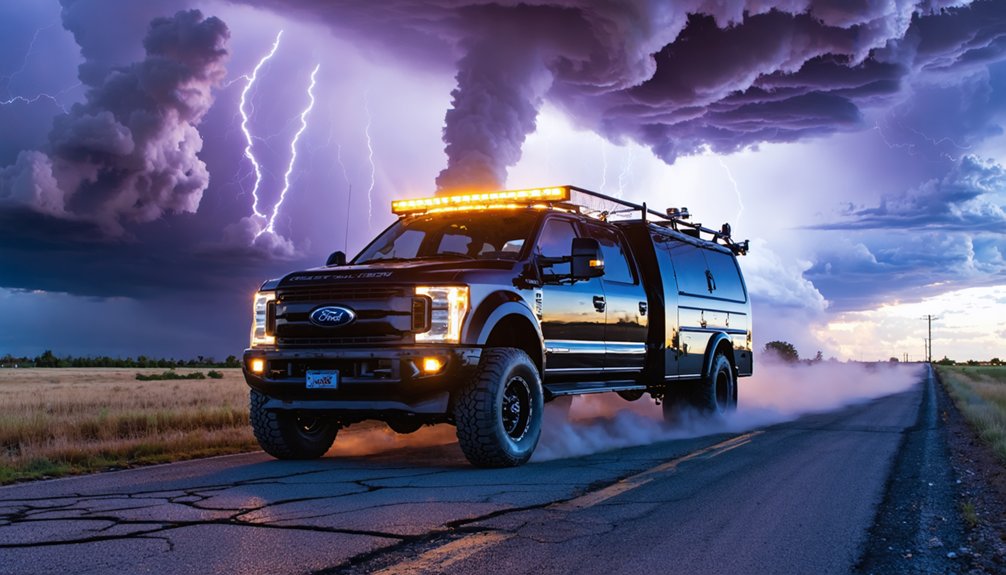
Your chassis choice shapes everything downstream, from suspension load ratings to interior headroom and final build weight. Ford F-350 and E-350 platforms dominate serious chase builds because they handle heavy armor, support high payload ratings, and accept aftermarket suspension upgrades without major engineering compromises.
If you’re prioritizing ground clearance for dirt roads and flooded intersections, a high-clearance truck chassis gives you more margin than a standard van platform. But you’ll trade off enclosed interior workspace in the process.
Heavy-Duty Chassis Options
Because the chassis determines everything from payload capacity to armor integration, picking the right platform is the single most critical decision in a custom storm chasing van build.
The Ford E-350 and F-350 dominate for good reason—both handle heavy armor plating, roof-mounted equipment bays, and reinforced flooring without compromising structural integrity.
You’ll want a chassis rated for at least 10,000 lbs GVWR if you’re planning serious intercept work.
Turbodiesel powertrains deliver the torque you need while supporting alternative fuel conversion compatibility for extended field operations.
Dodge-based platforms offer comparable load ratings and slightly different suspension geometry worth evaluating.
Integrate remote monitoring systems directly into your chassis electrical framework early—retrofitting costs you time and structural access.
Your chassis choice locks in every downstream decision, so choose deliberately.
Weight And Clearance Tradeoffs
Once you’ve locked in your chassis, the next variable that shapes your entire build is how weight and ground clearance interact under real field conditions. Add armor plating, van insulation, equipment racks, and battery banks, and your gross weight climbs fast. Every added pound lowers your clearance margin and stresses your suspension geometry.
Heavier builds like the TIV-2 at 14,300 lbs sacrifice agility for anchoring stability. Lighter van platforms trade wind resistance for faster repositioning. You’ll want to calculate your payload budget before committing to rooftop camera mounts or reinforced flooring.
Paint protection film on lower panels also adds negligible weight while shielding against hail abrasion during close intercepts. Balance your armor goals against your target terrain, and you’ll make smarter chassis decisions throughout the build.
Best Chassis For Builds
Choosing the right chassis determines everything downstream in your build, from suspension geometry to interior volume to maximum payload.
For van-based storm intercept work, the Ford E-350 stands out as the proven platform — it balances enclosed cargo volume, payload capacity, and aftermarket support effectively.
If you’re blending wildlife observation duties with chase operations, the E-350’s sealed interior protects sensitive optics and sensors better than open-bed alternatives.
Toyota-based platforms suit road trip customization builds where mobility outweighs armor requirements, offering lighter curb weight and tighter maneuverability.
Dodge-based van chassis provide comparable payload ratings but carry narrower fabricator support networks.
Your chassis choice locks in clearance limits, axle ratings, and frame reinforcement options early, so evaluate your operational weight targets before committing to any platform.
Must-Have Armor and Weather Protection Features for Chase Vans
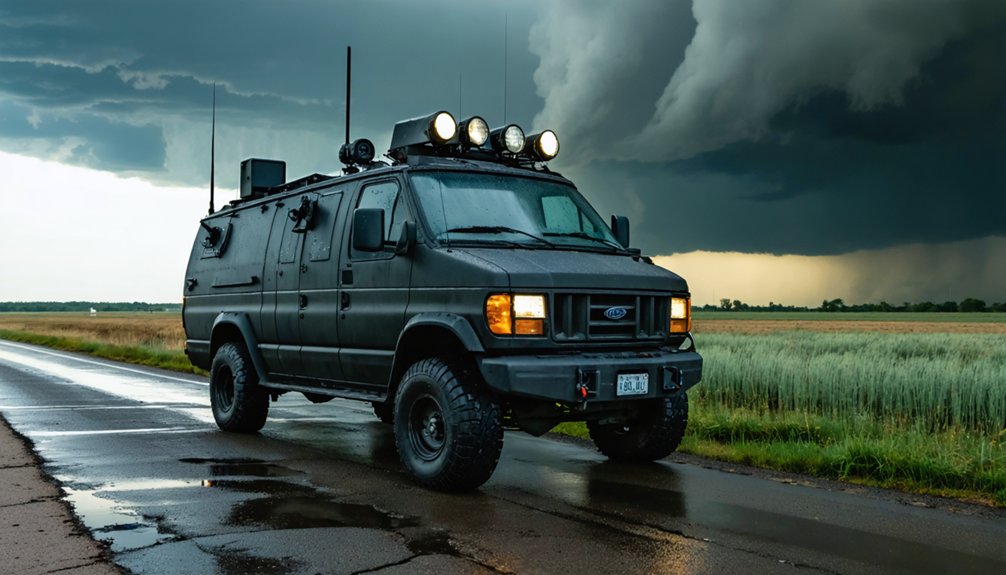
When building a chase van for close-range intercept work, armor and weather protection aren’t optional upgrades—they’re structural requirements. You’ll need reinforced body panels and door frames to resist debris impact, along with a hardened roof layer rated for golf-ball-sized hail.
Sealed equipment bays protect your electronics while supporting interior customization without compromising structural integrity.
Sealed equipment bays safeguard critical electronics while enabling interior customization that never compromises structural integrity.
Floor reinforcement matters equally—debris doesn’t only strike from above. Pair that with impact-resistant polycarbonate windows and rubber door seals rated for extreme pressure differentials.
For mobility, don’t sacrifice fuel efficiency chasing armor mass. Target a balanced weight class between 5,000 and 10,000 lbs, keeping your powertrain efficient enough for extended deployments.
Every protection layer you add must earn its weight through measurable wind, debris, or water resistance performance.
Cameras, Sensors, and Interior Equipment Every Chase Van Needs
Armor keeps you alive, but cameras and sensors are what make your chase van operationally useful. You’ll want a 360-degree external camera system to eliminate blind spots during close intercepts. Mount weather sensors externally for real-time wind speed, barometric pressure, and humidity readings. Inside, dedicate a hardened workspace to your laptop, GPS, and radio communications equipment.
Prioritize storm safety by routing all cables through sealed conduits, preventing water intrusion during violent precipitation. Label every system clearly so you’re never troubleshooting blindly under pressure.
Vehicle maintenance directly affects equipment reliability. Vibration from rough terrain degrades sensor mounts and camera connections over time, so inspect fasteners and connections after every chase. Your van’s operational value depends entirely on keeping these systems calibrated, secured, and consistently functional.
How Much Does a Custom Storm Chasing Van Actually Cost?
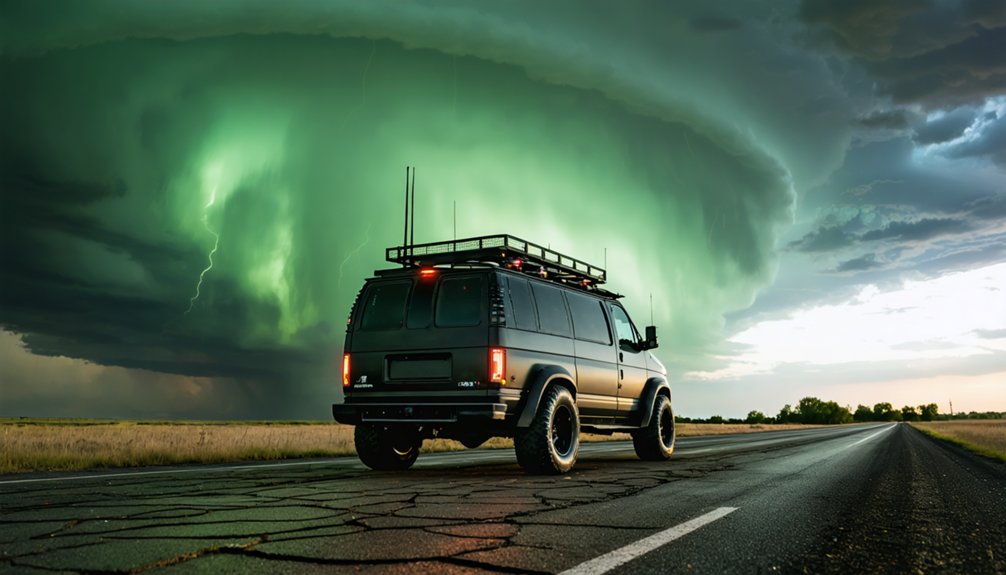
Building out your camera array and sensor suite adds up fast, and that’s before you factor in the van itself, fabrication labor, and structural reinforcement.
Entry-level builds using a used Ford E-350 with basic storm safety upgrades typically run $15,000–$30,000.
Mid-tier rigs with reinforced panels, roll cages, and integrated weather stations push $50,000–$80,000.
Professional intercept platforms like Dorothy required well over $100,000 once armor, sealed equipment bays, and communication systems were included.
Vehicle maintenance compounds your long-term budget notably. Heavy armor stresses suspension components, brakes, and drivetrain systems faster than standard use.
Budget 10–15% of your build cost annually for upkeep. Skipping maintenance on a storm-chasing platform isn’t a financial decision—it’s a safety liability.
Plan your build cost honestly from the start.
Can You Build Your Own Storm Chasing Van on a Real Budget?
Yes, you can build a functional storm-chasing van on a real budget—but only if you prioritize strategically and accept clear tradeoffs between protection, capability, and cost.
Start with a Ford E-350 chassis—it’s proven, parts-accessible, and mechanically straightforward. Dorothy demonstrates that a five-ton intercept-capable platform doesn’t require specialty fabrication contracts.
Allocate your budget across three tiers: structural reinforcement first, then communication protocols and electronics, then mobility upgrades. Skipping communication protocols cripples your operational awareness before a storm even develops.
Next, integrate a 360-degree camera system and weather sensors before spending on cosmetic armor.
Plan your Interstate logistics carefully—your van must handle long highway runs reliably between intercepts. Mechanical failure mid-deployment kills missions faster than budget constraints.
Build lean, test aggressively, and upgrade incrementally based on real field performance data.
Which Custom Storm Chasing Van Build Matches Your Chase Style?
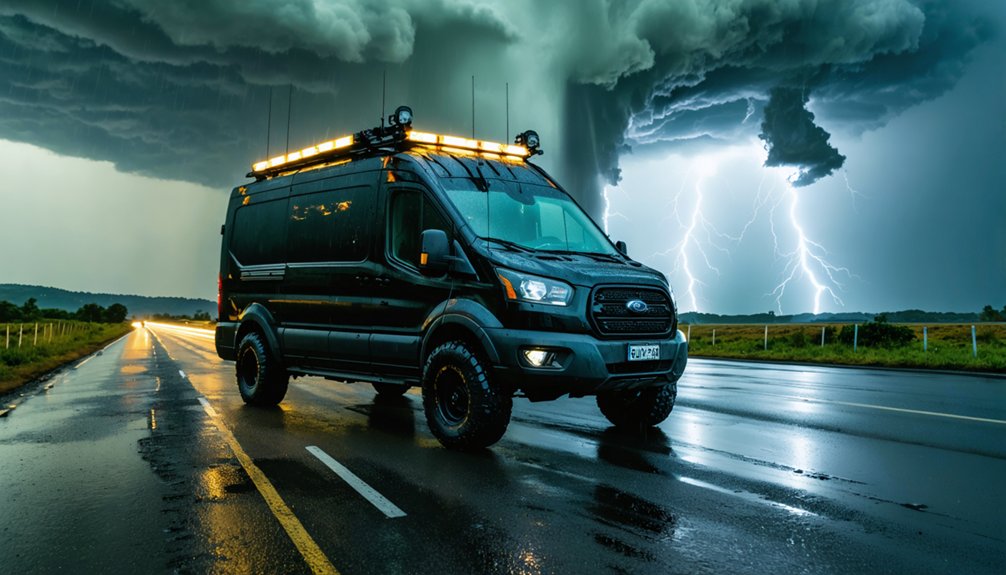
Your chase style dictates every build decision, from chassis selection to camera coverage to anchoring systems. If you’re running close-range intercepts, prioritize armor, storm safety, and hydraulic anchoring over fuel economy. A Ford E-350 platform like Dorothy gives you enclosed equipment bays, crew protection, and practical interior packaging for sustained operations.
If you’re chasing mobility and filming access, lighter platforms with 360-degree camera turrets and off-road suspension deliver better vehicle performance across varied terrain. You’ll sacrifice wind resistance but gain positioning flexibility.
Match your chassis to your threat exposure. Heavy intercept work demands reinforced doors, rollover protection, and debris shielding.
Documentary or positioning work rewards agility. Define your operational priority first, then build toward it with precision rather than guesswork.
Frequently Asked Questions
Are Storm Chasing Vans Street-Legal After Heavy Armor Modifications?
Yes, your heavily armored van can remain street-legal if you’ve met federal vehicle safety standards. You’ll need to verify armor durability doesn’t exceed weight limits or obstruct lighting, brakes, or visibility requirements.
Do Storm Chasers Need Special Insurance for Custom-Built Chase Vans?
Like Ahab needing specialized gear for his pursuit, you’ll need specialty insurance coverage for your chase van—standard policies won’t protect custom modifications, so you’ll want a commercial or specialty vehicle insurer familiar with high-risk builds.
How Long Does Building a Custom Storm Chasing Van Typically Take?
You’ll typically spend six months to two years completing van customization, depending on your scope of vehicle modifications. Complex armor, camera systems, and electrical integration extend timelines considerably, while simpler utility builds can reach completion faster.
Can a Storm Chasing Van Double as a Daily Driver?
Like wearing full plate armor to the grocery store, your storm van modifications trade daily usability for protection. You can drive it daily, but expect reduced fuel economy, limited parking access, and increased maintenance demands.
What Licenses or Certifications Do Storm Chasing Van Operators Need?
You don’t need specific licenses beyond a standard driver’s license, but you’ll want storm safety training and vehicle customization knowledge to operate effectively—certifications from meteorology programs or spotter networks strengthen your credibility considerably.
References
- https://www.youtube.com/watch?v=oiZW37YZBbY
- https://crazystormchasers.com/top-storm-chasing-vehicle-picks-for-tornado-alley/
- https://www.stormeyes.org/tornado/vehicles/index.html
- https://prairiechasers.com/vehicles
- https://www.serramonteford.com/blog/2018/june/8/ford-e-350-van-becomes-a-storm-chasing-machine.htm
- https://www.youtube.com/watch?v=Y9aSPl3S2yk
- https://en.wikipedia.org/wiki/Tornado_Intercept_Vehicle
- https://www.youtube.com/watch?v=2bzlkru8fCU
- https://stormtrack.org/threads/storm-chasing-vehicle-project-and-suggestions.27826/
- https://en.wikipedia.org/wiki/SRV_Dominator